

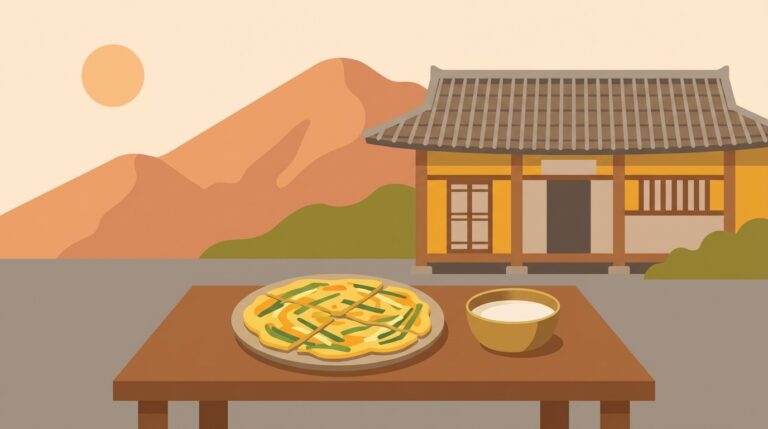
Phase 1: Empathy & The K-Culture Cold Open
Hello! This is the Daily Hangul Editor, your friendly neighborhood Korean tutor and cultural guide.
Imagine this: You are watching a K-Drama. The main characters just finished a tough, sweaty hike up a beautiful mountain. Do they go straight home to shower and sleep? Absolutely not! The next scene always cuts to a rustic, lively restaurant at the foot of the mountain. You hear the sizzle of oil, the clinking of golden brass bowls, and someone shouting, “크~ (Keu~)” after taking a sip of a milky white drink.
If you ever hike in Korea (which you should, as 70% of the country is mountainous!), descending the mountain is only half the journey. The real finish line is the 뒤풀이 (Dwipuri – After-party), where you reward yourself with 파전 (Pajeon – Green onion pancake) and 막걸리 (Makgeolli – Rice wine).
But how do you order like a true local? How do you join in on the fun without looking like a lost tourist? This guide is based on real experiences of my students who conquered Bukhansan Mountain and learned that the best part of Korean hiking… is the eating! Let’s dive in.
Phase 2: Core Expressions Deep Dive
Let’s learn the top 3 expressions you need at the mountain-side tavern.
1. 파전 하나, 막걸리 한 병 주세요. (One Pajeon and one bottle of Makgeolli, please.)
- Pronunciation: pajeon hana, makgeolli han byeong juseyo.
- Sound-alike guide: “Ju-se-yo” sounds like you are saying “Juice, say yo!” but spoken quickly.
- Meaning: Literal: Give me one pajeon and one bottle of makgeolli. / Real Nuance: “We survived the hike, let the feast begin!”
- K-Culture Moment: You sit down, wipe your sweat, and the “Imo-nim” (restaurant auntie) looks at you. You confidently say this phrase, and she gives you an approving nod. You are officially part of the hiking club!
- Editor’s Insight: This is the most magical formula in Korean ordering: [Item] + [Quantity] + 주세요(Please give me).
- Situation Spectrum:
[🚫 절대 금지] ———— [⚠️ 주의] ———— [✅ 자유롭게]
- Casual with friends: ✅
- Semi-formal (Co-workers): ✅
- Formal (Boss/Elders): ✅
- 🤔 Think About It: Why do Koreans use “하나 (one)” and “한 병 (one bottle)” instead of just saying the item names? How do you count items in your native language?
2. 바삭하게 구워주세요! (Please fry it crispy!)
- Pronunciation: ba-sak-ha-ge gu-wo-ju-se-yo.
- Sound-alike guide: “Ba-sak” sounds like the sharp crunch of stepping on dry autumn leaves.
- Meaning: Literal: Please bake it crispy. / Real Nuance: Make sure the edges of the pancake are super crunchy!
- K-Culture Moment: Koreans take their food textures very seriously. The edges of the Pajeon are the most coveted parts because they are the crispiest. Saying this makes you sound like a true foodie.
- Editor’s Insight: You can add “바삭하게 (crispy)” to anything fried, like Korean fried chicken!
- Situation Spectrum:
[🚫 절대 금지] ———— [⚠️ 주의] ———— [✅ 자유롭게]
- Casual with friends: ✅
- Semi-formal: ✅
- Formal: ✅
- 🤔 Think About It: Does your culture have a specific word to request a certain texture when ordering food?
3. 짠! (Cheers!)
- Pronunciation: Jjan!
- Sound-alike guide: Sounds like a high-pitched, sharp bell ringing.
- Meaning: Literal: (Sound effect of glasses clinking) / Real Nuance: Cheers!
- K-Culture Moment: You fill the brass bowls with Makgeolli, hold them up, and shout “Jjan!” together before taking a big sip.
- Editor’s Insight: This is highly casual and fun. It’s the sound of bonding.
- Situation Spectrum:
[🚫 절대 금지] ———— [⚠️ 주의] ———— [✅ 자유롭게]
- Casual with friends: ✅
- Semi-formal: ⚠️ (Okay if the vibe is very relaxed)
- Formal: 🚫 (Use “건배 – Geonbae” instead)
- 🤔 Think About It: Why do so many cultures have a tradition of clinking glasses and making a sound before drinking?
Phase 3: Textbook vs. Real Korean
| Situation | 📖 Textbook Korean | 🗣️ Real Korean | 💡 Why is it different? |
|---|---|---|---|
| Agreeing on a menu | 저는 막걸리를 마시겠습니다. (I will drink Makgeolli.) | 막걸리 콜! (Makgeolli, call!) | “콜 (Call)” is a popular slang from poker games, meaning “I’m in!” or “Sounds good!” |
| Expressing how good it is | 정말 맛있습니다. (It is very delicious.) | 크~ 죽인다! (Keu~ This kills!) | Koreans love dramatic expressions. “죽인다 (kills)” means “It’s to die for/awesome.” |
| Pouring drinks | 제가 따르겠습니다. (I will pour.) | 한잔 받으세요~ (Please receive a glass~) | It emphasizes the emotional exchange (receiving) rather than the physical action. |
Bottom Note: At an A2 level, saying “막걸리 콜!” with a big smile will definitely impress your Korean friends!
Phase 4: Cultural Context — K-Culture Deep Dive
4-1. Non-verbal Secrets: The Art of Pouring
In Korea, you rarely pour your own alcohol. This is where 눈치 (Nunchi – the ability to read the room) comes in! Keep an eye on your hiking buddy’s Makgeolli bowl. If it’s empty, pick up the bottle and pour it for them.
Crucial tip: If someone older or higher in status is pouring Makgeolli for you, always hold your brass bowl with both hands. It shows respect and gratitude.
4-2. K-Food Link: Why Pajeon and Makgeolli?
Why is this the golden combo after hiking or on a rainy day? Makgeolli is Korea’s oldest alcoholic beverage, traditionally drunk by farmers during hard labor to gain energy. Today, hiking is our “hard labor”! Furthermore, the sizzling sound of Pajeon frying in hot oil perfectly mimics the sound of rain falling. So, eating this combo is deeply rooted in Korean history, agricultural roots, and sensory pleasure.
Phase 5: Real-life Roleplay Scenario
Setting: Saturday afternoon, 2 PM. You just descended Bukhansan Mountain. Your legs feel like jelly, but the smell of toasted sesame oil and green onions pulls you into a lively, crowded tavern. You are sitting at a round metal table with your Korean hiking buddy.
Characters:
– YOU: An expat in Seoul, tired but excited for food.
– Minho (30): Your energetic Korean friend who planned this hike.
Dialogue:
Minho: 아, 진짜 힘들었다! 우리 뭐 먹을까? ⛰️
(A, jinjja himdeureotda! Uri mwo meogeulkka?)
(English) Ah, that was really hard! What should we eat?
YOU: 등산 후에는 당연히 파전이죠!
(Deungsan hu-eneun dangyeonhi pajeon-ijyo!)
(English) After hiking, it’s obviously Pajeon!
Minho: 오, 한국 사람 다 됐는데? 그럼 술은?
(O, hanguk saram da dwaenneunde? Geureom sureun?)
(English) Oh, you’ve become totally Korean! Then what about drinks?
YOU: 막걸리 콜!
(Makgeolli kol!)
(English) Makgeolli, I’m in!
(🎭 Stage Direction: Minho laughs and waves to the restaurant auntie)
Minho: 이모님! 여기 해물파전 하나랑 막걸리 한 병 주세요!
(Imo-nim! Yeogi haemulpajeon hanarang makgeolli han byeong juseyo!)
(English) Auntie! One seafood Pajeon and one bottle of Makgeolli here, please!
YOU: 아, 파전은 바삭하게 구워주세요~
(A, pajeon-eun basakhage guwojuseyo~)
(English) Ah, please fry the Pajeon crispy~
(🎭 Stage Direction: The food arrives. Minho shakes the Makgeolli bottle and opens it. He lifts the bottle to pour for you.)
🔀 Your Turn! Decision Point: Minho is slightly older than you and is pouring your drink. How do you receive it?
– A) Hold out the bowl with one hand while checking your phone.
– B) Lift the bowl slightly from the table using both hands.
– C) Say “No thanks, I will pour it myself!”✅ Best Choice: B — Lifting the bowl slightly with both hands is the perfect display of Korean drinking etiquette.
⚠️ Choice C Analysis: In some Western cultures, pouring your own drink is normal, but in Korea, pouring for each other builds friendship and “Jeong” (affection).
Minho: 자, 고생했어! 짠!
(Ja, gosaenghaesseo! Jjan!)
(English) Here, great job today! Cheers!
YOU: 짠! 크~ 진짜 죽인다!
(Jjan! Keu~ jinjja juginda!)
(English) Cheers! Keu~ This is totally awesome!
Minho: 많이 먹어! 내가 쏜다!
(Mani meogeo! Naega ssonda!)
(English) Eat a lot! It’s my treat!
YOU: 우와, 감사합니다! 잘 먹겠습니다!
(Uwa, gamsahamnida! Jal meokgetseumnida!)
(English) Wow, thank you! I will eat well!
🎁 Bonus Roleplay: The Convenience Store
What if you just want Makgeolli at your hotel?
Clerk: 봉투 필요하세요? (Bongtu piryohaseyo? – Do you need a bag?)
YOU: 네, 하나 주세요. (Ne, hana juseyo. – Yes, one please.)
Clerk: 영수증 드릴까요? (Yeongsujeung deurilkkayo? – Shall I give you the receipt?)
YOU: 아니요, 괜찮습니다. (Aniyo, gwaenchanseumnida. – No, it’s fine.)
Phase 6: 10-Second Shadowing Drill
Practice this sentence to sound like a natural! Pay attention to the pauses (/) and the feeling.
😊 이모님! / 여기 / 파전 바삭하게 / 구워주세요~
(Imo-nim! / yeogi / pajeon basakhage / guwojuseyo~)
Emotion Tag: Bright, polite, and anticipating delicious food!
Phase 7: K-Culture Mini Dictionary
| Korean | Romanization | English | Context |
|---|---|---|---|
| 이모님 | Imo-nim | Auntie | Polite/affectionate way to call a middle-aged female server in a casual restaurant. |
| 뒤풀이 | Dwipuri | After-party | The gathering/meal after an event, hike, or performance. Essential for team bonding. |
| 안주 | Anju | Drinking snacks | Food specifically meant to be eaten with alcohol. Pajeon is the ultimate Makgeolli anju! |
| 막걸리 | Makgeolli | Rice Wine | A milky, slightly sweet and fizzy traditional Korean alcoholic drink. |
Phase 8: Traveler’s Survival Kit
If you find yourself at a bustling mountain-side restaurant, you need these survival phrases!
🆘 Survival Phrase #1
– 🇰🇷 “여기요!” (Yeogiyo!)
– 🗣️ Pronunciation Guide: Yo-gee-yo!
– 📍 Where to use: Any restaurant to call the server.
– 💡 Pro Tip: Don’t be shy! Korean restaurants are loud. You have to speak up to get the server’s attention.🆘 Survival Phrase #2
– 🇰🇷 “물티슈 좀 주세요.” (Multisyu jom juseyo.)
– 🗣️ Pronunciation Guide: Mool-tissue jom joo-se-yo.
– 📍 Where to use: When your hands get greasy from tearing the Pajeon.
– 💡 Pro Tip: “Mool-tissue” means wet wipes. Very useful everywhere in Korea!📌 Editor’s Travel Note
– Ordering App: Many modern restaurants now use tablet menus on the table, but mountain taverns are usually old-school. You have to use your voice!
– Paying: You usually take your bill to the counter near the exit to pay after eating, rather than paying at the table.
– Tipping: NO TIPS! Korea has zero tipping culture. The price on the menu is the final price.
Phase 9: Critical Thinking Corner — “One Step Deeper”
Food & Identity: The Art of Tearing, Not Cutting
When your giant Pajeon arrives, you might notice something: there’s no knife. Instead, Koreans use their chopsticks to tear the pancake apart, often crossing chopsticks with their friends as everyone grabs a piece from the same plate. Why not just cut it neatly into slices?
In Korean food culture, sharing from a communal dish is a powerful way to build 정 (Jeong – deep emotional connection/affection). The slightly messy, collective act of tearing the food together breaks down social barriers. It says, “We are close enough to share this without formalities.”
💬 Your Turn: Does your culture have a dish that is specifically meant to be shared from one big plate? How do you feel about sharing food from the same dish? Let me know in the comments!
Phase 10: FAQ & Avoiding Misunderstandings
Q: Can I pour Makgeolli immediately after shaking it?
A: 🚫 NO! This is a Common Mistake! Makgeolli is carbonated. If you shake it vigorously and open it immediately, it will explode like a volcano!
✅ Do this instead: Gently mix it by turning the bottle upside down a few times, or lightly squeeze the plastic bottle to release the gas before opening.
Q: Can I use “이모님 (Imo-nim)” everywhere?
A: ⚠️ Be careful. It’s great for casual, rustic places (like mountain taverns, BBQ joints, or markets). But DO NOT use it in fancy cafes, fine-dining restaurants, or to young staff members. Use “저기요 (Excuse me)” instead.
Q: Do I have to drink alcohol to enjoy the “Dwipuri”?
A: Not at all! You can order Cider (사이다 – Korean Sprite) or Cola. Just pour it into a cup and shout “Jjan!” with everyone else!
Phase 11: Summary & Action Items
🎯 One-Liner Summary: Ordering Pajeon and Makgeolli with a loud “Jjan!” is the ultimate way to celebrate the end of a Korean hike like a true local.
🚀 Action Missions:
– 🥉 Bronze (Solo): Stand up, pretend you are holding a bowl with two hands, and confidently say “짠! (Jjan!)” out loud.
– 🥈 Silver (Online): Go to YouTube, search “막걸리 파전 ASMR” (Makgeolli Pajeon ASMR) and leave a comment: “바삭하게 구워주세요!”
– 🥇 Gold (Real World): Visit a Korean restaurant in your city, order a Pajeon, and use the magic formula: “파전 하나 주세요!”
🎒 Special K-Culture Mission: Next time you watch a K-Drama, look closely at the restaurant scenes. Can you spot the green Makgeolli bottles or the brass bowls? Notice how the characters hold their cups when drinking with older people!
Phase 12: Quiz — Interactive Challenge
1. Situational Judgment: You are at a Makgeolli tavern with your Korean boss. They pour you a drink. What should you do?
A) Hold the cup with one hand and say “Jjan!”
B) Hold the cup with two hands and say “Geonbae!”
C) Refuse it politely.
Hint: Check Phase 2 and 4! (Answer: B. Two hands show respect, and Geonbae is better for formal situations).
2. Fill in the Blank:
“이모님, 파전 하나 _________ 구워주세요!” (Auntie, please fry one Pajeon crispy!)
(Answer: 바삭하게 – basakhage)
3. True or False – K-Culture Edition:
“If you really enjoyed the service at the mountain tavern, you should leave a 15% tip on the table.”
(Answer: False. There is absolutely no tipping culture in Korea. Just saying “잘 먹었습니다 – I ate well” loudly is the best tip!)
Great job today! You are now ready to hit the mountains of Seoul. See you in the next lesson!
Frequently Asked Questions (FAQ)
Q: What does "파전 하나, 막걸리 한 병 주세요. (One Pajeon and one bottle of Makgeolli, please.)" mean in Korean and how do you pronounce it?
A: In Korean, "파전 하나, 막걸리 한 병 주세요. (One Pajeon and one bottle of Makgeolli, please.)" is pronounced [pajeon hana, makgeolli han byeong juseyo.] and means: Literal: Give me one pajeon and one bottle of makgeolli. / Real Nuance: "We survived the hike, let the feast begin!"
Q: What does "바삭하게 구워주세요! (Please fry it crispy!)" mean in Korean and how do you pronounce it?
A: In Korean, "바삭하게 구워주세요! (Please fry it crispy!)" is pronounced [ba-sak-ha-ge gu-wo-ju-se-yo.] and means: Literal: Please bake it crispy. / Real Nuance: Make sure the edges of the pancake are super crunchy!
Q: What does "짠! (Cheers!)" mean in Korean and how do you pronounce it?
A: In Korean, "짠! (Cheers!)" is pronounced [Jjan!] and means: Literal: (Sound effect of glasses clinking) / Real Nuance: Cheers!







