

Phase 1: Empathy & Immersion
Hello! I’m your lead editor and cultural navigator at Daily Hangul.
Imagine this: You are wandering through the winding, picturesque alleyways of Bukchon Hanok Village. You pull out your camera to capture the stunning contrast between the tiled traditional roofs and the N Seoul Tower in the distance. But right above a newly opened, Instagram-famous croffle cafe, you see a giant red banner: “주민들의 주거권을 보장하라!” (Guarantee the residents’ right to housing!).
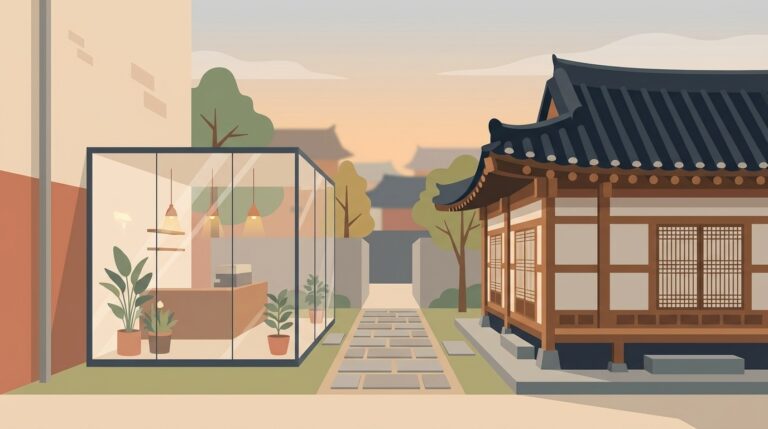
If you’ve watched K-Dramas like Itaewon Class or Vincenzo, you might think urban development is always a battle between a heroic underdog and an evil corporate conglomerate. But the reality of Seoul’s urban planning—especially the conflict between Hanok preservation and commercial development—is far more complex. It’s a delicate tug-of-war between preserving Korean heritage, protecting residents’ peace, and welcoming the economic boost of “hot places” (핫플).
If you’re at the C2 level, you aren’t just ordering coffee anymore. You’re discussing social issues, reading the room, and maybe even participating in professional debates. Let’s dive into the sophisticated, high-level Korean vocabulary you need to navigate the gentrification and preservation debates like a true Seoulite.
Phase 2: Core Expressions Deep Dive
To sound like a highly educated native speaker or an urban planning expert, you need to move beyond simple words like ‘개발’ (development) and ‘보존’ (preservation).
1. 상생 방안을 모색하다
- Pronunciation: [sang-saeng bang-an-eul mo-saek-ha-da] (sang-saeng sounds like a deep, balanced breath out).
- Meaning: Literal: To seek a plan for mutual life. / Real nuance: To find a win-win solution or a path for coexistence.
- K-Culture Moment: You will hear this exact phrase on Korean news programs (like KBS or JTBC) when discussing neighborhood disputes, or in a corporate meeting when a company is trying to show they care about local merchants.
- Editor’s Insight: This is the ultimate “diplomat’s phrase.” When tensions are high between Hanok residents and cafe owners, suggesting a “상생 방안” shows you respect both sides. It lowers defenses instantly.
- Situation Spectrum:
[🚫 절대 금지] ———— [⚠️ 주의] ———— [✅ 자유롭게]
- Casual with friends: ⚠️ (Too formal, sounds like a news anchor)
- Professional/Debate: ✅
- Public Hearings/Formal: ✅
- 🤔 Think About It: Why does Korean rely so heavily on Sino-Korean (Hanja) words like 상생 (相生 – mutual life) in formal settings instead of pure Korean? How does elevated vocabulary command authority in Korean society?
2. 둥지 내몰림 (젠트리피케이션)
- Pronunciation: [dung-ji nae-mol-lim]
- Meaning: Literal: Being driven out of the nest. / Real nuance: Gentrification.
- K-Culture Moment: While “젠트리피케이션” is widely used in media, “둥지 내몰림” is the refined, pure Korean translation promoted by the government. You’ll see it in documentaries about Ikseon-dong or Seochon, where elderly residents are forced to move because property taxes and rents skyrocketed after trendy cafes moved in.
- Editor’s Insight: Using “둥지 내몰림” instead of the English loanword shows a deep, empathetic understanding of the emotional toll of gentrification. It paints the neighborhood as a “nest”—a place of warmth and family—being destroyed.
- Situation Spectrum:
[🚫 절대 금지] ———— [⚠️ 주의] ———— [✅ 자유롭게]
- Academic essays/News: ✅
- Casual chats: ⚠️ (A bit heavy, but understandable)
- 🤔 Think About It: The word “nest” (둥지) implies vulnerability and home. How does using this emotional pure Korean word change the tone of a strictly economic debate?
3. 정체성을 훼손하지 않는 선에서
- Pronunciation: [jeong-che-seong-eul hwe-son-ha-ji an-neun seo-ne-seo]
- Meaning: Literal: At the line where identity is not damaged. / Real nuance: As long as it doesn’t undermine the original character/identity.
- K-Culture Moment: An architect pitching a new design for a modern Hanok stay will use this phrase to assure the city council that their glass-and-wood structure will respect the historic neighborhood’s vibe.
- Editor’s Insight: This phrase is incredibly useful for negotiations. It sets a boundary (“선”) while allowing flexibility. It’s the polite way of saying, “You can build your business, but don’t ruin our culture.”
- Situation Spectrum:
[🚫 절대 금지] ———— [⚠️ 주의] ———— [✅ 자유롭게]
- Academic/Business: ✅
- Everyday debates: ✅
Phase 3: Textbook vs. Real Korean
| Situation | 📖 Textbook Korean | 🗣️ Real C2 Korean | 💡 Why the difference? |
|---|---|---|---|
| Describing an over-commercialized area | 이 지역은 상업화가 많이 진행되었습니다. | 여기 완전 핫플 되더니 원주민들은 다 빠져나갔어. | In real life, “핫플” (hot place) contrasts with “원주민” (original residents) to highlight the social irony of trendy gentrification. |
| Suggesting a compromise | 우리는 함께 살 방법을 찾아야 합니다. | 상생 방안을 모색하는 게 시급합니다. | C2 professional Korean relies heavily on Hanja-based idiomatic structures for credibility. |
| Complaining about tourist noise | 관광객들이 너무 시끄럽습니다. | 오버투어리즘(과잉 관광) 때문에 주거권 침해가 심각해요. | Framing noise as a “violation of housing rights” (주거권 침해) elevates a complaint to a systemic issue. |
Phase 4: Cultural Context — K-Culture Deep Dive
4-1. Non-verbal Context: The Weight of “Nunchi” in Public Hearings
When discussing urban planning in Korea, especially at a 주민 공청회 (Public Hearing), body language is just as important as vocabulary. If you use words like “상생” (coexistence), your non-verbals must match. Direct, aggressive eye contact or pointing fingers will negate your polite vocabulary. Instead, slightly nodding while the opposing side speaks (showing Nunchi and respect for their position) builds the trust needed to reach a compromise.
4-2. K-Culture Connection: The “Hanok Cafe” Paradox
If you go to Ikseon-dong or Jeonju Hanok Village, you’ll notice a fascinating paradox. The architecture is from the Joseon Dynasty, but the interior sells French pastries, and K-Pop plays in the background.
This is a perfect example of Korea’s hyper-compressed modernization. While tourists love the aesthetic, locals often struggle with the loss of traditional community networks (품앗이/정). When you sit in a beautiful Hanok cafe, understanding this tension—that the very business preserving the physical building might be displacing the human community—gives you a profound, C2-level perspective on Korean society.
Phase 5: Real-World Roleplay Scenario
Setting: A Friday evening at the Jongno District Community Center. The fluorescent lights hum above. You are an international urban planning consultant invited to mediate a tense town hall meeting between long-time residents and new business owners in a Hanok preservation district.
Characters:
– YOU: The consultant. You need to de-escalate the tension.
– Mr. Kim (72): A resident who has lived in the Hanok village for 40 years. He is tired of tourists looking into his windows.
– Ms. Lee (32): A young entrepreneur who recently renovated an abandoned Hanok into a successful gallery cafe.
Dialogue:
Mr. Kim: 매일 주말마다 관광객들이 쓰레기를 버리고 가요! 우리 동네가 무슨 테마파크입니까?
(Maeil jumalmada gwangganggaekdeuri sseuregireul beorigo gayo! Uri dongnega museun temapakeu-imnikka?)
[Every weekend, tourists leave trash behind! Is our neighborhood some kind of theme park?]
(🎭 Stage Direction: Mr. Kim taps the table aggressively)
Ms. Lee: 어르신, 저희 상인회에서도 쓰레기 줍기 캠페인을 하고 있습니다. 상권이 죽으면 이 동네도 결국 슬럼화될 거예요.
(Eoreusin, jeo-hui sang-inhoe-eseodo sseuregi jupgi kaempein-eul hago itseumnida. Sang-gwoni jugeumyeon i dongnedo gyeolguk seulleomhwadoel geoyeyo.)
[Sir, our merchants’ association is also doing trash pick-up campaigns. If the commercial district dies, this neighborhood will eventually turn into a slum.]
Mr. Kim: 슬럼화? 우리가 조용히 잘 살고 있던 둥지에서 우리를 내몰고 있는 건 바로 당신들 카페야!
(Seulleomhwa? Uriga joyonghi jal salgo itdeon dungji-eseo urireul naemolgo inneun geon baro dangsindeul kape-ya!)
[Slum? The ones driving us out of the nest we’ve been quietly living in are your cafes!]
🔀 Your Turn! How do you intervene?
– A) “두 분 다 진정하세요. 법대로 합시다.” (Calm down both of you. Let’s go by the law.)
– B) “맞습니다. 카페들이 정체성을 훼손하고 있네요.” (That’s right. The cafes are damaging the identity.)
– C) “마을의 정체성을 훼손하지 않는 선에서 상생 방안을 모색해보는 건 어떨까요?”✅ Best Choice: C — Why? It validates Mr. Kim’s concern for the village’s identity (정체성) while using professional, constructive vocabulary (상생 방안을 모색) to invite Ms. Lee to collaborate.
⚠️ Choice A Analysis: Saying “Let’s go by the law” in Korea is often seen as a hostile end to negotiations, ignoring the cultural importance of human relations (정).
Phase 6: 10-Second Shadowing Drill
Master the C2 intonation! Read this aloud, pausing exactly at the slashes /.
😤 단호하지만 부드럽게 (Firm but gentle):
보존과 개발이 / 대립하는 것이 아니라, / 상생할 수 있는 방안을 / 모색해야 합니다.
(Bojon-gwa gaebari / daeriphaneun geosi anira, / sang-saenghal su inneun bang-an-eul / mosaek-haeya hamnida.)
Phase 7: K-Culture Mini Dictionary
| 한국어 | Romanization | English | Contextual Meaning |
|---|---|---|---|
| 공청회 | gong-cheong-hoe | Public Hearing | A formal meeting where residents and officials debate urban policies. |
| 핫플 | hat-peul | Hot Place | Trendy, Instagrammable locations. The trigger for gentrification. |
| 상권 | sang-gwon | Commercial District | The economic vitality of an area; crucial for business owners. |
| 주거권 | ju-geo-gwon | Right to Housing | The fundamental right to a peaceful living environment. |
| 정숙 관광 | jeong-suk gwang-gwang | Quiet Tourism | A campaign in Hanok villages asking tourists to whisper and not intrude. |
Phase 8: Traveler Survival Kit (Urban Explorer Edition)
If you are exploring Bukchon, Seochon, or Jeonju, you are walking right through the middle of this urban planning debate. Here is how to navigate it respectfully.
🆘 Survival Expression #1: Asking about boundaries
– 🇰🇷 “여기 사진 찍어도 되는 곳인가요?” (Yeogi sajin jjigeodo doeneun gosingayo?)
– 🗣️ Guide: [yeo-gi sa-jin jji-geo-do dwe-neun go-sin-ga-yo?]
– 📍 Where to use: In front of beautiful Hanok doors or alleyways.
– 💡 Pro Tip: Many Hanoks are private homes, not museums. Always ask before snapping a photo!📌 Editor’s Travel Note
– Look for the signs: If you see yellow or red signs that say “정숙” (Silence) or “거주 지역” (Residential Area), lower your voice immediately.
– Navigating Alleys: KakaoMap and Naver Map are essential. Google Maps cannot give walking directions in Seoul’s narrow alleys due to local security laws.
Phase 9: Critical Thinking — “One Step Deeper”
Media vs. Reality: The Romanticization of the Hanok
In K-Dramas, Hanok houses are often portrayed as peaceful retreats for wealthy elites or romantic hideaways for main characters. The media sells a hyper-curated, aesthetic version of tradition. However, the reality of living in a Hanok is quite different—maintenance is expensive, insulation against Korea’s harsh winters is notoriously difficult, and the influx of tourists can make daily life stressful.
When we only consume the media’s “theme park” version of Korean culture, we risk ignoring the voices of the actual residents facing 둥지 내몰림 (gentrification). True fluency in Korean means understanding not just the aesthetic beauty of the culture, but the socio-economic realities behind it.
💬 Your Turn: Does your home country have historic neighborhoods that suffer from “overtourism”? How do local residents express their frustrations? Share your thoughts in the comments!
Phase 10: FAQ & Mistake Prevention
Q: “Can I use words like 둥지 내몰림 in casual conversation with my Korean friends?”
Yes, but it will make you sound very well-read and intellectual! It’s perfect for a deep cafe conversation about society, but might be overkill if you’re just deciding where to eat.
Q: “Why do Koreans use the English word ‘젠트리피케이션’ (gentrification) instead of Korean words?”
Korea imports many academic and economic terms directly from English. However, government bodies and journalists have recently pushed for native words like “둥지 내몰림” to make the concepts more accessible and emotionally resonant for the older generation.
❌ Common Mistake #1: Treating Hanok villages purely as tourist attractions.
✅ Do this instead: Remember that real people live behind those beautiful wooden doors. Keep your voice down, don’t litter, and respect the “상생” (coexistence) of the space.
Phase 11: Summary & Action Items
- One-Liner Summary: True C2 fluency means discussing urban conflicts with empathy, using high-level terms like 상생 (coexistence) and 둥지 내몰림 (gentrification) to bridge the gap between tradition and modernity.
-
Action Mission 3 Steps:
- 🥉 Bronze (Solo): Read a Korean news article about Bukchon Hanok Village and highlight the advanced vocabulary words we learned today.
- 🥈 Silver (Online): Leave a comment in Korean on a travel vlog about an “overcrowded hot place,” discussing the importance of “정체성 훼손 방지” (preventing identity damage).
- 🥇 Gold (Real World): Visit an older neighborhood in your city or Seoul, observe the signs of commercialization, and write a short journal entry using “상생 방안” and “주거권.”
- K-Culture Mission: Watch an episode of a drama or documentary that features an old Seoul neighborhood (like Reply 1988 or a KBS documentary). Notice how the community interacts and imagine how modern gentrification would change that dynamic.
Phase 12: Interactive Quiz Challenge
1. Situational Judgment: You are attending a district meeting. A resident is crying because her rent doubled after a famous cafe opened next door. Which phrase BEST describes her situation?
– A) 오버투어리즘 (Overtourism)
– B) 둥지 내몰림 (Gentrification / Driven from the nest)
– C) 상생 방안 (Win-win solution)
2. Fill in the Blank:
“우리 마을의 _______을 훼손하지 않는 선에서 개발을 진행합시다.”
(Let’s proceed with development within boundaries that do not damage our village’s ______.)
– A) 상권 (commercial district)
– B) 정체성 (identity)
3. True or False – K-Culture Edition:
All Hanoks in Bukchon Village are government-owned museums where you can enter and take pictures freely. (T / F)
(Answers: 1: B, 2: B, 3: False – The majority are private residences!)
Frequently Asked Questions (FAQ)
Q: What does "상생 방안을 모색하다" mean in Korean and how do you pronounce it?
A: In Korean, "상생 방안을 모색하다" is pronounced [sang-saeng bang-an-eul mo-saek-ha-da] and means: Literal: To seek a plan for mutual life. / Real nuance: To find a win-win solution or a path for coexistence.
Q: What does "둥지 내몰림 (젠트리피케이션)" mean in Korean and how do you pronounce it?
A: In Korean, "둥지 내몰림 (젠트리피케이션)" is pronounced [dung-ji nae-mol-lim] and means: Literal: Being driven out of the nest. / Real nuance: Gentrification.
Q: What does "정체성을 훼손하지 않는 선에서" mean in Korean and how do you pronounce it?
A: In Korean, "정체성을 훼손하지 않는 선에서" is pronounced [jeong-che-seong-eul hwe-son-ha-ji an-neun seo-ne-seo] and means: Literal: At the line where identity is not damaged. / Real nuance: As long as it doesn't undermine the original character/identity.







