

Hello! I’m your lead editor at Daily Hangul.
Remember that unforgettable scene in the Oscar-winning movie Parasite (기생충)? The rich family’s young son pinches his nose, noticing that the driver and the housekeeper have the exact same “smell.” The father later realizes it’s the smell of the Banjiha (반지하)—the Korean semi-basement apartment.
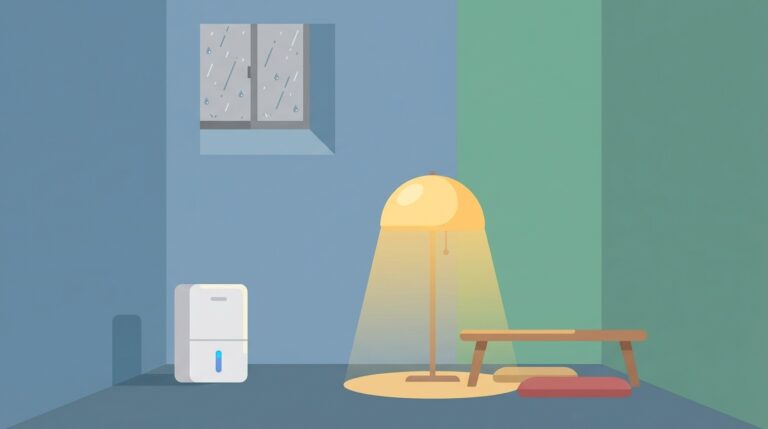
If you’re coming to Korea for a working holiday, studying abroad, or even just doing a long-term stay, you might actually end up living in a Banjiha or an Oktapbang (rooftop room) because the rent is incredibly affordable. But there’s a hidden boss you have to defeat in a Banjiha, especially during the Korean monsoon season (Jangma): The dampness.
Today, we aren’t just learning textbook vocabulary. I’m going to teach you exactly how to complain about the humidity, report mold to your landlord, and survive the Korean summer like a true local. Let’s dive in!
Phase 2: Core Expressions Deep Dive
Here are the three most essential phrases you need when the humidity starts getting to you.
1. 방이 너무 습해요 (The room is too damp/humid)
- Pronunciation: [bang-i neomu seupaeyo]
Sound-alike guide: ‘seup’ sounds like the ‘sup’ in ‘supper’, but with a sharper ‘p’ at the end.- Meaning: (Literal) The room is too humid. / (Real nuance) It’s uncomfortably damp in here.
- K-Culture Moment: You’ll hear this constantly in Korean vlogs during July. It’s the ultimate small-talk complaint among friends when stepping into a poorly ventilated room.
- Editor’s Insight: This is a factual but slightly complaining tone. It’s the standard way to express discomfort about the air quality without sounding too dramatic.
- Situation Spectrum:
[🚫 Never] ———— [⚠️ Be Careful] ———— [✅ Freely]
- Close Friends (Casual): ✅ (방이 너무 습해!)
- Landlord (Formal): ✅ (사장님, 방이 너무 습해요.)
- 🤔 Think About It: Korea has four distinct seasons, but summer is famously hot and humid. Why do you think Korean floors (Ondol) are designed to be heated even in summer? (Hint: Turning on the floor heater actually bakes the moisture out of the air!)
2. 곰팡이가 피었어요 (Mold has grown)
- Pronunciation: [gompang-i-ga pieosseoyo]
Sound-alike guide: ‘gom’ sounds like ‘comb’ but with a G. ‘pang-i’ sounds like ‘pang-ee’.- Meaning: (Literal) Mold has bloomed. / (Real nuance) There is a mold problem!
- K-Culture Moment: In K-Dramas featuring struggling college students, there is almost always a scene where the protagonist sighs while looking at a dark patch of mold on their peeling wallpaper.
- Editor’s Insight: Notice the verb “피다” (to bloom). We use the same verb for flowers (꽃이 피다) and mold (곰팡이가 피다). It’s quite poetic for something so gross, isn’t it?
- Situation Spectrum:
[🚫 Never] ———— [⚠️ Be Careful] ———— [✅ Freely]
- Close Friends (Casual): ✅ (벽에 곰팡이 피었어 ㅠㅠ)
- Landlord (Formal): ✅ (벽에 곰팡이가 피었어요. 확인 부탁드립니다.)
- 🤔 Think About It: Reporting damages immediately is crucial in Korean rental culture (Jeonse or Wolse). If you don’t report mold right away, the landlord might blame you for not ventilating the room. Have you ever had to negotiate a housing issue in a foreign language?
3. 아휴, 꿉꿉해! (Ugh, it’s so muggy/sticky!)
- Pronunciation: [ahyu, kkupkkuphae!]
Sound-alike guide: ‘kkup’ sounds like a tiny hiccup. Say ‘kkup-kkup’ fast with a tense K sound.- Meaning: (Literal) It is damp. / (Real nuance) I feel gross, sticky, and everything feels like a wet sponge.
- K-Culture Moment: You’re sitting in a Korean BBQ restaurant on a rainy day. The AC isn’t strong enough, and your shirt is sticking to your back. Someone will definitely say, “아, 진짜 꿉꿉하다!” (Ah, it’s seriously so muggy!)
- Editor’s Insight: This is the ultimate native speaker word. It describes not just the room’s humidity, but the gross, sticky feeling on your skin. Using this word will instantly elevate your Korean to B2+ in the eyes of locals.
- Situation Spectrum:
[🚫 Never] ———— [⚠️ Be Careful] ———— [✅ Freely]
- Close Friends (Casual): ✅
- Co-workers (Semi-formal): ⚠️ (Use 꿉꿉하네요 instead)
- Formal/Elders: 🚫 (It’s a bit too colloquial)
Phase 3: Textbook vs. Real Korean
Let’s see how locals actually complain about the weather and housing compared to your textbooks.
| Situation | 📖 Textbook Korean | 🗣️ Real Korean | 💡 Why the difference? |
|---|---|---|---|
| Expressing high humidity | 습도가 높습니다. (The humidity is high.) | 아, 완전 꿉꿉해. (Ah, it’s totally sticky.) | “습도” is a scientific term. “꿉꿉하다” is an emotional, sensory slang that perfectly captures the discomfort. |
| The floor feels sticky | 바닥이 습합니다. (The floor is humid.) | 바닥이 끈적거려요. (The floor is sticky.) | In Banjiha, the moisture makes the linoleum floors physically sticky to walk on. |
| Asking to fix the air | 환기를 시켜주세요. (Please ventilate.) | 제습기 좀 틀어줘. (Turn on the dehumidifier.) | Ventilation isn’t enough in the rainy season. A Jeseupgi (dehumidifier) is a survival tool. |
Phase 4: Cultural Context — K-Culture Deep Dive
4-1. Non-Verbal Cues: The Art of “Evidence”
When dealing with dampness and mold in Korea, your best friend is your smartphone camera. In Korean housing culture, Nunchi (reading the room) is important, but so is hard proof. Before you call the landlord to complain, take clear photos and videos. When you speak to them, use a polite but slightly distressed tone. Never get angry immediately; start by asking for their “help” to solve the problem.
4-2. The “Banjiha” in K-Media vs. Reality
You’ve seen the Banjiha in Parasite, and you’ve seen the Oktapbang (Rooftop room) in dramas like Fight for My Way. In dramas, the rooftop is romanticized—friends drinking beer under the stars. The Banjiha is often shown as a place of absolute despair.
But for many young Koreans and expats, these places are simply practical stepping stones. They are cheap. Yes, they get moldy in summer and freezing in winter, but they are spaces of independence. If a Korean friend invites you to their Banjiha, don’t pity them! Just buy them a pack of toilet paper (a traditional Korean housewarming gift) and maybe a portable dehumidifier from Daiso. They will love you forever.
Phase 5: Real-Life Roleplay Scenario
Setting: A Friday evening in July. It’s been raining for three days straight (Jangma season). You recently moved into a cheap Banjiha near your university. Your Korean friend, Min-su, drops by to see your new place, bringing a massive pack of toilet paper.
Characters:
– YOU: An international student. You love your independence, but the dampness is driving you crazy.
– Min-su (24): Your local Korean friend. Friendly, practical, and knows how to survive on a budget.
Dialogue:
Min-su: 우와, 이사 축하해! 이거 휴지 받아.
(Uwa, isa chukahae! Igeo hyuji bada.)
[Wow, congrats on the move! Take this toilet paper.]
YOU: 고마워! 근데 비가 와서 방이 좀 엉망이지?
(Gomawo! Geunde biga waseo bang-i jom eongmang-iji?)
[Thanks! But the room is a bit of a mess because of the rain, right?]
Min-su: 음… 야, 근데 방이 너무 습하다.
(Eum… ya, geunde bang-i neomu seupada.)
[Hmm… Hey, but the room is way too damp.]
YOU: 응, 맞아. 장마라서 그런지 완전 꿉꿉해.
(Eung, maja. Jangmaraseo geureonji wanjeon kkupkkuphae.)
[Yeah, right. Maybe because it’s monsoon season, it’s totally muggy.]
Min-su: 벽에 저거 혹시 곰팡이야?
(Byeoge jeogeo hoksi gompang-iya?)
[Is that mold on the wall by any chance?]
YOU: 헐… 진짜네. 어떡하지?
(Heol… jinjjane. Eotteokhaji?)
[OMG… it really is. What should I do?]
(🎭 Stage Direction: You look at the wall in panic)
🔀 YOUR TURN! How should you respond to this housing crisis?
– A) “집주인한테 전화해서 화낼 거야!” (I’m going to call the landlord and get angry!)
– B) “사진 먼저 찍고, 집주인한테 연락해 볼게.” (I’ll take a photo first and try contacting the landlord.)
– C) “그냥 내가 닦을게.” (I’ll just wipe it myself.)✅ Best Choice: B. In Korea, you must document the issue first and notify the landlord (집주인) politely.
⚠️ Choice A & C Analysis: Yelling at the landlord (A) will ruin your relationship and they might refuse to renew your lease. Wiping it yourself (C) is dangerous—if the mold spreads, the landlord might withhold your security deposit (Bogeumgum) when you move out, blaming you for not reporting it!
Min-su: 맞아, 사진 무조건 찍어놔. 그리고 다이소 가자.
(Maja, sajin mujogeon jjigeo nwa. Geurigo daiso gaja.)
[Right, definitely take a photo. And let’s go to Daiso.]
YOU: 다이소? 거기서 뭐 사게?
(Daiso? Geogiseo mwo sage?)
[Daiso? What are we buying there?]
Min-su: ‘물먹는 하마’ 사야지! 반지하 필수템이야.
(‘Mulmeongneun hama’ sayaji! Banjiha pilsu-temiya.)
[We have to buy a ‘Thirsty Hippo’ (Dehumidifying agent)! It’s an essential item for Banjiha.]
YOU: 아하! 그럼 나갈 준비 할게.
(Aha! Geureom nagal junbi halge.)
[Aha! I’ll get ready to head out then.]
Phase 6: 10-Second Shadowing Drill
Practice complaining about the humidity with the right emotional tone. Follow the slashes for pausing and pay attention to the emotional tags!
😩 지쳐서 (Exhausted)
아휴 / 방이 너무 / 꿉.꿉.해.요!
(Ahyu / bang-i neomu / kkup-kkup-hae-yo!)
[Ugh, the room is so muggy!]😤 단호하게 (Firmly, on the phone with the landlord)
사장님, / 벽에 / 곰팡이가 피었어요. / 확인 부탁드립니다.
(Sajangnim, / byeoge / gompang-i-ga pieosseoyo. / Hwagin butakdeurimnida.)
[Landlord, mold has grown on the wall. Please check on it.]
Phase 7: K-Culture Mini Dictionary
| Korean | Romanization | English | Context/Explanation |
|---|---|---|---|
| 반지하 | banjiha | Semi-basement | A housing unit half above and half below street level. Cheap but prone to dampness. |
| 장마 | jangma | Monsoon season | The rainy season in Korea, usually from late June to mid-July. Peak humidity. |
| 집주인 | jipjuin | Landlord | The owner of the house. Always maintain polite (jondaetmal) terms with them! |
| 제습기 | jeseupgi | Dehumidifier | An electronic appliance that sucks moisture from the air. A lifesaver. |
| 물먹는 하마 | mulmeongneun hama | Moisture absorber | Lit. “Water-eating hippo.” The most famous brand of closet dehumidifying tubs in Korea. |
Phase 8: Traveler/Expat Survival Kit
Even if you’re just staying in an Airbnb or a guesthouse during the summer, you might encounter the dreaded Korean humidity. Here are your survival phrases.
🆘 Survival Phrases: Fighting the Humidity
– 🇰🇷 “에어컨 제습 모드로 틀어주세요.” (Eeokeon jeseup modeu-ro teureojuseyo.)
– 🗣️ Pronunciation guide: [Air-con je-seup mo-deu-ro teu-reo-ju-se-yo]
– 📍 Where to use: Cafes, taxis, or asking your Airbnb host.
– 💡 Pro Tip: Korean ACs have a specific “제습” (Dehumidify) button marked with a water drop icon 💧. Sometimes this is better than making the room freezing cold!📌 Editor’s Housing Note
– Daiso is your best friend: If your room feels damp, go to Daiso and buy “제습제” (Moisture absorbers). Put them in your closet, or your clothes will get moldy.
– The Boiler Trick: Koreans sometimes turn on the Boiler (floor heating) for 30 minutes in the middle of summer with the windows open. It sounds crazy, but it bakes the moisture right out of the floors!
Phase 9: Critical Thinking — “One Step Deeper”
🧠 Think Deeper: Media vs. Reality
When the movie Parasite became a global phenomenon, the “Banjiha” became an international symbol of extreme poverty and social inequality. However, for many young Koreans and international students, living in a Banjiha is just a normal rite of passage. It’s a pragmatic choice to save money for tuition or a future deposit (Jeonse). While the media paints it with a dark, tragic brush, the reality is often filled with students trying their best to decorate their damp rooms with fairy lights and Daiso dehumidifiers. It’s important not to exoticize or overly pity this living situation.
💬 Your Turn: Does your country have a specific type of housing that is famous in movies but actually just a normal part of life for college students? Share it in the comments!
Phase 10: FAQ & Avoiding Mistakes
Q: Can I ask the landlord to buy me a dehumidifier?
Maybe, but usually no. Landlords are responsible for structural issues (like a leaking pipe causing mold). But everyday humidity is usually the tenant’s responsibility to manage. However, if the mold is severe due to bad building insulation, the landlord must pay to replace the wallpaper (Dobae).
Q: Should I use “사장님” to call my landlord?
Yes! While “집주인” is the word for landlord, when you are actually talking to them, you usually call them “사장님” (Boss) or “사모님” (Madam). It’s respectful and builds good rapport.
❌ Common Mistake #1: Trying to clean heavy mold yourself without telling the landlord.
✅ Do this instead: Report it immediately! If you wait until you move out, they might deduct the repair costs from your precious security deposit.
Phase 11: Summary & Action Items
One-Liner Summary: When the Korean summer turns your room into a swamp, say “방이 꿉꿉해요” and run to Daiso for moisture absorbers!
🎬 Action Missions:
– 🥉 Bronze (Solo): Look at a window and say “아휴, 너무 습해요” with a dramatic sigh 3 times.
– 🥈 Silver (Online): Find the weather app on your phone, change the location to Seoul, and write a comment here in Korean about whether it looks “습하다” today!
– 🥇 Gold (Real Life): If you are in Korea, go to Daiso and successfully locate the “제습제” (Dehumidifiers) section using the Korean word!
📺 K-Culture Mission:
Watch the first episode of any college-life K-Drama (like Cheese in the Trap or Fight for My Way). Pay attention to the housing. Can you spot a Banjiha or an Oktapbang? Notice how they deal with the weather!
Phase 12: Interactive Quiz
Let’s test what you’ve learned!
1. You are sweating in a sticky, humid room. What is the most natural slang/local expression to use with your close friend?
A) 습도가 90%입니다. (The humidity is 90%.)
B) 완전 꿉꿉해! (It’s totally muggy!)
C) 방이 더워요. (The room is hot.)
(Answer: B. It perfectly captures that sticky, gross feeling!)
2. Fill in the blank: 벽에 ______가 피었어요. (____ has bloomed on the wall.)
A) 제습기 (Dehumidifier)
B) 장마 (Monsoon)
C) 곰팡이 (Mold)
(Answer: C. Mold (곰팡이) uses the verb “to bloom” (피다) in Korean!)
3. True or False – K-Culture Edition:
If you find mold in your rented Banjiha, you should immediately clean it with bleach before the landlord sees it so you don’t get in trouble.
(Answer: FALSE! Always take a photo and report it to the landlord first. If it’s a structural issue, they need to fix it. If you hide it, you might be blamed later!)
How are you handling the weather wherever you are right now? Let me know in the comments below, and don’t forget to practice your new vocabulary! Until next time, stay dry and keep studying!
Frequently Asked Questions (FAQ)
Q: What does "방이 너무 습해요 (The room is too damp/humid)" mean in Korean and how do you pronounce it?
A: In Korean, "방이 너무 습해요 (The room is too damp/humid)" is pronounced [bang-i neomu seupaeyo] and means: (Literal) The room is too humid. / (Real nuance) It's uncomfortably damp in here.
Q: What does "곰팡이가 피었어요 (Mold has grown)" mean in Korean and how do you pronounce it?
A: In Korean, "곰팡이가 피었어요 (Mold has grown)" is pronounced [gompang-i-ga pieosseoyo] and means: (Literal) Mold has bloomed. / (Real nuance) There is a mold problem!
Q: What does "아휴, 꿉꿉해! (Ugh, it's so muggy/sticky!)" mean in Korean and how do you pronounce it?
A: In Korean, "아휴, 꿉꿉해! (Ugh, it's so muggy/sticky!)" is pronounced [ahyu, kkupkkuphae!] and means: (Literal) It is damp. / (Real nuance) I feel gross, sticky, and everything feels like a wet sponge.







