

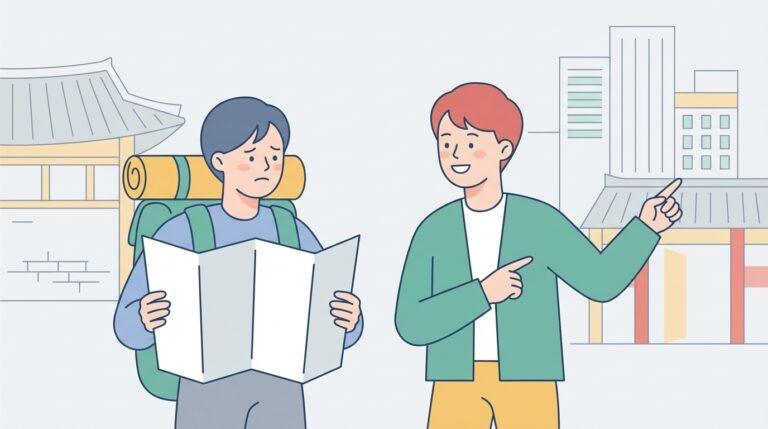
Phase 1: Empathy – The K-Drama Pacing Scene
Hello! I’m your Daily Hangul Editor.
Picture this: You are watching your favorite K-Drama. The main character is pacing back and forth in their room, aggressively biting their nails, and staring at their phone. Their friend hasn’t come back yet, and it’s raining outside. The subtitle simply says, “I’m worried.”
But if you listen closely, they aren’t just stating a fact. They are letting out a deep sigh and muttering something that sounds like a tiny panic attack.
In English, we say “I am worried” to express our concern. But in Korea, showing worry is a full-body, highly emotional experience. It’s about showing empathy, taking action, and sometimes… offering food!
If you only use the textbook phrase for “I am worried,” you might sound a bit like a news anchor. Today, as your personal Korean local friend, I’m going to teach you how to express negative emotions—specifically, worry—so naturally that native speakers will think you’ve lived in Seoul for years. Let’s dive in!
Phase 2: Core Expressions Deep Dive
Here are the top 3 ways Koreans actually express worry in real life.
1. 걱정돼요 (I am worried)
- Pronunciation: geok-jeong-dwae-yo [‘geok’ sounds like ‘guck’ in duck, ‘jeong’ like ‘jung’ in jungle]
- Meaning: I’m worried / It makes me worried.
- K-Culture Moment: Imagine a K-Pop fan meeting. A fan notices their favorite idol has a small bandage on their hand. The fan looks at them with big eyes and says, “오빠, 손 다쳤어요? 너무 걱정돼요…” (Oppa, did you hurt your hand? I am so worried…)
- Editor’s Insight: Notice how it ends in ‘dwaeyo’ (돼요), which is a passive verb ending. Koreans say “Worry becomes to me” rather than “I do the worry.” It feels more natural because the emotion is happening to you!
- Situation Spectrum:
[🚫 Never] ———— [⚠️ Be Careful] ———— [✅ Go Ahead]
- Close Friends (Casual – 걱정돼 / geok-jeong-dwae): ✅
- Co-workers (Semi-formal): ✅
- Boss/Elders (Formal): ⚠️ (Better to ask about their health instead)
- 🤔 Think About It: Why do you think Koreans use the passive voice (“Worry comes to me”) instead of the active voice (“I worry”)? Does your native language treat emotions as things we do, or things we feel?
2. 어떡해요? (What should I do? / Oh no!)
- Pronunciation: eo-tteo-kae-yo [‘eo’ sounds like ‘uh’, ‘kae’ like ‘care’]
- Meaning: Literal: What do I do? / Real Nuance: Oh my gosh! Oh no! I’m so worried!
- K-Culture Moment: You are eating at a busy Korean BBQ restaurant, and you accidentally spill a little bit of sauce on your white shirt. Your Korean friend will immediately gasp, grab a tissue, and yell, “어떡해!!!” (Eotteokae!!!)
- Editor’s Insight: This is the ultimate reaction word. If you drop your phone, if it starts raining and you have no umbrella, or if a friend shares bad news—”어떡해(요)” is your go-to phrase. It shows you are actively sharing their panic.
- Situation Spectrum:
[🚫 Never] ———— [⚠️ Be Careful] ———— [✅ Go Ahead]
- Close Friends (Casual – 어떡해 / eotteokae): ✅
- Co-workers (Semi-formal): ✅
- Boss/Elders (Formal): 🚫 (Too emotional for formal settings!)
- 🤔 Think About It: “어떡해” is used even when there’s nothing you can actually do to fix the situation. Why is panicking together considered comforting in Korea?
3. 괜찮아요? (Are you okay?)
- Pronunciation: gwaen-cha-na-yo
- Meaning: Are you okay? / Is it alright?
- K-Culture Moment: In a K-Drama, the female lead trips on a pebble (classic!). The male lead catches her just in time, stares into her eyes, and softly asks, “괜찮아요?”
- Editor’s Insight: Worrying often means checking on the other person. Instead of saying “I am worried,” asking “Are you okay?” shifts the focus to their well-being.
- Situation Spectrum:
[🚫 Never] ———— [⚠️ Be Careful] ———— [✅ Go Ahead]
- Close Friends (Casual – 괜찮아? / gwaenchana?): ✅
- Co-workers (Semi-formal): ✅
- Boss/Elders (Formal): ⚠️ (Use ‘괜찮으세요? / gwaenchaneusheyo’ instead to be polite)
Phase 3: Textbook vs. Real Korean
| Situation | 📖 Textbook Korean | 🗣️ Real Korean | 💡 Why is it different? |
|---|---|---|---|
| A friend is 30 mins late | 저는 당신이 매우 걱정됩니다. (I am very worried about you.) | 어떡해! 무슨 일 있어? (Oh no! Is something wrong?) | Koreans drop the words “I” and “You” and show worry through urgent questions. |
| Hearing bad news from a friend | 걱정이 많으시겠어요. (You must have many worries.) | 아고… 어떡해… (Aigo… what to do…) | “Aigo” (sigh) + “Eotteokae” is the standard formula for showing deep empathy. |
Bottom Note: As an A1 learner, you don’t need complicated grammar to show empathy. Master “어떡해요” and you’ll immediately sound like a local!
Phase 4: Cultural Context — K-Culture Deep Dive
4-1. Non-Verbal Elements: The Art of ‘Nunchi’
When expressing worry in Korea, body language matters. Don’t just stand still! If a friend is sharing a worry, lean in slightly, furrow your eyebrows, and nod. If it’s a close friend, light physical touch (like lightly patting their arm) is common. This is part of 눈치 (Nunchi)—reading the room and matching your friend’s emotional energy.
4-2. The K-Food Connection: Food = Love = Worry
In Korea, the ultimate way to say “I am worried about you” has nothing to do with the word “worry.” It’s all about food.
If you look tired, or if you’ve had a bad day, a Korean friend or a sweet restaurant owner (이모님 / Imonim) won’t say “Are you okay?” First, they will ask:
“밥은 먹었어?” (Babeun meogeosseo? – Did you eat?)
In K-Dramas, when a mother is worried about her child who is locked in their room after a breakup, what does she do? She doesn’t slide a therapy card under the door. She brings a tray of warm rice, soup, and side dishes.
If you want to show a Korean friend you are truly worried about them, say, “걱정돼요. 우리 맛있는 거 먹으러 가요!” (I’m worried. Let’s go eat something delicious!).
Phase 5: Real-Life Roleplay Scenario
Setting: Friday night, 7:30 PM. Gangnam Station, Exit 11. It’s crowded, noisy, and everyone is heading to dinner. You were supposed to meet your Korean friend, Min-su, at 7:00 PM. He finally runs up to you, sweating and panting.
Characters:
– YOU: A beginner Korean learner, visiting Seoul for vacation.
– Min-su (32): Your local Korean friend. Usually very punctual, but looks stressed today.
Dialogue:
Min-su: 헉… 헉… 미안해! 진짜 미안해! 길을 잃었어.
(heok… heok… mianhae! jinjja mianhae! gireul ileosseo.)
[Translation: Pant… pant… I’m sorry! I’m so sorry! I got lost.]
(🎭 Stage Direction: Min-su grabs his knees, trying to catch his breath.)
🔀 Your Turn! How should you respond?
– A) 너 너무 늦었어. (neo neomu neujeosseo – You are too late.)
– B) 괜찮아? 많이 늦어서 걱정했잖아!
(gwaenchana? mani neujeoseo geokjeonghaetjana! – Are you okay? You were so late, I was worried!)
– C) 저는 당신이 걱정됩니다. (jeoneun dangsini geokjeongdoemnida – I am worried about you.)✅ Best Choice: B — Why? It instantly shows relief and care. Starting with “Are you okay?” diffuses the tension of him being late.
⚠️ Choice A & C Analysis: ‘A’ sounds a bit cold. ‘C’ sounds like a robot translating an English textbook!
Min-su: 아… 핸드폰 배터리가 나가서 연락을 못 했어. 너무 미안해.
(ah… haendeupon baeteoriga nagaseo yeollageul mot haesseo. neomu mianhae.)
[Translation: Ah… my phone battery died so I couldn’t contact you. I’m so sorry.]
YOU: 어떡해! 고생했어요. 우리 밥 먹으러 가요!
(eotteokae! gosaenghaesseoyo. uri bam meogeureo gayo!)
[Translation: Oh no! You’ve suffered (worked hard). Let’s go eat!]
Min-su: 그래, 오늘 삼겹살은 내가 쏠게!
(geurae, oneul samgyeopsareun naega ssolge!)
[Translation: Yeah, tonight’s pork belly is on me!]
Phase 6: 10-Second Shadowing Drill
Practice out loud! Pay attention to the pauses (/) and the emotional tags.
- 🥺 (With big, sincere eyes)
진짜 / 걱정했어요!jja / geokjeonghaesseoyo!)
(jin
I was sooo worried! -
😢 (Stomping your feet slightly in panic)
어떡해… / 괜찮아요?
(eotteokae… / gwaenchanayo?)
What do we do… Are you okay?
Phase 7: K-Culture Mini Dictionary
| Korean | Romanization | English | Cultural Context |
|---|---|---|---|
| 눈치 | nunchi | Nunchi | The art of reading the room. Noticing when someone is worried without them saying it. |
| 어떡해 | eotteokae | Oh my gosh / What do I do | The national reflex phrase for any slightly negative or shocking situation. |
| 아이고 | aigo | Oh my / Sigh | Often used by older generations, but used by everyone to show sympathy or exhaustion. |
| 멘붕 | menbung | Mental breakdown | Slang. When you are so worried or shocked that your brain stops working. |
Phase 8: Traveler Survival Kit (Worry / Lost / Panic Edition)
Traveling in Korea is incredibly safe, but getting lost in the massive Seoul subway system? That’s a valid worry!
🆘 Survival Phrases for Panicking Travelers
– 🇰🇷 “도와주세요.” (do-wa-ju-se-yo) = Please help me.
– 🇰🇷 “길을 잃었어요.” (gi-reul i-reot-seo-yo) = I am lost.
– 🇰🇷 “이거 어떡해요?” (i-geo eo-tteo-kae-yo?) = What should I do about this? (Great for when a ticket machine isn’t working!)📌 Editor’s Travel Note
– Useful Apps: Google Maps doesn’t work well for walking in Korea! Download Naver Map or KakaoMap so you won’t have to worry about getting lost.
– Lost & Found: Don’t worry if you leave your wallet at a cafe. Korea has a high return rate for lost items. Go back, and it will probably be exactly where you left it!
– Emergency Number: If you are truly in a worrying situation, dial 112 for the police, or 1330 for the 24/7 Korea Travel Helpline (available in English!).
Phase 9: Critical Thinking Corner — “Think Deeper”
Food & Identity: Why “Did you eat?” means “I care”
Have you ever wondered why Koreans use food to express worry? Historically, Korea went through periods of extreme hardship and poverty, especially during and after the Korean War. During those times, having a proper meal was a struggle. Therefore, asking “Have you eaten?” was a genuine inquiry about survival and well-being. Today, Korea is incredibly wealthy, but that linguistic DNA remains. Food is the ultimate symbol of community, care, and love. When someone worries about you, they feed you.
💬 Your Turn:
How do people in your culture show worry or care without explicitly saying “I’m worried”? Do you have a phrase like “Did you eat?” Share it in the comments!
Phase 10: FAQ & Common Mistakes
Q: Can I use “어떡해 (Eotteokae)” to my boss if we miss a deadline?
A: No! “어떡해” is very emotional and casual. To a boss, it sounds unprofessional. Instead, use a calm, solution-oriented phrase like “어떻게 할까요? (Eotteoke halkkayo? – How should we handle this?)”.
Q: If I want to leave a comment on my favorite K-Pop idol’s post because they look tired, what should I say?
A: You can say “오빠/언니, 푹 쉬어요. 걱정돼요 ㅠㅠ” (Oppa/Unnie, rest well. I’m worried ㅠㅠ). The “ㅠㅠ” represents crying eyes and shows deep empathy!
❌ Common Mistake:
Saying “걱정해요 (geokjeong-haeyo)” instead of “걱정돼요 (geokjeong-dwaeyo)”.
✅ Do This Instead:
While “해” (active) exists, native speakers almost always use “돼” (passive) when talking about their own feelings of worry regarding a situation.
Phase 11: Summary & Action Items
One-Liner Summary: To sound like a local when worried, forget textbook grammar and use “걱정돼요,” “어떡해요?”, and “밥 먹었어?” with lots of emotion!
Action Mission:
– 🥉 Bronze (Solo): Stand in front of a mirror, put your hands on your cheeks, and dramatically say “어떡해!!!” 3 times.
– 🥈 Silver (Online): Leave a comment on a Korean YouTube vlog or an idol’s post using “항상 건강하세요! 걱정돼요 ㅠㅠ” (Always be healthy! I’m worried ㅠㅠ).
– 🥇 Gold (Real World): Next time your language exchange partner looks tired, ask them, “괜찮아요? 걱정돼요.”
K-Culture Mission:
Watch one episode of any K-Drama today. I guarantee you will hear “어떡해” or “괜찮아?” at least once. When you hear it, shout it out loud with them!
Engagement: Have you ever had a moment in Korea (or with a Korean friend) where you were super worried? What happened? Let me know below!
Phase 12: Interactive Quiz
Test your new “Nunchi” skills!
1. You are at a cafe. Your Korean friend spills hot Americano on their lap. What is the most natural first reaction?
A) 저는 당신이 걱정됩니다.
B) 어떡해!!! 괜찮아요?! 다쳤어요?!
C) 실례합니다.
2. True or False: If a Korean grandmother asks “밥 먹었어? (Did you eat?)”, she is only asking because she wants to know your exact diet plan for the day.
3. Fill in the blank: If you lose your way in Seoul, you can go to a local and say, “길을 ________. 도와주세요.”
A) 잃었어요 (lost)
B) 먹었어요 (ate)
C) 봤어요 (saw)
(Answers: 1. B – Panic with them! 2. False – It’s her way of saying “I care about you.” 3. A)
Frequently Asked Questions (FAQ)
Q: What does "걱정돼요 (I am worried)" mean in Korean and how do you pronounce it?
A: In Korean, "걱정돼요 (I am worried)" is pronounced [geok-jeong-dwae-yo ['geok' sounds like 'guck' in duck, 'jeong' like 'jung' in jungle] and means: I'm worried / It makes me worried.
Q: What does "어떡해요? (What should I do? / Oh no!)" mean in Korean and how do you pronounce it?
A: In Korean, "어떡해요? (What should I do? / Oh no!)" is pronounced [eo-tteo-kae-yo ['eo' sounds like 'uh', 'kae' like 'care'] and means: Literal: What do I do? / Real Nuance: Oh my gosh! Oh no! I'm so worried!
Q: What does "괜찮아요? (Are you okay?)" mean in Korean and how do you pronounce it?
A: In Korean, "괜찮아요? (Are you okay?)" is pronounced [gwaen-cha-na-yo] and means: Are you okay? / Is it alright?







