

Phase 1: Empathy (The K-Culture Cold Open)
Hello! I’m your Daily Hangul Editor.
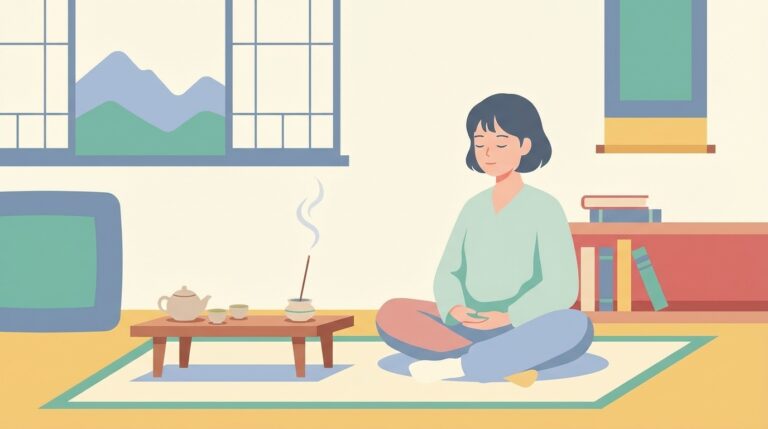
Picture this K-Drama scene: The protagonist, an heir to a massive conglomerate, has just returned home after a brutal boardroom battle. Do they immediately go to sleep? No. They walk into their sleek, minimalist living room overlooking the Han River, strike a match, and light a slender stick of incense. They sit down, close their eyes, and let out a long, heavy sigh as the thin ribbon of smoke dances into the air.
In Korea, burning incense and practicing meditation is no longer just for Buddhist monks in remote mountain temples. From hipsters in Seongsu-dong buying artisanal Nag Champa to office workers seeking a moment of peace after a relentless 14-hour workday, the culture of ‘mindfulness’ has taken deep root in modern Korean society.
But here is the catch for advanced (C1) learners: If you simply say “I’m resting” (저는 쉬고 있어요) or “I am meditating” (저는 명상을 합니다) like the textbooks teach you, you’re missing the profound, poetic, and sometimes colloquial nuances of how Koreans actually talk about clearing their minds. Today, we are going to dive deep into the vocabulary of incense, tea, and finding your zen in the heart of the “Pali-Pali” (hurry-hurry) culture.
Phase 2: Core Expressions Deep Dive
Let’s upgrade your vocabulary from basic to “insider.”
1. 향을 피우다
- Pronunciation: [hyang-eul pi-u-da] – The ‘hyang’ rhymes with ‘sang’, and ‘pi-u-da’ sounds like a soft ‘Pee-ooh-dah’.
- Meaning: (Literal) To bloom incense. / (Real Nuance) To burn incense or light an incense stick.
- K-Culture Moment: You visit a trendy lifestyle shop in Bukchon Hanok Village. The scent of sandalwood fills the air, and the clerk asks what kind of vibe you’re looking for. You tell them you want something for when you “light incense” at night.
- Editor’s Insight: Why use the verb 피우다 (to bloom) instead of 태우다 (to burn)? In Korean, we “bloom” things that spread beautifully in the air or create an atmosphere. We say 꽃을 피우다 (bloom a flower), 연기를 피우다 (create smoke), and 향을 피우다. Saying ‘향을 태우다’ sounds aggressively destructive, like you are trying to destroy the stick with fire!
- Situation Spectrum:
[🚫 Never] ———— [⚠️ Caution] ———— [✅ Freely]
- Close Friends (Casual): ✅ (향 피울까?)
- Colleagues (Semi-formal): ✅ (향을 피우는 걸 좋아해요.)
- Boss/Elders (Formal): ✅ (향을 피우셨군요.)
- 🤔 Think About It: Does your native language use a poetic verb like “to bloom” for lighting incense, or a functional one like “to burn” or “to light”? How does this change the feeling of the action?
2. 향멍 (때리다)
- Pronunciation: [hyang-meong (ttae-ri-da)] – ‘hyang’ + ‘mung’ (like lung).
- Meaning: (Literal) To hit incense space-out. / (Real Nuance) To zone out while staring at the smoke of an incense stick.
- K-Culture Moment: On a Friday night, instead of going out for soju, you post an Instagram story of your incense burner with the caption: “오늘 밤은 향멍” (Tonight is hyang-meong).
- Editor’s Insight: This is pure modern Korean genius. The slang 멍 때리다 means to space out or blank your mind. Koreans have started attaching ‘-멍’ to the object they stare at while zoning out. 불멍 (staring at fire/campfire), 물멍 (staring at water/river), and now, 향멍 (staring at incense smoke). It’s the modern, casual equivalent of “meditating.”
- Situation Spectrum:
[🚫 Never] ———— [⚠️ Caution] ———— [✅ Freely]
- Close Friends (Casual): ✅ (나 지금 향멍 때리는 중.)
- Colleagues (Semi-formal): ⚠️ (Use carefully; it’s slang. ‘향멍 하려고요’ is better.)
- Boss/Elders (Formal): 🚫 (Too informal. Use ‘명상’ or ‘휴식’ instead.)
- 🤔 Think About It: Why did Koreans invent so many specific words for “zoning out” (불멍, 물멍, 향멍)? What does this tell you about the mental fatigue of modern society?
3. 마음을 추스르다
- Pronunciation: [ma-eum-eul chu-seu-reu-da] – ‘chu’ like chew, ‘seu’ sounds like the disgusted sound you make stepping in gum, ‘reu’ like a soft ‘roo’.
- Meaning: (Literal) To gather/arrange one’s mind. / (Real Nuance) To compose oneself, to pull oneself together emotionally after a stressful event.
- K-Culture Moment: In a K-Drama, the heroine sits down at a traditional tea table (다상) after a terrible breakup. She brews a pot of green tea slowly, breathing deeply to compose her mind before facing the world again.
- Editor’s Insight: This is a true C1 level expression. While beginners say “마음이 편해요” (My mind is comfortable), advanced speakers use “마음을 추스르다” to describe the active process of managing emotional turbulence. You drink tea or burn incense specifically to do this.
- Situation Spectrum:
[🚫 Never] ———— [⚠️ Caution] ———— [✅ Freely]
- Close Friends (Casual): ✅
- Colleagues (Semi-formal): ✅
- Boss/Elders (Formal): ✅ (Highly respectful and mature expression)
- 🤔 Think About It: Korean has many verbs related to organizing the mind (마음을 다잡다, 가라앉히다, 추스르다). Why is emotional regulation treated almost like organizing a physical space in Korean culture?
Phase 3: Textbook vs. Real Korean
How do we transition from robotic textbook sentences to natural, flowing Korean?
| Situation | 📖 Textbook Korean | 🗣️ Real Korean | 💡 Why the difference? |
|---|---|---|---|
| Explaining your hobby | 저는 스트레스를 풀기 위해 명상을 합니다. (I meditate to relieve stress.) | 인센스 하나 피워놓고 향멍 때려요. (I light an incense and space out.) | ‘명상’ (meditation) sounds quite heavy and religious; ‘향멍’ is the trendy lifestyle equivalent. |
| Asking about a scent | 이 냄새는 무엇입니까? (What is this smell?) | 이 향 너무 좋은데, 무슨 향이에요? (This scent is so good, what scent is it?) | 냄새 is often associated with bad odors (like garbage). 향 (scent/fragrance) is always positive. |
| Describing calmness | 제 마음이 조용해집니다. (My mind becomes quiet.) | 마음이 차분하게 가라앉네요. (My mind calmly settles down.) | Native speakers use ‘가라앉다’ (to sink/settle) as a metaphor for turbulent emotions calming down. |
Bottom Note for C1 Learners: Slang like ‘향멍’ is great for casual settings, but if you are at a traditional tea house (다원) or a temple, stick to elegant phrases like ‘마음이 차분해지네요’ (I feel serene).
Phase 4: Cultural Context — K-Culture Deep Dive
4-1. Non-verbal Communication: The Art of Slowing Down
In Korea, the concept of Nunchi (reading the room) governs 90% of social interactions. You must be fast, hyper-aware, and responsive. However, the culture of tea (다도) and incense (향도) is the designated “Nunchi-Free Zone.” When you sit with someone for tea or incense, the non-verbal rule is to deliberately slow down your movements. Pouring tea with two hands, watching the smoke without speaking—silence here is not awkwardness; it is a shared respect for the pause.
4-2. K-Travel & Lifestyle Link: The “Incense Boom” in Seoul
If you travel to trendy neighborhoods in Seoul like Seongsu-dong, Mangwon-dong, or Bukchon, you will notice an explosion of lifestyle edit-shops selling incense sticks (인센스 스틱) and holders. What used to be associated strictly with Buddhist temples or ancestral rites (제사) has been rebranded for Gen Z and Millennials as a hip self-care ritual.
One of the most popular scent profiles in these modern shops is actually “절간 냄새” (Temple smell). Young Koreans actively seek out the woody, sandalwood scent of traditional Buddhist temples to bring a sense of groundedness into their tiny, stressful studio apartments.
Phase 5: Real-life Roleplay Scenario
Setting: Saturday afternoon in Bukchon Hanok Village. You step into a beautiful, dimly lit artisanal incense shop. Traditional Korean ambient music is playing. You want to buy some incense to help you relax after a crazy week of business meetings.
Characters:
– YOU (The Reader): A stressed expat working in Seoul, looking for some zen.
– Staff (20s, very polite, slightly hipster): Ready to guide your olfactory journey.
Dialogue:
Staff: 어서 오세요. 찾으시는 향 있으신가요? 🌿
(eoseo oseyo. chajeusineun hyang isseusingayo?)
[Welcome. Is there a specific scent you are looking for?]
YOU: 아, 요즘 스트레스가 많아서… 마음을 좀 추스를 수 있는 향을 찾고 있어요.
(a, yojeum seuteureseuga manaseo… ma-eum-eul jom chuseureul su itneun hyang-eul chatgo isseoyo.)
[Ah, I have a lot of stress lately… I’m looking for a scent to help me compose my mind.]
Staff: 아, 그러시군요. 그럼 너무 달콤한 향보다는 약간 묵직한 우디 계열이 좋으실 거예요. 이쪽 시향해 보시겠어요?
(a, geureosigunyo. geureom neomu dalkomhan hyang-bodaneun yakgan mukjikhan udi gyeyeori joeusil geoyeyo. ijjok sihyang-hae bosigesseoyo?)
[Ah, I see. Then rather than a sweet scent, a slightly heavy woody type would be good. Would you like to test the scent over here?]
YOU: 네, 이거 진짜 좋네요. 딱 제가 원하던 ‘절간 냄새’예요! (Smelling a stick)
(ne, igeo jinjja jonneyo. ttak jega wonhadeon ‘jeolgan naemsae’yeyo!)
[Yes, this is really good. It’s exactly the ‘temple smell’ I wanted!]
Staff: 맞아요! 그게 저희 베스트셀러예요. 퇴근하고 불 끄고 이거 하나 피워두시면…
(majayo! geuge jeohui beseuteuselleoyeyo. toegeunhago bul kkeugo igeo hana piwodusi-myeon…)
[Exactly! That’s our best seller. If you turn off the lights after work and light one of these…]
🔀 Your Turn! How do you reply?
– A) “향멍 때리기 딱 좋겠네요. 이걸로 할게요!”
– B) “너무 비싸네요. 깎아주세요.”
– C) “저는 명상을 매일 합니다.”✅ Best Choice: A — “It would be perfect for spacing out watching the smoke (hyang-meong). I’ll take this one!” It shows you understand modern Korean lifestyle slang perfectly. The staff will definitely be impressed.
⚠️ Choice B Analysis: “It’s too expensive, give me a discount.” Haggling is okay in traditional markets (Namdaemun), but completely inappropriate in modern boutique shops.
Phase 6: 10-Second Shadowing Drill
Practice this sentence to sound like a stressed-but-trendy Seoulite. Pay attention to the pauses!
😌 요즘 / 머리가 너무 복잡해서, / 인센스 스틱 피워놓고 / 향멍 좀 때리려고요.
(yojeum / meoriga neomu bokjaphaeseo, / insenseu seutik piwonoko / hyang-meong jom ttaeriryeogoyo.)
Lately my head is too complicated, so I’m going to light an incense stick and zone out for a bit.
Phase 7: K-Culture Mini Dictionary
| Korean | Romanization | English | Contextual Explanation |
|---|---|---|---|
| 다도 | dado | Tea Ceremony | The traditional way of brewing and drinking tea, focusing on mindfulness and etiquette. |
| 시향(하다) | sihyang(hada) | To test a scent | The act of smelling a perfume or incense before buying. A must-know shopping verb. |
| 절간 냄새 | jeolgan naemsae | Temple smell | A trendy term for woody, sandalwood, or earthy scents that remind Koreans of traditional Buddhist temples. |
| 심신 안정 | simsin anjeong | Mind and body stabilization | A phrase frequently seen on tea packaging or incense boxes. The ultimate goal of “healing” in Korea. |
Phase 8: Traveler Survival Kit
Are you planning to buy tea or incense in Korea? Save these cards!
🆘 Survival Expression #1: Testing Scents
– 🇰🇷 “이거 시향해 봐도 될까요?” (igeo sihyang-hae bwado doelkkayo?)
– 🗣️ English: Can I test the scent of this?
– 📍 Where to use: Olive Young, Tamburins, Granhand, local incense boutiques.🆘 Survival Expression #2: Describing Your Preference
– 🇰🇷 “조금 더 가벼운/묵직한 향 있나요?” (jogeum deo gabyeoun / mukjikhan hyang itnayo?)
– 🗣️ English: Do you have a slightly lighter / heavier scent?
– 📍 Note: ‘묵직하다’ (heavy/substantial) is a C1 level adjective that Koreans love to use for woody or musky scents.📌 Editor’s Travel Note
When buying traditional Korean tea (녹차, 오미자차) or incense, Insadong (인사동) is great for traditional vibes, but if you want modern aesthetic packaging, head to Seongsu-dong (성수동) or the area around Gyeongbokgung Palace (경복궁). Also, never call the fragrance of a product “냄새” to the staff; always use “향” (hyang)!
Phase 9: Critical Thinking Corner — “One Step Deeper”
🧠 Think Deeper: Modern Life & The Business of Rest
In recent years, the Korean lifestyle market has seen an explosion of products related to “healing”—from premium incense sticks to “spacing out” (멍 때리기) competitions held in public parks. Why are Koreans so obsessed with these micro-moments of zen?
It is deeply connected to the extreme intensity of the hyper-competitive society. When every waking hour is optimized for productivity, study, or work, true “rest” feels almost guilty. By creating specific rituals (like buying expensive tea or lighting aesthetic incense), the act of “doing nothing” becomes validated as a necessary, purposeful activity rather than mere laziness. The intense pursuit of relaxation is, ironically, a reflection of how intense Korean life is.
💬 Your Turn: How does your culture view “doing nothing”? Is resting considered a productive ritual, or just laziness? Share your thoughts below!
Phase 10: FAQ & Avoiding Common Mistakes
Q: “Can I use ‘제사’ (ancestral rite) when talking about incense in my room?”
No! This is a fatal cultural mistake. 제사 (jesa) specifically refers to the Confucian ritual of honoring dead ancestors. If you say “방에서 제사 향을 피워요,” Koreans will be shocked, thinking you are performing ghost rituals in your bedroom. Always say “인센스를 피워요” for lifestyle use.
Q: “Is it polite to ask a monk for ‘향멍’ at a temple?”
Maybe not. While ‘향멍’ is a fun slang term for the younger generation, it sounds a bit too light and slangy for a solemn temple stay. Use “명상” (meditation) or “마음 챙김” (mindfulness) with monks.
❌ Common Mistake #1: Mixing up 향 (Scent) and 냄새 (Smell).
Mistake: “이 차 냄새가 정말 좋네요!” (This tea’s smell is really good! – Sounds slightly off, like saying “This tea doesn’t stink!”)
✅ Do This Instead: “이 차 향이 정말 좋네요!”
Phase 11: Summary & Action Items
One-Liner Summary: To truly relax like a Korean, don’t just rest—light an incense stick (향을 피우다), compose your mind (마음을 추스르다), and embrace the art of zoning out (향멍).
Action Mission:
– 🥉 Bronze (Solo): Read the 10-second shadowing sentence aloud 3 times, focusing on your breathing at the pauses.
– 🥈 Silver (Online): Go to a Korean YouTube vlog (search “인센스 추천” or “향멍”). Leave a comment: “마음이 차분해지네요.”
– 🥇 Gold (Real Life): Visit a Korean cosmetic or lifestyle shop (even online) and practice asking “시향해 봐도 될까요?” in your head as you browse.
K-Culture Mission:
Tonight, turn off your main lights, light a candle or an incense stick, and try 5 minutes of “향멍” or “불멍” without looking at your phone. Let your mind sink (가라앉다).
Phase 12: Interactive Quiz Challenge
1. Situational Judgment: You are stressed out after failing an exam. Your Korean friend asks how you are doing. What is the most natural, C1-level response?
– A) 저는 명상을 할 것입니다.
– B) 냄새를 피우고 싶어요.
– C) 오늘은 집에 가서 향 하나 피우고 마음 좀 추스르려고요.
(Answer: C. A is too robotic. B means “I want to make a bad smell”—a terrible mistake! C perfectly combines the vocabulary and emotion.)
2. True or False – K-Culture Edition:
“If you tell a Korean friend you love the ‘절간 냄새’ (temple smell) of your new perfume, they will be offended because it’s religious.”
(Answer: False. ‘절간 냄새’ is currently a highly trendy, positive descriptor for woody, calm scents among young Koreans.)
3. Fill in the Blank:
어제 너무 바빠서 정신이 없었어요. 오늘은 카페에서 아무 생각 없이 ( ______ ) 때리려고요.
(Answer: 멍. To zone out is ‘멍 때리다’.)
Frequently Asked Questions (FAQ)
Q: What does "향을 피우다" mean in Korean and how do you pronounce it?
A: In Korean, "향을 피우다" is pronounced [hyang-eul pi-u-da] and means: (Literal) To bloom incense. / (Real Nuance) To burn incense or light an incense stick.
Q: What does "향멍 (때리다)" mean in Korean and how do you pronounce it?
A: In Korean, "향멍 (때리다)" is pronounced [hyang-meong (ttae-ri-da] and means: (Literal) To hit incense space-out. / (Real Nuance) To zone out while staring at the smoke of an incense stick.
Q: What does "마음을 추스르다" mean in Korean and how do you pronounce it?
A: In Korean, "마음을 추스르다" is pronounced [ma-eum-eul chu-seu-reu-da] and means: (Literal) To gather/arrange one's mind. / (Real Nuance) To compose oneself, to pull oneself together emotionally after a stressful event.







