

Phase 1: Empathy (Immersion Open)
Hello there! I’m your Daily Hangul editor.
Picture this: You’re in Seoul. You’ve just finished a fantastic day of cafe-hopping in Seongsu-dong. You confidently step onto the bus, tap your shiny T-money card, and instead of the cheerful “Beep!”, you hear a sad, rapid “Beep-beep! Janaegi bujokhamnida.” (Insufficient balance). Suddenly, the bus driver is looking at you, the people behind you are waiting, and panic sets in. You step off the bus, find the nearest convenience store, and… wait, what do you say to the cashier?
If you’ve watched any K-Drama, you know that the local convenience store (편의점) is the heart of Korean life. It’s where leads bump into each other, where you eat ramyeon at 2 AM, and most importantly, where you recharge your transportation card.
Don’t let the fear of a low balance stop your Seoul adventure! Today, we are going to learn exactly how to recharge your card smoothly. I promise, by the end of this guide, you’ll be doing it like a true local.
Phase 2: Core Expressions Deep Dive
Let’s look at the survival phrases you absolutely need.
1. 교통카드 충전해 주세요. (gyotongkadeu chungjeonhae juseyo.)
- Pronunciation: [gyo-tong-ka-deu chung-jeon-hae ju-se-yo] / ‘gyo’ sounds like the ‘gyo’ in Tokyo. ‘chung’ rhymes with ‘sung’.
- Meaning: Please recharge my transportation card.
- K-Culture Moment: You walk into a brightly lit CU or GS25. You place your card on the counter. Saying this phrase immediately tells the part-timer (Alba-saeng) what you need, bypassing any awkward silence.
- Editor’s Insight: “충전 (chungjeon)” means “recharge” or “charge.” You can also use this exact word when asking a cafe to charge your dying phone battery!
- Situation Spectrum:
[🚫 Never] ———— [⚠️ Be Careful] ———— [✅ Freely]
- Casual with friends: 🚫 (You wouldn’t ask a friend to recharge your card)
- Semi-formal (Store clerks): ✅ (Perfect and polite!)
- Formal (Elders/Boss): 🚫
- 🤔 Think About It: Why do Koreans add “주세요 (juseyo – please give/do)” at the end of almost every request? How does this reflect the culture of politeness compared to simply saying “I want to recharge” in your native language?
2. 만 원 충전해 주세요. (man won chungjeonhae juseyo.)
- Pronunciation: [man won chung-jeon-hae ju-se-yo] / ‘man’ sounds like ‘mahn’, not the English word ‘man’.
- Meaning: Please recharge 10,000 won.
- K-Culture Moment: Time is money in Korea (Pali-pali culture!). Instead of waiting for the clerk to ask “How much?”, savvy travelers state the amount right away.
- Editor’s Insight: You just replace “교통카드 (gyotongkadeu)” with the amount you want. 5,000 won is 오천 원 (ocheon won), 10,000 won is 만 원 (man won).
- Situation Spectrum:
[🚫 Never] ———— [⚠️ Be Careful] ———— [✅ Freely]
- Store clerks: ✅ (Very efficient and natural)
- 🤔 Think About It: In Korea, 10,000 won is a standard, comfortable amount to put on a transit card for a few days. How much do you usually put on your transit card back home?
3. 현금밖에 없어요? (hyeongeumbakke eopseoyo?)
- Pronunciation: [hyeong-geum-ba-kke eop-seo-yo?] / ‘hyeon’ sounds like ‘hyon’.
- Meaning: Do you only take cash? (Literal: Is there nothing outside of cash?)
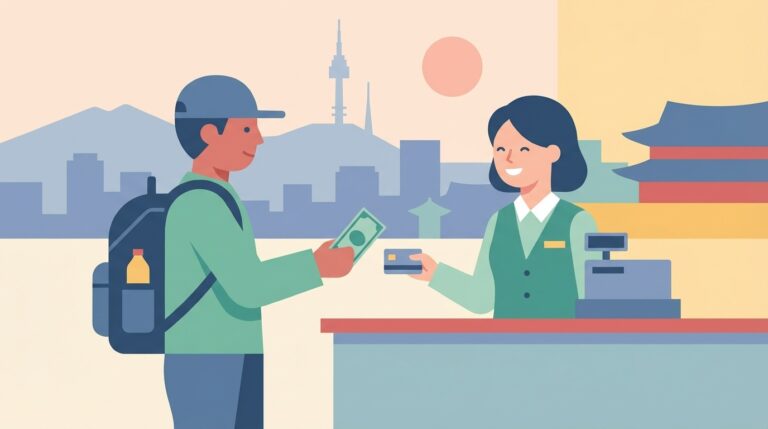
- K-Culture Moment: The biggest shock for tourists! Korea is a hyper-cashless society, but T-money recharges at convenience stores are strictly CASH ONLY. If you hand over a credit card, the clerk will cross their arms to make an ‘X’ sign.
- Editor’s Insight: This phrase is great when you are surprised that a place doesn’t take cards. It’s a handy survival phrase for traditional markets too!
- Situation Spectrum:
[🚫 Never] ———— [⚠️ Be Careful] ———— [✅ Freely]
- Store clerks: ✅ (Use it when you need to confirm if it’s cash only)
Phase 3: Textbook vs. Real Korean
| Situation | 📖 Textbook Korean | 🗣️ Real Korean | 💡 Why the difference? |
|---|---|---|---|
| Recharging your card | 이 교통카드에 돈을 충전하고 싶습니다. (I would like to recharge money onto this transit card.) | 티머니 만 원 충전해 주세요. (Please recharge 10,000 won on T-money.) | Koreans prefer getting straight to the point. State the brand (T-money) and the amount immediately! |
| Giving the money | 여기 현금 있습니다. (Here is the cash.) | (Just handing over the cash with two hands) | Non-verbal communication (handing items with both hands) speaks louder than words in Korea. |
| Ending the interaction | 대단히 감사합니다. 안녕히 계십시오. (Thank you very much. Please stay in peace.) | 감사합니다~ 수고하세요! (Thank you, keep up the good work!) | “수고하세요 (Sugohaseyo)” is the ultimate polite sign-off to service workers in Korea. |
Phase 4: Cultural Context — K-Culture Deep Dive
4-1. Non-Verbal Magic: The Two-Hand Rule
Language isn’t just about words. When you hand your T-money card and cash to the cashier, try using both hands, or place your left hand lightly on your right forearm as you hand it over. It’s a sign of respect. Also, remember Nunchi (눈치): if there’s a long line behind you, have your cash and card ready before you step up to the register!
4-2. K-Travel Link: The Convenience Store Oasis
In Korea, convenience stores (CU, GS25, 7-Eleven, Emart24) are everywhere. They are your best friends. Not only can you recharge your transit card, but you can also buy bandaids for blistered feet, grab a quick triangle kimbap (삼각김밥), and even eat ramen looking out the window. Remember: Recharging a transportation card here requires CASH. You cannot use your foreign Visa or Mastercard to top up your T-money card at a convenience store!
Phase 5: Real-Life Roleplay Scenario
Setting: It’s 10 AM. You are at a bustling GS25 convenience store near Hongdae Station. You need to catch a train to a K-Pop pop-up store, but your T-money card is empty.
Characters:
– YOU: A traveler who just realized they only have a 50,000 won bill.
– Jiwon (22): The part-time worker (알바생 – Alba-saeng), scanning snacks very fast.
Dialogue:
YOU: 안녕하세요! 티머니 충전해 주세요.
(annyeonghaseyo! timeoni chungjeonhae juseyo.)
[Hello! Please recharge my T-money.]
(🎭 Stage Direction: You place your card on the counter)
Jiwon: 네, 얼마 충전해 드릴까요?
(ne, eolma chungjeonhae deurilkkayo?)
[Yes, how much should I recharge for you?]
YOU: 만 원이요.
(man woniyo.)
[10,000 won, please.]
Jiwon: 네, 현금 주세요.
(ne, hyeongeum juseyo.)
[Okay, please give me cash.]
🔀 YOUR TURN! How do you respond while handing over a 50,000 won bill?
– A) 오만 원이에요. 거스름돈 주세요. (It’s 50,000 won. Give me change.)
– B) 여기요! (Here you go!)
– C) 헐, 현금만 돼요? (Omg, only cash?)✅ Best Choice: B — “여기요! (Yeogiyo!)” is the most natural and friendly way to hand something over. The clerk will automatically give you 40,000 won in change.
⚠️ Choice A Analysis: While grammatically correct, demanding change sounds a bit bossy.
⚠️ Choice C Analysis: “헐 (Heol)” is very casual slang. Best to avoid using it with staff you don’t know.
Jiwon: (Takes the 50,000 won bill, taps the screen, places the card on the scanner) 삐- (Beep). 다 됐습니다. 잔돈 4만 원이요.
(da dwaetseumnida. jandon saman woniyo.)
[It’s all done. Here is your 40,000 won change.]
YOU: 감사합니다! 수고하세요~
(gamsahamnida! sugohaseyo~)
[Thank you! Keep up the good work~]
Phase 6: 10-Second Shadowing Drill
Practice speaking out loud! Follow the pauses (/) and the emotion tags.
😊 안녕하세요! / 티머니 / 만 원 / 충전해 주세요.
(annyeonghaseyo! / timeoni / man won / chungjeonhae juseyo.)
[Hello! Please recharge 10,000 won on my T-money.]
🥺 앗, / 카드는 / 안 되나요?
(at, / kadeuneun / an doenayo?)
[Oops, do you not accept credit cards?]
😊 감사합니다! / 수고하세요~
(gamsahamnida! / sugohaseyo~)
[Thank you! Have a good shift~]
Phase 7: K-Culture Mini Dictionary
| Korean | Romanization | English | Contextual Meaning |
|---|---|---|---|
| 티머니 | timeoni | T-money | The most popular brand of transportation card in Korea. Used for buses, subways, and taxis. |
| 편의점 | pyeonuijeom | Convenience Store | Literally “convenience store.” The hub for T-money recharges. |
| 현금 | hyeongeum | Cash | The only accepted payment method for recharging transit cards at convenience stores. |
| 알바생 | albasaeng | Part-timer | Refers to the staff working part-time at cafes, convenience stores, and restaurants. |
| 잔액 | janaek | Balance | The remaining amount on your card. (잔액 부족 = Insufficient balance) |
Phase 8: Traveler Survival Kit
🆘 Survival Phrases for Transit
– 🇰🇷 “가까운 편의점이 어디예요?” (gakkaun pyeonuijeomi eodiyeyo?)
– 🗣️ Meaning: Where is the nearest convenience store?
– 📍 Where to use: When you need to find a place to recharge your card.
– 💡 Pro Tip: Look around for GS25, CU, 7-Eleven, or Emart24 signs. They are literally on every block in Seoul!📌 Editor’s Travel Note
– Must-Have Apps: Naver Map or KakaoMetro. Google Maps does not provide walking directions in Korea!
– Cash vs. Card: Korea is a “Card Heaven.” You can pay for a 1,000 won water bottle with a card. HOWEVER, recharging a T-money card is the one major exception. Always carry some 10,000 won bills (만 원권) just for your transit card!
– Transfer Magic: If you transfer from a bus to a subway within 30 minutes, the transfer is usually free or heavily discounted! Just remember to tap your card when you get OFF the bus.
Phase 9: Critical Thinking Corner — “One Step Deeper”
🧠 Think Deeper: Tech vs. Reality in Korea
Korea is famous for being a hyper-tech, cashless society. You can pay for almost everything with Samsung Pay, Apple Pay, or credit cards. So why do convenience stores only accept cash for T-money recharges? It comes down to transaction fees. If convenience stores accepted credit cards for transit card top-ups, the credit card companies would take a percentage as a fee, leaving the store owners with a loss. This unique situation forces even the most tech-savvy Koreans to carry a little bit of physical cash. It’s a fascinating clash between advanced digital infrastructure and basic economic reality.💬 Your Turn: Does your country have a unified transit card system like T-money? Do you usually pay with cash, card, or your phone for public transport? Let us know in the comments!
Phase 10: FAQ & Mistake Prevention
Q: Can I recharge my T-money card on the bus?
No. You must recharge it at a convenience store or at the subway station kiosks BEFORE boarding.
Q: What if I only have a credit card and my T-money is empty?
At subway stations, you can buy a single-journey ticket using cash, but there are no credit card machines for T-money. If you’re completely out of cash, you might have to withdraw some from a global ATM inside the convenience store first.
❌ Common Mistake #1: Handing the cashier your credit card to recharge T-money.
✅ Do this instead: Have your crisp Korean Won (cash) ready in hand along with your T-money card.❌ Common Mistake #2: Forgetting to tap the card when getting OFF the bus.
✅ Do this instead: Always tap off! If you don’t, you will be charged a penalty fee on your next ride, and you’ll lose the free transfer discount.
Phase 11: Summary & Action Items
- One-Liner Summary: To recharge your card, hand over your card and cash, and say: “티머니 (amount) 충전해 주세요!”
-
Action Mission:
- 🥉 Bronze (Solo): Say “만 원 충전해 주세요” out loud 3 times right now.
- 🥈 Silver (Online): Write down in your notebook how much you would typically recharge for a 3-day trip to Seoul.
- 🥇 Gold (Real Life): Next time you are in Korea, boldly walk into a GS25 and recharge your card entirely in Korean!
- K-Culture Mission:
Watch a V-log of someone traveling in Korea on YouTube. Notice what happens when they go to a subway station or convenience store to top up their card. Did they use cash?
Phase 12: Quiz — Interactive Challenge
1. Situational Judgment: You hand the convenience store clerk your T-money card and a Visa Credit Card, saying “만 원 충전해 주세요.” What will the clerk likely do?
– A) Smile and recharge the card.
– B) Say “현금만 됩니다” (Only cash is accepted) and return your credit card.
– C) Charge you a 10% extra fee.
2. Fill in the Blank:
“티머니 5천 원 _________ 주세요.” (Please recharge 5,000 won on T-money.)
3. True or False:
You must tap your T-money card when you get OFF the bus to avoid extra charges.
(Answers: 1: B – Cash only! / 2: 충전해 (chungjeonhae) / 3: True – Always tap off to get transfer discounts!)
Frequently Asked Questions (FAQ)
Q: What does "교통카드 충전해 주세요. (gyotongkadeu chungjeonhae juseyo.)" mean in Korean and how do you pronounce it?
A: In Korean, "교통카드 충전해 주세요. (gyotongkadeu chungjeonhae juseyo.)" is pronounced [gyo-tong-ka-deu chung-jeon-hae ju-se-yo] and means: Please recharge my transportation card.
Q: What does "만 원 충전해 주세요. (man won chungjeonhae juseyo.)" mean in Korean and how do you pronounce it?
A: In Korean, "만 원 충전해 주세요. (man won chungjeonhae juseyo.)" is pronounced [man won chung-jeon-hae ju-se-yo] and means: Please recharge 10,000 won.
Q: What does "현금밖에 없어요? (hyeongeumbakke eopseoyo?)" mean in Korean and how do you pronounce it?
A: In Korean, "현금밖에 없어요? (hyeongeumbakke eopseoyo?)" is pronounced [hyeong-geum-ba-kke eop-seo-yo?] and means: Do you only take cash? (Literal: Is there nothing outside of cash?)







