

Phase 1: Empathy (Welcome to the Real Korea!)
Hello there! I’m your Daily Hangul Editor, your personal guide to not just surviving, but thriving in Korea.
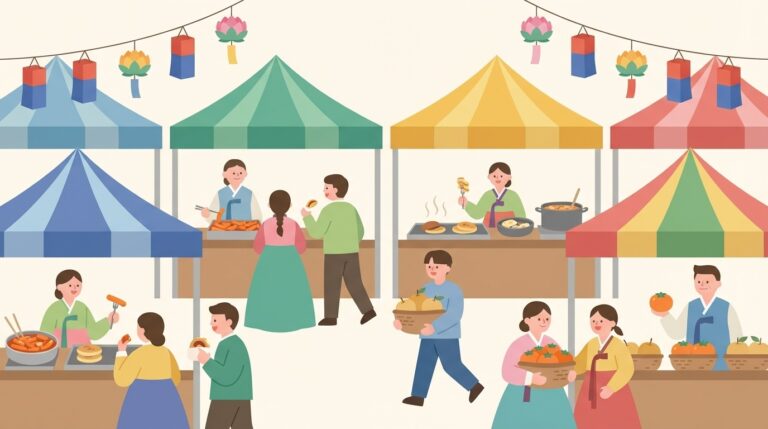
Imagine this: You’re watching an episode of 2 Days & 1 Night (1박 2일) or a classic K-Drama romantic getaway. The main characters stumble upon a vibrant, loud, and bustling local specialty festival (지역 특산물 축제). There are colorful tents, the smell of grilling meat, loud trot music playing, and mountains of fresh local produce. The lead actor flashes a smile, chats with the vendor, and miraculously walks away with a bag bursting with extra fruits—for free! The subtitles just say, “Thanks for the extra!” but what kind of linguistic magic did they actually use?
If you’ve ever visited a Korean regional festival—like the Nonsan Strawberry Festival or the Geumsan Ginseng Festival—you know the vibe. It’s energetic, a bit chaotic, and entirely different from scanning a barcode at a Seoul convenience store. If you only use your textbook Korean here, you might get your apples, but you’ll miss out on the rich, warm, and distinctly Korean experience of ‘Jeong’ (정).
This guide is crafted from the real experiences of my B2-level students who wanted to stop feeling like tourists and start bargaining, tasting, and joking with festival vendors like true locals. Let’s dive in!
Phase 2: Deep Dive into Core Expressions
Here are the absolute must-know phrases that will instantly upgrade your festival experience.
1. 이거 시식해 봐도 돼요? (Can I try a sample of this?)
- Pronunciation: igeo sisikhae bwado dwaeyo? [ee-geo shee-sheek-heh bwa-do dway-yo?]
- Meaning: Literal: Is it okay if I do a tasting of this? / Real Nuance: Can I try a piece before I buy?
- K-Culture Moment: You’re walking past a stall selling Jeju tangerines. The vendor has a plate of cut fruit but isn’t actively handing them out. Instead of just pointing and nodding awkwardly, you use this phrase. The vendor’s face lights up, and they hand you the sweetest piece.
- Editor’s Insight: The word ‘시식’ (sisik) specifically means ‘tasting food.’ It’s much more natural and polite in this context than asking ‘이거 먹어도 돼요?’ (Can I eat this?), which sounds a bit childish.
- Situation Spectrum:
[🚫 Never] ———— [⚠️ Caution] ———— [✅ Freely]
- At a festival/market stall: ✅
- At a large supermarket with sample corners: ✅
- At a formal restaurant: 🚫 (They don’t do samples!)
- 🤔 Think About It: In Korea, giving out free samples is a gesture of confidence in the food’s taste and a way to build a quick connection. Does your culture have a similar sampling culture at local markets?
2. 사장님, 덤으로 쪼금만 더 주시면 안 돼요? (Boss, could you throw in a little extra?)
- Pronunciation: sajangnim, deomeuro jjogeumman deo jusimyeon an dwaeyo? [sah-jang-neem, dum-eu-ro jjo-geum-man duh joo-shee-myun ahn dway-yo?]
- Meaning: Literal: Boss, can you not give me a little more as a bonus? / Real Nuance: Come on, give me a little extra, please~
- K-Culture Moment: This is the ultimate Aegyo (애교, cute display of affection) move for adults. You’ve already agreed to buy a box of strawberries. As they are bagging it, you smile warmly and drop this line. The vendor laughs and throws in two more handfuls.
- Editor’s Insight: The concept of ‘덤’ (Deom) is the heart of Korean traditional markets. It’s not a discount (깎아주는 것); it’s giving extra goods to show generosity. Adding ‘쪼금만’ (a cute pronunciation of 조금만, just a little) makes the request soft and playful, not demanding.
- Situation Spectrum:
[🚫 Never] ———— [⚠️ Caution] ———— [✅ Freely]
- Traditional markets / Festivals: ✅
- Department stores / Franchises: 🚫 (Prices and quantities are strictly fixed!)
- 🤔 Think About It: Why do Koreans prefer giving “extra goods (덤)” rather than “lowering the price (할인)”? It’s because giving more food is seen as sharing affection (정), whereas cutting prices is just a financial transaction.
3. 여기서 제일 잘나가는 게 뭐예요? (What’s the best-seller here?)
- Pronunciation: yeogiseo jeil jallaganeun ge mwoyeyo? [yuh-gee-suh jeh-eel jal-la-ga-neun geh mwo-yeh-yo?]
- Meaning: Literal: What is the thing that goes out the best here? / Real Nuance: What’s your most popular item?
- K-Culture Moment: You’re at a regional liquor festival (like the Andong Soju Festival). There are 20 different bottles in front of you. You want the local favorite, not the tourist trap. You ask the owner this question, showing you trust their expertise.
- Editor’s Insight: ‘잘나가다’ literally means ‘to go out well’, but it’s widely used as slang for ‘being popular’ or ‘selling well.’ It sounds 100x more natural than the textbook ‘가장 인기 있는 품목’ (most popular item).
- Situation Spectrum:
[🚫 Never] ———— [⚠️ Caution] ———— [✅ Freely]
- Cafes, restaurants, street vendors: ✅
- Formal business meetings: 🚫
- 🤔 Think About It: Notice how Koreans often rely on “the most popular choice” rather than individual preference when trying something new. This reflects a high-context culture that values collective trends and word-of-mouth trust.
Phase 3: Textbook vs. Real Korean
Let’s see why hitting the streets with only a textbook might make you sound like a news anchor!
| Situation | 📖 Textbook Korean | 🗣️ Real Korean | 💡 Why the difference? |
|---|---|---|---|
| Asking to taste | “이것을 맛보아도 됩니까?” (May I taste this?) | “이거 시식해 봐도 돼요?“ | ‘시식’ is the specific standard term for food sampling; ‘-아도 됩니까’ is too formal for a festival. |
| Asking for a discount | “가격을 할인해 주십시오.” (Please discount the price.) | “사장님, 조금만 깎아주세요~“ | ‘깎다’ (to cut) is the natural verb for haggling. Adding ‘~주세요~’ with a slight whine makes it friendly. |
| Asking what to buy | “가장 인기 있는 품목이 무엇입니까?” (What is the most popular item?) | “여기서 제일 잘나가는 게 뭐예요?” | ‘품목’ sounds like a corporate inventory check. ‘잘나가는 거’ is conversational and trendy. |
Bottom Note for B2 Learners: At your level, you should start replacing formal nouns with natural phrasing. Dropping particles (using ‘이거’ instead of ‘이것을’) instantly makes your Korean sound more fluent!
Phase 4: Cultural Context — K-Culture Deep Dive
4-1. Non-Verbal Communication: The Art of Nunchi at the Sample Stand
When you ask “이거 시식해 봐도 돼요?”, your body language matters. Don’t just grab a whole handful of samples with your bare hands! Use the provided toothpicks (이쑤시개). Eat one piece, nod appreciatively, say “와, 진짜 달아요!” (Wow, it’s really sweet!), and then look at the items for sale. This shows good Nunchi (눈치)—you respect their effort and aren’t just there for a free meal.
4-2. K-Travel Connection: The ‘Cash vs. Transfer’ Festival Rule
If you watch travel shows like Earth Arcade (뿅뿅 지구오락실) or YouTube travel vlogs, you’ll notice a distinct feature of Korean festivals: the Account Transfer (계좌이체) culture. While Korea is a “card-first” nation, temporary festival stalls often prefer or only accept cash or direct bank transfers.
Vendors will have a piece of cardboard with their bank account number written in thick black marker. Knowing how to say, “계좌이체 할게요” (I will do a bank transfer) will save you the panic of hunting down an ATM in the middle of a muddy field!
Phase 5: Real-Life Roleplay Scenario
Setting: A sunny Saturday afternoon at the famous Nonsan Strawberry Festival. The air smells like sweet sugar. You are standing in front of a bustling strawberry stall. Behind the mountain of bright red strawberries stands an energetic vendor auntie wearing a floral sun visor.
Characters:
– YOU: An international student in Korea who loves strawberries but is on a budget.
– Vendor Auntie (이모님): Mid-50s, loud, generous, but a tough negotiator.
Dialogue:
이모님: 자, 구경하고 가세요! 오늘 아침에 딴 논산 딸기! 엄청 달아요! 🍓
(ja, gugyeonghago gaseyo! oneul achime ttan nonsan ttalgi! eomcheong darayo!)
[Come take a look! Nonsan strawberries picked this morning! Super sweet!]
YOU: 우와, 진짜 크네요. 사장님, 이거 시식해 봐도 돼요?
(uwa, jinjja keuneyo. sajangnim, igeo sisikhae bwado dwaeyo?)
[Wow, they’re really big. Boss, can I try a sample of this?]
이모님: 그럼! 이거 하나 먹어봐요. (Hands you a huge strawberry on a toothpick)
(geureom! igeo hana meogeobwayo.)
[Of course! Try eating this one.]
YOU: (Tasting it) 대박! 진짜 달아요. 한 상자에 얼마예요?
(daebak! jinjja darayo. han sangja-e eolmayeyo?)
[Awesome! It’s really sweet. How much is one box?]
이모님: 원래 2만 원인데, 학생이니까 특별히 1만 8천 원에 줄게!
(wollae iman woninde, haksaeng-inikka teukbyeolhi ilman palcheon won-e julge!)
[It’s originally 20,000 won, but since you’re a student, I’ll give it to you for 18,000 won!]
🔀 Your Turn! How should you respond to seal the deal like a local?
– A) “너무 비싸요. 1만 5천 원에 주세요.” (Too expensive. Give it to me for 15,000 won.)
– B) “감사합니다! 그럼 계좌이체 할게요. 아, 사장님! 덤으로 몇 개만 더 주시면 안 돼요? 🥰”
– C) “아니요, 괜찮습니다. 안 살게요.”✅ Best Choice: B — Why? Haggling the price down after she already gave a “student discount” (A) can be seen as rude. Choice B accepts the price graciously but uses the Korean secret weapon: asking for ‘Deom’ (extra) with a smile. She will almost certainly throw in a few extra strawberries!
이모님: 아이고~ 학생이 말도 예쁘게 하네. 자, 여기 세 알 더! 많이 먹고 공부 열심히 해!
(aigo~ haksaeng-i maldo yeppeuge hane. ja, yeogi se al deo! mani meokgo gongbu yeolsimhi hae!)
[Oh my~ The student speaks so prettily. Here, three more berries! Eat a lot and study hard!]
(🎭 Stage Direction: Auntie aggressively shoves three giant strawberries into the top of your box.)
YOU: 헉, 감사합니다! 잘 먹겠습니다!
(heok, gamsahamnida! jal meokgetseumnida!)
[Gasp, thank you! I will eat them well!]
Bonus K-Culture Roleplay: The Endless Food Trap
You are at a festival food tent (포장마차) eating Pajeon (scallion pancake).
이모님: (Slams a plate of acorn jelly on your table) 이거 서비스예요. 맛 좀 봐요.
(igeo seobiseuyeyo. mat jom bwayo.)
[This is ‘service’ (on the house). Have a taste.]
YOU: 어? 저희 이거 안 시켰는데요?
(eo? jeohui igeo an sikyeonneundeyo?)
[Uh? We didn’t order this?]
이모님: 알아요~ 축제잖아! 그냥 먹어요!
(arayo~ chukjejana! geunyang meogeoyo!)
[I know~ It’s a festival! Just eat it!]
(Pro Tip: In Korea, “Service/서비스” means free stuff! Don’t panic, just say “감사합니다!”)
Phase 6: 10-Second Shadowing Drill
Practice the rhythm! In Korean, the pause (/) and the elongated sounds (~~) make all the difference between sounding like a robot and sounding like a native.
🥺 사장님~~ / 이거 너무 / 맛있는데, / 덤 쪼금만 / 주시면 안 돼요?
(sajangnim~~ / igeo neomu / masinneunde, / deom jjogeumman / jusimyeon an dwaeyo?)
(Boss~~ / This is so / delicious, / can’t you give me / a little extra?)
Editor’s Tip: Drag out the “님~~” slightly, and use an upbeat, slightly pleading tone. This is B2-level emotional inflection!
Phase 7: K-Culture Mini Dictionary
| 한국어 (Korean) | Romanization | English | Cultural Context |
|---|---|---|---|
| 덤 | deom | Extra / Bonus | Goods given for free on top of a purchase to show affection (정). |
| 시식 | sisik | Food sampling | Tasting corners at supermarkets or festivals. Free, but requires nunchi. |
| 흥정 | heungjeong | Haggling | The act of negotiating prices. Common in traditional markets, taboo in malls. |
| 이모님 | imonim | Auntie (Vendor) | Literally “Mother’s sister,” but used to address female workers/vendors politely and warmly to build rapport. |
| 서비스 | seobiseu | “On the house” | If a restaurant gives you “service,” it means it’s free! Do not try to pay for it. |
Phase 8: Traveler’s Survival Kit
When you’re out in the Korean countryside at a festival, you need survival phrases. Here are your lifesavers:
🆘 Survival Phrases for Regional Festivals
– 🇰🇷 “화장실이 어디예요?” (hwajangsiri eodiyeyo?)
– Where is the restroom? (Crucial, as festival layouts are confusing!)
– 🇰🇷 “여기 계좌이체 되나요?” (yeogi gyejwaiche doenayo?)
– Can I do a bank transfer here? (When they don’t have a card machine.)
– 🇰🇷 “포장해 주세요.” (pojanghae juseyo.)
– Please pack this to go. (If you bought too much to eat on the spot.)📌 Editor’s Travel Note
– Navigating: Don’t rely heavily on Google Maps outside of Seoul! Use KakaoMap (카카오맵) or Naver Map (네이버지도). They show exact bus routes for regional areas.
– Trash: Festivals in Korea have designated recycling zones (분리수거). Do NOT just leave your trash on a bench. Look for the large bins and sort your plastics from your food waste!
Phase 9: Critical Thinking Corner — “One Step Deeper”
Language & Power: Why Do We Call Strangers “Family”?
🧠 Think Deeper:
Have you noticed that in Korean markets, we call the female vendors ‘이모님’ (Aunt) or ‘어머님’ (Mother), and the male vendors ‘사장님’ (Boss/CEO) or ‘삼촌’ (Uncle)? By using kinship terms instead of a cold “Excuse me” (저기요), Koreans instantly lower the psychological boundary between buyer and seller. It transforms a simple commercial transaction into a relationship based on ‘정’ (Jeong – communal affection). If she’s your “Aunt,” she naturally wants to take care of you by giving you ‘Deom’ (extra). It’s a brilliant linguistic tool that shows how deeply Korean society values collective bonds over individualism.💬 Your Turn: How do you get a vendor’s attention in your culture? Do you have a way to build instant rapport with a stranger using language? Let us know in the comments!
Phase 10: FAQ & Avoiding Misunderstandings
Q: Can I ask for ‘Deom’ (extra) or a discount at a convenience store or Olive Young?
A: NO! 🚫 This is a huge mistake. Bargaining and ‘Deom’ culture strictly belong to traditional markets (전통시장), regional festivals, and street vendors. Doing this at a franchise store will only confuse the part-time worker who has no power to change the barcode price.
Q: The vendor grabbed my hand while giving me the bag! Are they mad?
A: Quite the opposite! Older Korean women (often affectionately called ajummas) might pat your arm or hold your hand briefly while handing you your goods. It’s a physical expression of ‘Jeong’ and friendliness.
❌ Common Mistake: Saying “당신” (Dangsin – You) to the vendor.
✅ Do This Instead: NEVER use “당신” in spoken Korean to a stranger. It sounds aggressive and confrontational. Always use their title: 사장님 (Sajangnim) or 이모님 (Imonim)!
Phase 11: Summary & Action Items
- One-Liner Summary: At a Korean festival, respectfully asking to taste (“시식해 봐도 돼요?”) and playfully asking for extras (“덤 좀 주세요”) using kinship terms (“이모님”) unlocks the true magic of Korean ‘Jeong’.
🎯 Action Missions:
– 🥉 Bronze (Solo): Stand in front of a mirror and practice the shadowing drill from Phase 6, focusing on the cute, pleading tone.
– 🥈 Silver (Online): Write a comment below in Korean pretending you are at a festival. Tell us what you want to buy and ask for an extra!
– 🥇 Gold (Real World): Visit a traditional market in Korea (like Gwangjang Market or Mangwon Market) and successfully buy something using “사장님, 이거 시식해 봐도 돼요?”
🎪 K-Culture Mission:
Go to YouTube and search for “한국 지역 축제 브이로그” (Korean regional festival vlog). Find a moment where the vlogger buys food and listen closely—can you hear them say “감사합니다” when the vendor gives them extra?
Phase 12: Quiz — Interactive Challenge
1. You are at the Boryeong Mud Festival and want to buy a grilled squid. You want to ask if it’s the most popular item. What do you say?
A) 여기서 제일 잘나가는 게 뭐예요?
B) 당신의 인기 품목이 무엇입니까?
C) 덤 좀 주시면 안 돼요?
Hint: Which one sounds like a local, not a robot?
2. True or False: If a restaurant owner at the festival gives you a plate of dumplings and says “서비스예요” (It’s service), you must pay for it.
Hint: Check Phase 7!
3. Fill in the Blank:
You want to ask for a little extra beautifully. “사장님, ( ___ ) 쪼금만 더 주시면 안 돼요?”
🚨 Click to reveal answers!
- A (B sounds like a corporate spy. C is asking for extras, not popularity.)
- False (Service = Free! Just say thank you and enjoy!)
- 덤 (Deom)
Frequently Asked Questions (FAQ)
Q: What does "이거 시식해 봐도 돼요? (Can I try a sample of this?)" mean in Korean and how do you pronounce it?
A: In Korean, "이거 시식해 봐도 돼요? (Can I try a sample of this?)" is pronounced [igeo sisikhae bwado dwaeyo? [ee-geo shee-sheek-heh bwa-do dway-yo?] and means: Literal: Is it okay if I do a tasting of this? / Real Nuance: Can I try a piece before I buy?
Q: What does "사장님, 덤으로 쪼금만 더 주시면 안 돼요? (Boss, could you throw in a little extra?)" mean in Korean and how do you pronounce it?
A: In Korean, "사장님, 덤으로 쪼금만 더 주시면 안 돼요? (Boss, could you throw in a little extra?)" is pronounced [sajangnim, deomeuro jjogeumman deo jusimyeon an dwaeyo? [sah-jang-neem, dum-eu-ro jjo-geum-man duh joo-shee-myun ahn dway-yo?] and means: Literal: Boss, can you not give me a little more as a bonus? / Real Nuance: Come on, give me a little extra, please~
Q: What does "여기서 제일 잘나가는 게 뭐예요? (What's the best-seller here?)" mean in Korean and how do you pronounce it?
A: In Korean, "여기서 제일 잘나가는 게 뭐예요? (What's the best-seller here?)" is pronounced [yeogiseo jeil jallaganeun ge mwoyeyo? [yuh-gee-suh jeh-eel jal-la-ga-neun geh mwo-yeh-yo?] and means: Literal: What is the thing that goes out the best here? / Real Nuance: What's your most popular item?







