

Phase 1: Empathy — The Synchronized Symphony of Panic
Hello! I’m your Lead Editor at Daily Hangul.
Picture this: It’s late August in Seoul. You’re on the bustling Line 2 subway, noise-canceling earbuds in, deeply engrossed in the latest K-Drama on your phone. Suddenly, your screen freezes. A piercing, synchronized BEEEEEP erupts not just from your phone, but from every single phone in the carriage. People briefly glance at their screens, swipe away the notification, and go back to what they were doing with unsettling calm.
You sit there, heart pounding, wondering if the world is ending.
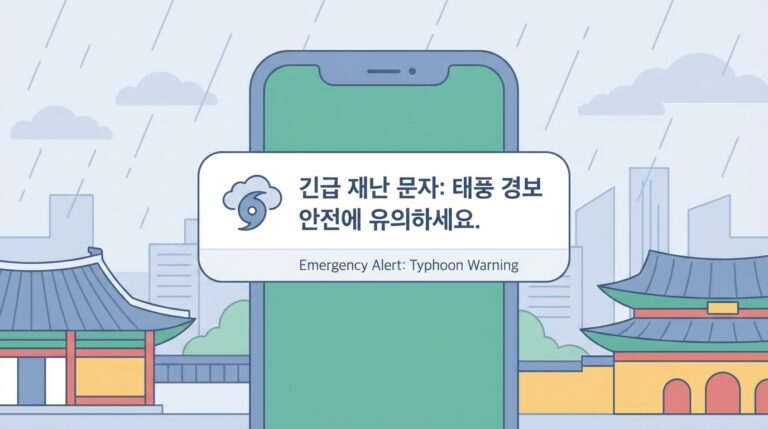
Congratulations, you’ve just experienced your first 재난문자 (Disaster Alert Text).
In Korea, late summer and early autumn bring typhoons (태풍). Navigating Korea during this season isn’t just about carrying a sturdy umbrella; it’s about understanding the high-level, highly specific vocabulary used by the 기상청 (Korea Meteorological Administration) and news broadcasters. If you’re an advanced (C2) learner, you know that Koreans don’t just say “It’s raining hard.” They use formal Sino-Korean vocabulary to convey urgency, authority, and precise spatial tracking.
Today, we’re going to decode the dramatic, high-stakes language of Korean typhoon path predictions and disaster broadcasting. By the end of this, you won’t just understand the news—you’ll be debating weather models like a true Seoulite.
Phase 2: Core Expressions Deep Dive
Let’s dissect the vocabulary that takes over Korean airwaves during a typhoon.
1. 역대급 태풍이 북상하고 있습니다. (An unprecedented typhoon is moving northward.)
- Pronunciation: [yeokdaegeup taepung-i buksanghago itseumnida]
- Sound-alike guide: “Yuck-day-geup tay-poong-ee book-sang-ha-go it-seum-nee-da.” (‘역대급’ sounds sharp, emphasizing the severity).
- Meaning: Literal: A historical-grade typhoon is ascending north. / Real nuance: The mother of all typhoons is heading our way.
- K-Culture Moment: You’ll hear this from the deadpan, serious news anchor standing in front of a giant radar screen. Interestingly, 역대급 started as internet slang (역대 ‘historical’ + 급 ‘grade/class’) but became so widely used that major news outlets now use it for typhoons to emphasize maximum danger.
- Editor’s Insight: The word 북상 (北上) literally means “to move north.” Because typhoons form south of the Korean peninsula near the equator and travel upward, weather forecasters almost exclusively use this term instead of the simple “오고 있다” (is coming).
- Situation Spectrum:
[🚫 Avoid] ———— [⚠️ Caution] ———— [✅ Freely Use]
- Casual with friends (using the root): “야, 이번 태풍 역대급이래.” ✅
- News/Formal Broadcast: ✅
- Talking to a toddler: 🚫 (Too complex)
- 🤔 Think About It: Why do you think an internet slang word like ‘역대급’ made its way into formal disaster broadcasts? What does this say about the evolution of modern Korean language?
2. 외출을 자제해 주시기 바랍니다. (Please refrain from going out.)
- Pronunciation: [oechureul jajehae jusigi baramnida]
- Sound-alike guide: “Weh-chool-eul ja-jeh-hay joo-she-gee ba-ram-nee-da.”
- Meaning: Literal: We desire that you control your outings. / Real nuance: Seriously, stay indoors.
- K-Culture Moment: This is the exact phrase that buzzes on your phone via the emergency alert system. You’ll also see K-Pop idols posting on Weverse or Bubble: “엔진! 오늘 외출 자제! 집에 꼭 붙어있어요!” (Engenes! Refrain from going out today! Stay glued to your home!)
- Editor’s Insight: 자제하다 (to refrain/control oneself) is a high-level polite imperative. The government isn’t commanding you to stay home (which would be 나가지 마세요); they are politely asking you to exercise self-restraint. It reflects the Korean administrative tone of respectful authority.
- Situation Spectrum:
[🚫 Avoid] ———— [⚠️ Caution] ———— [✅ Freely Use]
- Official announcements: ✅
- Professional emails: ✅
- Telling your best friend not to go out: 🚫 (Sounds ridiculously stiff. Say “나가지 마!”)
- 🤔 Think About It: Does your government use direct commands (“Do not go out”) or polite requests (“Please refrain”) during natural disasters?
3. 국지성 호우로 인한 침수 피해 (Flood damage caused by localized heavy rain)
- Pronunciation: [gukjiseong houro inhan chimsu pihae]
- Sound-alike guide: “Gook-jee-sung ho-woo-ro in-han chim-soo pee-hay.”
- Meaning: Flood damage due to torrential rain concentrated in a specific area.
- K-Culture Moment: During the monsoon or typhoon season, parts of Gangnam (which is geographically low-lying) often experience flash floods. The news will loop videos of half-submerged cars while the anchor repeatedly uses this exact phrase.
- Editor’s Insight: This is pure C2 territory. Breaking it down: 국지성 (localized/regional) + 호우 (heavy rain) + 침수 (submersion/flooding) + 피해 (damage). If you use these Hanja-based words instead of just saying “비가 많이 와서 물이 찼어요,” Koreans will immediately assume you have native-level proficiency.
Phase 3: Textbook vs. Real Korean
Let’s see how language shifts from the classroom to the eye of the storm.
| Situation | 📖 Textbook Korean | 🗣️ Real Korean (Broadcast/C2) | 💡 Why the Difference? |
|---|---|---|---|
| Predicting the storm | 태풍이 오고 있습니다. (A typhoon is coming.) | 태풍이 북상하고 있습니다. | ‘북상’ (moving north) provides precise geographical context necessary for news. |
| Warning to stay home | 밖으로 나가지 마세요. (Don’t go outside.) | 외출을 자제해 주시기 바랍니다. | Government alerts use highly formal Hanja to maintain polite but firm authority. |
| Heavy rain warning | 비가 아주 많이 옵니다. (It is raining a lot.) | 국지성 호우가 예상됩니다. | ‘국지성 호우’ is the scientific meteorological term used for accuracy in broadcasting. |
| Water damage | 물이 넘쳐서 위험합니다. (It’s dangerous because water is overflowing.) | 하천 범람 우려가 있습니다. | ‘범람’ (overflow/inundation) is a specific disaster management term used to prevent panic while issuing warnings. |
Bottom Note: As a C2 learner, your goal is to seamlessly switch between the “Textbook” column when chatting casually, and the “Real Korean” column when discussing the news or writing formal reports.
Phase 4: Cultural Context — K-Culture Deep Dive
4-1. Non-verbal Cue: The Nunchi Game of Leaving Work
In Korean corporate culture, a typhoon brings about a severe game of 눈치 (Nunchi). When a major typhoon hits during work hours, the government often advises companies to adjust commuting hours (출퇴근 시간 조정). But who stands up first to say, “I’m leaving early to avoid the storm”? Unless the boss officially declares 조기 퇴근 (leaving work early), everyone will subtly watch each other, waiting for someone brave enough to pack their bags.
4-2. The K-Pop & K-Food Typhoon Ecosystem
K-Pop Connection:
Typhoons trigger a wave of affection in K-Pop fandoms. Idols will flood fan apps with messages like, “창문 꼭 닫고 자요!” (Make sure to close your windows tight before sleeping!) or “바람 소리 너무 무서운데 다들 괜찮아요?” (The sound of the wind is so scary, is everyone okay?). It’s a moment where the parasocial relationship feels incredibly protective and intimate.
K-Food Controversy:
When it rains in Korea, people crave 파전 (Pajeon – scallion pancake) and 막걸리 (Makgeolli). In the past, people would just order delivery. However, in recent years, a massive social shift has occurred. Ordering food via apps like Baemin during a severe typhoon alert is now highly frowned upon. It’s considered dangerous and unethical for the delivery riders (라이더). If you order delivery during a red alert, you might get serious side-eyes from your Korean friends.
Phase 5: Real-Life Roleplay Scenario
Let’s put you in a very specific, high-level Korean context.
Setting:
It’s 4:00 PM on a Thursday. You are in a high-rise office in Yeouido. The sky outside is a bruised, menacing purple. Rain is horizontally lashing against the glass. Your phone buzzes with an emergency alert: [기상청] 서울 전역 태풍경보 발효. 외출 자제 바람.
Characters:
– YOU: An expat regional manager who follows international weather models.
– 지훈 (Ji-hoon): A 35-year-old Korean coworker who trusts the local news implicitly.
Dialogue:
지훈: 와, 방금 재난문자 온 거 보셨어요? 이번 태풍 진짜 역대급인가 봐요.
(Wa, banggeum jaenanmunja on geo bosyeosseoyo? Ibeon taepung jinjja yeokdaegeubin-ga bwayo.)
[Wow, did you see the disaster text that just came? I guess this typhoon is truly unprecedented.]
YOU: 네, 봤어요. 기상청 보도자료 보니까 오늘 밤이 고비라고 하더라고요.
(Ne, bwasseoyo. Gisangcheong bodojaryo bonikka oneul bami gobirago hadeoragoyo.)
[Yes, I saw it. Looking at the KMA press release, they say tonight is the critical moment.]
지훈: 맞아요. 창문 다 깨지는 거 아닌가 몰라요. 근데 미국 기상청(JTWC) 모델은 경로가 좀 다르다면서요?
(Majayo. Changmun da kkaejineun geo aninga mollayo. Geunde miguk gisangcheong(JTWC) modereun gyeongroga jom dareudamyeonseoyo?)
[Right. I wonder if all the windows will shatter. But I heard the US weather model’s path is a bit different?]
YOU: 네, 유럽 모델(ECMWF)이랑 미국 모델은 태풍이 동쪽으로 빠질 거라고 예측하더라고요.
(Ne, yureop model(ECMWF)irang miguk modereun taepung-i dongjjogeuro ppajil georago yecheukhadeoragoyo.)
[Yes, the European and US models predict the typhoon will slip away to the east.]
(🎭 Stage Direction: The wind howls loudly against the window. Ji-hoon shivers slightly.)
지훈: 제발 비켜갔으면 좋겠네요. 아, 오늘 저녁 야근해야 하는데… 밥은 어떡하죠? 배달 시킬까요?
(Jebal bikyeogasseumyeon joketneyo. Ah, oneul jeonyeok yageunhaeya haneunde… babeun eotteokhajo? Baedal sikilkkayo?)
[I really hope it bypasses us. Ah, I have to work overtime tonight… what should we do for dinner? Should we order delivery?]
🔀 Your Turn! How do you respond?
– A) “좋아요! 비 오는 날엔 역시 짬뽕이죠. 제가 시킬게요.”
– B) “이런 날씨에 라이더분들 위험하잖아요. 그냥 지하 편의점 가서 컵라면 먹어요.”
– C) “기상청 예보 틀릴 수도 있으니까 그냥 나가서 먹죠!”✅ Best Choice: B — “It’s dangerous for the riders in this weather. Let’s just go to the basement convenience store and eat cup noodles.”
Why? It shows you understand the modern Korean social conscience regarding gig workers during extreme weather.
⚠️ Choice A & C Analysis: Choice A is culturally insensitive during a typhoon alert (regular rain is fine, typhoons are not). Choice C is physically dangerous and ignores the “외출 자제” warning!
Phase 6: 10-Second Shadowing Drill
Channel your inner Korean news anchor! Speak clearly, with gravity, and pause exactly where indicated.
😤 (Grave & Authoritative tone)
현재 태풍은 / 제주 서귀포 남쪽 해상을 / 지나고 있습니다. / 시청자 여러분께서는 / 외출을 / 자제해 주시기 바랍니다.
(hyeonjae taepung-eun / jeju seogwipo namjjok haesang-eul / jinago itseumnida. / sicheongja yeorobunkkeseoneun / oechureul / jajehae jusigi baramnida.)
Phase 7: K-Culture Mini Dictionary
| Korean | Romanization | English Translation | Contextual Meaning |
|---|---|---|---|
| 재난문자 | jaenan munja | Emergency Alert Text | The loud, unavoidable messages sent by the government for weather, missing persons, or emergencies. |
| 기상청 | gisangcheong | Korea Meteorological Administration (KMA) | The official weather bureau. Often playfully criticized by citizens when forecasts are wrong. |
| 고비 | gobi | Critical moment / Peak | Used to describe the worst part of a storm. “오늘 밤이 고비입니다” (Tonight is the peak/critical moment). |
| 조기 퇴근 | jogi toegeun | Leaving work early | The magical phrase every office worker prays to hear from the CEO when a typhoon approaches. |
| 동파 | dongpa | Bursting from freezing | (Winter context) You’ll get disaster texts about this in winter, warning to let faucets drip to prevent frozen pipes. |
Phase 8: Traveler’s Survival Kit
If you are traveling in Korea and the skies turn black, don’t panic.
🆘 Survival Expressions for Extreme Weather
– 🇰🇷 “여기 대피소가 어디예요?” (yeogi daepisoga eodiyeyo?)
– Where is the shelter here?
– 🇰🇷 “비행기 결항됐나요?” (bihaenggi gyeolhangdwaetnayo?)
– Has the flight been canceled? (Crucial for Jeju Island travelers!)
– 🇰🇷 “우산 뒤집어졌어요!” (usan dwijibeojyeosseoyo!)
– My umbrella flipped inside out! (A highly relatable complaint you can say to anyone).📌 Editor’s Travel Note
– The Must-Have App: Download ‘Emergency Ready App’ (안전디딤돌). It translates those loud, scary Korean disaster texts into English so you know exactly what’s happening.
– Transportation: During severe typhoons, the KTX (bullet train) slows down significantly or halts, and flights to Jeju are canceled. Always check the Korail app.
Phase 9: Critical Thinking — “One Step Deeper”
🧠 Think Deeper: Food, Labor, and Identity in a Storm
The way Koreans handle food delivery during typhoons offers a profound look into the evolving social contract in Korea. A decade ago, a typhoon meant explosive sales for delivery restaurants. It was considered a “service” to bring comfort food to people trapped indoors. However, as the gig economy expanded and labor rights came to the forefront of social media, public sentiment shifted drastically. Today, ordering Baemin during a typhoon is widely debated online as an act of “갑질” (abusing one’s power as a consumer). This shift shows how modern Korean society is actively renegotiating the balance between intense consumer convenience (“빨리빨리” culture) and collective empathy for blue-collar workers.
💬 Your Turn: In your home country, is there a social stigma against ordering delivery or utilizing certain services during severe weather? Let’s discuss it in the comments!
Phase 10: FAQ & Mistake Prevention
Q: Can I turn off the 재난문자 (Disaster Texts) if they annoy me?
Yes, you can toggle them off in your phone’s notification settings. However, we highly recommend keeping them on during summer. They warn you of localized flash floods which can happen in minutes.
Q: A Korean friend texted me “태풍 조심해!” How do I reply?
Don’t use the formal broadcast terms here! Reply with something warm and casual like, “너도! 창문 꼭 닫고 집에 있어~” (You too! Keep your windows closed and stay home~).
❌ Common Mistake #1: Trying to use “북상하다” in casual conversation.
Example: “내 친구가 서울로 북상하고 있어.” (My friend is moving north to Seoul.) -> This makes your friend sound like a typhoon.
✅ Do this instead: “내 친구가 서울로 올라오고 있어.” (My friend is coming up to Seoul.)
Phase 11: Summary & Action Items
One-Liner Summary: To navigate Korea’s extreme weather broadcasts, you must master the formal, Hanja-based vocabulary (like 북상 and 자제) and understand the collective social etiquette during a crisis.
Action Mission:
– 🥉 Bronze: Stand in front of a mirror and practice the news anchor shadowing drill. Nail that serious tone!
– 🥈 Silver: Next time it rains heavily, write a short diary entry in Korean using the words ‘국지성 호우’ and ‘고비’.
– 🥇 Gold: Download the ‘Emergency Ready App’ and translate the last alert you received using the vocabulary from this lesson.
🎤 K-Culture Mission: Go to YouTube and search “태풍 뉴스특보” (Typhoon News Breaking). Listen for 3 minutes and try to catch the words 역대급, 북상, or 자제.
Did you catch any? What was the hardest word to hear? Let me know below!
Phase 12: Interactive Challenge (Quiz)
1. Situational Judgment:
You are writing an official email to your team as the HR manager, advising them to work from home due to the typhoon. Which phrase is best?
A) 내일은 회사에 오지 마세요. (Don’t come to the office tomorrow.)
B) 내일은 외출을 자제해 주시기 바랍니다. (Please refrain from going out tomorrow.)
C) 내일은 역대급이니까 집에서 쉬세요. (Tomorrow is unprecedented, so rest at home.)
2. Fill in the Blank (K-Culture Edition):
“During a typhoon alert, ordering food delivery is increasingly seen as a safety hazard for the _________ (Korean word for gig delivery drivers).”
3. True or False:
The word ‘북상하다’ can be used casually to describe your family traveling from Busan up to Seoul.
(Answers: 1: B – perfect formal corporate tone. 2: 라이더 (Rider) or 배달원. 3: False – it is reserved for typhoons and weather systems!)
Frequently Asked Questions (FAQ)
Q: What does "역대급 태풍이 북상하고 있습니다. (An unprecedented typhoon is moving northward.)" mean in Korean and how do you pronounce it?
A: In Korean, "역대급 태풍이 북상하고 있습니다. (An unprecedented typhoon is moving northward.)" is pronounced [yeokdaegeup taepung-i buksanghago itseumnida] and means: Literal: A historical-grade typhoon is ascending north. / Real nuance: The mother of all typhoons is heading our way.
Q: What does "외출을 자제해 주시기 바랍니다. (Please refrain from going out.)" mean in Korean and how do you pronounce it?
A: In Korean, "외출을 자제해 주시기 바랍니다. (Please refrain from going out.)" is pronounced [oechureul jajehae jusigi baramnida] and means: Literal: We desire that you control your outings. / Real nuance: Seriously, stay indoors.
Q: What does "국지성 호우로 인한 침수 피해 (Flood damage caused by localized heavy rain)" mean in Korean and how do you pronounce it?
A: In Korean, "국지성 호우로 인한 침수 피해 (Flood damage caused by localized heavy rain)" is pronounced [gukjiseong houro inhan chimsu pihae] and means: Flood damage due to torrential rain concentrated in a specific area.







