

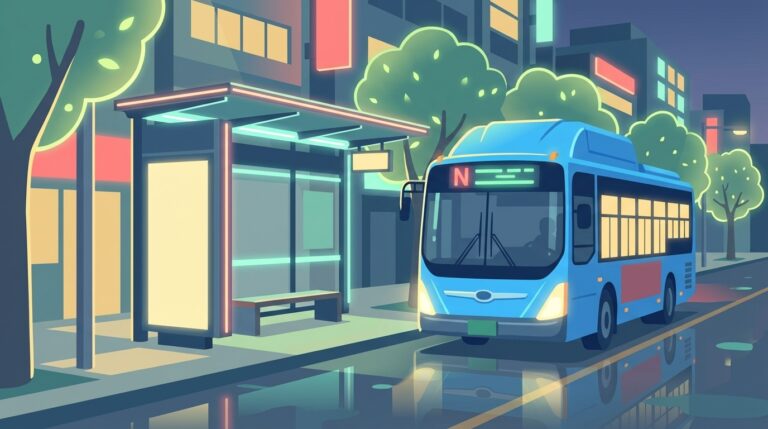
Phase 1: Empathy (Welcome to the Real Seoul Midnight!)
Hello! This is your Daily Hangul Editor.
Imagine this: You’ve just walked out of an incredible K-Pop concert, or maybe you’re leaving a bustling Samgyeopsal (pork belly) joint in Gangnam after a team dinner (Hoesik). The vibes are immaculate, your stomach is full, but then you look at your watch… It’s 1:30 AM.
In K-Dramas, this is the exact moment the main character confidently raises a hand, a sleek taxi pulls up instantly, and they ride off into the neon-lit Seoul night.
Reality check? You are standing on the sidewalk freezing, your taxi app shows “No cars available,” and empty cabs are zooming past you with a red “예약 (Reserved)” light. Taxis have late-night surcharges (Haljeong), and the subway is fast asleep. Panic mode? Not for you.
Because today, we are going to master the absolute lifesaver of Seoul’s public transportation: The Owl Bus (올빼미버스 / N-Bus). Knowing these B2-level phrases won’t just save you a 30,000 won taxi fare—it will instantly upgrade you to “Seoul Insider” status.
(Note: This guide is crafted from the actual midnight panic moments of our expat students!)
Phase 2: Core Expressions Deep Dive
Let’s learn the survival phrases you need when the clock strikes midnight.
1. 막차 끊겼어. (mak-cha kkeun-gyeo-sseo.)
- Pronunciation: [mak-cha kkeun-gyeo-sseo] -> ‘kkeun’ sounds like a sharp ‘gun’ with a tight throat, and ‘gyeo’ sounds like ‘gyo’ in Tokyo but shorter.
- Meaning: Literal: “The last vehicle is cut off.” / Real nuance: “I missed the last train/bus.”
- K-Culture Moment: You’ll hear this exact phrase in dramas when the lead couple “accidentally” misses the last train to spend more time together. In reality, it’s the frantic text you send your friends when you realize you stayed at the Noraebang (karaoke) too long.
- Editor’s Insight: The verb 끊기다 (to be cut off) is widely used in Korea. We use it for phone calls dropping, internet disconnecting, and yes, public transport ending. It carries a slight feeling of helplessness.
- Situation Spectrum:
[🚫 Do Not Use] ———— [⚠️ Caution] ———— [✅ Freely]
- Close Friends (Casual): ✅ (막차 끊겼어!)
- Co-workers (Semi-formal): ⚠️ (막차가 끊겼네요.)
- Boss/Elders (Formal): 🚫 (Use: 막차 시간이 지났습니다.)
- 🤔 Think About It: Why does Korean use a passive, slightly dramatic word like “cut off” (끊기다) for missing a train? Does your language treat missing transport as an active mistake you made, or a passive event that happened to you?
2. N버스(올빼미) 배차 간격이 어떻게 돼요? (N-beoseu bae-cha gan-gyeok-i eo-tteo-ke dwae-yo?)
- Pronunciation: [bae-cha gan-gyeok] -> ‘bae-cha’ rhymes with ‘play-cha’, ‘gan’ sounds like ‘gone’.
- Meaning: Literal: “How is the dispatch interval for the N-bus?” / Real nuance: “How often does this night bus come?”
- K-Culture Moment: Standing at a smart bus stop at 2 AM. You see someone staring intensely at the digital board. If you ask them this, you sound like a true local. Night buses don’t come every 5 minutes like daytime buses!
- Editor’s Insight: “배차 간격” (dispatch interval) is a magical B2 vocabulary word. Beginners say “버스 언제 와요?” (When is the bus coming?), but using “배차 간격” instantly signals that your Korean is advanced.
- Situation Spectrum:
[🚫 Do Not Use] ———— [⚠️ Caution] ———— [✅ Freely]
- Strangers at the bus stop: ✅ (With a polite tone)
- Friends: ✅ (Drop the ‘요’: 배차 간격 어떻게 돼?)
- 🤔 Think About It: Korea is famous for its Pali-pali (hurry up) culture, yet people patiently wait 40 minutes for an N-Bus. How does late-night transportation reflect a city’s work culture?
3. 할증 붙기 전에 그냥 N버스 타자. (hal-jjeung but-gi jeo-ne geu-nyang N-beo-seu ta-ja.)
- Pronunciation: [hal-jjeung] -> ‘hal’ sounds like ‘Hal’ in Halloween, ‘jjeung’ is a tense, squeaky ‘juhng’.
- Meaning: Literal: “Before the surcharge attaches, let’s just ride the N-bus.” / Real nuance: “Let’s just take the night bus to avoid the late-night taxi fee.”
- K-Culture Moment: At 10:55 PM, you will see a sudden mad dash of people trying to catch cabs. Why? Because the late-night surcharge (Haljeong) for taxis kicks in at 11:00 PM and gets even more expensive by midnight!
- Editor’s Insight: “할증이 붙다” (a surcharge attaches) is a very natural phrasing. This is the ultimate “I live in Korea and I budget my money” expression.
- Situation Spectrum:
[🚫 Do Not Use] ———— [⚠️ Caution] ———— [✅ Freely]
- Close Friends (Casual): ✅
- Co-workers: ⚠️ (할증 붙기 전에 N버스 타시죠.)
- 🤔 Think About It: Words related to fees “attaching” (붙다) are common in Korean. What are some late-night surcharges in your home country?
Phase 3: Textbook vs Real Korean
| Situation | 📖 Textbook Korean | 🗣️ Real Korean | 💡 Why the difference? |
|---|---|---|---|
| Realizing the subway is closed | 지하철 운행이 종료되었습니다. (The subway operation has ended.) | 아, 막차 끊겼어. (Ah, the last train’s cut off.) | Textbook uses formal broadcasting language; real life uses emotional, passive verbs. |
| Asking about the night bus | 심야 버스가 언제 도착합니까? (When does the late-night bus arrive?) | N버스 배차 간격 어떻게 돼요? (What’s the interval for the N-bus?) | Seoulites call them “N-Bus” (Night Bus), and ask for the interval rather than a specific time. |
| Deciding against a taxi | 택시 요금이 너무 비쌉니다. (The taxi fare is too expensive.) | 택시 할증 붙어서 그냥 버스 탈래. (The taxi has a surcharge, I’ll just take the bus.) | Specific terminology (할증) replaces the generic “expensive” for efficiency. |
Editor’s Bottom Note: At a B2 level, transitioning from “운행 종료” to “막차 끊기다” is what makes your Korean sound organic. Don’t overdo slang; just use precise societal vocabulary!
Phase 4: Cultural Context — K-Culture Deep Dive
4-1. The Silent Nunchi of the Night Bus
When you finally board the N-Bus, you’ll notice something striking: it is incredibly quiet. Even if it’s packed with 50 people post-party, no one is talking loudly. This is peak Nunchi (눈치).
Because the N-bus is primarily used by late-night workers (designated drivers, restaurant staff finishing their shifts) and exhausted students, the unspoken rule is absolute silence. If you are chatting loudly with friends, you’ll get the “death stare” from locals. Speak in whispers!
4-2. The K-Drama “Window Lean” Trope
If you’ve watched My Liberation Notes or Itaewon Class, you know the scene. The protagonist sits at the back of a dimly lit bus, leaning their head against the window, gazing at the Han River as a melancholic OST plays.
The N-Bus is the perfect place to recreate this! Night buses cross the major bridges over the Han River when the city is quiet. It’s a genuinely romantic and introspective Seoul experience. Just remember to tap your T-money card when you get off!
Phase 5: Real-Life Roleplay Scenario
Setting: Gangnam Station Exit 10, Friday night, 1:45 AM. The neon lights are blazing, but the winter air is freezing. You just finished a team dinner (Hoesik) with your Korean co-workers.
Characters:
– YOU: An expat who has lived in Seoul for 8 months. You want to save money.
– Minsu (32): Your friendly Korean co-worker. A bit tipsy, trying to catch a cab but failing miserably.
Dialogue:
Minsu: 아, 진짜 춥다! 택시 왜 이렇게 안 잡혀요? 🚕
(A, jinjja chupda! Taeksi wae ireoke an japhyeoyo?)
[Ah, it’s so cold! Why are taxis so hard to catch?]
(Minsu aggressively taps his KakaoT app)
YOU: 막차 진작에 끊겼죠? 지금 거의 2시예요.
(Makcha jinjage kkeungyeotjyo? Jigeum geoui dusi-yeyo.)
[The last train was cut off ages ago, right? It’s almost 2 AM.]
Minsu: 네, 게다가 지금 심야 할증 시간이라 요금도 엄청 비싼데…
(Ne, gedaga jigeum simya haljjeung siganira yogeumdo eomcheong bissande…)
[Yeah, plus it’s late-night surcharge time now, so the fare is super expensive…]
YOU: 선배님, 우리 그냥 올빼미버스 타는 게 낫지 않을까요?
(Seonbaenim, uri geunyang olppaemibeoseu taneun ge natji aneulkkayo?)
[Senior, wouldn’t it be better if we just took the Owl Bus?]
Minsu: 오, N버스요? 근데 배차 간격이 너무 길지 않아요?
(O, N-beoseu-yo? Geunde baecha gangyeogi neomu gilji anayo?)
[Oh, the N-Bus? But isn’t the dispatch interval too long?]
🔀 YOUR TURN! How do you respond?
- A) “버스가 언제 옵니까?” (Grammatically correct, but completely unnatural for the flow.)
- B) “제가 지도 앱으로 언제 오는지 한번 확인해 볼게요!” (Proactive, natural, polite.)
- C) “빨리 와라 대박!” (Too casual/random for speaking to an older co-worker.)
✅ Best Choice: B
Reason: It shows you understand Korean navigation apps and uses a very natural B2 grammar pattern (~해 볼게요: I will try to do it).
(Continuing with B)
YOU: 제가 지도 앱으로 언제 오는지 한번 확인해 볼게요! 어, N37번 버스 5분 뒤에 도착해요.
(Jega jido aebeuro eonje oneunji hanbeon hwaginhae bolgeyo! Eo, N-samsip-chil-beon beoseu obun dwie dochakaeyo.)
[I’ll check the map app to see when it comes! Oh, the N37 bus arrives in 5 minutes.]
Minsu: 와, 진짜요? 00씨 완전 한국인 다 됐네요! 👍
(Wa, jinjjayo? 00-ssi wanjeon hangugin da dwaenneyo!)
[Wow, really? You’ve completely become Korean!]
YOU: 빨리 뛰어가요! 이거 놓치면 40분 기다려야 돼요.
(Ppalli ttwieogayo! Igeo notchimyeon sasip-bun gidaryeoya dwaeyo.)
[Let’s run! If we miss this, we have to wait 40 minutes.]
Minsu: 가자 가자! 오늘 교통비 굳었네요.
(Gaja gaja! Oneul gyotongbi gudeonneyo.)
[Let’s go, let’s go! We saved on transit fare today.]
Phase 6: 10-Second Shadowing Drill
Practice speaking like a native! Follow the pauses (/) and match the emotion.
😭 Frustrated:
아, 어떡해. / 막차가 / 벌써 끊겼어.
(A, eotteokae. / makcha-ga / beolsseo kkeungyeosseo.)
🤓 Smart & Helpful:
택시 / 할증 붙으니까, / 그냥 / N버스 타자!
(Taeksi / haljjeung buteunikka, / geunyang / N-beoseu taja!)
🥺 Anxious waiting:
이 버스 / 배차 간격이 / 어떻게 돼요?
(I beoseu / baecha gangyeogi / eotteoke dwaeyo?)
Phase 7: K-Culture Mini Dictionary
| 한국어 | Romanization | English | Cultural Context |
|---|---|---|---|
| 올빼미 | ol-ppae-mi | Owl | Owls are nocturnal. Seoul named its late-night bus system “Owl Buses” because they run from midnight to 4 AM. |
| N버스 | N-beoseu | N-Bus | The official name of the Owl bus. The ‘N’ stands for Night. The routes start with ‘N’ (e.g., N37). |
| 막차 | mak-cha | Last train/bus | Missing the ‘makcha’ is a major plot device in Korean dramas. It dictates when most people leave a gathering. |
| 할증 | hal-jjeung | Surcharge | Late-night premium applied to taxis (from 11 PM/Midnight). A word every budget-conscious person in Korea knows! |
| 회식 | hoe-sik | Company dinner | Team bonding dinners involving a lot of food and drinks. The primary reason people need the N-Bus. |
Phase 8: Traveler Survival Kit
🆘 Survival Expressions TOP 3 (Night Bus Edition)
- 🇰🇷 “이 버스 서울역 가요?” (I beoseu seoul-yeok gayo?)
- 🗣️ English: Does this bus go to Seoul Station?
- 💡 Pro Tip: Just swap “Seoul Station” with your destination (e.g., Hongdae, Gangnam).
- 🇰🇷 “N버스 정류장이 어디예요?” (N-beoseu jeongnyujangi eodiyeyo?)
- 🗣️ English: Where is the N-Bus stop?
- 💡 Pro Tip: N-Buses use the large median bus lanes in the middle of the road, not the ones on the sidewalk.
- 🇰🇷 “내릴게요!” (Naerilgeyo!)
- 🗣️ English: I’m getting off!
- 💡 Pro Tip: If the bus is packed and you can’t reach the door, shout this politely so the driver waits for you.
📌 Editor’s Travel Note
– Essential Apps: You cannot survive Seoul nights without KakaoMap or Naver Map. Google Maps does not track live bus arrivals well in Korea.
– Payment: Cash is being phased out. Use a T-Money card. Remember to tap both when getting on and getting off!
Phase 9: Critical Thinking — “One Step Deeper”
🧠 Think Deeper: Media vs Reality (Seoul’s Nightscape)
K-Dramas often portray late-night Seoul as a playground for the wealthy—sleek black cabs, romantic walks along empty streets, and chaebol heirs driving sports cars. But if you ride the N-Bus at 2 AM, you’ll see the real heartbeat of the city. The passengers are often designated drivers (대리기사) commuting to their next client, university students studying late at internet cafes, and restaurant owners closing shop. The N-Bus, introduced in 2013, was specifically created to support the working class who couldn’t afford midnight taxi surcharges. It is a brilliant example of public policy addressing social inequality.
💬 Your Turn: Does your city have 24-hour public transport? If the subway stops, how do average workers get home late at night? Share in the comments!
Phase 10: FAQ & Common Mistakes
🙋♂️ “Can I just wait at the daytime bus stop for the N-Bus?”
Usually, yes, but in major areas like Gangnam or Jongno, N-Buses exclusively use the central bus lanes (중앙 차로) in the middle of the street. If you wait on the sidewalk stop, the bus will zoom right past you!
🙋♀️ “Is it safe to ride the bus at 3 AM in Seoul?”
Absolutely. South Korea has one of the lowest crime rates globally, and buses are brightly lit with CCTVs. The biggest danger is falling asleep and missing your stop!
❌ Common Mistake #1: Not checking the “Direction” (방면).
You see N37 and get on, but it’s going the opposite way.
✅ Do this: Always look at the app to see the final destination (e.g., 은평공영차고지 방면), or simply ask the driver: “[Your Stop] 가요?”
Phase 11: Summary & Action Items
✨ One-Liner Summary: When the subway stops, don’t panic—use “막차 끊겼어” (I missed the last train) and catch the N-Bus to save your hard-earned won from taxi surcharges!
🚀 Action Mission:
– 🥉 Bronze: Say “막차 끊겼어!” out loud with dramatic K-Drama flair 3 times.
– 🥈 Silver: Open a Korean map app, search for “N버”, and see how many routes pop up.
– 🥇 Gold (Real Life): Next time you are out late in Seoul, tell your friends: “우리 할증 붙기 전에 그냥 N버스 타자!” (Let’s just take the N-bus before the surcharge hits!).
🎥 K-Culture Mission: Look up any scene from My Mister (나의 아저씨) or My Liberation Notes (나의 해방일지) where they are commuting at night. Can you spot the difference between their fictional commute and yours?
Phase 12: Interactive Quiz 🧩
1. Fill in the Blank:
Your friend wants to take a taxi at midnight, but you are broke.
“택시 ____ 붙어서 너무 비싸. N버스 타자!”
A) 막차
B) 할증
C) 배차
2. Situational Judgment:
You are at the bus stop and want to know how often the N15 comes. What is the most natural B2-level way to ask?
A) 이 버스 배차 간격이 어떻게 돼요?
B) 심야 버스 시간이 몇 시입니까?
C) 버스 언제 와?
3. True or False – K-Culture Edition:
It is acceptable to play a K-pop video out loud on your phone while riding the N-Bus because everyone is awake partying anyway. (T/F)
(Answers: 1. B, 2. A, 3. False – Peak Nunchi dictates silence on the N-Bus!)
Enjoying your Seoul nightlife? Study these phrases and make the city yours. See you in the next Daily Hangul post! 🦉🚌
Frequently Asked Questions (FAQ)
Q: What does "막차 끊겼어. (mak-cha kkeun-gyeo-sseo.)" mean in Korean and how do you pronounce it?
A: In Korean, "막차 끊겼어. (mak-cha kkeun-gyeo-sseo.)" is pronounced [mak-cha kkeun-gyeo-sseo] and means: Literal: "The last vehicle is cut off." / Real nuance: "I missed the last train/bus."
Q: What does "N버스(올빼미) 배차 간격이 어떻게 돼요? (N-beoseu bae-cha gan-gyeok-i eo-tteo-ke dwae-yo?)" mean in Korean and how do you pronounce it?
A: In Korean, "N버스(올빼미) 배차 간격이 어떻게 돼요? (N-beoseu bae-cha gan-gyeok-i eo-tteo-ke dwae-yo?)" is pronounced [bae-cha gan-gyeok] and means: Literal: "How is the dispatch interval for the N-bus?" / Real nuance: "How often does this night bus come?"
Q: What does "할증 붙기 전에 그냥 N버스 타자. (hal-jjeung but-gi jeo-ne geu-nyang N-beo-seu ta-ja.)" mean in Korean and how do you pronounce it?
A: In Korean, "할증 붙기 전에 그냥 N버스 타자. (hal-jjeung but-gi jeo-ne geu-nyang N-beo-seu ta-ja.)" is pronounced [hal-jjeung] and means: Literal: "Before the surcharge attaches, let's just ride the N-bus." / Real nuance: "Let's just take the night bus to avoid the late-night taxi fee."







