

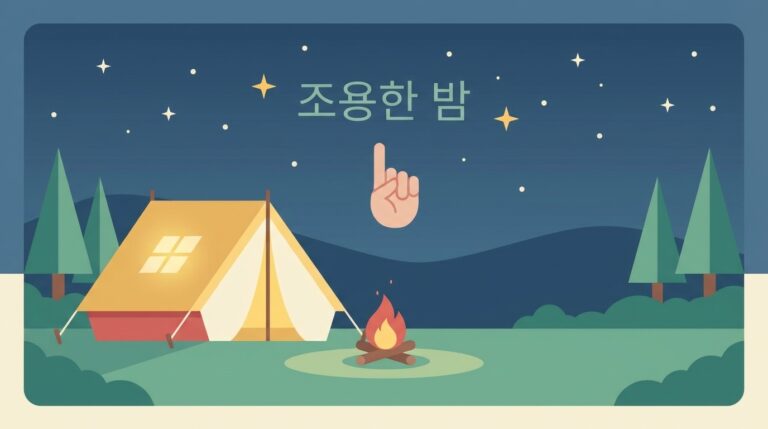
How to Survive Korean Glamping: Mastering the Art of ‘Manner Time’
Hello! I’m your Daily Hangul Editor.
Imagine this: You’re at a stunning luxury glamping site in Gapyeong. The fairy lights are twinkling, you’re enjoying Bulmeong (staring blankly at the campfire), and you’ve got a glass of highball in hand. It feels just like a scene from BTS In the Soop or Hospital Playlist. But then, right at 10:00 PM, a heavy silence falls over the campsite. Someone nearby whispers, “Shh, it’s Manner Time.”
Manner Time? What exactly is this, and why does everyone suddenly act like they’re in a library?
If you’re an advanced (C1) Korean learner planning to enjoy Korea’s massive camping culture, simply knowing how to say “Please be quiet” isn’t enough. Korean campsites are notoriously densely packed, and navigating the social etiquette of 매너타임 (Manner Time / Quiet Hours) requires a high level of cultural tact and linguistic nuance. This guide is based on real experiences of expats who learned the hard way that a direct “Shut up” is a huge cultural faux pas in Korea.
Let’s dive into the sophisticated, highly-contextual Korean needed to navigate these woodland politics.
Phase 2: Core Expression Deep Dive
When dealing with noise complaints or wrapping up a party, advanced Korean relies heavily on indirectness and trailing sentences to preserve social harmony (and Nunchi).
1. “이제 매너타임이라서요…”
- Pronunciation: [ije maeneotaimiraseoyo…]
- Meaning: Literal: “Because it is Manner Time now…” / Real nuance: “It’s Quiet Hours now, so we need to hush up (or please keep it down).”
- K-Culture Moment: You’ll see this in reality shows when cast members are whispering to the camera late at night. The sentence intentionally drops the conclusion. By trailing off with “~아서/어서요”, you allow the listener to deduce the rest (“…so please be quiet”). It avoids sounding bossy.
- Editor’s Insight: This is the ultimate passive-polite phrasing. It shifts the blame from you to the “rules.” You’re not saying “I want you to be quiet”; you’re saying “The rules compel us to be quiet.”
- Situation Spectrum:
[🚫 절대 금지] ———— [⚠️ 주의] ———— [✅ 자유롭게]
- Close Friends (Casual): ✅ (Drop the ‘요’: “야, 매너타임이라서 그래.”)
- Strangers/Neighbors (Formal): ✅ (Perfectly polite and indirect)
- 🤔 Think About It: Why do Koreans frequently use incomplete sentences (ending in ~요) when asking for favors or complaining? How does this reflect the culture of Nunchi (reading the room)?
2. “저희가 슬슬 정리하겠습니다.”
- Pronunciation: [jeohuiga seulseul jeongrihagetseumnida.]
- Meaning: Literal: “We will slowly organize.” / Real nuance: “We’ll start wrapping things up now.”
- K-Culture Moment: This isn’t just for camping! You use this exact phrase at company dinners (회식 – hoesik) when it’s getting late, and it’s time to pay the bill and leave.
- Editor’s Insight: The magic word here is 슬슬 (seul-seul). It means “gradually” or “at a leisurely pace.” It implies you aren’t rushing out in a panic, but gracefully concluding the gathering.
- Situation Spectrum:
[🚫 절대 금지] ———— [⚠️ 주의] ———— [✅ 자유롭게]
- Boss/Elder/Campsite Owner (Formal): ✅
- Friends (Casual): ✅ (“우리 슬슬 정리할까?”)
- 🤔 Think About It: Notice the verb “정리하다” (to organize/clean up). In Korean, ending a party isn’t just about “leaving”; it’s conceptually tied to “cleaning up the space.”
3. “소리 조금만 낮춰 주실 수 있을까요?”
- Pronunciation: [sori jogeumman natchwo jusil su isseulkkayo?]
- Meaning: Literal: “Could you possibly lower your sound just a little bit?” / Real nuance: “Could you keep your voices down?”
- K-Culture Moment: If the neighboring tent is singing K-pop at midnight, this is the most polite way to intervene.
- Editor’s Insight: Count the softeners: “조금만” (just a little) + “주실 수” (could you give me the favor of) + “있을까요?” (is it possible?). It’s heavily cushioned to prevent the listener from losing face.
- Situation Spectrum:
[🚫 절대 금지] ———— [⚠️ 주의] ———— [✅ 자유롭게]
- Strangers (Formal): ⚠️ (Even though it’s polite, approaching strangers directly at night is risky in modern Korea. See FAQ!)
Phase 3: Textbook vs. Real Korean
| Situation | 📖 Textbook Korean | 🗣️ Real Korean | 💡 Why the difference? |
|---|---|---|---|
| Telling friends to be quiet | 조용히 하세요. (Be quiet.) | 얘들아, 매너타임. 쉿. (Guys, Manner Time. Shh.) | Textbook Korean is too stiff and direct. Friends use the noun “Manner Time” as a verb-like command. |
| Apologizing for noise | 시끄럽게 해서 미안합니다. (Sorry for being loud.) | 아유, 저희가 너무 시끄러웠죠? 죄송합니다. (Oh my, were we too loud? We are so sorry.) | Phrasing it as a rhetorical question (“Were we too loud?”) shows high empathy and self-awareness (Nunchi). |
| Asking owner for help | 저 사람들이 시끄러워요. (Those people are loud.) | 캠장님, 옆 텐트가 아직 안 주무시는 것 같아서요… (Owner, it seems the next tent isn’t sleeping yet…) | C1 nuance: Never accuse directly. Stating an objective observation allows the owner to take the hint. |
Phase 4: Cultural Context — K-Culture Deep Dive
4-1. Non-Verbal Nunchi in the Woods
When enforcing or adhering to Manner Time, your body language matters. If you must approach a neighboring tent, never shine your flashlight at their tent. Keep the beam pointed at the ground. Cough softly to announce your presence before speaking, as tents offer zero sound privacy.
4-2. The Glamping Boom & K-Variety Shows
During the pandemic, camping and glamping exploded in Korea. Shows like Camping Vibes (갬성캠핑) and House on Wheels (바퀴 달린 집) romanticized the outdoors. However, Korea’s mountainous terrain means campsites are essentially terraced parking lots for tents. You are often just 2 meters away from your neighbor.
Because Koreans value community harmony over individual entitlement, “Manner Time” became a sacred law. Breaking it labels you a 진상 (Jinsang – an entitled nuisance customer).
Phase 5: Interactive Roleplay Scenario
Setting: A Friday night, 10:30 PM. A luxury glamping site in Gapyeong. The fairy lights are off. The air is crisp. You are sitting around a dying fire pit with your Korean coworkers, Min-su and Ji-yeon. They are a bit tipsy and laughing loudly about an inside joke.
Characters:
– YOU: An expat professional living in Seoul, trying to be culturally respectful.
– Min-su (32): Your lively coworker who forgot the time.
– Ji-yeon (29): Your other coworker, currently laughing at Min-su’s joke.
Dialogue:
Min-su: 아 진짜, 그때 부장님 표정 봤어야 되는데! 푸하하! 🤣
(Ah jinjja, geuttae bujangnim pyojeong bwasseoya doeneunde! Puhaha!)
[Oh man, you should have seen the boss’s face then! Hahaha!]
Ji-yeon: 맞아요, 완전 대박이었어요!
(Majayo, wanjeon daebagieosseoyo!)
[Right? It was totally epic!]
YOU: (Noticing the neighboring tent’s light flicker in annoyance)
🔀 Your Turn! How do you gracefully shut this down?
– A) “여러분, 시끄러워요. 닥치세요.” (Guys, you’re loud. Shut up.)
– B) “우리 이제 매너타임이니까 목소리 조금만 낮출까요? 슬슬 정리해요.”
– C) “저기 옆 텐트에서 화난 것 같아요.”✅ Best Choice: B — Reason: It uses inclusive language (“우리” – we), references the objective rule (“매너타임”), and suggests wrapping up naturally.
⚠️ Choice A Analysis: “닥치세요” is highly offensive, even among friends.
⚠️ Choice C Analysis: It shifts the blame to the neighbor, which might make your drunk friends defensive or confrontational.
(Assuming you chose B)
Min-su: 헉, 벌써 10시 반이네? 미안미안.
(Heok, beolsseo yeol-si banine? Mian-mian.)
[Gasp, is it 10:30 already? Sorry, sorry.]
Ji-yeon: 아유, 저희가 진상 부릴 뻔했네요. 얼른 치워요!
(Ayu, jeohuiga jinsang buril ppeonhaenneyo. Eolleun chiwoyo!)
[Oh my, we almost became ‘jinsangs’. Let’s clean up quickly!]
Phase 6: 10-Second Shadowing Drill
Read this out loud, mimicking the soft, apologetic tone of a veteran camper.
🥺 아유 / 저희가 너무 시끄러웠죠? / 슬슬 / 정리하겠습니다~
(Ayu / jeohui-ga neomu shikkeureowotjyo? / seul-seul / jeongri-hagetseumnida~)
[Oh my / were we too loud? / We will slowly / start wrapping up~]
Intonation tip: End the sentence with a soft, descending tone. The “~” at the end means you should elongate the final syllable slightly to sound friendlier.
Phase 7: K-Culture Mini Dictionary
| Korean | Romanization | English | Context |
|---|---|---|---|
| 매너타임 | maeneotaim | Quiet Hours | Literally “Manner Time.” Usually enforced from 10 PM or 11 PM to 7 AM at all Korean campsites. |
| 불멍 | bulmeong | Fire-gazing | A portmanteau of “불” (fire) and “멍때리다” (to zone out). The quintessential Korean camping activity. |
| 캠장님 | caemjangnim | Campsite Owner | Short for 캠핑장 (campsite) + 사장님 (boss). This is how you address the host politely. |
| 진상 | jinsang | Nuisance/Karen | A customer who causes trouble, is overly demanding, or ignores public etiquette. |
| 캠린이 | caemrini | Camping beginner | 캠핑 (camping) + 어린이 (child). Used affectionately for camping newbies. |
Phase 8: Traveler Survival Kit
If you are traveling and staying at a Korean campsite or Hanok stay, the concept of “Manner Time” applies everywhere.
🆘 Survival Expression: Texting the Owner
If your neighbors are too loud, DO NOT approach them yourself. In modern Korean culture, direct confrontation is avoided. Text the “캠장님” instead!
– 🇰🇷 “캠장님, 00번 텐트인데 옆 텐트가 매너타임인데도 너무 시끄러워서요. 조치 부탁드립니다.”
– 🗣️ [Caemjangnim, 00-beon tenteu-inde yeop tenteu-ga maeneotaim-indedo neomu shikkeureowoseoyo. Jochi butakdeurimnida.]
– 🇬🇧 “Owner, I’m in tent 00, and the tent next to us is very loud even though it’s Manner Time. Please take action.”📌 Editor’s Travel Note
– Campsite Apps: Koreans use apps likeCampfit (캠핏)orCamper Story (캠퍼스토리)to book glamping sites.
– Manner Time Enforcement: Some premium sites have a “Two-Strike” rule. If you break Manner Time twice, you will be forcibly evicted without a refund!
Phase 9: Critical Thinking Corner — “A Step Deeper”
🧠 Think Deeper: Global Era Konglish (글로벌 시대의 한국어)
Have you ever wondered why Koreans use the English words “Manner” and “Time” instead of pure Korean words for quiet hours? In modern Korean society, English loanwords (Konglish) are often used to soften the blow of rules. A sign saying “조용히 하세요” (Be quiet – Korean) feels like a strict order from an authority figure. However, “매너타임” (Manner Time – Konglish) frames the rule as a sophisticated, modern social contract. It implies, “If you are a cultured person with manners, you will observe this time.” It’s a brilliant linguistic trick blending globalization with Korea’s deeply rooted emphasis on social harmony.
💬 Your Turn: Does your native language use loanwords to make strict rules sound softer or more modern? Share in the comments!
Phase 10: FAQ & Common Mistakes
Q: Can I use “매너타임이라서요” to my boss at a company glamping retreat?
Yes and No. If your boss is being extremely loud, it’s safer to use Phase 2’s second expression: “부장님, 저희 슬슬 정리할까요?” (Boss, shall we start wrapping up?). Mentioning the rule directly to a superior can feel like a reprimand.
Q: If I’m renting an Airbnb in Seoul, does Manner Time apply?
Absolutely! While not officially called “매너타임” in apartment buildings, noise complaints (층간소음) are a huge social issue in Korea. Always quiet down after 10 PM.
❌ Common Mistake #1: Yelling “조용히 좀 합시다!” (Let’s be quiet!) across the campsite.
✅ Do This Instead: Send a polite SMS to the campsite owner. Let the management handle the conflict. Direct confrontation can lead to serious arguments.
Phase 11: Summary & Action Items
🏕️ One-Liner Summary: To survive Korean Manner Time, remember to blame the clock (“매너타임이라서요”) and wrap up slowly (“슬슬 정리해요”).
Action Mission 3-Step:
– 🥉 Bronze: Say “슬슬 정리하겠습니다” out loud 3 times while putting away your study materials today.
– 🥈 Silver: Leave a comment below using the word “진상” or “불멍” in a sentence!
– 🥇 Gold: Next time you are out with Korean friends and it gets late, suggest ending the night by saying “우리 슬슬 일어날까요?” (Shall we slowly get up?).
K-Culture Mission:
Go to YouTube and search for “캠핑 매너타임” (Camping Manner Time) or “캠핑장 빌런” (Campsite Villain/Jinsang). Watch how Korean vloggers talk about the importance of quiet hours!
Phase 12: Quiz — Interactive Challenge
1. Situational Judgment: It’s 11:00 PM at your glamping site. The neighbors are playing acoustic guitar. What is the most culturally appropriate Korean response?
– A) Go over and say, “조용히 하세요!”
– B) Text the owner: “옆 텐트 조치 부탁드립니다.”
– C) Play your own music louder to assert dominance.
2. Fill in the Blank: “It’s getting late. Let’s gradually wrap up.” -> “시간이 늦었네요. 우리 [ ] 정리할까요?”
3. True or False: The term “Manner Time” is only used by foreigners visiting Korea.
(Check your answers below!)
Answers
1. B – Indirect resolution via the owner is the Korean way.
2. 슬슬 (seul-seul) – The magical adverb for graceful transitions.
3. False – It is a Konglish term universally used by native Koreans.
Frequently Asked Questions (FAQ)
Q: What does ""이제 매너타임이라서요..."" mean in Korean and how do you pronounce it?
A: In Korean, ""이제 매너타임이라서요..."" is pronounced [ije maeneotaimiraseoyo...] and means: Literal: "Because it is Manner Time now..." / Real nuance: "It's Quiet Hours now, so we need to hush up (or please keep it down)."
Q: What does ""저희가 슬슬 정리하겠습니다."" mean in Korean and how do you pronounce it?
A: In Korean, ""저희가 슬슬 정리하겠습니다."" is pronounced [jeohuiga seulseul jeongrihagetseumnida.] and means: Literal: "We will slowly organize." / Real nuance: "We'll start wrapping things up now."
Q: What does ""소리 조금만 낮춰 주실 수 있을까요?"" mean in Korean and how do you pronounce it?
A: In Korean, ""소리 조금만 낮춰 주실 수 있을까요?"" is pronounced [sori jogeumman natchwo jusil su isseulkkayo?] and means: Literal: "Could you possibly lower your sound just a little bit?" / Real nuance: "Could you keep your voices down?"







