

Phase 1: Welcome to the K-Mountain!
Hello! I’m the Daily Hangul Editor, your personal Korean tutor and local culture navigator.
Picture this: You’re watching a K-Drama, and suddenly, the ruthless CEO decides the whole team needs to go on a weekend hike for “team building.” Everyone shows up decked out in head-to-toe fluorescent outdoor gear. Someone slips on a rock, the CEO grabs their hand, and romance blooms!
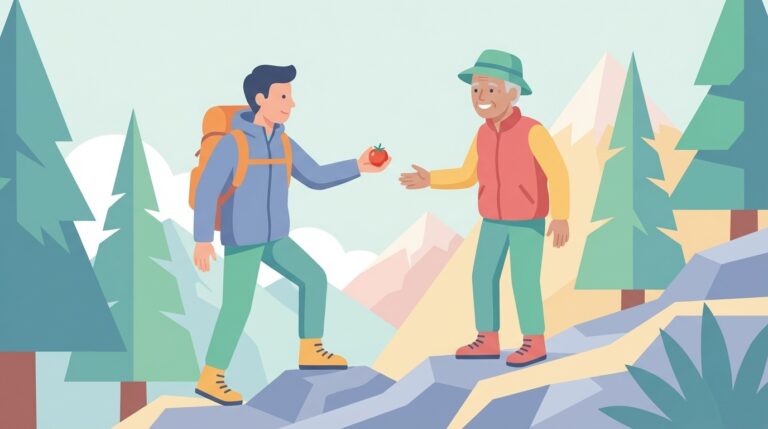
But let’s be real—if you hike the beautiful but rocky mountains of Korea like Bukhansan or Seoraksan, you need more than just K-Drama romance. You need to stay safe, navigate narrow trails, and know how to interact with the enthusiastic local hikers (who will inevitably try to feed you a cherry tomato).
Today, we are diving into Korean Hiking Culture (등산 문화) and the essential Safe Hiking Rules (안전 산행 수칙). This isn’t just about survival; it’s your ticket to becoming a true insider on the trail. Let’s pack our bags and go!
Phase 2: Core Trail Expressions Deep Dive
Here are the top 3 expressions you need to stay safe and polite on a Korean mountain.
1. 미끄러우니까 조심하세요 (It’s slippery, so be careful)
- Pronunciation: mi-kkeu-reo-u-ni-kka jo-sim-ha-se-yo (Say ‘jo-sim’ like ‘Joe, seem’)
- Meaning: Literal: Because it is slippery, please be careful. / Real nuance: Watch your step, it’s slick here!
- K-Culture Moment: You’re struggling over a smooth granite rock, and a friendly Ahjussi (middle-aged man) passing by points at the wet rock and warns you with this phrase to ensure you don’t twist an ankle.
- Editor’s Insight: This phrase shows you care about the other person’s safety. Koreans use
-(으)니까(because) to provide a helpful reason before giving a command or suggestion.- Situation Spectrum:
[🚫 절대 금지] ———— [⚠️ 주의] ———— [✅ 자유롭게]
- Casual with friends (미끄러우니까 조심해): ✅
- Strangers on the trail: ✅
- Boss/Elders: ✅ (Perfectly polite and caring)
- 🤔 Think About It: Why do strangers on a Korean trail feel responsible for your safety? How does this reflect the Korean concept of community compared to hiking etiquette in your country?
2. 먼저 지나갈게요 (I’ll pass first)
- Pronunciation: meon-jeo ji-na-gal-ge-yo
- Meaning: Literal: I will pass by first. / Real nuance: Excuse me, passing through.
- K-Culture Moment: Korean mountain trails can get notoriously crowded on weekends. When you need to overtake someone on a narrow path without startling them, you announce your movement gently with this phrase.
- Editor’s Insight: Instead of just saying “Excuse me” (실례합니다), stating your action (“I will pass”) is the standard trail etiquette. It prevents unexpected collisions.
- Situation Spectrum:
[🚫 절대 금지] ———— [⚠️ 주의] ———— [✅ 자유롭게]
- Casual/Friends (먼저 갈게): ✅
- Strangers on the trail: ✅
- Boss/Elders: ⚠️ (Add “죄송하지만” – I’m sorry but – to be extra polite)
- 🤔 Think About It: Does your language have a specific phrase for overtaking someone on a path, or do you just use a general “excuse me”?
3. 길을 잃었어요. 도와주세요. (I’m lost. Please help me.)
- Pronunciation: gi-reul i-reo-sseo-yo. do-wa-ju-se-yo.
- Meaning: I lost the path. Please help.
- K-Culture Moment: You took a wrong turn chasing a great photo spot, and the trail markings disappeared. You spot another hiker and need to ask for directions to the main path.
- Editor’s Insight:
길을 잃다(to lose the way) is a crucial survival verb. Don’t be shy to use it; Koreans are generally very eager to help lost foreigners!- Situation Spectrum:
[🚫 절대 금지] ———— [⚠️ 주의] ———— [✅ 자유롭게]
- Anyone who can help: ✅
Phase 3: Textbook vs. Real Korean on the Trail
Mountains require quick reactions. Here is how textbook Korean transforms in the wild.
| 상황 (Situation) | 📖 교과서 한국어 (Textbook) | 🗣️ 진짜 한국어 (Real Korean) | 💡 왜 다를까? (Why the difference?) |
|---|---|---|---|
| Warning someone of danger | 위험합니다. 주의하십시오. | 어어! 조심! 거기 미끄러워요! | Danger requires immediate, short exclamations rather than formal sentences. |
| Suggesting a break | 우리 잠시 쉬는 것이 어떨까요? | 아휴, 좀 쉬었다 가요. / 숨차요. | “쉬었다 가다” (rest and go) highlights the continuous journey of hiking. |
| Asking distance to the peak | 정상까지 얼마나 남았습니까? | 다 왔어요? / 얼마나 더 가야 돼요? | Dropping formal endings for practical, slightly desperate, conversational questions. |
Bottom Note for B1 Learners: When you’re out of breath, it’s totally fine to use shorter phrases! Just keep the 요 at the end to maintain politeness.
Phase 4: Cultural Context — K-Culture Deep Dive
4-1. Non-Verbal Trail Etiquette (Nunchi on the Mountain)
When you pass someone on the trail, you don’t need to give a full 90-degree bow or strike up a long conversation. A slight nod, brief eye contact, and a soft “안녕하세요” (Hello) or “수고하십니다” (Keep up the good work) is the perfect display of mountain Nunchi.
4-2. The K-Food Connection: The Real Reason We Hike
Let’s be honest—in Korea, hiking is just a warm-up for eating! At the base of almost every famous mountain, you will find a lively cluster of restaurants. The ultimate post-hike ritual? 파전 (Pajeon – Green onion pancake) and 막걸리 (Makgeolli – Rice wine).
During the hike, Koreans love to take snack breaks. Don’t be surprised if a group of colorful Ahjummas (middle-aged women) suddenly offers you a handful of cherry tomatoes, sliced cucumbers, or a cup of hot mixed coffee from their thermos. Refusing outright can be seen as rejecting their warmth (정 – Jeong). Accept it with two hands, smile, and say “감사합니다! 잘 먹겠습니다!” (Thank you! I will eat it well!).
Phase 5: Real-Life Roleplay Scenario
Setting: Saturday morning, 9:00 AM. Halfway up Bukhansan Mountain. The air is crisp, but you are sweating buckets. You are hiking with your friendly Korean coworker, Min-su.
Characters:
– YOU: A foreign professional working in Seoul, currently regretting your life choices on these steep stairs.
– Min-su (32): Your energetic Korean coworker who hikes every weekend.
Dialogue:
Min-su: 야, 오늘 날씨 진짜 좋다! 빨리 올라가자!
(Ya, oneul nalssi jinjja jota! ppalli ollagaja!)
Wow, the weather is so good today! Let’s go up quickly!
YOU: 민수 씨, 천천히 가요. 저 벌써 힘들어요.
(Minsu ssi, cheoncheonhi gayo. jeo beolsseo himdeureoyo.)
Min-su, let’s go slowly. I’m already tired.
Min-su: (Laughing) 에이, 다 왔어요. 5분만 더 가면 돼요!
(Ei, da wasseoyo. obunman deo gamyeon dwaeyo!)
Hey, we’re almost there. Just 5 more minutes!
🔀 Your Turn! How do you respond to this classic Korean hiker lie?
– A) “와! 진짜요? 빨리 가요!” (Wow! Really? Let’s go quickly!)
– B) “거짓말하지 마세요. 아까도 5분이라고 했잖아요!” (Stop lying. You said 5 minutes earlier too!)
– C) “저 먼저 쉬었다 갈게요. 먼저 가세요.”✅ Best Choice: B or C.
Choice B is a great, witty response among friends. Every foreigner eventually learns that “just 5 minutes” on a Korean mountain actually means 45 minutes!
Choice C (“I will rest a bit. You go first.”) is the perfect survival phrase if you genuinely need to stop without holding your friend back.
(🎭 Stage Direction: You sit on a rock, heavily panting. Min-su hands you a bottle of water.)
Min-su: 알았어요, 알았어. 여기서 물 좀 마시고 쉬었다 가요.
(Arasseoyo, arasseo. yeogiseo mul jom masigo swieotda gayo.)
Okay, okay. Let’s drink some water here and rest before going.
YOU: 감사합니다. 돌이 미끄러우니까 조심하세요.
(Gamsahamnida. dori mikkeureounikka josimhaseyo.)
Thank you. The rocks are slippery, so be careful.
Phase 6: 10-Second Shadowing Drill
Practice this sentence to sound like a native hiker taking a well-deserved break! Remember to follow the slash marks for pausing.
🥵 아휴, / 저 먼저 / 쉬었다 갈게요.
(a-hyu, / jeo meon-jeo / swi-eot-da gal-ge-yo.)
Phew, I’ll take a rest first.
Phase 7: K-Culture Mini Dictionary
| 한국어 | Romanization | English | Cultural Context |
|---|---|---|---|
| 등산복 | deungsanbok | Hiking clothes | Koreans take hiking fashion seriously. Expect bright, neon colors and full-gear setups even for small hills! |
| 정상 | jeongsang | Peak / Summit | Reaching the ‘jeongsang’ is a matter of pride. Everyone takes a picture with the peak stone marker. |
| 산장 | sanjang | Mountain hut | Shelters on big mountains like Jirisan where hikers sleep or buy instant ramen. |
| 막걸리 | makgeolli | Rice wine | The traditional milky alcoholic drink consumed at the bottom of the mountain with savory pancakes. |
Phase 8: Traveler’s Survival Kit
If you are visiting Korea and plan to hike, these phrases and tips will save your life (and your legs).
🆘 Survival Phrases for the Trail
1. 🇰🇷 “정상까지 얼마나 걸려요?” (jeongsangkkaji eolmana geollyeoyo?)
🗣️ Meaning: How long does it take to the peak?
2. 🇰🇷 “119 불러주세요!” (irilgu bulleojuseyo!)
🗣️ Meaning: Please call 119! (119 is the emergency number in Korea, like 911).
3. 🇰🇷 “길을 잘못 든 것 같아요.” (gireul jalmot deun geot gatayo.)
🗣️ Meaning: I think we took the wrong path.📌 Editor’s Travel Note
– Apps: Do NOT rely on Google Maps for hiking trails in Korea. Download KakaoMap or Naver Map. They show detailed, color-coded hiking trails for almost every mountain in the country!
– Gear: Don’t hike rocky Korean mountains in flat sneakers. You need shoes with good grip. Many tourists twist their ankles because Korean mountains are heavily granite-based.
Phase 9: Critical Thinking — “A Step Deeper”
Food & Identity: The Magic of ‘Jeong’ on the Mountain
In Western hiking culture, hikers often prefer solitude and independence, carrying only what they need for themselves. In Korea, however, hiking is a deeply communal activity. Even if you hike alone, older Korean hikers will frequently offer you part of their lunch—be it kimbap, fruit, or tea. This stems from the cultural concept of 정 (Jeong), a deep emotional connection and collective warmth. Sharing food is the ultimate expression of Jeong. On a mountain, where everyone is facing the same physical struggle, offering food is a way of saying, “We are in this together, and I acknowledge your hard work.”
💬 Your Turn: Have you ever experienced a stranger offering you food or help in your home country? How does the concept of ‘Jeong’ compare to community values where you live? Let us know in the comments!
Phase 10: FAQ & Avoiding Common Mistakes
Q: An older hiker offered me food, but I’m full. Can I say “아니요, 괜찮아요” (No, I’m okay)?
Yes, but it’s all about delivery! If you just say a blunt “아니요”, it might seem cold. Smile, gesture with your hands gently, and say “아, 제가 배가 불러서요. 마음만 감사히 받겠습니다!” (Ah, I am full. I will gratefully accept just the thought!).
Q: Everyone keeps saying “다 왔어요” (We are almost there). Is it true?
No. Never trust a Korean hiker who says “다 왔어요” (Literally: We have arrived all the way). It is a motivational lie meant to give you energy. You probably have at least 30 more minutes of uphill climbing!
❌ Common Mistake: Using casual language (반말) to an older hiker just because you are wearing casual clothes and sweating together.
✅ Do This Instead: Always use the요or습니다form with strangers, no matter how friendly the mountain vibe is. (e.g., Use “조심하세요” instead of “조심해”).
Phase 11: Summary & Action Items
One-Liner Summary: To survive a Korean mountain, watch out for slippery rocks, don’t trust “we are almost there,” and always be ready to share some cherry tomatoes!
Action Missions:
– 🥉 Bronze (Solo): Stand up right now, stretch your legs, and confidently say “아휴, 쉬었다 갈게요” three times.
– 🥈 Silver (Online): Go to a Korean language forum or your social media, post a picture of nature, and write “정상까지 얼마나 걸려요?” in the caption.
– 🥇 Gold (Real-world): Next time you are in Korea, hike Bukhansan or Namsan, use “먼저 지나갈게요” to pass safely, and eat Pajeon afterward!
K-Culture Mission:
Download Naver Map or KakaoMap right now. Search for “북한산” (Bukhansan) and look at how detailed the hiking trails (usually marked in green or red lines) are mapped out compared to your local map apps!
Phase 12: Interactive Quiz Challenge
1. Situational Judgment: You are resting on a trail and an older Korean lady hands you an apple slice. What is the most culturally appropriate response?
– A) “얼마예요?” (How much is it?)
– B) 두 손으로 받으며 “감사합니다! 잘 먹겠습니다!” (Take it with two hands saying “Thank you! I will eat it well!”)
– C) 고개를 저으며 “아니요.” (Shake your head and say “No.”)
Answer: B. Accepting food with two hands and expressing gratitude is the perfect way to embrace Korean ‘Jeong’.
2. Fill in the Blank:
The path is very narrow, and you want to politely overtake the person in front of you.
“저 ________ 지나갈게요.”
Answer: 먼저 (meon-jeo – first)
3. True or False — K-Culture Edition:
When a Korean hiker tells you “다 왔어요” (We are almost there), it means the peak is visibly less than 1 minute away.
Answer: False! It is a notorious motivational tactic. Pace yourself, you still have a way to go!
Frequently Asked Questions (FAQ)
Q: What does "미끄러우니까 조심하세요 (It's slippery, so be careful)" mean in Korean and how do you pronounce it?
A: In Korean, "미끄러우니까 조심하세요 (It's slippery, so be careful)" is pronounced [mi-kkeu-reo-u-ni-kka jo-sim-ha-se-yo (Say 'jo-sim' like 'Joe, seem'] and means: Literal: Because it is slippery, please be careful. / Real nuance: Watch your step, it's slick here!
Q: What does "먼저 지나갈게요 (I'll pass first)" mean in Korean and how do you pronounce it?
A: In Korean, "먼저 지나갈게요 (I'll pass first)" is pronounced [meon-jeo ji-na-gal-ge-yo] and means: Literal: I will pass by first. / Real nuance: Excuse me, passing through.
Q: What does "길을 잃었어요. 도와주세요. (I'm lost. Please help me.)" mean in Korean and how do you pronounce it?
A: In Korean, "길을 잃었어요. 도와주세요. (I'm lost. Please help me.)" is pronounced [gi-reul i-reo-sseo-yo. do-wa-ju-se-yo.] and means: I lost the path. Please help.







