

Phase 1: Immersive Hook
Hello there! It’s your Daily Hangul Editor.
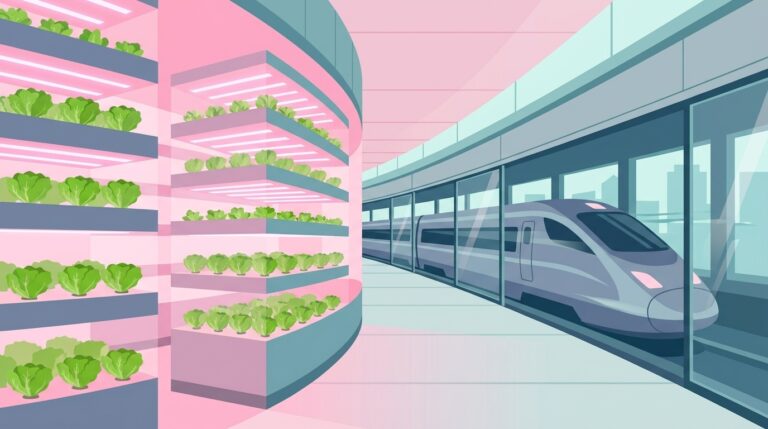
Picture this: You’re rushing through Sangdo Station in Seoul, navigating the sea of commuters. Suddenly, you notice a vibrant, neon-pink glow radiating from behind a massive glass wall. Is it a pop-up nightclub? A K-Pop music video set?
You step closer, and to your surprise, it’s… lettuce. Rows and rows of pristine, hyper-green leafy vegetables growing in climate-controlled, futuristic tiers right in the middle of a subway station.
Welcome to Seoul’s ‘Metro Farm’—a brilliant intersection of agritech, urban planning, and Korea’s obsession with space efficiency.
As a C2-level Korean learner, your conversations are no longer just about ordering an Americano or asking for directions. You’re expected to discuss societal trends, technology, and global issues like agriculture (농업) and food security (식량 안보). Knowing how to talk about urban vertical farming (수직 농장) won’t just help you ace the TOPIK II exam; it will make you the smartest person at any Gangnam dinner party.
Let’s dive into the high-level vocabulary and cultural nuances that will make your Korean sound incredibly sophisticated.
Phase 2: Deep Dive into Core Expressions
Here are three advanced expressions essential for discussing agritech and urban farming.
1. 공간 활용도를 극대화하다
- Pronunciation: gonggan hwaryongdoreul geukdaehwahada [gong-gan hwal-yong-do-reul geuk-dae-hwa-ha-da]
- Meaning: (Literal) To maximize the degree of space utilization. (Real nuance) Making the absolute most out of limited space.
- K-Culture Moment: South Korea is roughly the size of Indiana, and 70% of it is mountainous. Real estate is fiercely competitive (as seen in dramas like Queen of Tears or Penthouse). This phrase is highly respected in business and urban planning contexts.
- Editor’s Insight: ‘극대화하다’ (to maximize) adds an instant layer of professionalism. It sounds much smarter than just saying ‘공간을 잘 쓰다’ (to use space well).
- Situation Spectrum:
[🚫 절대 금지] ———— [⚠️ 주의] ———— [✅ 자유롭게]
- Casual with friends: ⚠️ (A bit too formal/stiff for a casual pub chat)
- Semi-formal coworkers: ✅
- Formal presentations/Bosses: ✅ (Perfect for boardroom pitches!)
- 🤔 Think About It: Korea’s hyper-dense geography has historically forced innovation. How does your home country’s geography influence its architectural or agricultural language?
2. 기후에 구애받지 않다
- Pronunciation: gihu-e gu-aebatji anta [gi-hoo-eh goo-ae-baht-jee ahn-tah]
- Meaning: (Literal) To not be courted/restricted by the climate. (Real nuance) To be completely unaffected by weather conditions; climate-resilient.
- K-Culture Moment: Every summer, Korea faces a brutal monsoon season (장마철). When typhoons hit, the price of agricultural goods skyrockets. This expression frequently pops up on the 9 PM News when anchors discuss how smart farms save the day.
- Editor’s Insight: ‘구애받다’ sounds like the word for ‘courtship’ (구애), but here it means being restricted or tied down by something. It’s a top-tier C2 vocabulary word that native speakers love using to sound objective and analytical.
- Situation Spectrum:
[🚫 절대 금지] ———— [⚠️ 주의] ———— [✅ 자유롭게]
- Casual with friends: ✅ (Can be used playfully, e.g., ‘나이에 구애받지 않다’ – not restricted by age)
- Semi-formal coworkers: ✅
- Formal presentations/Bosses: ✅
- 🤔 Think About It: Why do you think Korean news relies so heavily on specialized Sino-Korean vocabulary (Hanja) to convey authority, compared to English news?
3. 식량 안보의 든든한 대안
- Pronunciation: singnyang anboui deundeunhan dae-an [sing-nyang ahn-bo-eh deun-deun-hahn dae-ahn]
- Meaning: (Literal) A reliable alternative for food security. (Real nuance) A solid, dependable solution to the food crisis.
- K-Culture Moment: ‘든든하다’ is a deeply emotional Korean adjective. You say it when you eat a hearty bowl of 국밥 (Gukbap), or when you have a reliable friend. Pairing this warm, emotional word with a cold, political term like ‘식량 안보’ (food security) creates a beautifully native-sounding rhetoric.
- Editor’s Insight: ‘대안’ (alternative) is your best friend in debates or TOPIK writing. It shows you aren’t just pointing out a problem; you’re offering a solution.
- Situation Spectrum:
[🚫 절대 금지] ———— [⚠️ 주의] ———— [✅ 자유롭게]
- Casual with friends: ⚠️ (Too academic)
- Semi-formal coworkers: ✅
- Formal presentations/Bosses: ✅
- 🤔 Think About It: Korean often blends highly technical terms with deeply emotional adjectives. Does your language mix emotion and academia in a similar way?
Phase 3: Textbook vs Real Life
Let’s see how C2-level concepts transition from textbooks to real-world native banter.
| Situation | 📖 Textbook Korean | 🗣️ Real Korean | 💡 Why the difference? |
|---|---|---|---|
| Explaining vertical farming | 수직 농장은 공간을 효율적으로 사용합니다. (Vertical farming uses space efficiently.) | 요즘 도심 스마트팜이 공간 활용 끝판왕이잖아. (Urban smart farms are the ultimate boss of space utilization these days.) | ‘끝판왕’ (final boss from gaming culture) is universally used to mean the absolute pinnacle of something. |
| Discussing weather resilience | 실내 농업은 날씨의 영향을 받지 않습니다. (Indoor agriculture is not affected by weather.) | 장마철이라고 상추값이 금값이 될 일은 없겠네. (No need to worry about lettuce becoming gold during monsoon season.) | Linking abstract concepts to tangible, daily K-Food struggles (expensive lettuce for pork belly). |
| Food security impact | 이것은 식량 문제의 좋은 대안입니다. (This is a good alternative for the food problem.) | 이게 진짜 식량 안보의 효자 노릇을 톡톡히 하네. (This is really playing the role of a devoted son for food security.) | ‘효자’ (devoted son) is used metaphorically for anything that solves a major problem or brings in a lot of money. |
Bottom Note: While ‘끝판왕’ and ‘효자’ are slightly colloquial, they are widely accepted in business settings to lighten the mood while showing absolute fluency.
Phase 4: Cultural Deep Dive
4-1. Non-verbal Communication: The “Nunchi” of Innovation
When discussing high-tech solutions like Vertical Farming with older Korean executives, you must balance your enthusiasm with respect for traditional agriculture (농사). A lot of older Koreans have a nostalgic, romanticized view of farming (often dreaming of 귀농 – returning to the countryside to farm).
Actionable Tip: When praising smart farms, nod slightly and acknowledge the hard work of traditional farmers first. “물론 전통 농업의 가치도 크지만…” (Of course, the value of traditional agriculture is immense, but…)
4-2. K-Culture Connection: K-Food & The “Gold Lettuce” Phenomenon
If you want to understand why vertical farming is a massive trend in Korea, you must look at a K-BBQ table.
Koreans eat meat wrapped in fresh lettuce and perilla leaves (쌈 문화 – Ssam culture). It is communal, generous, and essential. However, during the unpredictable summer typhoons, outdoor crops are destroyed. Suddenly, a basket of lettuce at the market costs more than the pork belly itself! The media calls this 금추 (Geum-chu: Gold + Lettuce).
Vertical farming directly solves this cultural crisis. By placing Metro Farms in subway stations and smart farms in city skyscrapers, urban agritech ensures that K-BBQ lovers can have their affordable Ssam all year round, unaffected by the climate (기후에 구애받지 않고). It’s not just about science; it’s about protecting the Korean soul food experience!
Phase 5: Immersive Roleplay Scenario
Scenario A: The Business Lunch
Setting: A trendy farm-to-table salad cafe in Yeouido, the Wall Street of Seoul. You can literally see the hydroponic vertical farm glowing behind the barista. You are having a casual lunch with your Korean manager, Min-su.
Characters:
– YOU: A foreign agritech consultant working in Seoul.
– Min-su (40s): Your manager. Pragmatic, loves a good business trend, but always worries about costs.
Min-su: 여기 샐러드 진짜 신선하네요. 저기 스마트팜에서 바로 따서 주나 봐요.
(Yeogi saelleodeu jinjja sinseonhaneyo. Jeogi seumateupam-eseo baro ttaseo juna bwayo.)
[This salad is really fresh. I guess they pick it straight from the smart farm over there.]
YOU: 네, 수직 농장 덕분에 도심 한복판에서도 기후에 구애받지 않고 신선한 채소를 먹을 수 있죠.
(Ne, sujik nongjang deokbun-e dosim hanbokpan-eseodo gihu-e gu-aebatji anko sinseonhan chaesoreul meogeul su itjyo.)
[Yes, thanks to vertical farming, we can eat fresh vegetables right in the middle of the city, unaffected by the climate.]
Min-su: 맞아요. 요즘 장마철이라 상추값이 완전 금값인데, 이런 시스템이 식량 안보의 대안이 될 수 있겠어요.
(Majayo. Yojeum jangmacheorira sangchugapsi wanjeon geumgapsinde, ireon siseutemi singnyang anboui dae-ani doel su itgesseoyo.)
[Right. It’s monsoon season so lettuce is literally gold, this kind of system could be an alternative for food security.]
Min-su: 근데 초기 설치 비용이 만만치 않을 텐데, 수익성이 있을까요?
(Geunde chogi seolchi biyong-i manmanchi aneul tende, su-ikseong-i isseulkkayo?)
[But the initial installation cost must be hefty. Will it be profitable?]
🔀 Your Turn! How do you respond?
– A) “글쎄요. 저도 잘 모르겠습니다.” (I don’t know.)
– B) “장기적으로 보면 공간 활용도를 극대화할 수 있어서 결국 이익일 겁니다.” (In the long run, because it can maximize space utilization, it will ultimately be profitable.)
– C) “대박이죠! 완전 돈 많이 벌 거예요!” (It’s epic! They’ll make so much money!)✅ Best Choice: B — Reason: It perfectly uses the C2-level vocabulary to address a business concern logically and professionally.
⚠️ Choice C Analysis: Too casual and childish for a business discussion with a manager.
Scenario B: Bonus – The Tourist Hustle
Setting: You are exploring Sangdo Station and see the Metro Farm. You want to ask a subway worker if you can go inside.
YOU: 저기요, 혹시 저 수직 농장 안에 들어가서 구경할 수 있나요?
(Jeogiyo, hoksi jeo sujik nongjang an-e deureogaseo gugyeonghal su innayo?)
[Excuse me, can I go inside that vertical farm and look around?]
Worker: 아, 체험 프로그램은 미리 온라인으로 예약하셔야 가능합니다.
(A, cheheom peurogeuraemeun miri onlain-euro yeyakhaseya ganeunghamnida.)
[Ah, the experience program is only possible if you book online in advance.]
Phase 6: 10-Second Shadowing Drill
Practice your flow, intonation, and rhythm! At the C2 level, pausing at the right grammatical markers is crucial for sounding like an intellectual.
😤 (Confident & Professional)
수직 농장은 / 공간 활용도를 극대화하고, /
(Sujik nongjang-eun / gonggan hwaryongdoreul geukdaehwahago, /)
기후에 / 구애받지 않기 때문에 /
(Gihu-e / gu-aebatji anki ttaemun-e /)
미래 식량 안보의 / 핵심 대안입니다.
(Mirae singnyang anboui / haeksim dae-animnida.)
Phase 7: K-Culture Glossary (Agritech & Urban Living)
| 한국어 | Romanization | English | Context/Explanation |
|---|---|---|---|
| 금추 | geumchu | Gold Lettuce | A portmanteau of 금 (gold) and 상추 (lettuce). Used when vegetable prices surge due to bad weather. |
| 스마트팜 | seumateupam | Smart Farm | High-tech farming using IoT, LED, and automation. Extremely popular in Korean agritech startups. |
| 식량 자급률 | singnyang jageumnyul | Food Self-Sufficiency Rate | A major political and economic talking point, as Korea imports a vast majority of its grain and food. |
| 끝판왕 | kkeutpanwang | Final Boss | Slang from gaming used in everyday life to describe the absolute best or ultimate version of something. |
| 귀농 | gwinong | Returning to Farming | The trend of city dwellers moving to the countryside to start a farm, seeking a slower life. |
Phase 8: Traveler’s Survival Kit
Visiting one of Seoul’s high-tech smart farm cafes or Metro Farms? Here’s what you need to know.
🆘 Survival Phrases for Smart Cafes
– 🇰🇷 “이 샐러드, 스마트팜 채소로 만든 건가요?” (I saelleodeu, seumateupam chaesoro mandeun geongayo?)
– 🗣️ Meaning: Is this salad made with smart farm vegetables?
– 🇰🇷 “체험 예약은 어디서 하나요?” (Cheheom yeyageun eodiseo hanayo?)
– 🗣️ Meaning: Where do I book the experience (tour)?
– 📍 Where to use: Farm-to-table cafes, Metro Farms (Sangdo, Euljiro 3-ga stations).📌 Editor’s Travel Note
– Cashless Korea: Almost all smart cafes and subway stations in Seoul are entirely cashless (카드 전용 매장). Make sure you have a credit card or T-money card ready!
– Metro Farm Locations: You don’t need to go out of your way to see the future of agriculture. Simply transfer at major hubs like Euljiro 3-ga, Sangdo, or Cheonwang to see these glowing green tech hubs underground.
Phase 9: Think Deeper — K-Tech vs. The Romance of Nature
Global Era & K-Tech vs Tradition
🧠 Think Deeper:
Traditional agriculture is deeply tied to nature, seasons, and patience. Korean folklore, holidays like Chuseok, and even everyday proverbs are rooted in an agrarian society that waited on the rain and sun. However, vertical farming fundamentally alters this relationship—it is about controlling nature rather than living in harmony with it. As Korea rapidly adopts agritech to overcome its geographic limitations and ensure food security, it shifts the Korean identity from ‘people of the land’ to ‘masters of the lab.’ Does hyper-efficient technology strip the soul out of the food we eat, or is it a necessary evolution for survival in a global metropolis?💬 Your Turn: How does your culture view high-tech farming? Is it seen as futuristic and safe, or unnatural and dystopian? Share your thoughts below!
Phase 10: Troubleshooting & FAQ
Q: Can I use “구애받지 않다” in normal daily conversation, or will I sound like a news anchor?
Yes, you can! While it is advanced, native speakers use it naturally to sound articulate. For example, “다른 사람 시선에 구애받지 마세요” (Don’t be restricted by how others look at you).
Q: What is the difference between 농사 (nongsa) and 농업 (nongeop)?
Great C2 question!
– 농사 is the physical act or traditional concept of farming (e.g., 농사를 짓다 – to farm).
– 농업 is the macro industry of agriculture (e.g., 농업 기술 – agricultural technology).
If you are talking about vertical farming as an industry, always use 농업.
❌ Common Mistake #1: Saying “도시 농사를 좋아해요” (I like city farming).
✅ Do this instead: Say “도시 농업에 관심이 많아요” (I am highly interested in urban agriculture). It sounds much more professional and accurate.
Phase 11: Wrap-up & Action Items
One-Liner Summary: Today, we mastered C2-level professional vocabulary to discuss vertical farming, space maximization, and food security in the context of Seoul’s high-tech underground farms.
Your 3-Step Action Mission:
– 🥉 Bronze (Solo): Read the Shadowing Drill out loud 3 times in front of the mirror, pretending you are a Korean tech CEO pitching to investors.
– 🥈 Silver (Online): Write a comment below using the word “극대화하다” (maximize) to describe how you study Korean!
– 🥇 Gold (Real Life): Next time you eat K-BBQ, wrap a piece of meat in lettuce and explain the “금추” (gold lettuce) phenomenon to your friends.
K-Culture Mission:
Go to YouTube and search “서울 지하철 스마트팜” (Seoul Subway Smart Farm) or “상도역 메트로팜” (Sangdo Station Metro Farm). Take a virtual tour of the glowing underground farms and leave a comment in Korean on the video!
Phase 12: Interactive Quiz
Ready to test your C2 instincts? Let’s go!
1. Fill in the Blank (Vocabulary)
“이 시스템은 날씨에 ____________ 않고 365일 농작물을 재배할 수 있습니다.”
– A) 구애받지
– B) 극대화하지
– C) 대안하지
(Hint: Think about being unaffected or unrestricted!)
2. True or False: K-Culture Edition
“During the monsoon season in Korea, the price of lettuce usually drops because there is plenty of water.”
– True or False?
3. Situational Judgment
You are writing an academic essay for the TOPIK II exam about how urban farming solves the issue of importing food. Which phrase is the MOST appropriate to use?
– A) 상추값이 완전 금값이다.
– B) 식량 안보의 훌륭한 대안으로 떠오르고 있다.
– C) 농사를 짓는 건 끝판왕이다.
Click here for Answers & Explanations!
1. A) 구애받지 (You can grow crops 365 days a year without being restricted by the weather.)
2. False. Heavy rains and typhoons destroy outdoor crops, causing prices to surge. This is known as the ‘금추’ (Gold Lettuce) phenomenon.
3. B. This is the perfect, sophisticated C2-level sentence for an essay. A and C are colloquial slangs better suited for casual conversations with friends.
Frequently Asked Questions (FAQ)
Q: What does "공간 활용도를 극대화하다" mean in Korean and how do you pronounce it?
A: In Korean, "공간 활용도를 극대화하다" is pronounced [gonggan hwaryongdoreul geukdaehwahada [gong-gan hwal-yong-do-reul geuk-dae-hwa-ha-da] and means: (Literal) To maximize the degree of space utilization. (Real nuance) Making the absolute most out of limited space.
Q: What does "기후에 구애받지 않다" mean in Korean and how do you pronounce it?
A: In Korean, "기후에 구애받지 않다" is pronounced [gihu-e gu-aebatji anta [gi-hoo-eh goo-ae-baht-jee ahn-tah] and means: (Literal) To not be courted/restricted by the climate. (Real nuance) To be completely unaffected by weather conditions; climate-resilient.
Q: What does "식량 안보의 든든한 대안" mean in Korean and how do you pronounce it?
A: In Korean, "식량 안보의 든든한 대안" is pronounced [singnyang anboui deundeunhan dae-an [sing-nyang ahn-bo-eh deun-deun-hahn dae-ahn] and means: (Literal) A reliable alternative for food security. (Real nuance) A solid, dependable solution to the food crisis.






