

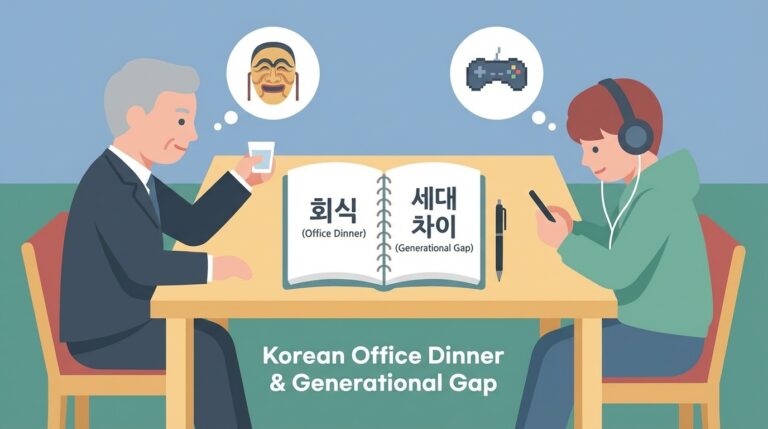
Navigating the Korean Generation Gap: From ‘Kkondae’ Bosses to Gen Z Slang
Phase 1: 공감 — 몰입형 오프닝 (Immersive Hook)
Hello! This is your Daily Hangul Editor.
Picture this: You’ve binge-watched over 200 K-Dramas, studied Korean up to a C1 level, and finally landed a job in Seoul. You’re at a Hoesik (company dinner) near Gangnam. Your boss, a man in his 50s, takes a shot of Soju, clears his throat, and starts a sentence with, “나 때는 말이야…” (Back in my day…). Suddenly, your 20-something Gen Z intern rolls her eyes, nudges you, and whispers, “Ugh, literal Latte.”
Wait… Latte? The coffee?
Welcome to the ultimate test of advanced Korean: The Generational Language Gap. Knowing textbook grammar is great, but understanding the socio-linguistic tug-of-war between the older generation (기성세대) and the MZ generation (MZ세대) is what truly makes you an insider. Without this cultural context, you might unknowingly offend an elder, or completely miss the sarcastic humor of your younger friends. Today, let’s decode the unwritten rules of Korean generational communication!
Phase 2: 핵심 표현 심층 분석 (Deep Dive)
1. 꼰대
- Pronunciation: kkondae [sounds like a sharp, tight ‘K’ followed by ‘day’]
- Meaning: Literal: An old person/teacher (slang origin). Real nuance: A condescending, rigid older person who forces their outdated views on younger people; the Korean equivalent of a “boomer.”
- K-Culture Moment: In K-Dramas like Misaeng or My Mister, this is the manager who yells at the team for leaving exactly at 6:00 PM or insists that company loyalty is more important than personal life.
- Editor’s Insight: This word has evolved beyond age. Koreans now use “젊은 꼰대” (young kkondae) for a 30-year-old who acts rigidly towards a 20-year-old! It captures the frustration of a strict hierarchical society.
- Situation Spectrum:
[🚫 절대 금지] ———— [⚠️ 주의] ———— [✅ 자유롭게]- Complaining to close friends: ✅
- Joking with a very close senior (highly risky): ⚠️
- To your boss’s face: 🚫
- 🤔 Think About It: Why did a word specifically targeting “condescending elders” become so viral in modern Korea? What does it say about the rapid economic shift the country experienced in just 50 years?
2. 라떼는 말이야
- Pronunciation: latte-neun mariya [la-tte-nun mah-ree-ya]
- Meaning: Literal: “Latte is horse…” Real nuance: A sarcastic pun on “나 때는 말이야” (Na ttae-neun mariya), which means “Back in my day…”
- K-Culture Moment: You’ll see this meme everywhere. Even massive Korean corporate commercials use a cup of latte with a horse on it to playfully mock older bosses.
- Editor’s Insight: It’s a humorous coping mechanism. When the younger generation hears a lecture starting with “Back in my day,” they internally translate it to “Latte is horse” to diffuse their own annoyance.
- Situation Spectrum:
[🚫 절대 금지] ———— [⚠️ 주의] ———— [✅ 자유롭게]- Friends (Casual): ✅
- Co-workers (Semi-formal): ⚠️
- Superiors (Formal): 🚫 (Unless the boss makes the joke first!)
- 🤔 Think About It: Does your native language have a humorous phrase used by the youth to deflect “back in my day” stories from older generations?
3. 오지랖
- Pronunciation: ojilap [oh-jee-rap – sounds like a quick wrap-up]
- Meaning: Literal: The wide front of a traditional Korean coat. Real nuance: Meddling, being nosy, or overstepping boundaries.
- K-Culture Moment: During family gatherings (Chuseok/Seollal), aunts asking “When are you getting married?” Older folks think it’s Jeong (정 – affection/care), but Gen Z calls it Ojilap.
- Editor’s Insight: This word perfectly captures the cultural friction. To survive in Korea, you must learn to distinguish between genuine care and pure nosiness.
- Situation Spectrum:
[🚫 절대 금지] ———— [⚠️ 주의] ———— [✅ 자유롭게]- Complaining to friends: ✅
- Directing it at an elder: 🚫
Phase 3: 교과서 vs 진짜 한국어 (Textbook vs Real Life)
| 상황 | 📖 교과서 한국어 | 🗣️ 진짜 한국어 | 💡 왜 다를까? |
|---|---|---|---|
| 듣기 싫은 조언을 들을 때 | 조언해 주셔서 감사합니다. | 넵, 알겠습니다! | MZ generation prefers efficient, non-confrontational agreement (the “넵” disease) over formal gratitude. |
| 과거 이야기를 꺼낼 때 | 제가 어렸을 때는… | 라떼는 말이야… | Humor and memes diffuse the tension of strict hierarchical communication. |
| 지나친 간섭을 피할 때 | 그것은 개인적인 일입니다. | 아, 네~ (하며 화제 전환) | Direct confrontation is avoided; indirect evasion (Nunchi) is culturally safer than setting hard verbal boundaries. |
Bottom Note: At a C1 level, you already know the polite forms. Now, mastering the professional “넵” (Nep – a slightly more energetic, crisp ‘yes’ than ‘네’) is your secret weapon in Korean corporate life!
Phase 4: 문화적 맥락 — K-Culture 딥다이브 (Cultural Deep Dive)
4-1. 비언어적 요소 (Non-verbal Communication)
When bridging the generation gap, words are only 10% of the battle. The other 90% is Nunchi (눈치). If an older person is giving a “Latte” speech, the expected non-verbal response is active listening: nodding, slight eye contact (but not staring them down), and sprinkling in “아~ (Ah~)” or “정말요? (Really?)”. Gen Z humorously calls this “영혼 없는 리액션” (soulless reaction)—a survival tactic to show respect without necessarily agreeing.
4-2. K-Culture Connection: K-Drama Office Dynamics
If you’ve watched K-Dramas like Search: WWW or Misaeng, you’ve witnessed the clash between the rigid, seniority-based corporate culture and the individualistic approach of younger workers. Older generations built Korea’s rapid economic success through collective sacrifice (“We” culture), while the MZ generation values work-life balance and personal boundaries (“I” culture).
Critical View: Dramas often exaggerate this for comedic effect—making all bosses look like Kkondae and all youths look rebellious. In reality, many modern Korean companies are actively trying to bridge this gap through “reverse mentoring” and flattening office hierarchies!
Phase 5: 실전 롤플레이 시나리오 (Immersive Roleplay)
시나리오 A: 메인 롤플레이 (Main Scenario)
Setting: Friday, 7 PM. A smoky Samgyeopsal (pork belly) restaurant near Gangnam Station. Green Soju bottles line the table. You are at a team dinner.
Characters:
– YOU: A foreign manager who has worked in Seoul for 2 years. Fluent in Korean, but still navigating office politics.
– Mr. Kim (52): The team director. Warm-hearted but prone to long lectures.
– Ji-ah (25): The new Gen Z intern. Smart, efficient, but strictly clocks out at 6 PM.
Mr. Kim: 우리 막내 지아 씨, 고기 좀 구워볼까? 나 때는 말이야, 막내들이 알아서 다 세팅하고 그랬어~ 껄껄! 🥩
(Uri mangnae Ji-a ssi, gogi jom guwobolkka? Na ttae-neun mariya, mangnaedeuri araseo da seting-hago geuraesseo~ kkeolkkeol!)
[Hey our youngest Ji-ah, shall we grill some meat? Back in my day, the youngest would set up everything automatically~ haha!]
(🎭 Stage Direction: Mr. Kim taps his Soju glass. Ji-ah looks visibly annoyed but reaches for the tongs.)
Ji-ah: 아… 네. 부장님. 제가 구울게요.
(A… ne. Bujangnim. Jega gu-ulgeyo.)
[Ah… yes. Director. I will grill it.]
(🎭 Stage Direction: Ji-ah sighs softly. The atmosphere gets slightly awkward.)
🔀 당신의 차례! 어떻게 대답할까요? (Your Turn!)
– A) “부장님, 요즘 MZ세대는 그런 거 안 좋아합니다.” (Director, the MZ generation doesn’t like that these days.)
– B) “에이 부장님, 요새 누가 고기를 막내가 굽습니까? 제가 기가 막히게 구워보겠습니다!” (Hey Director, who makes the youngest grill these days? Let me show you my amazing grilling skills!)
– C) “지아 씨, 내가 도와줄게요.” (Ji-ah, I will help you.)
✅ Best Choice: B — Reason: You use humor (“에이~”) to deflect the Kkondae moment, protect the intern, and show respect to the boss by volunteering yourself. This is advanced Nunchi!
⚠️ Choice A Analysis: Too direct and confrontational. In Korean culture, publicly criticizing an elder/boss causes them to “lose face” (체면), making the situation worse. Choice C is okay but doesn’t resolve the tension with the boss.
시나리오 B: K-Culture 보너스 롤플레이 (Bonus Scenario)
(🎭 Scene: A holiday family gathering. An older relative keeps asking when you’re going to get a promotion.)
Aunt: 외국인이라서 진급이 느린 거 아니야? 오지랖이라고 생각하지 말고 들어~
[Are you getting promoted slowly because you’re a foreigner? Don’t think of this as meddling, just listen~]
You: (Smiling politely) 하하, 이모님! 요새는 천천히 올라가는 게 대세예요~ 걱정해 주셔서 감사합니다!
[Haha, Auntie! Slowly climbing up is the trend these days~ Thanks for worrying about me!]
Phase 6: 10초 섀도잉 드릴 (Shadowing Drill)
Master this diplomatic, C1-level sentence to politely disagree with an older person while maintaining respect! Follow the slashes for pausing.
😊 아 부장님! / 부장님 말씀도 / 백번 맞습니다만, / 요즘 세대는 / 조금 다르게 생각하더라고요!
(A bujangnim! / bujangnim malsseumdo / baekbeon matseumnidaman, / yojeum sedaeneun / jogeum dareuge saenggakhadeoragoyo!)
[Ah, Director! / You are 100% right, but / the younger generation / seems to think a bit differently!]
Phase 7: K-Culture 미니 사전 (K-Culture Glossary)
| 한국어 | Romanization | 영어 | 맥락 설명 |
|---|---|---|---|
| 꼰대 | kkondae | Boomer / Condescending elder | Used to describe older folks who force their outdated views. |
| 눈치 | nunchi | Situational awareness | The essential Korean social sense of reading the room. |
| 회식 | hoesik | Company dinner | A crucial part of Korean work culture, often bridging (or widening) the generation gap. |
| 정 | jeong | Affection / Bonding | The warm, collective feeling older Koreans value. |
| 오지랖 | ojilap | Nosiness | When “Jeong” crosses a boundary and becomes intrusive. |
Phase 8: 여행자 서바이벌 키트 (Traveler’s Survival Kit)
Even if you’re not in a Korean corporate office, you’ll encounter the generation gap on the streets of Seoul!
🆘 서바이벌 표현 (Survival Phrases for Approaching Different Generations)
– 🇰🇷 Approaching an older person: “어르신, 길 좀 여쭐게요.” (Eoreusin, gil jom yeojjulgeyo)
– 🗣️ 영어 발음 가이드: [Uh-reu-shin, gil jom yuh-jjool-gae-yo]
– 📍 쓰는 곳: Asking directions from someone 60+. It shows immense respect!
- 🇰🇷 Approaching a younger person: “저기요, 혹시…” (Jeogiyo, hoksi…)
- 🗣️ 영어 발음 가이드: [Juh-gi-yo, hok-shee…]
- 📍 쓰는 곳: Getting the attention of someone your age or younger on the street.
📌 Editor’s Travel Note
– Language Shift: Older Koreans in markets might use Banmal (informal language) with you. Don’t be offended! To them, it’s often a sign of grandmotherly Jeong (affection), not disrespect.
– Asking for Help: Younger Koreans are generally more fluent in English and rely heavily on map apps. If you’re lost, approaching someone in their 20s/30s with “저기요” is highly effective.
Phase 9: 비판적 사고 코너 — “한 발 더 깊이” (Think Deeper)
🧠 Think Deeper: 언어와 권력 (Language & Power)
The Korean language is deeply rooted in neo-Confucian hierarchy, clearly seen in its strict honorifics (존댓말). However, as Korea becomes a global tech hub, this rigid language structure creates a barrier to rapid, creative communication between generations. To fix this, many modern Korean startups (like Kakao and Toss) have abolished traditional titles (과장님, 부장님) altogether! Instead, they mandate English names (e.g., “Hi, Brian!”) or attach “-님 (Nim)” to first names regardless of age. This linguistic shift is a deliberate, radical attempt to flatten the power dynamic and bridge the generation gap.
💬 Your Turn: Does your culture have a built-in linguistic hierarchy? How do you show respect to older generations while maintaining your own boundaries? Let us know in the comments!
Phase 10: FAQ & 오해 방지 (Troubleshooting)
❌ 흔한 실수 #1: Calling an older person “당신 (Dangsin)”. In textbooks, it translates to “you,” but in real life, using it with a stranger or an elder sounds like you want to start a street fight!
✅ 이렇게 하세요: Use their professional title (사장님 – Boss/Owner, 기사님 – Driver) or politely drop the pronoun altogether.
K-Culture 특화 FAQ:
– Q: “If an older restaurant owner calls me ‘학생 (Student)’ even though I’m 35, should I correct them?”
A: Haha, take it as a compliment! It means you look young. Just smile and order your food.
– Q: “Is it okay to use MZ slang like ‘폼 미쳤다’ (Form is crazy) with my older boss?”
A: Only if you have a very casual relationship and are using it playfully to praise them. Otherwise, stick to standard polite Korean to be safe.
– Q: “How do I politely decline a drink from an older person at a Hoesik?”
A: Say, “제가 술을 잘 못 해서요 (I’m not good at drinking),” but politely accept a glass of water or soda so you can still “cheers” (건배) with them. It shows you’re participating in the Jeong.
Phase 11: 요약 및 액션 아이템 (Wrap-up)
- One-Liner Summary: Bridging the Korean generation gap requires balancing deep traditional respect (Nunchi) with modern conversational boundaries!
-
Action Mission 3단계:
- 🥉 Bronze (혼자서): Practice the shadowing drill (Phase 6) in front of a mirror until you sound like a true diplomat.
- 🥈 Silver (온라인): Go to a Korean YouTube video about “꼰대” and read the comments to see how Koreans really express their frustrations.
- 🥇 Gold (실전): Next time an older Korean offers you unsolicited advice, use your best Nunchi smile and say “아~ 네, 알겠습니다!”
- K-Culture Mission: Watch one episode of Misaeng or My Mister and try to spot the exact moment the generational communication gap causes tension in the office!
Phase 12: 퀴즈 — 인터랙티브 챌린지 (Interactive Quiz)
1. Situational Judgment: An older colleague tells you, “Back in my day, we worked weekends without complaining!” What is the most culturally savvy response for a C1 learner?
– A) “라떼는 말이야~” (Saying it directly to their face)
– B) “꼰대시네요.” (You are a Kkondae.)
– C) “아이고, 그때는 정말 고생 많으셨네요!” (Oh my, you must have suffered a lot back then!)
Answer: C. Validate their hardship first! A and B will ruin the relationship. (Unless A is used in a very joking manner with a cool boss, but C is the safest bet!)
2. True or False — K-Culture Edition:
“When an older Korean market vendor uses Banmal (casual speech) to you, they are trying to disrespect you.”
Answer: False. It is often an expression of ‘Jeong’ (affection) from elders to younger people, though modern generations are starting to debate whether this is still appropriate!
Frequently Asked Questions (FAQ)
Q: What does "꼰대" mean in Korean and how do you pronounce it?
A: In Korean, "꼰대" is pronounced [kkondae [sounds like a sharp, tight 'K' followed by 'day'] and means: Literal: An old person/teacher (slang origin). Real nuance: A condescending, rigid older person who forces their outdated views on younger people; the Korean equivalent of a "boomer."
Q: What does "라떼는 말이야" mean in Korean and how do you pronounce it?
A: In Korean, "라떼는 말이야" is pronounced [latte-neun mariya [la-tte-nun mah-ree-ya] and means: Literal: "Latte is horse..." Real nuance: A sarcastic pun on "나 때는 말이야" (Na ttae-neun mariya), which means "Back in my day..."
Q: What does "오지랖" mean in Korean and how do you pronounce it?
A: In Korean, "오지랖" is pronounced [ojilap [oh-jee-rap - sounds like a quick wrap-up] and means: Literal: The wide front of a traditional Korean coat. Real nuance: Meddling, being nosy, or overstepping boundaries.







