

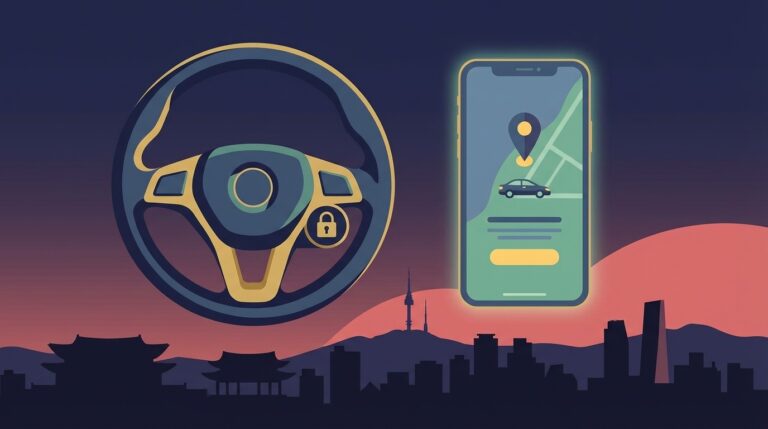
Phase 1: Immersive Hook — The Unforgivable K-Drama Plot Twist
Hello there! It’s your Head Editor at Daily Hangul.
Picture this: You’re watching an intense K-Drama. The charismatic lead has just finished an emotionally charged hoesik (company dinner) at a local pojangmacha (tent bar). They down a glass of soju, slam it on the table, grab their car keys, and storm out.
Wait, freeze right there! 🛑
Ten years ago, that scene might have aired without a hitch. Today? The internet would explode, the actor would issue a public apology, and the show might even be canceled. In modern South Korea, drinking and driving is not just a mistake; it’s social suicide.
But as a C2 advanced learner, your goal isn’t just to say, “Don’t drink and drive.” You are here to debate current affairs, engage with Korean news, and discuss sophisticated policies just like a local. Recently, one of the hottest topics in South Korean society has been the 음주 운전 시동 잠금 장치 도입 (Introduction of Ignition Interlock Devices for Drunk Driving).
If you want to move beyond textbook pleasantries and hold your own in a deep, late-night cafe debate with Seoulite intellectuals, this guide is exactly what you need. Let’s dive in!
Phase 2: Core Expressions Deep Dive
To discuss this high-level topic, you need high-level vocabulary. Here are three crucial expressions that will make you sound like a news anchor.
1. 음주 운전 방지 장치 의무화
- Pronunciation: [eum-ju un-jeon bang-ji jang-chi ui-mu-hwa]
(Sound-alike guide: Oom-joo oon-jeon bang-jee jang-chee wee-moo-hwa) - Meaning:
- Literal: Drunk driving prevention device mandating.
- Real nuance: Making ignition interlock devices legally mandatory.
- K-Culture Moment: You’ll hear this exact phrase echoing across YTN or KBS News every time a major DUI incident makes headlines. It’s the battle cry of lawmakers and citizens demanding stricter road safety.
- Editor’s Insight: The suffix -화 (hwa) means “-ization” or “making something into [state].” Mastering “-화” (like 세계화/globalization, 대중화/popularization) is a major flex for C2 learners.
- Situation Spectrum:
[🚫 Casual banter] ———— [⚠️ Normal chat] ———— [✅ Intellectual debate/News]- Friends (Casual): ⚠️ (A bit stiff, use casually as “기계 꼭 달게 해야 돼” instead)
- Colleagues (Semi-formal): ✅
- Formal Debate/Essays: ✅
- 🤔 Think About It: Why does Korean rely so heavily on four-character Hanja constructs (like 의무화) for official matters? How does this change the “weight” of the sentence compared to your native language?
2. 재범률을 획기적으로 낮추다
- Pronunciation: [jae-beom-ryu-reul hoek-gi-jeo-geu-ro nat-chu-da]
(Sound-alike guide: Jae-beom-ryul-eul hwek-gee-jeok-uh-ro nat-choo-da) - Meaning:
- Literal: To lower the re-offense rate epochally.
- Real nuance: To dramatically reduce the recidivism (repeat offense) rate.
- K-Culture Moment: In Korean society, the outrage often stems from the fact that many DUI offenders are repeat offenders. “재범” (repeat offense) is a keyword that instantly triggers public anger.
- Editor’s Insight: Notice the adverb 획기적으로 (dramatically/groundbreakingly). Koreans love strong, dynamic adverbs when discussing policy effectiveness. It adds passion to your argument.
- Situation Spectrum:
[🚫 Kids] ———— [⚠️ Teenagers] ———— [✅ Adults/News]- Friends (Casual): ⚠️
- Academic/Formal: ✅
- 🤔 Think About It: The concept of “giving someone a second chance” vs. “zero tolerance”—how does language reflect society’s tolerance for criminal behavior?
3. 상습 음주 운전자
- Pronunciation: [sang-seup eum-ju un-jeon-ja]
(Sound-alike guide: Sang-seup oom-joo oon-jeon-ja) - Meaning:
- Literal: Habitual drunk driver.
- Real nuance: Chronic or repeat DUI offenders.
- K-Culture Moment: This is the demographic that the new ignition interlock laws are targeting. If you read the comment section of a Naver news article, you will see this word plastered everywhere.
- Editor’s Insight: “상습” (habitual/chronic) is a C2 powerhouse word. You can attach it to other negative behaviors, like 상습 지각생 (habitual latecomer).
Phase 3: Textbook vs Real Life
Let’s look at how the textbook handles DUI prevention versus what Koreans actually say after a few rounds of Somaek (Soju + Beer).
| Situation | 📖 Textbook Korean | 🗣️ Real Korean | 💡 Why the difference? |
|---|---|---|---|
| Telling someone not to drive | 음주 운전을 하지 마십시오. (Do not drink and drive.) | 대리 불러줄게. 차 두고 가. (I’ll call a Daeri. Leave your car.) | In Korea, “Daeri-unjeon” (hiring someone to drive your car home) is deeply embedded in the culture. It’s the default solution. |
| Discussing the new law | 시동 잠금 장치가 필요합니다. (Ignition locks are necessary.) | 아예 시동도 못 걸게 막아야 돼. (We need to block them from even starting the engine.) | Conversational Korean prefers vivid verbs (막다 – to block) over clinical nouns (장치 – device). |
| Describing a strict policy | 처벌이 강화되었습니다. (Punishments have been strengthened.) | 요즘 단속 장난 아니야. (Crackdowns are no joke these days.) | “장난 아니다” (It’s no joke) is the ultimate native-level colloquialism to describe intensity. |
Bottom Note for C2 Learners: In formal writing, stick to the “Textbook” column. But if you’re out having drinks with Korean colleagues and debating society, dropping “요즘 단속 장난 아니야” will earn you instant respect.
Phase 4: Cultural Deep Dive
4-1. Non-verbal Communication: The Gravity of the Topic
When discussing DUIs (음주 운전) in Korea, your non-verbal cues must match the severity of the topic.
– No laughing: Do not treat it as a lighthearted “oops” moment.
– The Solemn Nod: When someone explains the damages of a DUI, maintain strong eye contact and use a deep, slow nod accompanied by “그러니까요” (I know, right / Exactly).
– Nunchi (눈치): If a coworker drove to the dinner, everyone will be using their nunchi to ensure that person does NOT touch a drop of alcohol. If they do, someone will physically take their keys.
4-2. K-Culture Connection: The “Daeri” App Revolution 📱
Why is the ignition interlock debate so fierce in Korea? Because there is zero excuse to drink and drive. Korea has the most efficient designated driver system in the world—대리운전 (Daeri-unjeon).
Open Kakao T (the Korean Uber equivalent), tap “Daeri,” and within 5 minutes, a professional driver arrives on an electric scooter, folds it up, puts it in your trunk, and drives you home in your car for about $20-$30.
Because this service is so accessible, the public views DUIs not as a “lack of options,” but as pure, malicious negligence. This cultural backdrop is why the demand for 시동 잠금 장치 (ignition interlocks) has immense public backing. When K-Pop idols or actors get caught drunk driving, they aren’t just fined; they are immediately removed from their groups, edited out of dramas, and virtually exiled from the industry.
Phase 5: Immersive Roleplay — The Late-Night Debate
Setting: A cozy Izakaya in Yeonnam-dong. It’s 11 PM on a Friday. You are having highballs with your Korean coworker, Min-su. A news segment about a celebrity’s DUI plays on the TV above the bar.
Characters:
– YOU: An expat professional living in Seoul, highly fluent in Korean.
– Min-su (34): Your Korean coworker. Opinionated and follows social issues closely.
Dialogue:
Min-su: 아휴, 또 음주 운전이야? 저 배우 이제 끝났네. 📺
(Ahyu, tto eumju unjeoniya? Jeo baeu ije kkeunnatne.)
[Ugh, another DUI? That actor’s career is over now.]
YOU: 그러니까요. 요즘 뉴스 보면 음주 운전 사고가 너무 많은 것 같아요.
(Geureonilkkayo. Yojeum nyuseu bomyeon eumju unjeon sagoga neomu maneun geot gatayo.)
[I know, right. Watching the news lately, it seems like there are too many DUI accidents.]
Min-su: 그래서 이번에 상습범들 차에 시동 잠금 장치 의무화하는 법안이 발의됐대요.
(Geuraeseo ibeone sangseupbeomdeul chae sidong jamgeum jangchi uimuhwahaneun beobani baridoetdaeyo.)
[That’s why a bill was just proposed to mandate ignition interlock devices in the cars of repeat offenders.]
YOU: 아, 숨을 불어넣어서 알코올이 감지되면 아예 시동이 안 걸리는 그거요?
(A, sumeul bureoneoeoseo alkkooli gamjidoemyeon aye sidongi an geollineun geugeoyo?)
[Ah, the one where the engine won’t even start if alcohol is detected when they blow into it?]
(🎭 Stage Direction: Min-su takes a sip of his highball and nods emphatically)
Min-su: 맞아요. 전 솔직히 모든 차량에 다 달아야 한다고 봐요. OO씨는 어떻게 생각해요?
(Majayo. Jeon soljikhi modeun charyange da daraya handago bwayo. OO-ssineun eotteoke saenggakaeyo?)
[Exactly. Honestly, I think they should install them in ALL vehicles. What do you think?]
🔀 Your Turn! How do you respond?
– A) “비용이 너무 많이 들지 않을까요?” (Simple, a bit too basic for C2)
– B) “재범률을 낮추는 데는 확실히 효과가 있겠지만, 모든 차량에 도입하는 건 과잉 규제라는 논란도 있을 것 같아요.”
– C) “대리운전 부르면 되잖아요.”✅ Best Choice: B — This is the ultimate C2 response. It acknowledges the effectiveness (효과) while intelligently pointing out potential counterarguments like “과잉 규제” (excessive regulation). It keeps the intellectual volley going smoothly.
⚠️ Choice C Analysis: While true, it completely derails the policy debate Min-su was trying to have with you.
Phase 6: 10-Second Shadowing Drill
Let’s practice delivering a powerful, news-worthy opinion. Pay attention to the pauses (/) and intonation!
😤 상습 / 음주 운전자의 차량에는 / 반드시 / 시동 잠금 장치를 / 도입해야 합니다.
(Sang-seup / eum-ju un-jeon-ja-ui cha-ryang-e-neun / ban-deu-si / si-dong jam-geum jang-chi-reul / do-ip-hae-ya ham-ni-da.)
“We must absolutely introduce ignition interlock devices to the vehicles of habitual drunk drivers.”
Pro-tip: Stress the word 반드시 (absolutely/must) with a firm, slightly slower cadence to show conviction.
Phase 7: K-Culture Glossary
Here are the essential vocabulary words regarding driving and drinking culture in Korea.
| 한국어 | Romanization | English | Cultural Context |
|---|---|---|---|
| 대리운전 | daeri-unjeon | Designated driver service | A massive industry in Korea. You hire a person to drive your car. |
| 회식 | hoesik | Company dinner | The primary source of weekday drinking in Korea. |
| 음주 단속 | eumju dansok | DUI checkpoint | Police frequently set up funnels on major roads, especially late at night or early morning. |
| 윤창호법 | yunchanghobeop | Yoon Chang-ho Act | A landmark 2018 law that drastically increased penalties for DUIs following a tragic fatality. |
| 시동 잠금 장치 | sidong jamgeum jangchi | Ignition interlock | The current frontier of DUI prevention policy in Korea. |
Phase 8: Traveler’s Survival Kit
Even if you aren’t debating policy, navigating Korea’s drinking and driving landscape is crucial for any expat or traveler.
🆘 Survival Expressions for Late Nights
– 🇰🇷 “대리 불러드릴까요?” (Daeri bulleo-deurilkkayo?)
– Meaning: Shall I call a designated driver for you?
– When to use: If a Korean friend who drove seems like they are about to leave after drinking.
– 🇰🇷 “저 차 가져와서 술은 못 마셔요.” (Jeo cha gajyeowaseo sureun mot masyeoyo.)
– Meaning: I brought my car, so I can’t drink.
– Pro Tip: This is the absolute best, unquestionable excuse to refuse alcohol in Korea.
📌 Editor’s Travel Note:
– The BAC Limit: South Korea’s blood alcohol content (BAC) limit is 0.03%. That is essentially one sip of beer. If you drink anything, DO NOT sit in the driver’s seat.
– Kakao T App: Download this app immediately. It’s not just for taxis; the “Daeri” tab is a lifesaver.
Phase 9: Think Deeper — “A Step Further”
🧠 Language & Society: The Zero-Tolerance Evolution
The vocabulary surrounding drunk driving in Korea has shifted dramatically over the past two decades. In the past, it was sometimes brushed off with the word “음주” (drinking), a somewhat neutral term. Today, terms like “잠재적 살인” (potential murder) are frequently used by the media and public to describe drunk driving. This linguistic shift reflects a societal evolution. After high-profile tragedies, public outcry didn’t just demand apologies; it demanded structural, legislative changes—hence the push for mandatory 시동 잠금 장치 (ignition interlocks). Language in Korea acts as a mirror to public morality, which is highly collective and strictly enforced.
💬 Your Turn: How does your home country treat repeat DUI offenders? Is the public response as swift and career-ending for celebrities as it is in Korea? Share your thoughts in the comments!
Phase 10: FAQ & Troubleshooting
Q: Can I use “음주 운전 방지 장치” in everyday conversation?
Yes, but it sounds slightly academic. If you are casually talking to a friend, you might just say, “술 마시면 시동 안 걸리는 기계” (The machine that won’t let the engine start if you drink).
Q: What if someone insists I just drive because it’s a short distance?
In modern Korea, this is extremely rare. But if it happens, firmly say, “절대 안 돼요. 단속 심해요.” (Absolutely not. Crackdowns are severe.)
❌ Common Mistake: Making light of a DUI.
✅ Do This instead: If the topic comes up, maintain a serious tone. Joking about dodging a DUI checkpoint will instantly ruin your reputation among Korean peers.
Phase 11: Wrap-up & Action Items
One-Liner Summary: Mastering vocabulary like “의무화” (mandating) and “재범률” (recidivism rate) elevates your Korean from textbook survival to intellectual socio-political debate.
Your Action Mission:
– 🥉 Bronze: Stand in front of a mirror and read the Phase 6 shadowing sentence with anchor-level confidence.
– 🥈 Silver: Go to YouTube, search “음주운전 시동잠금장치”, and read the top 5 Korean comments to see these words in the wild.
– 🥇 Gold: Next time you are at a gathering and the topic of traffic laws or news comes up, bring up this policy: “한국은 시동 잠금 장치 도입한대요?” (Are they introducing ignition interlocks in Korea?)
Phase 12: Interactive Quiz
Test your C2 knowledge!
1. Fill in the blank (Advanced Vocabulary):
“정부는 음주 운전 _____을 낮추기 위해 시동 잠금 장치를 의무화하기로 했습니다.”
(The government decided to mandate ignition interlocks to lower the DUI _______.)
A) 취업률 (Employment rate)
B) 재범률 (Recidivism rate)
C) 환율 (Exchange rate)
2. True or False – K-Culture Edition:
In Korea, it is culturally acceptable to drive home if you only had one glass of beer and you feel completely sober.
3. Situational Judgment:
You are at a company dinner. Your boss, who drove to the restaurant, has had two glasses of Soju and reaches for his car keys. What is the most culturally appropriate and natural Korean response?
A) “경찰에 신고하겠습니다.” (I will report you to the police.)
B) “음주 운전은 나빠요.” (Drunk driving is bad.)
C) “부장님, 제가 대리 불러드릴게요! 차 키 주세요.” (Boss, I’ll call a Daeri for you! Give me the keys.)
(Answers: 1: B, 2: False – The limit is 0.03%, practically zero tolerance, 3: C – Taking initiative to call a Daeri is the ultimate sign of good Nunchi and care.)
Frequently Asked Questions (FAQ)
Q: What does "음주 운전 방지 장치 의무화" mean in Korean and how do you pronounce it?
A: In Korean, "음주 운전 방지 장치 의무화" is pronounced [eum-ju un-jeon bang-ji jang-chi ui-mu-hwa] and means: Literal: Drunk driving prevention device mandating.
Q: What does "재범률을 획기적으로 낮추다" mean in Korean and how do you pronounce it?
A: In Korean, "재범률을 획기적으로 낮추다" is pronounced [jae-beom-ryu-reul hoek-gi-jeo-geu-ro nat-chu-da] and means: Literal: To lower the re-offense rate epochally.
Q: What does "상습 음주 운전자" mean in Korean and how do you pronounce it?
A: In Korean, "상습 음주 운전자" is pronounced [sang-seup eum-ju un-jeon-ja] and means: Literal: Habitual drunk driver.






