

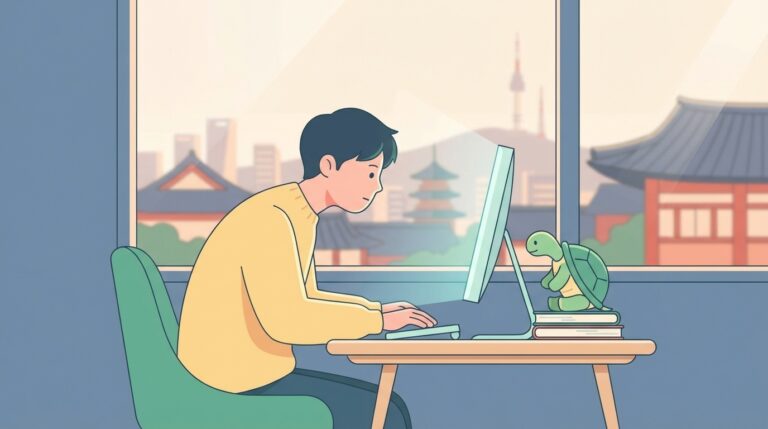
Phase 1: Empathy — Immersive Hook
Hello there! It’s your Daily Hangul Editor.
Picture this: You are riding the Seoul subway on Line 2 during rush hour. You look around, and almost everyone—from the high school student intensely watching a K-Pop V-Live to the office worker furiously typing an email—is staring down at their smartphones. Their necks are curved forward, forming a perfect ‘C’ shape.
Or maybe you’ve been sitting in a Korean PC Bang (internet cafe) for three hours, completely absorbed in a game or trying to secure those impossible K-Pop concert tickets. Suddenly, your Korean friend taps your shoulder and says, ‘Hey, you’re turning into a turtle!’
A turtle? 🐢
In today’s digital era, good posture (바른 자세) is a universal struggle, but Koreans have a very specific, slightly adorable, yet medically serious term for this modern epidemic. If you’re living in Korea, working at a Korean company, or simply spending hours hunched over your desk studying Hangul, knowing how to talk about your stiff neck and posture isn’t just about vocabulary—it’s survival.
Let’s dive into the words that will save your neck (literally) and make you sound like a true local.
Phase 2: Deep Dive into Core Expressions
1. 거북목 (Tech Neck / Forward Head Posture)
- Pronunciation: geo-bung-mok [Sounds like: ‘go’ + ‘boong’ + ‘mock’]
- Meaning: Literal: Turtle neck / Real nuance: Tech neck, forward head posture caused by looking at screens.
- K-Culture Moment: You’ll see this word everywhere in Korea—on orthopedic clinic advertisements in subway stations, in YouTube Pilates tutorials, and among friends teasing each other for having terrible posture while binge-watching K-Dramas.
- Editor’s Insight: It’s a highly visual word. When you stick your neck forward to look at a monitor, you look exactly like a turtle poking its head out of its shell. It’s used both casually among friends and formally by doctors.
- Situation Spectrum:
[🚫 Do not use] ———— [⚠️ Caution] ———— [✅ Freely]
- Close friends (Casual): ✅
- Co-workers (Semi-formal): ✅
- Boss/Elders (Formal): ✅ (It is a medical/descriptive term, totally fine!)
- 🤔 Think About It: Why did Koreans choose an animal (turtle) to describe a medical condition? Does your native language have visual metaphors for physical symptoms?
2. 목이 뻐근해요 (My neck is stiff)
- Pronunciation: mo-gi ppeo-geun-hae-yo [mo-gee ppeo (tense ‘p’ like ‘speak’ + ‘uh’) – geun – hae – yo]
- Meaning: Literal: My neck is stiff / Real nuance: My neck feels tight, heavy, and achy from bad posture or fatigue.
- K-Culture Moment: Imagine a classic K-Drama scene where the weary office worker stretches out their arms, rolls their neck, and lets out a long sigh after working overtime (야근). This is exactly what they are feeling.
- Editor’s Insight: English speakers often say ‘My neck hurts’ (목이 아파요). But in Korean, ‘아프다’ (hurts) usually implies a sharp pain or injury. If it’s just stiff and tired from sitting too long, ‘뻐근하다’ is the golden B2-level word you MUST know.
- Situation Spectrum:
[🚫 Do not use] ———— [⚠️ Caution] ———— [✅ Freely]
- Close friends (Casual): ✅ (목 뻐근해)
- Co-workers (Semi-formal): ✅ (목이 뻐근하네요)
- Boss/Elders (Formal): ✅ (목이 뻐근합니다)
- 🤔 Think About It: Korean has countless specific adjectives for different types of pain (stiff, throbbing, stinging, achy). Why do you think Korean culture puts so much emphasis on describing the exact ‘texture’ of physical sensation?
3. 어깨 쫙 펴세요! (Open up your shoulders!)
- Pronunciation: eo-kkae jjwag pyeo-se-yo! [eo-kkae jjwak (like ‘Jack’ but with a tight ‘jj’) pyeo-se-yo]
- Meaning: Literal: Spread your shoulders wide / Real nuance: Stop slouching, sit up straight, have confidence!
- K-Culture Moment: Your Korean personal trainer (PT) or Pilates instructor will shout this at you. It is also used metaphorically by parents to their children, meaning ‘Be confident! Don’t be intimidated!’
- Editor’s Insight: The adverb ‘쫙’ adds a satisfying sound effect, meaning ‘widely’ or ‘fully’. It gives the sentence an energetic, encouraging vibe.
- Situation Spectrum:
[🚫 Do not use] ———— [⚠️ Caution] ———— [✅ Freely]
- Close friends (Casual): ✅ (어깨 쫙 펴!)
- Co-workers (Semi-formal): ⚠️ (Might sound a bit bossy if you say it to a senior)
- Boss/Elders (Formal): 🚫 (Never tell your boss to fix their posture!)
- 🤔 Think About It: Body language is closely tied to emotion. How does ‘slouching’ translate to ‘lack of confidence’ in your culture?
Phase 3: Textbook vs Real Life
Let’s see how you actually sound in the wild versus in a classroom.
| Situation | 📖 Textbook Korean | 🗣️ Real Korean | 💡 Why is it different? |
|---|---|---|---|
| Telling someone their posture is bad | 자세가 좋지 않습니다. (Your posture is not good.) | 너 그러다 거북목 돼! (You’re gonna get a turtle neck!) | Koreans love exaggerating outcomes (turning into a turtle) to show care and concern. |
| Complaining about neck pain | 목에 통증이 있습니다. (I have pain in my neck.) | 아, 어깨 뭉쳤어. / 목 뻐근해. (Ah, my shoulders are knotted / neck is stiff.) | ‘뭉치다’ (to bunch up/knot) and ‘뻐근하다’ describe the exact physical sensation rather than a clinical ‘pain’. |
| Suggesting a stretch | 스트레칭을 하는 것이 어떨까요? (How about doing some stretching?) | 기지개 좀 켤까? (Shall we stretch our arms/bodies?) | ‘기지개’ specifically refers to that satisfying full-body stretch you do when waking up or after sitting a long time. |
Bottom Note for B2 Learners: Upgrading your vocabulary from basic ‘아프다’ (to hurt) to nuanced adjectives like ‘뻐근하다’ (stiff) or ‘뭉치다’ (knotted) instantly makes you sound like you’ve lived in Seoul for years.
Phase 4: Cultural Deep Dive
4-1. Non-verbal Communication: The Office Stretch & Nunchi
In a Korean office, working hard is valued, but so is not dying at your desk. It is totally acceptable to suddenly stand up, twist your torso, and do a little neck stretch by your desk. However, this requires a bit of ‘눈치’ (Nunchi – the ability to read the room). If the team atmosphere is extremely tense because a deadline was missed, maybe do your stretching quietly in the restroom rather than sighing loudly and stretching in front of your stressed manager!
4-2. K-Culture Connection: The Irony of the Palli-Palli Lifestyle
Have you ever noticed how K-Drama characters who are successful CEOs or fierce lawyers always seem to have impeccable posture, while the overworked junior staff are constantly rubbing the backs of their necks?
Korea’s intense ‘빨리빨리’ (Palli-Palli / Hurry-Hurry) culture means long hours sitting at desks, studying in ‘Hagwons’ (cram schools), or working in front of computers. To combat this, Korea has a massive health and wellness industry. It is very common to see office workers taking Pilates classes during their lunch breaks, or K-Pop idols carrying around massage tools (like wooden massage balls or foam rollers) in their ‘What’s in my bag’ videos. Taking care of your posture is seen as a form of self-management (자기관리), which is highly respected in Korean society.
Phase 5: Immersive Roleplay Scenario
Scenario A: The ‘Turtle’ in the Cafe
Setting: A trendy cafe in Yeonnam-dong. It’s 3 PM on a Sunday. You’ve been hunched over your laptop for three hours, intensely studying Korean grammar. Your Korean friend, Min-su (28, a graphic designer who suffers from chronic neck pain), is sitting across from you.
민수: 야, 화면 안으로 들어가겠다. 목 좀 펴!
(Ya, hwamyeon an-eu-ro deureogagetda. mok jom pyeo!)
(English: Hey, you’re going to crawl into the screen. Straighten your neck!)
(🎭 Stage Direction: Min-su physically mimics your terrible posture, hunching his shoulders up to his ears.)
YOU: 아, 진짜? 나 지금 자세 많이 이상해?
(Ah, jinjja? Na jigeum jase mani isanghae?)
(English: Ah, really? Is my posture really weird right now?)
민수: 어, 완전 거북목이야. 그러다 나처럼 도수치료 받으러 다녀야 돼.
(Eo, wanjeon geo-bung-mo-gi-ya. Geureoda nacheoreom dosuchiryo badeureo danyeoya dwae.)
(English: Yeah, it’s a total turtle neck. If you keep that up, you’ll have to go get physical therapy like me.)
🔀 Your Turn! How should you respond?
– A) 네, 저는 바른 자세를 유지하는 건강한 외국인입니다. (Yes, I am a healthy foreigner who maintains good posture.)
– B) 아, 목 뻐근해. 우리 기지개 좀 켤까? (Ah, my neck is stiff. Shall we do a little stretch?)
– C) 신경 쓰지 마! 내 목이야! (Mind your own business! It’s my neck!)✅ Best Choice: B — Why? It acknowledges the situation naturally, uses advanced vocabulary (뻐근해, 기지개), and suggests a collective action, which Koreans love.
⚠️ Choice C Analysis: Way too aggressive for a friend who is just worried about your health!
Scenario B: Bonus — The Pharmacy Rescue
Setting: You finally realize your neck is killing you. You walk into a Korean Pharmacy (약국) with a glowing green cross sign.
약사 (Pharmacist): 어떻게 오셨어요?
(How can I help you?)
YOU: 목이 너무 뻐근해서요. 파스 좀 주세요.
(My neck is really stiff. Please give me some pain relief patches.)
약사: 시원한 거 드릴까요, 뜨거운 거 드릴까요?
(Would you like the cooling ones or the heating ones?)
YOU: 뜨거운 걸로 주세요!
(The heating ones, please!)
Phase 6: 10-Second Shadowing Drill
Let’s practice the most useful sentence when you’ve been working too hard.
😫 아, / 목이 너무 뻐근해요. / 우리 / 기지개 한 번 켤까요?
(Ah, / mo-gi neo-mu ppeo-geun-hae-yo. / u-ri / gi-ji-gae han beon kyeol-kka-yo?)
- Intonation tip: Let out a little groan on ‘아’ (Ah) to sound authentic. Pause briefly at the slashes
/. - Vibe: Exhausted but looking for a quick refreshing break.
Phase 7: K-Culture Glossary
| Korean | Romanization | English | Context/Explanation |
|---|---|---|---|
| 거북목 | geo-bung-mok | Turtle neck / Tech neck | Forward head posture caused by screen time. |
| 파스 | pa-seu | Pain relief patch | Essential Korean pharmacy item. Comes in Cool (쿨) and Hot (핫). |
| 기지개 | gi-ji-gae | Full body stretch | The act of stretching one’s limbs out, usually accompanied by a groan of relief. |
| 안마의자 | an-ma-ui-ja | Massage chair | Very popular in Korean households and relaxation cafes to fix stiff muscles. |
| 야근 | ya-geun | Overtime work | Working late at night, a common cause of ‘geo-bung-mok’ and stiff shoulders! |
| 자기관리 | ja-gi-gwan-ri | Self-management | The concept of taking care of one’s appearance, health, and posture. |
Phase 8: Traveler’s Survival Kit
If you are traveling in Korea, carrying heavy luggage or looking down at Naver Maps all day will ruin your posture and your neck! Here is what you need to know when you visit a pharmacy (약국).
🆘 Survival Expression #1: Buying Patches
– 🇰🇷 “목에 붙일 파스 주세요.” (moge buchil paseu juseyo.)
– 🗣️ Pronunciation: mo-ge boo-chil pa-seu joo-se-yo.
– 📍 Where to use: 약국 (Pharmacy)
– 💡 Pro Tip: Korean pharmacies have dozens of ‘파스’ (patches). If you have muscle stiffness from bad posture, ask for a ‘핫파스’ (Hot patch) to relax the muscles. If you have an acute injury (like a sprained ankle), ask for a ‘쿨파스’ (Cool patch).📌 Editor’s Travel Note
Convenience stores (CU, GS25, 7-Eleven) also sell basic medical supplies, including ‘파스’, late at night when pharmacies are closed. Just look for the ‘안전상비의약품’ (Over-the-counter medicine) shelf near the cashier!
Phase 9: Think Deeper — Media vs Reality
🧠 Think Deeper: Media vs Reality in Korean Corporate Life
In K-Dramas, the wealthy CEO is always sitting perfectly upright in a sleek ergonomic chair, looking flawless. However, the reality of the Korean workplace is quite different. Walk into any office in Gangnam or Pangyo, and you’ll see a sea of ‘turtle necks’ (거북목) hunched over keyboards, with small desk humidifiers running and pain relief patches (파스) peeking out from under collars. The media portrays Korean professionals as effortlessly polished, but real life reveals a culture of intense dedication that takes a physical toll. This is why the ‘wellness’ and ‘posture correction’ industries are booming in Korea—it’s a necessary counterbalance to the extreme work ethic.💬 Your Turn: Does media in your country accurately portray the physical reality of working long hours? Share your thoughts in the comments!
Phase 10: FAQ & Troubleshooting
Q: “Can I tell my boss ‘거북목이에요’ (You have a turtle neck)?”
A: No, please don’t! 🚫 While ‘거북목’ is a clinical term, commenting on a superior’s posture or physical appearance is considered rude. If you want to care for your boss, quietly place a warm coffee or a vitamin C drink on their desk instead!
Q: “What if my whole body aches, not just my neck?”
A: You can use the word ‘몸살’ (mom-sal), which refers to body aches from fatigue or a cold. “몸살 났어요” (I have body aches).
❌ Common Mistake:
Translating “My shoulders are tight” literally into “내 어깨는 타이트하다” (nae eo-kkae-neun ta-i-teu-ha-da).
✅ Do this instead:
Koreans don’t use the English loanword ‘tight’ for muscles. Always use “어깨가 뭉쳤어요” (eo-kkae-ga mung-chyeo-sseo-yo), meaning the muscles are bunched up or knotted.
Phase 11: Wrap-up & Action Items
One-Liner Summary: To survive the digital age in Korea, don’t become a ‘turtle’ (거북목), and know how to say your neck is stiff (뻐근하다)!
Your Mission for Today:
– 🥉 Bronze (Solo): Roll your shoulders back right now and say “어깨 쫙 펴자!” (Let’s open up our shoulders!) to yourself.
– 🥈 Silver (Online): Leave a comment on this post saying how your neck feels today using the word ‘뻐근하다’.
– 🥇 Gold (Real World): The next time you are studying Korean with a friend or language partner, suggest a stretching break by saying “우리 기지개 좀 켤까요?”
K-Culture Mission: Next time you watch a K-Drama or a K-Pop idol’s behind-the-scenes vlog, look out for anyone stretching their neck or complaining about their shoulders being ‘뭉쳤어’ (knotted). It happens more often than you think!
How is your posture right now while reading this? Tell me in the comments! 👇
Phase 12: Interactive Quiz
1. Situational Judgment:
You’ve been studying Hangul for 4 hours straight. Your neck feels heavy and tight. What is the most natural thing to say to your friend?
– A) 목이 아픕니다. 병원에 가야 합니다.
– B) 아, 목 뻐근해. 기지개 좀 켤까?
– C) 내 거북목을 보세요.
2. Fill in the Blank:
Stop slouching! ______ 쫙 펴세요! (Open up your ______!)
– A) 다리 (Legs)
– B) 허리 (Waist)
– C) 어깨 (Shoulders)
3. True or False — K-Culture Edition:
If you have a stiff neck at 11 PM and pharmacies are closed, you can buy a ‘파스’ (pain relief patch) at a Korean convenience store. (T/F)
(Answers: 1. B – ‘뻐근해’ is exactly for this stiff feeling! / 2. C – 어깨 (Shoulders) / 3. True! Look for the medical shelf near the counter.)
Frequently Asked Questions (FAQ)
Q: What does "거북목 (Tech Neck / Forward Head Posture)" mean in Korean and how do you pronounce it?
A: In Korean, "거북목 (Tech Neck / Forward Head Posture)" is pronounced [geo-bung-mok [Sounds like: 'go' + 'boong' + 'mock'] and means: Literal: Turtle neck / Real nuance: Tech neck, forward head posture caused by looking at screens.
Q: What does "목이 뻐근해요 (My neck is stiff)" mean in Korean and how do you pronounce it?
A: In Korean, "목이 뻐근해요 (My neck is stiff)" is pronounced [mo-gi ppeo-geun-hae-yo [mo-gee ppeo (tense 'p' like 'speak' + 'uh'] and means: Literal: My neck is stiff / Real nuance: My neck feels tight, heavy, and achy from bad posture or fatigue.
Q: What does "어깨 쫙 펴세요! (Open up your shoulders!)" mean in Korean and how do you pronounce it?
A: In Korean, "어깨 쫙 펴세요! (Open up your shoulders!)" is pronounced [eo-kkae jjwag pyeo-se-yo! [eo-kkae jjwak (like 'Jack' but with a tight 'jj'] and means: Literal: Spread your shoulders wide / Real nuance: Stop slouching, sit up straight, have confidence!







