

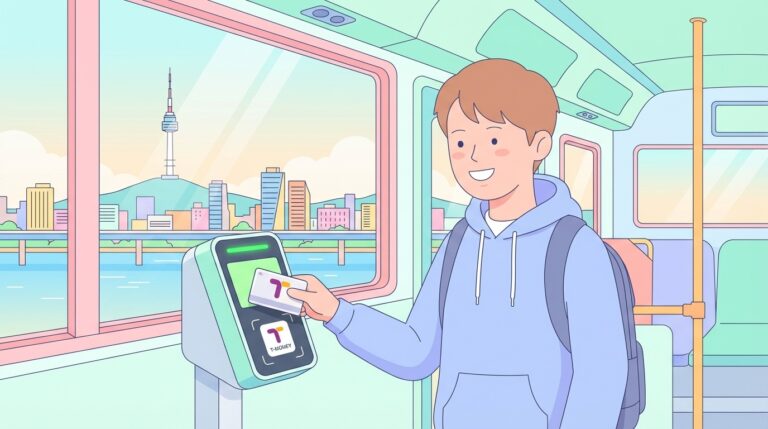
Phase 1: Immersive Hook\n\nHello! I am the lead editor at Daily Hangul, your veteran tutor and local cultural navigator. \n\nPicture this: You are finally in Seoul. You’ve watched over 100 K-Dramas where the main character gazes thoughtfully out the bus window, listening to indie music as the city lights blur by. It looks so romantic, right? \n\nSo, you confidently step onto the iconic green Seoul bus, tap your transit card, and suddenly… \n\nBEEP BEEP BEEP! \”잔액이 부족합니다!\” (Insufficient balance!) \n\nThe driver glares. The passengers behind you let out a soft sigh. The K-Drama fantasy shatters instantly, and you’re left standing there with a line of busy locals waiting behind you. \n\nDon’t worry! Every foreigner (and even Koreans!) has experienced this exact moment. Public transportation in Korea is incredibly efficient, but it moves fast. If you don’t know the unwritten rules and key phrases, the bus can feel like an intimidating ride. \n\nThis guide is based on real panic moments from my beginner (A2) students. Today, we are going to learn exactly what to say when paying your bus fare, how to avoid the dreaded error beeps, and how to ride the Seoul bus like a true local.\n\n—\n\n## Phase 2: Deep Dive into Core Expressions\n\nLet’s master the most crucial phrases you need for the Korean bus. \n\n> ### 1. 기사님, 두 명이요! (Driver, for two please!)\n> \n> – Pronunciation: [gisanim, du myeong-iyo] -> ghee-sah-neem, doo myuhng-ee-yo (‘du’ sounds like ‘do’, ‘myeong’ rhymes with ‘song’)\n> – Meaning: I am paying for two people. (Literal: Driver, two people!)\n> – K-Culture Moment: You are traveling with a friend who forgot their wallet, or you want to treat your date by paying their fare. In Korea, treating someone to small things like coffee or a bus fare is a common way to show affection (정 – jeong).\n> – Editor’s Insight: You must say this before you tap your card! If you just tap it twice, the machine will flash a red error light because it has a cooldown timer to prevent accidental double-charges.\n> – Situation Spectrum:\n> [🚫 Do not use] ———— [⚠️ Caution] ———— [✅ Freely]\n> – Friends (Casual): ✅ (You say this to the driver, not your friend)\n> – Strangers/Service Staff (Polite): ✅ \n> – 🤔 Think About It: Notice how we call the driver “기사님” (Engineer/Driver + respectful ‘nim’). Why do Koreans use job titles instead of “Mr.” or “Excuse me”? How do you call service workers in your culture?\n\n> ### 2. 000원 충전해 주세요. (Please recharge 000 won.)\n> \n> – Pronunciation: [-won chungjeonhae juseyo] -> *-wahn choong-jeon-hae joo-seh-yo\n> – Meaning: Please put [amount] on my transit card.\n> – K-Culture Moment: You run into a GS25 or CU convenience store right before the bus arrives. You hand them cash and your T-money card. It’s a classic traveler survival moment!\n> – Editor’s Insight: You can’t recharge a T-money card on the bus itself. You must do it at a convenience store or subway station. \n> – Situation Spectrum:\n> [🚫 Do not use] ———— [⚠️ Caution] ———— [✅ Freely]\n> – Convenience Store Clerks: ✅\n> – 🤔 Think About It: The word “충전” (chungjeon) literally means “charging a battery.” Koreans use it for phones, transit cards, and even taking a rest (“I need to recharge my energy”). \n\n> ### 3. 내려주세요! (Please let me off!)\n> \n> – Pronunciation: [naeryeojuseyo] -> *neh-ryuh-joo-seh-yo\n> – Meaning: Please open the door / I want to get off!\n> – K-Culture Moment: The bus is packed like a can of sardines during rush hour. You couldn’t push your way to the back door in time, and the doors are closing! You yell this in a slight panic.\n> – Editor’s Insight: Korean buses don’t wait long. If you don’t step off immediately, the driver assumes no one is leaving. Don’t be shy—shout this if you’re trapped!\n> – Situation Spectrum:\n> [🚫 Do not use] ———— [⚠️ Caution] ———— [✅ Freely]\n> – Emergency/Bus driver: ✅\n\n—\n\n## Phase 3: Textbook vs Real Life\n\nTextbooks teach you grammatically perfect sentences, but on a moving bus, nobody has time for that. Let’s look at the difference.\n\n| Situation | 📖 Textbook Korean | 🗣️ Real Korean | 💡 Why is it different? |\n|—|—|—|—|\n| Want to pay | 현금으로 내겠습니다. (I will pay with cash.) | (Silently taps T-money card) | Seoul is transitioning to “Cashless Buses” (현금 없는 버스) for efficiency! |\n| Asking the price | 버스 요금이 얼마입니까? (How much is the fare?) | (Just looks at the card reader screen) | The T-money machine shows exactly how much is deducted and your remaining balance. |\n| Getting off | 이번 정류장에서 내리겠습니다. (I will get off at this stop.) | (Silently presses the red STOP bell) | Communication is automated to keep the “pali-pali” (fast) system flowing smoothly. |\n\n—\n\n## Phase 4: Cultural Deep Dive — K-Culture on the Bus\n\n### 4-1. Non-verbal Communication: The “Pali-Pali” Stance\nIn your country, you might be taught to stay seated until the bus comes to a complete stop. Do not do this in Korea! Due to the Pali-pali (hurry up) culture, you must stand up, walk to the back door, and hover your card over the reader before the bus stops. If you wait until it stops to stand up, the driver might close the doors and drive away! It requires a bit of physical balance, but you’ll get used to it.\n\n### 4-2. The Magic of “Transfer” (환승)\nIn K-Dramas, you might see a character get off a bus and immediately jump onto the subway to chase someone. Economically, this is brilliant because of Korea’s Transfer System (환승 할인)! If you tap your card when getting off the bus (하차 태그), your next ride on a different bus or subway within 30 minutes is almost entirely free. \n\n—\n\n## Phase 5: Immersive Roleplay Scenario\n\nSetting: A rainy Friday evening in Hongdae. Bus 273 pulls up. The doors hiss open. It’s crowded, and everyone wants to get home.\nCharacters:\n- YOU: A traveler who has been studying Korean for 3 months.\n- MINA (25): Your energetic Korean friend who was busy taking selfies.\n\nDialogue:\n\nMINA: 야, 버스 왔다! 뛰어! 🏃♀️\n(Ya, beoseu watda! Ttwieo!)\n[Hey, the bus is here! Run!]\n(🎭 Stage Direction: You both dash toward the green bus. Mina frantically pats her pockets.)\n\nYOU: Wait, 273… Is this our bus?\n\nMINA: 헐… 나 지갑 안 가져왔어. 😱\n(Heol… na jigap an gajyeowasseo.)\n[Omg… I didn’t bring my wallet.]\n\nYOU: Seriously? Don’t panic, I have my T-money card.\n\nMINA: 아, 진짜? 고마워! 근데 나까지 어떻게 내? \n(A, jinjja? Gomawo! Geunde nakkaji eotteoke nae?)\n[Ah, really? Thanks! But how do you pay for me too?]\n\n> 🔀 Your Turn! How will you respond to the driver?\n> – A) \”두 명입니다.\” (Standard, but a bit stiff)\n> – B) \”기사님, 두 명이요!\” (Friendly, natural, and gets the driver’s attention)\n> – C) (Just tap the card twice silently)\n> \n> ✅ Best Choice: B. If you choose C, the machine will reject the second tap. You must tell the driver so they can adjust the machine’s setting to charge for two!\n\nYOU: 기사님, 두 명이요! ✌️\n(Gisanim, du myeong-iyo!)\n[Driver, for two please!]\n\nDRIVER: 네, 카드 대세요.\n(Ne, kadeu daeseyo.)\n[Yes, please tap your card.]\n(🎭 Stage Direction: You confidently tap the card on the scanner.)\n\nMACHINE: 삑! 다인승입니다. 🤖\n(Bbeeg! Dainseung-imnida.)\n[Beep! Multi-passenger.]\n\nMINA: 대박! 너 진짜 한국인 같아. ✨\n(Daebak! Neo jinjja hangugin gata.)\n[Awesome! You seem like a real Korean.]\n\nYOU: Pali-pali! Let’s hold onto the handles before the bus takes off!\n\n—\n\n## Phase 6: 10-Second Shadowing Drill\n\nLet’s practice the exact rhythm and intonation. Follow the slashes (/) for pauses!\n\n🗣️ 😊 기사님! / 두 명이요~ \n(gi-sa-nim! / du myeong-i-yo~)\n(Friendly tone: Driver! / Two people~)\n\n🗣️ 🥺 저기요! / 내려주세요! \n(jeo-gi-yo! / nae-ryeo-ju-se-yo!)\n(Desperate/Urgent tone: Excuse me! / Please let me off!)\n\n—\n\n## Phase 7: K-Culture Glossary (Mini Dictionary)\n\n| Korean | Romanization | English | Cultural Context |\n|—|—|—|—|\n| 눈치 | nunchi | Reading the room | Essential bus skill: sensing when to move to the back so others can board. |\n| 티머니 | ti-meo-ni | T-money | The supreme transit card. Works on buses, subways, taxis, and even in convenience stores! |\n| 하차벨 | hacha-bel | Stop bell | The red buttons scattered around the bus. Press it before your stop approaches. |\n| 환승 | hwanseung | Transfer | The system that gives you free/discounted rides if you tap when getting off. |\n| 다인승 | dainseung | Multi-passenger | What the machine says when you successfully pay for more than one person. |\n\n—\n\n## Phase 8: Traveler’s Survival Kit 🎒\n\nIf you forget everything else, save this card to your phone!\n\n> 🆘 Survival Phrases for the Bus\n> 1. 🇰🇷 \”기사님, 두 명이요!\” (Driver, two people!)\n> – 📍 When to use: Boarding the bus with a friend using one card.\n> 2. 🇰🇷 \”만원 충전해 주세요.\” (Please recharge 10,000 won.)\n> – 📍 When to use: Handing cash and your card to a convenience store clerk.\n> 3. 🇰🇷 \”내려주세요!\” (Please let me off!)\n> – 📍 When to use: If the doors close before you can exit.\n\n> 📌 Editor’s Travel Note\n> – Cashless Buses: Look for buses with \”현금 없는 버스\” signs. They do not accept coins or bills. Always keep your T-money card loaded!\n> – Apps: Download Naver Map or KakaoMap. Google Maps does not give accurate walking or bus directions in Korea due to security laws.\n> – Tapping Out: Always tap your card when you get OFF the bus, even if you aren’t transferring. It prevents penalty charges on your next ride!\n\n—\n\n## Phase 9: Think Deeper — \”Media vs Reality\”\n\n🧠 Media vs Reality: The K-Drama Bus Illusion\nIn K-Dramas, bus scenes are used for quiet reflection. The protagonist sits in the back, leaning their head against the window while a soft acoustic OST plays. In reality, doing this might result in hitting your head against the glass! Korean bus drivers navigate dense traffic with incredible speed and agility. This reflects Korea’s intense drive for efficiency and the fast-paced modern lifestyle. The bus isn’t just a vehicle; it’s the pulsing bloodstream of Seoul, moving millions of people exactly on time. \n\n💬 Your Turn: Does public transport in your country run perfectly on time? Is it slow and relaxing, or fast and chaotic like Seoul? Share in the comments!\n\n—\n\n## Phase 10: FAQ & Troubleshooting\n\nQ: Can I pay for 3 or 4 people with one card?\nYes! Just change the number. \”기사님, 세 명이요 (Three people)\” or \”네 명이요 (Four people).\” Just make sure you have enough balance!\n\nQ: What if I forget to tap my card when getting off?\nYou won’t go to jail, but you will be charged a penalty fee (double the base fare) the next time you use that card. Always tap out!\n\n> ❌ Common Mistake #1: \n> Tapping the card twice silently to pay for two people.\n> ✅ Do this instead: \n> Tell the driver FIRST (기사님, 두 명이요!), wait for them to press a button on their console, and then tap your card when they say \”네 (Yes)\” or \”대세요 (Tap it)\”.\n\n—\n\n## Phase 11: Wrap-up & Action Items\n\n💡 One-Liner Summary: To survive the Seoul bus, tell the driver before you tap for multiple people, and always remember to tap when you get off!\n\n🚀 Action Missions:\n- 🥉 Bronze (Solo): Say \”기사님, 두 명이요!\” out loud 3 times mimicking the shadowing drill.\n- 🥈 Silver (Online): Leave a comment in English or Korean: \”If I visit Seoul, I want to take the bus to [Your Dream Destination]!\”\n- 🥇 Gold (Real Life): Next time you are in Korea or at a Korean convenience store in your country, try using \”__원 충전해 주세요\” to reload a card!\n\n**🎧 K-Culture Mission:** \nWatch an episode of any modern K-Drama today. Look closely at the bus scenes. Notice how they tap their cards (listen for the ‘Beep!’) and see if they press the red STOP bell!\n\n—\n\n## Phase 12: Interactive Quiz 🎯\n\nTest your new survival skills!\n\n**1. You are getting on the bus with two friends (3 people total). You are paying for everyone. What do you do?**\n- A) Tap the card 3 times very fast.\n- B) Say \”기사님, 세 명이요!\” and wait for the driver’s nod before tapping.\n- C) Give the driver a 50,000 won bill.\n(Answer: B. A will cause an error, and C will make the driver very stressed, especially on a cashless bus!)\n\n**2. Fill in the blank:** You want to get off, but the bus is too crowded and the door is closing. You shout: \”기사님, ________!\”\n- A) 안녕하세요 (Hello)\n- B) 내려주세요 (Please let me off)\n- C) 사랑해요 (I love you)\n(Answer: B. If you say C, the driver will be very confused!)\n\n**3. True or False:** You should stay comfortably in your seat until the bus completely stops at your destination.\n(Answer: False! You need to stand up, move to the door, and get ready to tap out before the bus stops.)\n\nGreat job today! You are now officially ready to navigate the streets of Seoul like a local. See you in the next Daily Hangul lesson! 👋
Frequently Asked Questions (FAQ)
Q: What does "BEEP BEEP BEEP! \"잔액이 부족합니다!\"" mean in Korean and how do you pronounce it?
A: In Korean, "BEEP BEEP BEEP! \"잔액이 부족합니다!\"" is pronounced [Insufficient balance!] and means: \n\nThe driver glares. The passengers behind you let out a soft sigh. The K-Drama fantasy shatters instantly, and you're left standing there with a line of busy locals waiting behind you. \n\nDon't worry! Every foreigner (and even Koreans!) has experienced this exact moment. Public transportation in Korea is incredibly efficient, but it moves







