

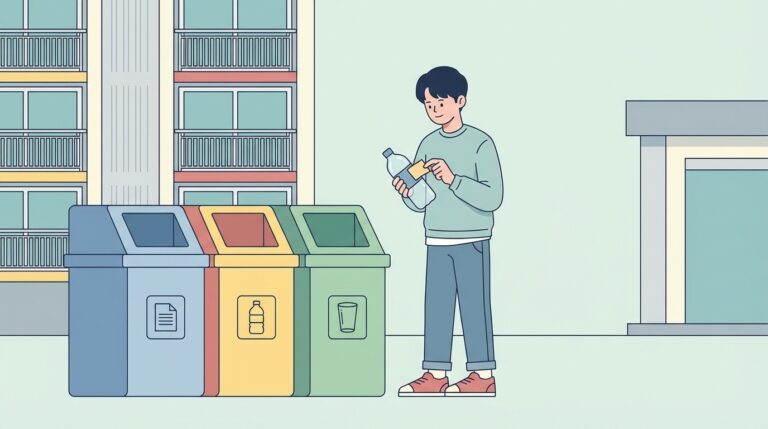
Phase 1: Immersive Hook — The Late-Night Trash Run Romance\n\nWelcome back! I’m the Lead Editor of Daily Hangul, your veteran Korean tutor and local cultural navigator.\n\nPicture this: You’re watching a slice-of-life K-Drama. The male and female leads, dressed in baggy sweatpants and oversized hoodies, bump into each other late at night. Where are they? A romantic rooftop? A dimly lit alleyway? No, they are at the neighborhood recycling station (분리수거장). And what is the female lead doing? She is aggressively, almost mathematically, ripping a plastic label off a clear water bottle before crushing it with her heel. \n\nIn Korea, recycling isn’t just an eco-friendly suggestion—it’s practically a competitive sport and a strict legal obligation. Since the nationwide mandate for separating transparent PET bottles (투명 페트병 분리 배출 의무화) and removing their labels began, the way Koreans handle their trash has fundamentally changed. If you don’t follow this rule, not only could you face a hefty fine (과태료), but you’ll also suffer the ultimate social punishment: the intense, judgmental glare (nunchi) of the neighborhood security guard (경비 아저씨) or your neighbors.\n\nAs a C2 advanced learner, you already know basic vocabulary like ‘쓰레기’ (trash). Today, we’re diving into the sophisticated, highly specific vocabulary and cultural nuances required to survive Korea’s strict Eco Action laws. Let’s make sure you never end up as the villain in your neighborhood’s recycling drama!\n\n—\n\n## Phase 2: Deep Dive — Core Expressions for Eco Survival\n\nTo navigate this complex system, you need precise verbs and nouns. Let’s break down the essential expressions.\n\n> ### 1. 투명 페트병은 라벨을 완전히 뜯어서 버려야 돼요.\n> \n> – Pronunciation: Tumyeong peteubyeong-eun rabel-eul wanjeonhi tteudeoseo beoryeoya dwaeyo. / ‘뜯’ sounds like the sharp ‘t’ when you say ‘tut-tut’, but tighter.\n> – Meaning: You must completely tear off the label from clear PET bottles before throwing them away.\n> – K-Culture Moment: You’re in a shared office pantry or a guesthouse. Someone is about to toss an unpeeled Coke bottle into the bin. You gently but firmly step in to save them from the wrath of the building manager.\n> – Editor’s Insight: The verb 뜯다 (to tear/rip off) is much more commonly used in spoken Korean than the formal 제거하다 (to remove). Notice the grammatical structure -아/어야 되다 expressing strong obligation. This isn’t a request; it’s a rule.\n> – Situation Spectrum: [🚫 절대 금지] ———— [⚠️ 주의] ———— [✅ 자유롭게]\n> – Casual with friends: ✅ (Often shortened to “라벨 뜯고 버려!”)\n> – Office/Semi-formal: ✅\n> – Formal/Elders: ⚠️ (Use “라벨을 제거하고 버리셔야 합니다” for extra politeness)\n> – 🤔 Think About It: Why does Korean have so many specific verbs for altering objects (뜯다, 까다, 벗기다, 떼다)? How does your native language handle the concept of ‘removing an outer layer’?\n\n> ### 2. 내용물을 물로 한 번 헹궈주세요.\n> \n> – Pronunciation: Naeyongmul-eul mul-lo han beon henggwojuseyo. / ‘헹’ sounds like ‘heng’ with a slight sigh.\n> – Meaning: Please rinse out the contents with water once.\n> – K-Culture Moment: At a Han River picnic, after finishing delivery tteokbokki and sweet drinks, your Korean friend takes the plastic containers to the restroom to rinse them before throwing them away. Yes, we actually do this!\n> – Editor’s Insight: 헹구다 (to rinse) is a crucial vocabulary word for advanced learners. You can’t just throw away a sticky juice bottle. It must be clean. The addition of 한 번 (once) softens the command, making it sound more polite and cooperative.\n> – Situation Spectrum: [🚫 절대 금지] ———— [⚠️ 주의] ———— [✅ 자유롭게]\n> – Casual with friends: ✅ (야, 물로 한 번 헹궈!)\n> – Office/Semi-formal: ✅\n> – Formal/Elders: ✅ (Perfectly polite)\n> – 🤔 Think About It: Does the expectation to wash your trash before discarding it exist in your culture? How does this reflect Korea’s collective responsibility mindset?\n\n> ### 3. 발로 꽉 찌그러뜨려서 부피를 줄이셔야 돼요.\n> \n> – Pronunciation: Bal-lo kkwak jjigeureotteuryeoseo bupi-reul jurisyeoya dwaeyo. / ‘찌’ sounds like ‘jji’ in ‘jiggle’ but much tenser.\n> – Meaning: You need to crush it tight with your foot to reduce the volume.\n> – K-Culture Moment: The satisfying CRUNCH echoing through a Korean apartment complex on a Thursday night (typically recycling day). Fathers and college students alike are stomping on mountains of Coupang water bottles.\n> – Editor’s Insight: 찌그러뜨리다 (to crush/crumple) is a fantastic, highly descriptive verb. 부피를 줄이다 (to reduce volume) is the formal reason we do it. Using these words instantly makes you sound like a local who pays their resident taxes.\n> – Situation Spectrum: [🚫 절대 금지] ———— [⚠️ 주의] ———— [✅ 자유롭게]\n> – Casual with friends: ✅ (발로 밟아!)\n> – Office/Semi-formal: ✅\n> – Formal/Elders: ✅\n> – 🤔 Think About It: Notice the adverb 꽉 (tightly/firmly). Korean uses a lot of mimetic words (의태어) to add vivid imagery to actions. Can you think of other Korean verbs paired with ‘꽉’?\n\n—\n\n## Phase 3: Textbook vs Real Life\n\nAs a C2 learner, you need to know the gap between government PSAs and how people actually speak at the trash bins.\n\n| 상황 | 📖 교과서/정부 안내문 | 🗣️ 진짜 한국어 (Real Life) | 💡 왜 다를까? (Why the difference?) |\n|—|—|—|—|\n| Referring to the act of recycling | 분리배출을 생활화합시다. (Let’s make separating trash a daily habit.) | 분리수거 똑바로 해라. (Do the recycling properly.) | Technically, citizens ‘배출’ (discharge) and the city ‘수거’ (collects), but in everyday slang, everyone just says 분리수거 (bunrisugeo). |\n| Removing the label | 라벨을 제거해 주십시오. | 라벨 뜯어/떼어내. | ‘제거하다’ is a Sino-Korean word (Hanja) used in writing. Native Korean verbs (뜯다/떼다) are preferred in spoken, dynamic situations. |\n| Fines | 과태료가 부과됩니다. | 걸리면 벌금 물어요/딱지 끊겨요. | While ‘과태료’ is the legal term, everyday conversation often borrows the dramatic ‘벌금을 물다’ (pay a penalty) or ‘딱지를 끊기다’ (get a ticket). |\n\nBottom Note: Stick to 분리수거 in daily conversation, but if you’re writing a formal email to your landlord, use 분리배출 to show off your C2 proficiency!\n\n—\n\n## Phase 4: Cultural Deep Dive — The Rules of the Bin\n\n### 4-1. Non-verbal Communication: The “Nunchi” of Recycling\nWhen you take out the recycling in a Korean apartment complex (아파트 단지), you are entering a zone of extreme nunchi. If you hesitate in front of the bins, holding a plastic bottle and wondering if it’s PET or regular plastic, the security guard (경비원) will likely swoop in. \n\nThe non-verbal rule here is confidence and speed. Have your clear PET bottles already peeled, crushed, and bagged before you leave your apartment. If you try to peel labels in front of the bins, you’ll hold up the line, and the collective sighs of your neighbors will be deafening.\n\n### 4-2. K-Culture Connection: The Drama Tropes & Shared Living\nK-Drama Connection: The recycling bin is a classic K-Drama trope. Why? Because it’s the one place where characters must go regardless of their status, and they usually go looking their worst (sweatpants, messy hair). It represents a great equalizer. It’s where neighbors gossip, where the mother-in-law inspects the daughter-in-law’s domestic skills, and where secret late-night confessions happen. \n\nK-Travel/Living Connection: If you stay in an Airbnb, a Gosiwon, or a shared villa, the host will almost always leave you a detailed, 5-page manual on recycling. The strictness isn’t the host being difficult; it’s because the local district office will literally refuse to pick up the trash if a single clear PET bottle has a label on it, leading to a rotting pile of garbage and massive fines for the building.\n\n—\n\n## Phase 5: Immersive Roleplay — The Office Pantry Showdown\n\nSetting: Friday, 5:30 PM. The pantry of your startup office in Gangnam. Everyone is tired and wants to go home. The trash bins are overflowing. You are standing near the sink when your Korean coworker, Minsu, walks in holding an empty, label-on clear plastic juice bottle.\n\nCharacters:\n- YOU: An expat working in Seoul, fiercely protective of the office recycling rules because you got scolded by the cleaning lady last week.\n- Minsu (32): Your friendly but slightly lazy Korean coworker who is rushing to leave for a Friday night company dinner (회식).\n\n(Dialogue)\n\nMinsu: 아, 드디어 퇴근이다! 이번 주 진짜 길었죠? 😩\n(A, deudieo toegeun-ida! Ibeon ju jinjja gireotjyo?)\n[Ah, finally time to get off work! This week was really long, right?]\n\nYOU: 맞아요, 수고하셨어요 민수 씨. 근데 그 병, 그냥 버리시게요?\n(Majayo, sugohasyeosseoyo Minsu ssi. Geunde geu byeong, geunyang beorisigeyo?)\n[Right, great job this week, Minsu. But that bottle, are you going to just throw it away like that?]\n\nMinsu: 네? 아, 이거 플라스틱 통에 넣으면 되는 거 아니에요?\n(Ne? A, igeo peullaseutik tong-e noeumyeon doeneun geo anieyo?)\n[Huh? Ah, shouldn’t I just put this in the plastic bin?]\n\nYOU: 앗, 그거 투명 페트병이잖아요. 라벨 떼고 버리셔야 돼요!\n(At, geugeo tumyeong peteubyeong-ijanayo. Rabel ttego beorisyeoya dwaeyo!)\n[Ah, that’s a clear PET bottle. You have to remove the label before throwing it away!]\n\nMinsu: 아… 진짜 귀찮네요. 옛날엔 그냥 다 같이 버렸는데. 😅\n(A… jinjja gwichanneyo. Yennal-en geunyang da gachi beoryeonneunde.)\n[Ah… that’s really annoying. In the past, we just threw it all together.]\n\nYOU: 법이 바뀌어서 이제 투명 페트병은 따로 분리배출해야 한대요.\n(Beob-i bakkwieoseo ije tumyeong peteubyeong-eun ttaro bunribaeChul-haeya handaeyo.)\n[The law changed, so now clear PET bottles have to be recycled separately.]\n\nMinsu: (Trying to peel it, but it’s sticky) 어? 이거 끈적거려서 잘 안 떨어지는데요?\n(Eo? Igeo kkeunjeokgeoryeoseo jal an tteoreojineundeyo?)\n[Uh? It’s sticky so it’s not coming off easily?]\n\n> 🔀 당신의 차례! 어떻게 대답할까요? (Your Turn! How will you respond?)\n> \n> – A) “제가 대신 떼어 드릴게요.” (I’ll peel it off for you.)\n> – B) “안에 물로 한 번 헹구고, 발로 꽉 찌그러뜨려서 버리시면 돼요!” (Just rinse it with water, crush it with your foot, and throw it away!)\n> – C) “안 떼면 과태료 30만 원이에요. 청소 아주머니한테 혼나요!” (If you don’t peel it, it’s a 300,000 won fine. The cleaning lady will scold you!)\n\n> ✅ Editor’s Choice: C is actually the most “Korean coworker” response! Koreans love using slightly exaggerated warnings (과태료, 아주머니한테 혼난다) to enforce social rules playfully but firmly. B is also excellent for giving exact instructions.\n\n(🎭 Stage Direction: Minsu finally rips the label off, rinses the bottle, crushes it, and throws it in the designated clear PET bin.)\n\nMinsu: 와, 이거 은근히 스트레스 풀리는데요? 찌그러뜨리는 거. 😆\n(Wa, igeo eungeunhi seuteureseu pullineundeyo? Jjigeureotteurineun geo.)\n[Wow, this is actually kind of a stress reliever? The crushing part.]\n\nYOU: 그렇죠? 이제 완벽해요. 주말 잘 보내세요!\n(Geureotjyo? Ije wanbyeokaeyo. Jumal jal bonaeseyo!)\n[Right? Now it’s perfect. Have a great weekend!]\n\n—\n\n## Phase 6: 10-Second Shadowing Drill\n\nPractice this sentence until it rolls off your tongue naturally. Follow the pauses (/) and the emotional tone!\n\n😤 투명 페트병은 / 라벨을 완전히 뜯고 / 찌그러뜨려서 버리셔야 돼요!\n(tumyeong peteubyeong-eun / rabel-eul wanjeonhi tteutgo / jjigeureotteuryeoseo beorisyeoya dwaeyo!)\n\nTip: When you say “완전히” (completely) and “찌그러뜨려서” (crush), put a heavy emphasis on the first syllables (완! and 찌!) to sound like an authoritative Korean neighbor.\n\n—\n\n## Phase 7: K-Culture Glossary (Mini Dictionary)\n\n| 한국어 (Korean) | Romanization | 영어 (English) | 맥락 설명 (Cultural Context) |\n|—|—|—|—|\n| 분리수거 | bunrisugeo | Recycling / Waste sorting | The everyday term for separating trash. A major chore in Korean households. |\n| 투명 페트병 | tumyeong peteubyeong | Clear PET bottle | By law, these must be separated from colored plastic to be recycled into high-quality clothing fibers. |\n| 종량제 봉투 | jongnyangje bongtu | Volume-based garbage bag | You cannot use regular plastic bags for general waste. You must buy these specific, district-coded bags from convenience stores. |\n| 과태료 | gwataeryo | Fine / Penalty | The financial punishment for breaking administrative rules, like improper recycling or illegal parking. |\n| 무라벨 생수 | murabel saengsu | Label-free bottled water | A recent mega-trend in Korea. Brands now sell water without labels to save consumers the hassle of peeling them off. |\n\n—\n\n## Phase 8: Traveler & Expat Survival Kit\n\nIf you’re visiting Korea or just moved here, the trash system will be your first major cultural hurdle. \n\n> 🆘 Survival Phrases for the Convenience Store & Airbnb\n> \n> – 🇰🇷 “일반 쓰레기 종량제 봉투 10리터짜리 하나 주세요.” (ilban sseuregi jongnyangje bongtu simniteojjari hana juseyo.)\n> – 🗣️ English: “Please give me one 10-liter volume-based garbage bag for general waste.”\n> – 📍 Where to use: Convenience stores (CU, GS25, 7-Eleven).\n> \n> – 🇰🇷 “이거 페트병 수거함에 버리면 되나요?” (igeo peteubyeong sugeoham-e beorimyeon doenayo?)\n> – 🗣️ English: “Can I throw this in the PET bottle collection bin?”\n> – 📍 Where to use: Asking your Airbnb host, office manager, or the security guard.\n\n> 📌 Editor’s Living Note\n> – Where to buy bags: Supermarkets and convenience stores. Pro Tip: When you buy groceries, ask for a “종량제 봉투” instead of a regular plastic bag to carry your items. You can use it as your trash bag later!\n> – Food Waste (음식물 쓰레기): Do NOT put food waste in general trash. It has its own special yellow bags or RFID bins. Chicken bones and eggshells, however, are general waste (일반 쓰레기). Yes, it’s a science.\n\n—\n\n## Phase 9: Think Deeper — “한 발 더 깊이”\n\nCommunity vs Individual: The Civic Duty of Trash\nWhy is Korea so intensely focused on collective rules like removing PET bottle labels? As a highly densely populated country with limited landmass, waste management is a matter of national survival. But on a deeper cultural level, the recycling system perfectly illustrates the Korean concept of 공동체 의식 (Community Consciousness). \n\nFailing to recycle properly isn’t just seen as “bad for the environment”—it is viewed as a direct inconvenience to your neighbors and the sanitation workers. Removing a sticky label is an annoying, individual micro-labor, but Koreans accept it because of the societal pressure and the ingrained belief that one’s personal convenience should not become a burden to the collective. In a way, taking off a label is an act of civic respect.\n\n> 💬 Your Turn: In your home country, is recycling driven more by individual environmental guilt, or by strict laws and community pressure like in Korea? Let us know in the comments!\n\n—\n\n## Phase 10: Troubleshooting (FAQ & Common Mistakes)\n\nQ: What if the label leaves a sticky residue? Do I still get fined?\nA: You should try your best to rip it all off. However, the authorities are looking for intentional neglect. If a tiny sticky piece remains after you clearly tried to remove it, you won’t be fined. This is why “무라벨” (label-free) water is becoming so popular!\n\nQ: Can I use formal language (존댓말) to the security guard when asking about trash?\nA: Absolutely YES. Security guards (경비원 아저씨) are usually older men. Always use formal language (존댓말) and bow slightly. Being polite to them will make your life in Korea 100x easier.\n\n> ❌ Common Mistake #1: Mixing colored plastics with clear PET bottles.\n> ✅ How to fix it: Clear PET bottles (투명 페트병) are treated like royalty. They have their own VIP bin. Colored plastic cups from cafes, banana milk bottles, or opaque shampoo bottles go into the general ‘플라스틱’ (Plastic) bin.\n\n> ❌ Common Mistake #2: Throwing away delivery food containers with red pepper paste (고추장) stains.\n> ✅ How to fix it: If a plastic container is permanently stained red from Tteokbokki and won’t wash off even with soap, it can no longer be recycled. It must go into the general waste bag (종량제 봉투).\n\n—\n\n## Phase 11: Wrap-up & Action Items\n\nOne-Liner Summary: In Korea, surviving recycling day requires peeling labels off clear PET bottles, crushing them, and respecting the strict community nunchi.\n\n🎯 Your Action Mission:\n- 🥉 Bronze (Solo): Grab a plastic bottle right now, rip the label off, crush it, and say: “라벨을 뜯고 찌그러뜨려!”\n- 🥈 Silver (Online): Look up “무라벨 생수” (Label-free water) on a Korean shopping site like Coupang to see how prevalent the trend is.\n- 🥇 Gold (Real Life): The next time you buy a drink at a Korean convenience store, properly peel the label and separate the cap and bottle into the correct bins before you leave!\n\n🌿 Eco K-Culture Mission: Watch any modern K-Drama set in an apartment (like Hospital Playlist or Reply 1988). Spot the scenes that happen near the neighborhood recycling bins. Notice how characters interact there!\n\n—\n\n## Phase 12: Interactive Quiz — Test Your Eco-Nunchi!\n\n1. Situational Judgment: You just finished a delicious iced Americano from a Korean cafe. The cup is clear plastic. Where do you throw it?\n- A) With the clear PET water bottles (투명 페트병).\n- B) With the general plastics (플라스틱).\n- C) General waste (일반 쓰레기).\n\nAnswer: B! Cafe cups are made of different plastic (often PS or PP), not high-quality PET. They go into general plastics!\n\n2. Fill in the Blank:\n”투명 페트병은 반드시 ( ______ )을/를 제거하고 버리셔야 합니다.”\n- A) 뚜껑 (Lid)\n- B) 라벨 (Label)\n- C) 물 (Water)\n\nAnswer: B! (Though emptying the water is also important, removing the label is the legal focus here).\n\n3. True or False – K-Culture Edition:\n”If I buy a plastic bag from the convenience store to carry my snacks, I can use that same bag to throw out my general trash at my Airbnb.”\n\nAnswer: FALSE. Regular plastic bags are not accepted as trash bags. You must specifically ask for a ‘종량제 봉투’ (volume-based garbage bag).\n\n***\n\nDid you survive the Korean recycling challenge? Drop a comment below if you’ve ever been confused by the Korean trash system! Until next time, stay culturally fluent! 🇰🇷✨
Frequently Asked Questions (FAQ)
Q: What does "🔀 당신의 차례! 어떻게 대답할까요?" mean in Korean and how do you pronounce it?
A: In Korean, "🔀 당신의 차례! 어떻게 대답할까요?" is pronounced [Your Turn! How will you respond?] and means: \n> \n> -
Q: What does "공동체 의식" mean in Korean and how do you pronounce it?
A: In Korean, "공동체 의식" is pronounced [Community Consciousness] and means: . \n\nFailing to recycle properly isn't just seen as "bad for the environment"—it is viewed as a direct inconvenience to your neighbors and the sanitation workers. Removing a sticky label is an annoying, individual micro-labor, but Koreans accept it because of the societal pressure and the ingrained belief that one's personal convenience should not become a burden to the collective. In a way, taking off a label is an act of civic respect.\n\n>







