

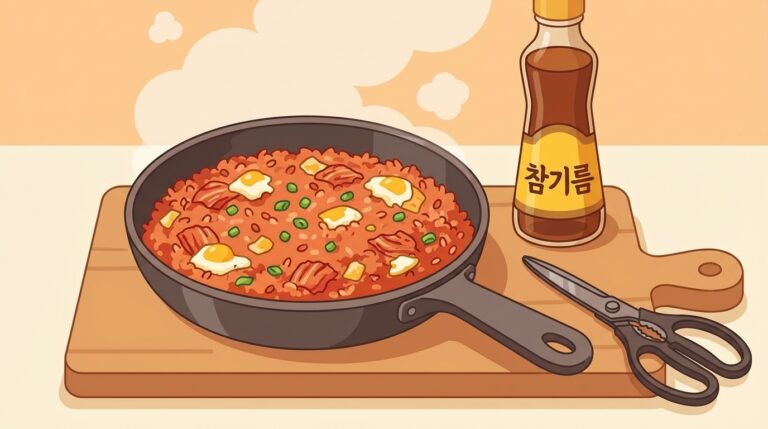
Phase 1: Immersive Hook\n\nHello! I’m your Daily Hangul Editor. 👋\n\nPicture this: You are watching your favorite K-Drama. The main character just had a really stressful day at work. They storm into their apartment, open the fridge, and pull out a giant, slightly stained plastic container of Kimchi. They dump some cold, leftover rice into a pan, and then… they start aggressively snipping the Kimchi directly into the pan with a pair of scissors?! ✂️\n\nYes, scissors! If you’ve ever watched a Korean cooking vlog or a drama, you know that making 김치볶음밥 (Kimchi Fried Rice) is the ultimate Korean soul food ritual. But textbook Korean won’t teach you the secret kitchen hacks or the exact ingredients that make it taste like a true Seoul local made it.\n\nToday, we are going to learn how to prepare ingredients for Kimchi Fried Rice. If you know these words, you won’t just survive your trip to H-Mart—you’ll be shopping like a true Korean grandma! Let’s dive in. (And yes, this guide is based on real questions from my students who accidentally made Kimchi soup instead of fried rice!)\n\n—\n\n### Phase 2: Deep Dive into Core Expressions\n\nTo make the perfect Kimchi Fried Rice, you need three magical ingredients. Let’s learn them!\n\n> ### 1. 신김치 (Sour/Overripe Kimchi)\n>\n> – Pronunciation: Sin-gimchi [sounds like ‘sheen’ + ‘kimchi’]\n> – Meaning: Literal = sour kimchi. Real nuance = well-fermented, aged kimchi perfect for cooking.\n> – K-Culture Moment: If you use fresh Kimchi (the crunchy kind you eat with bossam), your fried rice will be bland. In dramas, moms always have a specific container of Sin-gimchi hidden in the back of the Kimchi fridge, reserved strictly for stews and fried rice.\n> – Editor’s Insight: Sin (신) means sour. When Kimchi gets old, it gets sour and soft, which releases incredible umami when fried with oil!\n> – Situation Spectrum:\n> [🚫 절대 금지] ———— [⚠️ 주의] ———— [✅ 자유롭게]\n> – Asking a Korean friend if they have it: ✅\n> – Asking staff at a supermarket: ✅\n> – 🤔 Think About It: Why do Koreans have a separate refrigerator just for Kimchi? How does the changing taste of fermented food reflect the patience in Korean culinary culture?\n\n> ### 2. 찬밥 (Cold Leftover Rice)\n>\n> – Pronunciation: Chan-bap [sounds like ‘chan’ (rhymes with Ron) + ‘bop’]\n> – Meaning: Literal = cold rice. Real nuance = leftover rice that has been sitting in the fridge.\n> – K-Culture Moment: A classic late-night snack trope! When someone is hungry at midnight, they don’t cook new rice. They scavenge for Chan-bap.\n> – Editor’s Insight: Fresh, hot rice is too sticky and will turn your fried rice into mush. Chan-bap has less moisture, so each grain gets perfectly coated in Kimchi juice and oil.\n> – Situation Spectrum:\n> [🚫 절대 금지] ———— [⚠️ 주의] ———— [✅ 자유롭게]\n> – Using it for cooking at home: ✅\n> – Serving it to an honorable guest as a main dish (unfried): 🚫 (Always serve fresh hot rice to guests!)\n> – 🤔 Think About It: In Korea, throwing away rice was historically considered a sin. How do dishes like fried rice or bibimbap show the culture of zero-waste?\n\n> ### 3. 참기름 (Sesame Oil)\n>\n> – Pronunciation: Cham-gi-reum [Cham + gee + r + ‘eu’ (the disgusted sound you make when stepping in gum) + m]\n> – Meaning: Sesame oil.\n> – K-Culture Moment: The “fairy dust” of Korean cooking. You don’t fry the rice in it; you drizzle it on top at the very end before turning off the stove. The nutty aroma instantly fills the room!\n> – Editor’s Insight: It’s the ultimate finishing touch. Without Cham-gi-reum, it’s just spicy rice. With it, it’s K-Food.\n> – Situation Spectrum:\n> [🚫 절대 금지] ———— [⚠️ 주의] ———— [✅ 자유롭게]\n> – Using it as a finishing oil: ✅\n> – Deep frying with it: 🚫 (It burns easily!)\n\n—\n\n### Phase 3: Textbook vs. Real Life\n\nLet’s see how native speakers actually talk in the kitchen.\n\n| Situation | 📖 Textbook Korean | 🗣️ Real Korean | 💡 Why is it different? |\n|—|—|—|—|\n| Cutting Kimchi | 칼로 김치를 자르세요. (Cut Kimchi with a knife) | 가위로 싹둑싹둑 잘라요. (Snip it with scissors) | Koreans use kitchen scissors for EVERYTHING (meat, noodles, kimchi) because it saves time and washing a cutting board! |\n| Adding protein | 돼지고기를 넣습니다. (Put pork in) | 스팸 넣어! (Put Spam in!) | Spam is a premium, beloved ingredient in Korea, especially for quick home cooking. |\n| The cooking oil | 식용유를 쓰세요. (Use cooking oil) | 파기름 먼저 내자. (Let’s make green onion oil first) | Frying green onions in oil first is a famous chef’s secret to elevating the flavor. |\n\nBottom Note: As an A2 learner, using words like “가위” (scissors) and “스팸” (Spam) will make your Korean friends gasp in pleasant surprise!\n\n—\n\n### Phase 4: Cultural Deep Dive — The K-Food Spirit\n\n#### 4-1. Non-verbal Communication: The “Eyeballing” Method\nWhen you ask a Korean mom how much Kimchi or Sesame oil to put in, they will never give you exact measurements like “1 tablespoon.” They will say, “적당히” (Jeok-dang-hi), which means “appropriately.” You have to use your Nunchi (눈치 – sensing the vibe). Watch the color of the rice—if it’s a pale pink, add more Kimchi juice. If it’s a deep, rich red, you’re good!\n\n#### 4-2. K-Culture Connection: The “K-Dessert” (K-디저트)\nHave you ever been to a Korean BBQ restaurant or a Dakgalbi (spicy stir-fried chicken) place? After you finish the main meal, what happens? The waiter comes over and uses the leftover meat and sauce in the pan to make… you guessed it, Fried Rice! \n\nIn Korea, we playfully call this the “K-Dessert” (K-디저트). While Westerners eat cake or ice cream after a meal, Koreans eat carbohydrate-heavy fried rice to finish off a protein-heavy meal. It is the perfect conclusion to dining together.\n\n—\n\n### Phase 5: Immersive Roleplay Scenario\n\nSetting: Friday evening, 7 PM. You are at an Airbnb in Seoul with your Korean friend, Minsu. You guys decided to stay in, watch a movie, and cook some Kimchi Fried Rice.\n\nCharacters:\n- YOU: A K-food enthusiast eager to cook.\n- Minsu (30): Your friendly Korean language exchange partner who loves Spam.\n\nDialogue:\n\nMinsu: 배고프다! 우리 김치볶음밥 만들까?\n(Baegopeuda! Uri gimchi-bokkeumbap mandeulkka?)\n(English) I’m hungry! Should we make Kimchi Fried Rice?\n\nYOU: 좋아요! 재료가 뭐 필요해요?\n(Joayo! Jaeryoga mwo piryohaeyo?)\n(English) Sounds good! What ingredients do we need?\n\nMinsu: 일단 김치랑 밥! 아, 냉장고에 신김치 있다.\n(Ildan gimchirang bap! Ah, naengjanggo-e sin-gimchi itda.)\n(English) First, Kimchi and rice! Oh, we have sour kimchi in the fridge.\n(🎭 Stage Direction: Minsu takes out a red-stained Tupperware box)\n\nYOU: 고기도 넣을까요?\n(Gogido neo-eulkkayo?)\n(English) Should we put meat in too?\n\nMinsu: 당연하지! 스팸 넣자. 너 가위로 김치 좀 잘라줄래?\n(Dangyeonhaji! Seupaem neotja. Neo gawiro gimchi jom jallajullae?)\n(English) Of course! Let’s put Spam. Can you cut the Kimchi with the scissors?\n\n> 🔀 Your Turn! Minsu is getting the rice ready. He asks you a question:\n> Minsu: “밥은 어떤 걸로 할까?” (What kind of rice should we use?)\n>\n> – A) “방금 만든 따뜻한 밥!” (Freshly made warm rice!)\n> – B) “냉장고에 있는 찬밥!” (The cold rice in the fridge!)\n> – C) “햇반 데워서 줄게!” (I’ll heat up the instant microwave rice!)\n>\n> ✅ Best Choice: B — 찬밥 (Cold rice) is the absolute best for fried rice. If you choose C, don’t heat it up completely! Use it slightly hard. If you choose A, your fried rice will turn into Kimchi porridge.\n\nMinsu: 오~ 한국 사람 다 됐네! 마지막엔 뭐 넣어야 하지?\n(Oh~ Hanguk saram da dwaenne! Majimage-n mwo neo-eoya haji?)\n(English) Oh~ You’ve basically become Korean! What do we put in at the end?\n\nYOU: 참기름 한 방울!\n(Cham-gi-reum han bang-ul!)\n(English) A drop of sesame oil!\n\n—\n\n### Phase 6: 10-Second Shadowing Drill\n\nLet’s practice ordering your friend around in the kitchen! Pay attention to the pauses (/) and emotion tags.\n\n> 😊 (Brightly) 저는 / 신김치로 / 볶음밥을 만들어요!\n> (Jeo-neun / sin-gimchi-ro / bokkeum-babeul mandeureoyo!)\n> I make fried rice with sour kimchi!\n>\n> 😤 (With determination) 가위로 / 스팸을 / 싹둑싹둑!\n> (Gawi-ro / seupaem-eul / ssak-duk-ssak-duk!)\n> Snip snip the Spam with scissors!\n\n—\n\n### Phase 7: K-Culture Glossary (Mini Dictionary)\n\n| Korean | Romanization | English | Context |\n|—|—|—|—|\n| 신김치 | sin-gimchi | Sour Kimchi | Aged Kimchi, perfect for stews and frying. |\n| 찬밥 | chan-bap | Cold Rice | Leftover rice. The secret to non-mushy fried rice. |\n| 참기름 | cham-gi-reum | Sesame Oil | The nutty finishing oil of Korean cuisine. |\n| 주방 가위 | jubang gawi | Kitchen Scissors | The ultimate multi-tool in a Korean kitchen. |\n| 싹둑싹둑 | ssak-duk-ssak-duk| Snip-snip | The mimicking sound word (onomatopoeia) of scissors cutting. |\n\n—\n\n### Phase 8: Traveler’s Survival Kit (H-Mart & Markets)\n\nEven if you aren’t in Korea, you might visit a Korean grocery store to buy these ingredients. Here are the survival phrases you need:\n\n> 🆘 Survival Phrases at the Korean Mart\n> – 🇰🇷 “신김치 어디 있어요?” (Sin-gimchi eodi isseoyo?)\n> – 🗣️ Pronunciation: Sheen-gimchi oh-dee ee-sso-yo?\n> – 📍 Where to use: Asian Supermarkets, Traditional Markets.\n> – 💡 Pro Tip: If you can’t find “신김치” labeled, just buy regular Kimchi, leave it in your fridge for a couple of weeks, and let nature do the work!\n\n> 📌 Editor’s Travel Note\n> – Buying Sesame Oil in Korea: If you visit a traditional market (like Gwangjang Market), you’ll see glass bottles filled with dark liquid, often stopped with a cork or newspaper. That’s freshly pressed sesame oil! It is 100x better than factory-made ones.\n> – Spam in Korea: Don’t be shocked, but Spam is considered a premium gift in Korea. During holidays like Chuseok, you will see luxurious Spam gift sets in department stores!\n\n—\n\n### Phase 9: Think Deeper — Food & Identity\n\n🥘 Sharing from the Pan: The Culture of ‘Jeong’ (정)\nIn many Western cultures, once food is cooked, it is carefully divided onto individual plates before eating. But in Korea, if you make Kimchi Fried Rice at home, it’s very common to just put the hot frying pan right in the middle of the table. Everyone grabs a spoon and digs directly into the same pan!\n\nThis isn’t considered rude; rather, it’s a reflection of ‘Jeong’ (정 – deep connection and affection). Sharing from the same vessel breaks down boundaries and builds a sense of community. Eating together from the pan means, “We are close enough to share our food intimately.”\n\n> 💬 Your Turn: In your culture, is it common to eat directly out of the cooking pot with friends or family? Share in the comments!\n\n—\n\n### Phase 10: FAQ & Troubleshooting\n\nLet’s clear up some common kitchen confusions!\n\n- Q: “Can I wash the Kimchi if I don’t want it to be too spicy?”\n – A: Yes and No! If you wash it, you lose the signature flavor. Instead, try adding a little bit of sugar (설탕) while frying! Sugar magically neutralizes the sourness and cuts down the spice.\n- Q: “Do I have to use Spam?”\n – A: No! Tuna (참치 – chamchi) and bacon are also incredibly popular alternatives in Korea.\n\n> ❌ Common Mistake #1: Pouring sesame oil into the pan at the beginning like olive oil.\n> ✅ How to fix it: Sesame oil has a very low smoke point and loses its aroma if heated too long. Use regular cooking oil for frying, and drizzle sesame oil after you turn off the heat.\n\n—\n\n### Phase 11: Wrap-up & Action Items\n\nOne-Liner Summary: To make authentic Kimchi Fried Rice, arm yourself with scissors, grab some cold rice (찬밥), sour Kimchi (신김치), and finish with a drop of sesame oil (참기름)!\n\n🎯 Action Mission:\n- 🥉 Bronze (Solo): Stand in your kitchen and say “신김치 어디 있어요?” out loud 3 times.\n- 🥈 Silver (Online): Comment below with your favorite Kimchi Fried Rice topping (Cheese? Fried egg? Spam?).\n- 🥇 Gold (Real Life): Go to your local Asian market, find the sesame oil section, and read the label to find “참기름”.\n\n🎬 K-Culture Mission: \nNext time you watch a K-Drama, look closely at the dining scenes. Count how many times you see the characters eating directly out of the pot or pan!\n\n—\n\n### Phase 12: Interactive Quiz!\n\nLet’s test your K-Kitchen knowledge!\n\n1. Situational Judgment: You are making Kimchi Fried Rice for your Korean friends. You open the fridge. Which rice should you grab?\n- A) The fresh, steaming hot rice from the rice cooker.\n- B) The cold, slightly dried-out rice from yesterday.\n\n2. Fill in the Blank:\nTo give the fried rice that authentic Korean nutty flavor at the very end, I must add ________ (sesame oil).\n- A) 신김치 (sin-gimchi)\n- B) 참기름 (cham-gi-reum)\n\n3. True or False – K-Culture Edition:\n- Koreans often use scissors to cut meat and Kimchi in the kitchen. (T / F)\n\n(Answers: 1. B – Cold rice prevents mushiness! 2. B – Cham-gi-reum is the magic touch! 3. True! Kitchen scissors are a chef’s best friend in Korea.)
Frequently Asked Questions (FAQ)
Q: What does "김치볶음밥" mean in Korean and how do you pronounce it?
A: In Korean, "김치볶음밥" is pronounced [Kimchi Fried Rice] and means: is the ultimate Korean soul food ritual. But textbook Korean won't teach you the secret kitchen hacks or the exact ingredients that make it taste like a true Seoul local made it.\n\nToday, we are going to learn how to prepare ingredients for Kimchi Fried Rice. If you know these words, you won't just survive your trip to H-Mart—you'll be shopping like a true Korean grandma! Let's dive in. (And yes, this guide is based on real questions from my students who accidentally made Kimchi soup instead of fried rice!)\n\n---\n\n### Phase 2: Deep Dive into Core Expressions\n\nTo make the perfect Kimchi Fried Rice, you need three magical ingredients. Let's learn them!\n\n> ### 1. 신김치 (Sour/Overripe Kimchi)\n>\n> -
Q: What does "찬밥" mean in Korean and how do you pronounce it?
A: In Korean, "찬밥" is pronounced [Cold rice] and means: is the absolute best for fried rice. If you choose C, don't heat it up completely! Use it slightly hard. If you choose A, your fried rice will turn into Kimchi porridge.\n\n







