

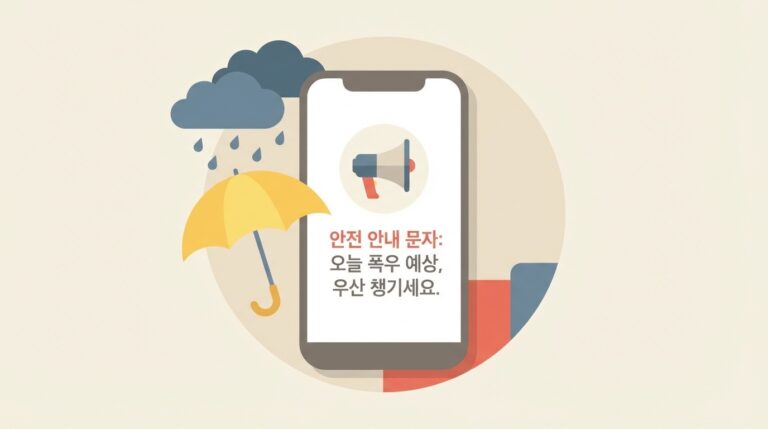
Phase 1: Immersive Hook — The Sound That Stops Everyone
Hello! I’m your Head Editor at Daily Hangul.
Picture this: You are riding the Seoul subway. Everyone is quietly scrolling through their phones. Suddenly, a loud, piercing BEEEEEP! BEEEEEP! rings out from literally every smartphone in the carriage at the exact same time. Did a war break out? Is it an alien invasion?
Nope, it’s a 재난문자 (Jaenan-munja, Emergency Alert), and right now, it’s warning everyone that a massive typhoon is approaching.
If you’ve watched Korean news during the summer, you’ve definitely seen that classic K-Drama-esque trope: a brave reporter standing in a raincoat, leaning at a 45-degree angle against brutal winds, yelling into a microphone. But what are they actually saying?
If you don’t understand these news phrases, you might end up wandering around in a dangerous storm, wondering why all the shops are closed and why your food delivery app isn’t working. Let’s decode the formal news Korean and the real-life slang you need to survive a Korean typhoon like a true local!
Phase 2: Deep Dive into Core Expressions
When a typhoon comes, the news anchors use very formal, Sino-Korean vocabulary. Here are the top 3 phrases you will hear constantly.
1. 태풍이 북상하고 있습니다.
- Pronunciation: [Taepung-i buksang-hago itseumnida.] (buksang sounds like ‘book-sang’)
- Meaning: (Literal) The typhoon is moving north. / (Real nuance) A typhoon is coming up towards Korea.
- K-Culture Moment: Because Korea is located in the Northern Hemisphere, typhoons always come from the south (usually near the Philippines or Japan) and move up. So, Korean news rarely says ‘It is coming.’ They specifically say ‘It is moving north’ (북상: 北上).
- Editor’s Insight: This is pure news-speak. If you say this to a friend, you’ll sound like a robotic news anchor.
- Situation Spectrum:
[🚫 절대 금지] ———— [⚠️ 주의] ———— [✅ 자유롭게]
- Friends (Casual): 🚫 (Too formal/stiff)
- Formal News/Announcements: ✅
- 🤔 Think About It: Why does Korean news prefer Sino-Korean words (Hanja) like ‘북상(North-move)’ instead of native Korean words like ‘위로 올라오고 있어요(It is coming up)’? Do news anchors in your country use a different vocabulary set from daily life?
2. 외출을 자제해 주시기 바랍니다.
- Pronunciation: [Oechul-eul jaje-hae jusigi baramnida.] (‘jaje’ sounds like ‘jah-jeh’)
- Meaning: (Literal) Please refrain from going out. / (Real nuance) Seriously, stay inside.
- K-Culture Moment: You won’t just hear this on TV. If you live in a Korean apartment, the management office will broadcast this over the loudspeakers directly into your living room.
- Editor’s Insight: ‘자제하다’ means to refrain or control oneself. It’s a polite but firm way of saying ‘Don’t do it.’ It’s much softer than ‘나가지 마세요!’ (Don’t go out!), showing the Korean preference for indirect, polite requests.
- Situation Spectrum:
[🚫 절대 금지] ———— [⚠️ 주의] ———— [✅ 자유롭게]
- Public Announcements/Formal: ✅
- To a friend: 🚫 (Say ‘나가지 마’ instead)
- 🤔 Think About It: Notice the ending ‘-주시기 바랍니다’ (We hope/wish that you…). Why is the burden of action placed as a ‘hope’ rather than a direct command?
3. 비 피해 없으시길 바랍니다.
- Pronunciation: [Bi pihae eop-seu-si-gil baramnida.]
- Meaning: (Literal) I hope you have no rain damage. / (Real nuance) Please stay safe from the rain.
- K-Culture Moment: This is the classic closing line for news anchors or formal emails during typhoon season. It shows Jeong (정) — community care and empathy.
- Editor’s Insight: Koreans love wishing safety and health as a goodbye. Instead of just ‘Goodbye,’ acknowledging the current weather situation makes you sound incredibly fluent and empathetic.
- Situation Spectrum:
[🚫 절대 금지] ———— [⚠️ 주의] ———— [✅ 자유롭게]
- Work Emails (Semi-formal): ✅
- Casual text to a boss: ✅
Phase 3: Textbook vs Real Life (Textbook vs 진짜 한국어)
How do actual Koreans text each other when the news says the typhoon is Buksang-ing?
| Situation | 📖 Textbook Korean | 🗣️ Real-Life Korean | 💡 Why is it different? |
|---|---|---|---|
| Describing the storm | 비가 아주 많이 와요. (It rains a lot) | 이번 태풍 역대급이래. (They say this typhoon is record-breaking) | ‘역대급’ (All-time level/Record-breaking) is a massive trend word used for everything from weather to a really good burger. |
| Telling someone to stay in | 집에 있으세요. (Please stay home) | 오늘 그냥 강제 집콕이다. (Today is forced stay-at-home) | ‘집콕’ (Stuck inside the house) is a cute slang combining ‘house’ and ‘poke/stuck’. |
| Warning a friend | 조심하세요. (Be careful) | 우산 뒤집어지니까 조심해! (Your umbrella will flip inside out, be careful!) | Focuses on the real struggle: Korean winds destroy umbrellas instantly. |
Phase 4: Cultural Deep Dive — K-Culture during a Typhoon
4-1. Non-verbal Communication: The Art of Taping Windows
If you walk outside before a typhoon hits, you might see Koreans taping large ‘X’ marks on their windows or putting wet newspaper on the glass frames. This is a nationwide survival tactic to prevent windows from shattering in the wind. If your Korean neighbor helps you tape your window, that is peak Nunchi and Jeong in action!
4-2. K-Food Connection: The ‘Jeon’ Dilemma & Delivery Etiquette
In Korea, rainy days mean one thing: 파전 (Pajeon, Green onion pancake) and 막걸리 (Makgeolli, Rice wine). The sound of rain resembles the sizzling of the pancake batter.
But here is a critical K-Culture Reality Check. During a severe typhoon, you might think, ‘Perfect day to order Baemin (Delivery app)!’
Wrong.
During severe weather, delivery apps will show a notice: 기상 악화로 배달이 제한됩니다 (Delivery restricted due to severe weather). This is a social agreement to protect the delivery riders on motorcycles. Demanding delivery during a typhoon is considered extremely bad manners (and very dangerous for the rider).
Phase 5: Immersive Roleplay — The Friday Night Typhoon
Setting: Friday evening, 6:00 PM. You are at your office in Seoul. The wind is howling outside, and the sky is completely yellow-gray. Your Korean coworker, Min-su (32, friendly and always hungry), looks at his phone as an emergency alert blares.
Min-su: 아휴, 재난문자 또 왔네요. 이번 태풍 진짜 역대급인가 봐요. 🌪️
(Ahyu, jaenan-munja tto wanneyo. Ibeon taepung jinjja yeokdae-geubin-ga bwayo.)
[Sigh, another emergency alert. I guess this typhoon is truly record-breaking.]
YOU: 그러게요. 뉴스 보니까 오늘 밤에 상륙한대요.
(Geureogeyo. Nyuseu bonikka oneul bame sangnyuk-handaeyo.)
[I know, right. I saw the news, they said it will make landfall tonight.]
Min-su: 아, 오늘 불금인데… 그냥 집에 일찍 가야겠어요.
(Ah, oneul bulgeuminde… geunyang jibe iljjik gayagesseoyo.)
[Ah, today is Fire Friday (TGIF)… I should just go home early.]
YOU: 맞아요. 오늘은 외출 자제하는 게 좋아요.
(Majayo. Oneureun oechul jaje-haneun ge joayo.)
[Right. It’s better to refrain from going out today.]
Min-su: 집에 가면 밥 해 먹기도 귀찮은데…
(Jibe gamyeon bap hae meokgido gwichaneunde…)
[When I get home, I’m too lazy to cook…]
(🎭 Stage Direction: Min-su opens his food delivery app, contemplating his dinner)
🔀 Your Turn! How should you respond to Min-su?
– A) “태풍 오는데 배달 시키면 위험해요! 집에 가서 라면 끓여 드세요.”
– B) “오! 저도 배달 시킬까요? 뭐 드실 거예요?”
– C) “북상하고 있습니다. 피해 없으시길 바랍니다.”✅ Best Choice: A — You are showing cultural awareness! Reminding him that ordering delivery is dangerous for the riders during a typhoon, and suggesting the ultimate Korean comfort food: Ramyeon!
⚠️ Choice B Analysis: You might not be able to order anyway because apps shut down, and it lacks consideration for riders.
❌ Choice C Analysis: You suddenly turned into a news anchor. Min-su will be very confused.
Phase 6: 10-Second Shadowing Drill
Practice speaking like a caring Korean friend! Pay attention to the pauses (/) and the emotional tone.
😟 오늘 / 태풍 온대요. (oneul / taepung ondaeyo.)
😤 밖에 / 나가지 말고 / 집콕하세요! (bakke / nagaji malgo / jipkokhaseyo!)
😊 비 피해 / 없으시길 / 바랄게요~ (bi pihae / eopseusigil / baralgeyo~)
Phase 7: K-Culture Glossary (K-Culture 미니 사전)
| Korean | Romanization | English | Context |
|---|---|---|---|
| 재난문자 | Jaenan-munja | Emergency Alert Text | The loud, vibrating messages sent by the government for extreme weather, missing persons, or emergencies. |
| 역대급 | Yeokdae-geup | Record-breaking / Legendary | Slang used to describe anything that is the ‘best/worst ever in history.’ |
| 집콕 | Jip-kok | Staying stuck at home | Staying indoors. Very popular during extreme weather or the pandemic. |
| 불금 | Bul-geum | Fire Friday (TGIF) | The excitement of Friday night. Usually ruined by typhoons. |
| 우천 취소 | Ucheon chwiso | Cancelled due to rain | Crucial term if you have baseball tickets or outdoor concert tickets! |
Phase 8: Traveler’s Survival Kit (Typhoon Edition)
If you are traveling in Korea during a typhoon (usually July-September), you MUST know these words, or you might end up stranded at the airport!
🆘 Survival Phrases & Vocab TOP 3
– 🇰🇷 “비행기 결항됐나요?” (Bihaenggi gyeolhang-dwaennayo?)
– 🗣️ Meaning: Is the flight cancelled?
– 📍 Where to use: Jeju Airport, Incheon Airport
- 🇰🇷 “이거 우천 취소되나요?” (Igeo ucheon chwiso-doenayo?)
- 🗣️ Meaning: Is this cancelled due to rain?
- 📍 Where to use: Outdoor festivals, K-Pop concerts, theme parks
🇰🇷 “지하철은 정상 운행하나요?” (Jihacheol-eun jeongsang unhaeng-hanayo?)
- 🗣️ Meaning: Is the subway operating normally?
- 📍 Where to use: Train stations, hotel concierge
📌 Editor’s Travel Note
– Transportation: Subways usually run normally during typhoons since they are underground, but buses and KTX trains might be delayed or suspended.
– The Alert Translation Hack: Jaenan-munja (Emergency texts) are in Korean. Don’t panic! Screenshot the text, open the Papago app, and use the image translation feature to know exactly what the warning is about.
Phase 9: Think Deeper — Community Care in the Digital Age
Media vs Reality: The Loudness of Care
If you are from a Western country, you might be shocked by how frequently the Korean government sends loud emergency alerts to your phone. Sometimes it’s for a typhoon, sometimes it’s heavy rain, and sometimes it’s to find a missing elderly person in your neighborhood.
While some foreigners find the alarm annoying, this system perfectly reflects the Korean concept of Jeong (community connection). The society operates on a shared responsibility mindset: ‘We are all in this together, so everyone needs to be aware.’ It’s not just an invasion of your phone’s privacy; it’s a digital manifestation of a village elders making sure everyone has locked their doors before the storm.
💬 Your Turn: Does your country have an emergency text system? Do you prefer a quiet, individualistic approach, or this loud, collective community warning? Let us know in the comments!
Phase 10: FAQ & Troubleshooting
❌ Common Mistake #1: Asking a friend “외출을 자제하세요” (Please refrain from going out).
✅ Do this instead: Say “위험하니까 나가지 마세요” (It’s dangerous, so don’t go out). Save ‘자제하세요’ for formal writing or public speaking.
Q: Should I bring my umbrella if it’s a typhoon?
A: Actually, many Koreans switch to sturdy raincoats (우의) during severe typhoons. Korean typhoons bring fierce winds, and your convenience store umbrella will be destroyed in exactly 12 seconds.
Q: I saw a puddle on the street. Can I walk through it?
A: No! During Korean typhoon news, they always warn about electric shock hazards (감전 위험) from flooded streetlamps or manholes. Always walk around deep puddles in the city.
Phase 11: Wrap-up & Action Items
One-Liner Summary: When the typhoon news says “북상” (moving north), cancel your delivery, text your friends “집콕하자” (let’s stay home), and stay safe!
Your 3-Step Mission:
– 🥉 Bronze (Solo): Read the 3 news expressions aloud in your most serious, dramatic news anchor voice.
– 🥈 Silver (Online): Go to YouTube, search ‘한국 태풍 뉴스’ (Korean typhoon news), and try to catch the word “북상” or “자제”.
– 🥇 Gold (Real Life): Next time it rains heavily, message a Korean friend: “비 오는데 빗길 조심하세요!” (It’s raining, be careful on the wet roads!). Watch them be amazed by your natural Korean.
K-Culture Mission:
Check your phone’s settings to ensure emergency alerts (재난문자) are turned ON if you are living in or visiting Korea. It’s the ultimate survival tool!
Did you ever experience a heavy storm in Korea? Tell me your story below! 👇
Phase 12: Interactive Quiz — Test Your Survival Skills!
1. You are at an outdoor K-Pop concert, and it starts raining heavily. You want to ask the staff if the event is cancelled. What do you say?
– A) 배달 중단되나요?
– B) 우천 취소되나요?
– C) 역대급인가요?
(Answer: B! 우천 취소 is the golden word for outdoor event cancellations.)
2. True or False: During a severe typhoon warning, it is a great idea to use Baemin to order hot soup.
(Answer: False. App services are usually paused, and even if they aren’t, it’s considered very poor etiquette due to the danger to riders.)
3. Fill in the blank: The news anchor says “태풍이 ____하고 있습니다.” (The typhoon is moving north).
– A) 집콕
– B) 자제
– C) 북상
(Answer: C! Buk-sang means moving north.)
Frequently Asked Questions (FAQ)
Q: What does "태풍이 북상하고 있습니다." mean in Korean and how do you pronounce it?
A: In Korean, "태풍이 북상하고 있습니다." is pronounced [Taepung-i buksang-hago itseumnida.] and means: (Literal) The typhoon is moving north. / (Real nuance) A typhoon is coming up towards Korea.
Q: What does "외출을 자제해 주시기 바랍니다." mean in Korean and how do you pronounce it?
A: In Korean, "외출을 자제해 주시기 바랍니다." is pronounced [Oechul-eul jaje-hae jusigi baramnida.] and means: (Literal) Please refrain from going out. / (Real nuance) Seriously, stay inside.
Q: What does "비 피해 없으시길 바랍니다." mean in Korean and how do you pronounce it?
A: In Korean, "비 피해 없으시길 바랍니다." is pronounced [Bi pihae eop-seu-si-gil baramnida.] and means: (Literal) I hope you have no rain damage. / (Real nuance) Please stay safe from the rain.







