

How to Say “No” in Korea Like a Pro: The Magic of “다음에 할게요”
Hello, language learners! I’m the Lead Editor at Daily Hangul, your personal guide to not just speaking Korean, but feeling it.
Picture this: You are walking down the vibrant, neon-lit streets of Myeongdong. Suddenly, a friendly cosmetic store employee approaches you, handing you a shopping basket with a free face mask, enthusiastically explaining a “1+1” mega sale in rapid-fire Korean. You are overwhelmed. You want to walk away, but saying a flat “No” (아니요) feels way too aggressive. You panic, smile awkwardly, and end up buying three snail-mucin creams you didn’t even want.
Sound familiar? Don’t worry, we’ve all been there!
In Korean culture, outright saying “No” can sometimes feel like a splash of cold water. Preserving social harmony and the other person’s feelings is key. Today, I am going to teach you the ultimate “Get Out of Jail Free” card for these situations. It’s polite, it’s natural, and it will make you sound like an absolute local. Let’s dive into the art of the Korean refusal!
Phase 2: Core Expressions Deep Dive
Here are the top three expressions you need when you want to gently refuse an offer.
1. 다음에 할게요 (I’ll do it next time)
- Pronunciation: [da-eum-e hal-kke-yo]
(Think of it as: “Dah-oom-eh / hal-keh-yo”. The ‘eum’ sounds like the disgusted sound you make when stepping in gum, and ‘hal’ rhymes with ‘pal’.)- Meaning: Literal = I will do it next time. / Real Nuance = No thank you, I’ll pass for now.
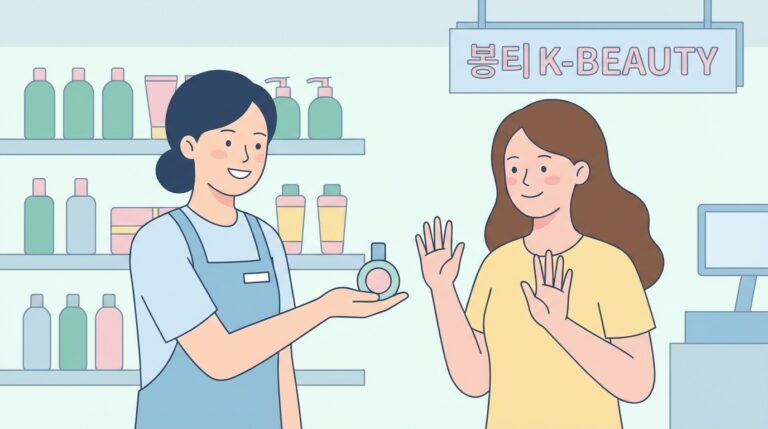
- K-Culture Moment: You are at a trendy K-Beauty shop, and the cashier asks if you want to sign up for a membership. You don’t live in Korea, so you just smile and say, “다음에 할게요.” The cashier nods happily and finishes your transaction without any awkwardness.
- Editor’s Insight: This is the holy grail of polite refusals. You aren’t actually promising a “next time.” It’s a soft, cushioned way to reject an offer without crushing the other person’s spirit.
- Situation Spectrum:
[🚫 Never] ———— [⚠️ Caution] ———— [✅ Go ahead!]
- Casual (Friends): ✅ (Usually shortened to “다음에 할게”)
- Semi-formal (Clerks, Strangers): ✅
- Formal (Boss, Elders): ⚠️ (Needs more padding, like “죄송하지만…” – I’m sorry but…)
- 🤔 Think About It: Why do Koreans promise a “next time” even when they know there won’t be one? How does this reflect the Korean value of maintaining social harmony?
2. 괜찮습니다 / 괜찮아요 (I’m okay / It’s fine)
- Pronunciation: [gwaen-chan-seum-ni-da / gwaen-cha-na-yo]
- Meaning: Literal = It is okay. / Real Nuance = I’m good, no thanks.
- K-Culture Moment: You are at a bustling K-BBQ restaurant. The kind owner (이모님 – Imo-nim) tries to refill your plate with spicy kimchi, but you are already full. A gentle hand wave and a “괜찮아요” works like a charm.
- Editor’s Insight: Just like saying “I’m good” in English, this expression is highly versatile. It works for both saying “I’m okay physically” and “No thank you.”
- Situation Spectrum:
[🚫 Never] ———— [⚠️ Caution] ———— [✅ Go ahead!]
- Casual: ✅
- Semi-formal: ✅
- Formal: ✅ (Use 괜찮습니다)
3. 아, 오늘은 좀… (Ah, today is a bit…)
- Pronunciation: [Ah, o-neul-eun jom…]
- Meaning: Literal = Ah, today is a little… / Real Nuance = I can’t do it today (Please don’t make me explain why).
- K-Culture Moment: It’s Friday night. Your Korean coworkers invite you to a second round of drinking (2차 – i-cha) for a Hoesik (company dinner). You want to go back to your hotel and binge-watch K-Dramas. You trail off with “아, 오늘은 좀…”
- Editor’s Insight: Koreans love trailing off their sentences to soften a blow. By leaving the sentence unfinished, you let the other person fill in the blanks with their Nunchi (social tact).
- Situation Spectrum:
[🚫 Never] ———— [⚠️ Caution] ———— [✅ Go ahead!]
- Casual: ✅
- Semi-formal: ⚠️
- Formal: 🚫 (Too vague for a strict boss!)
Phase 3: Textbook vs Real Life
Let’s see how the rigid textbook Korean compares to what you’ll actually hear on the streets of Seoul.
| Situation | 📖 Textbook Korean | 🗣️ Real Korean | 💡 Why the difference? |
|---|---|---|---|
| Rejecting a store membership | 아니요, 가입 안 하겠습니다. (No, I will not join.) | 아, 다음에 할게요~ (Ah, I’ll do it next time~) | Direct “No” sounds like you are angry. Softening it preserves peace. |
| Refusing extra food | 아니요, 안 먹습니다. (No, I do not eat it.) | 아유, 괜찮아요. 배불러요! (Oh, it’s okay. I’m full!) | Adding an exclamation of fullness softens the rejection of their hospitality. |
| Declining an invitation | 저는 오늘 못 갑니다. (I cannot go today.) | 아, 오늘은 좀… (trailing off) | Explicit refusal is harsh; trailing off lets the listener take a hint politely. |
Bottom Note: As an A1 beginner, don’t worry about complex grammar. Just memorizing “다음에 할게요” will save you in 90% of shopping and dining situations!
Phase 4: Cultural Deep Dive
4-1. Non-verbal Communication: The “Windshield Wiper” Hand
Words are only half the battle! When saying “다음에 할게요” or “괜찮아요,” Koreans use a very specific hand gesture. Hold your hand up, palm facing out, and wave it side to side a couple of times—like a windshield wiper on a car. Combine this with a slight, apologetic bow of the head, and breaking eye contact just a little bit. Staring dead into their eyes while saying “No” can be seen as confrontational!
4-2. K-Culture Connection: The “Service” (서비스) Culture
If you visit a Korean restaurant, street food stall, or even a K-Pop merchandise store, you will inevitably encounter the magical word: 서비스 (Service). In Korea, “Service” doesn’t mean the quality of the waitstaff; it means “Free stuff!”
A restaurant owner might bring you a steaming bowl of steamed egg (계란찜) and say, “서비스예요!” (It’s service/on the house!). While you usually accept this with a joyful “감사합니다!”, sometimes they might offer you something you can’t eat (like extra spicy peppers or a strange seafood side dish). That is exactly when you smile, do the windshield wiper hand, and say, “아, 괜찮아요. 다음에 먹어볼게요!” (Ah, it’s okay. I’ll try it next time!).
Phase 5: Immersive Roleplay Scenario
Scenario A: The Myeongdong Skincare Gauntlet
Setting: It’s a sunny Saturday afternoon in Myeongdong. You’ve just walked into a brightly lit K-Beauty store. K-Pop is blasting from the speakers. You just want to buy one simple lip balm, but the enthusiastic store clerk, Min-ji, spots you.
Characters:
– YOU: A traveler trying to survive the shopping spree without going bankrupt.
– Min-ji (24): A friendly, highly energetic cosmetic clerk who really wants to hit her daily sales quota.
(🎭 Stage Direction: Min-ji approaches you with a little plastic shopping basket)
Min-ji: 안녕하세요! 찾으시는 거 있으세요?
(Annyeonghaseyo! chajeusineun geo isseuseyo?)
[Hello! Are you looking for anything?]
YOU: 아, 그냥 보는 거예요. 감사합니다.
(Ah, geunyang boneun geo-yeyo. Gamsahamnida.)
[Ah, I’m just looking. Thank you.]
Min-ji: 고객님! 지금 이 수분크림 1+1 행사 중이에요! 손에 한 번 발라보실래요?
(Gogaengnim! Jigeum i subun-keurim 1+1 haengsa jung-ieyo! Sone han beon ballabosillaeyo?)
[Customer! This moisture cream is on a 1+1 sale right now! Would you like to try it on your hand?]
(🎭 Stage Direction: She opens a tester jar and reaches for your hand)
YOU: 아… 괜찮아요. 립밤만 하나 살게요.
(Ah… gwaenchanayo. Ribbam-man hana salgeyo.)
[Ah… I’m okay. I will just buy one lip balm.]
Min-ji: 네, 알겠습니다! 결제 도와드릴게요. 혹시 저희 매장 멤버십 있으신가요? 오늘 가입하시면 10% 추가 할인돼요!
(Ne, algetseumnida! Gyeolje dowadeurilgeyo. Hoksi jeohui maejang membeosip isseusingayo? Oneul gaiphasimyeon 10% chuga halindwaeyo!)
[Yes, understood! I’ll help you with the payment. Do you happen to have our store membership? If you sign up today, you get an extra 10% discount!]
🔀 Your Turn! How should you respond to the membership offer?
– A) “아니요. 안 해요.” (No. I won’t do it.)
– B) “아, 다음에 할게요.” (Ah, I’ll do it next time.)
– C) “싫어요.” (I hate it / I don’t want to.)✅ Best Choice: B — It’s soft, polite, and immediately understood by the clerk that you are politely declining.
⚠️ Why A and C are dangerous: A sounds very robotic and slightly annoyed. C sounds like a moody teenager throwing a tantrum!
YOU (choosing B): 아, 다음에 할게요.
(Ah, da-eum-e hal-kke-yo.)
[Ah, I’ll do it next time.]
Min-ji: 네, 알겠습니다! 영수증 여기 있습니다. 즐거운 여행 되세요!
(Ne, algetseumnida! Yeongsujeung yeogi itseumnida. Jeulgeoun yeohaeng doeseyo!)
[Yes, understood! Here is your receipt. Have a great trip!]
YOU: 감사합니다!
(Gamsahamnida!)
[Thank you!]
Scenario B: Bonus K-Culture Moment – The Cafe
You are at a trendy cafe in Seongsu-dong. You order an Iced Americano.
Barista: 영수증 필요하신가요?
(Yeongsujeung piryohasingayo? / Do you need the receipt?)
YOU: 아, 괜찮아요. 버려주세요.
(Ah, gwaenchanayo. Beoryeojuseyo. / Ah, it’s fine. Please throw it away.)
Phase 6: 10-Second Shadowing Drill
Let’s practice the flow and rhythm. Repeat this out loud! Follow the pauses (/) and the emotional tags.
🥺 (Apologetic smile) 아… / 괜찮아요. / 다음에 / 할게요~
(Ah… / gwaen-cha-na-yo. / da-eum-e / hal-kke-yo~)
“Ah… I’m okay. I’ll do it next time~”
Pro-tip: Drag out the “Ah…” slightly to show hesitation. It makes you sound 100% native!
Phase 7: K-Culture Mini Glossary
| Korean | Romanization | English | Cultural Context |
|---|---|---|---|
| 눈치 | nunchi | Social tact / Wit | The Korean superpower of reading the room and picking up on subtle cues (like someone saying “next time” to mean “no”). |
| 기분 | kibun | Mood / Face | A person’s state of mind or prestige. Refusing politely protects the other person’s kibun. |
| 서비스 | seobiseu | On the house | Free items given to customers at restaurants or shops to show appreciation. |
| 행사 | haengsa | Sale / Event | Promotional events like 1+1 (buy one get one free) or 2+1, extremely common in Korean convenience stores. |
| 회식 | hoesik | Company dinner | A mandatory-but-not-mandatory gathering for coworkers to eat and drink. Saying “no” to these requires high-level Korean skills! |
Phase 8: Traveler’s Survival Kit 🧳
If you are traveling to Korea, you will definitely visit a convenience store (CU, GS25, 7-Eleven). Here are your survival phrases for dealing with offers and sales!
🆘 Survival Phrases: Convenience Store Edition
– 🇰🇷 “이거 1+1 (원플러스원) 이에요?” (igeo won-peulleoseu-won i-eyo?)
– 🗣️ English: Is this Buy 1 Get 1 Free?
– 📍 Where to use: Convenience stores, cosmetic shops.
– 🇰🇷 “봉투 필요 없어요.” (bongtu piryo eopseoyo.)
– 🗣️ English: I don’t need a bag.
– 📍 Where to use: Everywhere (Korea charges for plastic bags).
– 🇰🇷 “아, 다음에 할게요.” (Ah, da-eum-e hal-kke-yo.)
– 🗣️ English: Ah, I’ll do it next time. (When asked to download an app or sign up for points).📌 Editor’s Travel Note
– Points & Memberships: At checkout, clerks will almost always ask “포인트 적립하시겠어요?” (Would you like to earn points?). Since you are a traveler without a local phone number, simply reply with your new favorite phrase: “괜찮아요. 다음에 할게요.”
Phase 9: Think Deeper — “One Step Further”
🧠 Language & Power: Preserving Social Harmony
Have you ever wondered why Koreans go through so much trouble to avoid a direct “No”? It all ties back to the concept of Kibun (기분 – mood/pride) and social harmony. In Korean culture, relationships are built on mutual respect and making sure neither party “loses face.”
When a shop clerk offers you a membership, they are doing their job. A flat “No” can feel like a rejection of them, not just the offer. By saying “I’ll do it next time” (다음에 할게요), you are validating their effort while gently declining. It’s a beautiful linguistic dance of empathy.
💬 Your Turn:
Does your culture have a similar “soft” way of saying no? Or do people prefer direct and blunt refusals? Share your thoughts in the comments below!
Phase 10: FAQ & Troubleshooting
Q: Can I use “다음에 할게요” to my boss or professor?
A: Maybe, but tread carefully. While it’s polite enough for strangers, using it with a strict elder or boss might sound a bit dismissive. For superiors, it’s better to add an apology first: “죄송하지만, 다음에 하겠습니다.” (I am sorry, but I will do it next time.)
Q: What if I actually DO want to do it next time?
A: The beauty of the phrase is that it works both ways! If you genuinely mean it, just say it with more enthusiasm: “오늘은 바빠서, 다음에 꼭 할게요!” (I’m busy today, but I will definitely do it next time!).
❌ Common Mistake Alert!
Do not use “다음에 할게요” when refusing food someone cooked for you. It sounds like “I’ll eat your food later (because I don’t want it now).” Instead, use: “배가 너무 불러서요. 잘 먹었습니다!” (I am so full. I ate well!).
Phase 11: Wrap-up & Action Items
🎯 One-Liner Summary:
When a direct “No” feels too harsh, save the vibe by saying “다음에 할게요” (I’ll do it next time).
🔥 Action Mission:
– 🥉 Bronze (Solo): Stand in front of a mirror, do the “windshield wiper” hand gesture, and say “아, 괜찮아요. 다음에 할게요” three times.
– 🥈 Silver (Online): Comment below or on a Korean language forum about a time you awkwardly couldn’t say no in a foreign country!
– 🥇 Gold (Real Life): Next time you are at a Korean restaurant or grocery store and they offer you a bag or receipt you don’t need, use this expression!
🎬 K-Culture Mission:
Watch one episode of any K-Drama today. I guarantee you will hear someone say “괜찮아요” (Gwaen-chan-a-yo) or “다음에” (Da-eum-e). When you hear it, shout it out!
Phase 12: Interactive Quiz 📝
Let’s test your Nunchi and memory!
1. Situational Judgment:
You are at an Olive Young store. The cashier asks, “Would you like to purchase a 100-won paper bag?” You have your own backpack. What is the most natural response?
– A) 아니요. 안 사요. (No. I don’t buy.)
– B) 싫어요. (I hate it.)
– C) 아, 괜찮아요. 가방에 넣을게요. (Ah, it’s okay. I will put it in my bag.)
2. True or False – K-Culture Edition:
If a restaurant owner gives you a free “Service” (서비스) dish, you must tip them extra. (T/F)
3. Fill in the Blank:
When someone offers you a membership sign-up, you can politely refuse by saying: “( )에 할게요.”
(Answers: 1: C, 2: False – Korea is a no-tipping culture! Just say thank you!, 3: 다음)
How did you do? Keep practicing, and soon you’ll be navigating Korean conversations like a true Seoulite. See you in the next lesson! 화이팅! (Fighting!)
Frequently Asked Questions (FAQ)
Q: What does "다음에 할게요 (I'll do it next time)" mean in Korean and how do you pronounce it?
A: In Korean, "다음에 할게요 (I'll do it next time)" is pronounced [da-eum-e hal-kke-yo] and means: Literal = I will do it next time. / Real Nuance = No thank you, I'll pass for now.
Q: What does "괜찮습니다 / 괜찮아요 (I'm okay / It's fine)" mean in Korean and how do you pronounce it?
A: In Korean, "괜찮습니다 / 괜찮아요 (I'm okay / It's fine)" is pronounced [gwaen-chan-seum-ni-da / gwaen-cha-na-yo] and means: Literal = It is okay. / Real Nuance = I'm good, no thanks.
Q: What does "아, 오늘은 좀... (Ah, today is a bit...)" mean in Korean and how do you pronounce it?
A: In Korean, "아, 오늘은 좀... (Ah, today is a bit...)" is pronounced [Ah, o-neul-eun jom...] and means: Literal = Ah, today is a little... / Real Nuance = I can't do it today (Please don't make me explain why).







