

Phase 1: 공감 — 몰입형 오프닝 (Immersive Hook)
Hello! I’m your Daily Hangul Editor, your local culture navigator and veteran tutor.
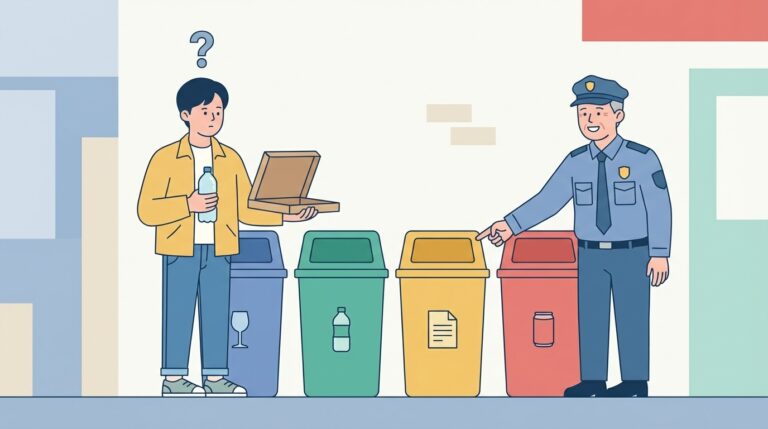
Imagine this K-Drama scene: The stylish main character, who always looks perfect at the office, sneaks out of their apartment at 11 PM wearing stretched-out sweatpants, thick glasses, and holding a suspiciously smelly plastic bag. Suddenly, they bump into their crush in the elevator! Or worse, they get yelled at by the apartment security guard (경비 아저씨) because they threw a greasy pizza box into the paper bin.
If you’re moving into a Korean apartment or an Airbnb, the 분리수거장 (Bunrisugeojang – Recycling Area) is the ultimate boss level of daily survival. Korea has one of the strictest recycling systems in the world. But don’t worry! Today, we’re going to learn the exact survival phrases you need to navigate the bins, impress the security guard, and avoid those K-Drama embarrassing moments. Let’s dive in!
Phase 2: 핵심 표현 심층 분석 (Deep Dive)
1. 분리수거
- Pronunciation: [bun-ri-su-geo] Sounds like: boon-ree-soo-guh
- Meaning: Separate collection (Recycling)
- K-Culture Moment: You’ll see this word on giant signs in your apartment complex or on the bins behind convenience stores. It’s a weekly ritual for Korean families.
- Editor’s Insight: Think of it as the ‘sorting’ process. If you don’t do this right, you might find a passive-aggressive sticky note on your door!
- Situation Spectrum:
[🚫 절대 금지] ———— [⚠️ 주의] ———— [✅ 자유롭게]
- Casual / Formal: ✅ (It’s a standard noun, use it anywhere!)
- 🤔 Think About It: Why does a small country like Korea have such a strict sorting system? How is waste managed in your hometown?
2. 일반 쓰레기
- Pronunciation: [il-ban sseu-re-gi] Sounds like: eel-ban suh-ray-gee (with ‘suh’ sounding like the disgusted sound you make when stepping in gum)
- Meaning: General waste (Non-recyclable)
- K-Culture Moment: When you order delivery food (배달음식) and you have dirty napkins or bones left over, they go here!
- Editor’s Insight: “일반” means general, and “쓰레기” means trash. If it can’t be recycled, burned, or eaten by animals, it goes into the ‘General Waste’ bag.
- Situation Spectrum:
[🚫 절대 금지] ———— [⚠️ 주의] ———— [✅ 자유롭게]
- Casual / Formal: ✅
- 🤔 Think About It: In Korea, you must buy special government-issued bags for ‘일반 쓰레기’. It’s a ‘pay-as-you-throw’ system to encourage less waste!
3. 음식물 쓰레기
- Pronunciation: [eum-sing-mul sseu-re-gi] Sounds like: oom-shing-mool suh-ray-gee
- Meaning: Food waste
- K-Culture Moment: The dreaded chore in every Korean household. The youngest sibling or the dad is usually the one sent down to empty the smelly food waste bucket!
- Editor’s Insight: Rule of thumb: If a pig can eat it, it’s food waste. Chicken bones? Onion peels? Pig says no, so it’s general waste!
- Situation Spectrum:
[🚫 절대 금지] ———— [⚠️ 주의] ———— [✅ 자유롭게]
- Casual / Formal: ✅
Phase 3: 교과서 vs 진짜 한국어 (Textbook vs Real Life)
| 상황 | 📖 교과서 한국어 | 🗣️ 진짜 한국어 | 💡 왜 다를까? |
|---|---|---|---|
| 버릴 곳을 물어볼 때 | 이것은 어디에 버립니까? (Where do I throw this?) | 저기요, 이거 어디 버려요? (Excuse me, where do I throw this?) | Koreans prefer the softer ‘~요’ ending in daily life. ‘버립니까’ sounds like a soldier! |
| 쓰레기 봉투 살 때 | 쓰레기 봉투 하나 주십시오. (Please give me one trash bag.) | 종량제 봉투 20리터짜리 하나 주세요. (One 20-liter standard bag, please.) | You must specify ‘종량제’ (standardized) and the size when buying at a convenience store. |
Phase 4: 문화적 맥락 — K-Culture 딥다이브 (Cultural Deep Dive)
4-1. 비언어적 요소 (Non-verbal Communication)
눈치 (Nunchi) at the Recycling Bin:
If you’re unsure where a piece of plastic goes, use your Nunchi (the Korean art of reading the room). Watch what the locals are doing! If the security guard (경비 아저씨 – Gyeongbi Ahjussi) helps you sort it, bow slightly and say “감사합니다 (Thank you)”. Building a good relationship with him will save your life!
4-2. K-Culture Connection: The K-Drama Recycling Trope
In Korean dramas, the recycling area is a classic plot device. Because people take out their trash in their most comfortable, unflattering clothes (think oversized t-shirts and messy hair), it’s the perfect comedic setup for running into the handsome neighbor or an ex-lover.
Critical View: While dramas make it look like a place for cute romantic encounters, in reality, it’s a fast-paced sorting zone where everyone just wants to finish their chore and get back inside!
Phase 5: 실전 롤플레이 시나리오 (Immersive Roleplay)
시나리오 A: 메인 롤플레이 (Main Scenario)
- Setting: Thursday evening, 8 PM. The basement recycling area of your Korean apartment. Fluorescent lights buzz above.
- Characters:
- YOU (The Reader): An expat living in Korea for a month. You just ate a delicious delivery pizza.
- 경비 아저씨 (Security Guard – Ahjussi): Strict but secretly warm-hearted. Wears a blue uniform.
경비 아저씨: (Pointing at your greasy pizza box) 학생, 그거 거기 넣으면 안 돼!
(Haksaeng, geugeo geogi noeumeun an dwae!)
[Student, you can’t put that in there!]
(🎭 Stage Direction: He walks over, looking at your greasy pizza box about to go into the clean paper bin.)
YOU: 헉, 죄송해요. 이거 종이 아니에요?
(Heok, joesonghaeyo. Igeo jong-i anieyo?)
[Gasp, I’m sorry. Isn’t this paper?]
경비 아저씨: 기름 묻은 건 일반 쓰레기야.
(Gireum mudeun geon ilban sseuregiya.)
[The ones with grease on them are general waste.]
🔀 당신의 차례! 어떻게 대답할까요? (Your Turn! How will you respond?)
– A) “아, 그럼 일반 쓰레기에 버릴게요. 감사합니다!” (Ah, then I’ll throw it in general waste. Thank you!)
– B) “왜요? 종이잖아요!” (Why? It’s paper!)
– C) “아저씨가 버려주세요.” (Ahjussi, please throw it away for me.)✅ Best Choice: A — Always accept the Ahjussi’s wisdom! He knows the rules best. Bowing slightly and correcting your mistake will make him smile.
⚠️ Choice B/C 분석: Arguing (B) will cause a scene, and asking him to do it for you (C) is considered very rude in Korean culture.
Phase 6: 10초 섀도잉 드릴 (Shadowing Drill)
Practice this lifesaver sentence. Use it whenever you are confused!
🥺 저기요, / 이거 / 어디에 / 버려요? (Jeogiyo, / igeo / eodie / beoryeoyo?)
(Excuse me, / this / where / do I throw away?)
Tip: Pause slightly at the slashes (/). Say it with a slightly helpless, polite tone. Koreans will happily point you to the right bin!
Phase 7: K-Culture 미니 사전 (K-Culture Glossary)
| 한국어 | Romanization | 영어 | 맥락 설명 |
|---|---|---|---|
| 분리수거 | bunrisugeo | Recycling | The act of separating waste. A mandatory daily chore. |
| 종량제 봉투 | jongnyangje bongtu | Volume-based garbage bag | You MUST buy these at the local mart/convenience store for general waste. |
| 배달 음식 | baedal eumsik | Delivery food | K-Food culture is great, but it creates a lot of plastic boxes you must wash before recycling! |
| 경비 아저씨 | gyeongbi ajeossi | Security guard | The gatekeeper of the apartment. Treat him well! |
| 눈치 | nunchi | Social awareness | Looking at how neighbors wash and crush their bottles before recycling them. |
Phase 8: 여행자 서바이벌 키트 (Traveler’s Survival Kit)
Even if you’re just traveling and staying at an Airbnb or visiting a convenience store, you will encounter multiple bins. Don’t be the tourist who messes up the system!
🆘 서바이벌 표현 TOP 3
– 🇰🇷 1. “이거 어디 버려요?” (igeo eodi beoryeoyo?) – Where do I throw this?
– 🇰🇷 2. “일반 쓰레기” (ilban sseuregi) – General waste
– 🇰🇷 3. “플라스틱” (peullaseutik) – Plastic📌 Editor’s Travel Note
– At Convenience Stores: You will usually see bins labeled 일반 쓰레기 (General), 캔/병 (Cans/Bottles), and 플라스틱 (Plastic). Pour out remaining liquids into the designated liquid bucket first!
– Airbnb Rules: Hosts can get fined if you don’t recycle. Always ask your host where the ‘분리수거장’ is.
Phase 9: 비판적 사고 코너 — “한 발 더 깊이” (Think Deeper)
Community over Convenience (공동체 의식)
Why is the Korean recycling system so intense? Living on a relatively small peninsula with a high population density, Korea ran out of landfill space decades ago. The strict ‘volume-based fee system’ (buying specific trash bags) and extreme recycling rules reflect the Korean mindset of ‘공동체’ (community). It’s an unspoken agreement: we all suffer a little bit of inconvenience at the recycling bin so that our collective home stays clean. It’s not just about the environment; it’s about social duty.
💬 Your Turn: Does your country have strict recycling laws? Do you think a ‘pay for your trash bag’ system would work in your culture? Let us know in the comments!
Phase 10: FAQ & 오해 방지 (Troubleshooting)
Q: Can I use regular plastic bags from the grocery store for my trash?
No! This is illegal. You must use the ‘종량제 봉투’ (Standardized garbage bag) specific to your district (구). If you use a regular bag, the garbage collectors will not pick it up, and you might get fined!
Q: Do I really have to wash my delivery food containers?
Yes. A greasy tteokbokki container is NOT recyclable. You must rinse the red sauce out. If the stain doesn’t come off, it goes into the 일반 쓰레기 (General waste).
❌ 흔한 실수 #1: Throwing chicken bones or fruit pits into the Food Waste (음식물 쓰레기) bin.
✅ 이렇게 하세요 (Do this instead): Hard items like bones, eggshells, and fruit pits go into General Waste (일반 쓰레기).
Phase 11: 요약 및 액션 아이템 (Wrap-up)
One-Liner Summary: Survive the K-Apartment by mastering “분리수거 (Recycling)” and asking “이거 어디 버려요?” when in doubt!
Action Mission 3단계:
– 🥉 Bronze: Say “일반 쓰레기” and “음식물 쓰레기” out loud 3 times right now.
– 🥈 Silver: Look at the trash bin in your room. Categorize your trash in Korean in your head!
– 🥇 Gold: Next time you go to a Korean convenience store or your apartment bin, ask someone: “이거 어디 버려요?”
🎬 K-Culture Mission:
Next time you watch a modern K-Drama, look closely at the background when characters are outside their apartments. Can you spot the green and blue recycling bins?
Phase 12: 퀴즈 — 인터랙티브 챌린지 (Interactive Quiz)
1. Fill in the blank:
You have a plastic bottle. You ask the clerk, “저기요, 이거 어디 _______?”
(Excuse me, where do I throw this?)
2. True or False:
Chicken bones belong in the ‘음식물 쓰레기’ (Food Waste) bag because they are from food. (T/F)
3. Situational Judgment:
You are at the convenience store and don’t know where to throw your empty ramen cup. What is the BEST thing to do?
– A) Leave it on the table.
– B) Throw it in general waste secretly.
– C) Hold it up to the clerk and ask “이거 어디 버려요?”
정답 보기 (Click for Answers)
1. 버려요 (beoryeoyo)
2. False. Chicken bones are hard and cannot be eaten by animals, so they go into ‘일반 쓰레기’ (General Waste).
3. C is the best! The clerk will gladly tell you. (Never do A, it’s very rude!)
Frequently Asked Questions (FAQ)
Q: What does "분리수거" mean in Korean and how do you pronounce it?
A: In Korean, "분리수거" is pronounced [bun-ri-su-geo] and means: Separate collection (Recycling)
Q: What does "일반 쓰레기" mean in Korean and how do you pronounce it?
A: In Korean, "일반 쓰레기" is pronounced [il-ban sseu-re-gi] and means: General waste (Non-recyclable)
Q: What does "음식물 쓰레기" mean in Korean and how do you pronounce it?
A: In Korean, "음식물 쓰레기" is pronounced [eum-sing-mul sseu-re-gi] and means: Food waste







