

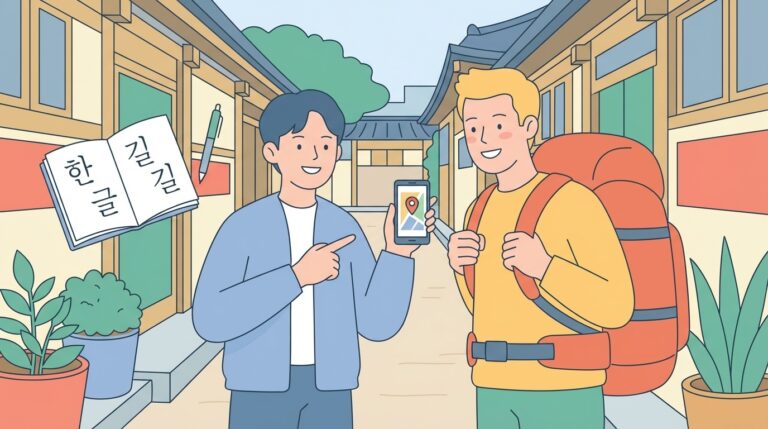
Hello there! I’m the Lead Editor at Daily Hangul, your veteran tutor and local cultural navigator.
Picture this: You are standing in the middle of a bustling street in Myeongdong. Your map app insists you have “arrived,” but all you see is a sea of neon signs and definitely not the dumpling restaurant you were looking for.
You cautiously approach a local, show them your phone, and ask for directions. You expect them to point left or right. Instead, they look at your screen, nod, and start walking away while gesturing for you to follow.
Wait, are they kidnapping me? Is this a scam?
Don’t panic! You have just experienced one of the most heartwarming, uniquely Korean cultural phenomena: the “Jeong (정)” of personally escorting a lost stranger to their destination. In K-Dramas, you might see the male lead suddenly grabbing the heroine’s wrist to lead her through a crowd. In real life, it’s an ordinary office worker or a friendly grandma who simply cannot bear the thought of you getting lost.
Today, we are diving deep into the vocabulary and cultural mindset behind this surprising Korean kindness.
Phase 2: Deep Dive into Key Expressions
Let’s look at the actual phrases you will hear when a Korean decides to become your personal tour guide.
1. 제가 안내해 드릴게요. (I’ll guide you.)
- Pronunciation: [jega an-nae-hae deulilgeyo] / sounds like: je-ga an-nae-hae deu-ril-ge-yo
- Meaning: Literal: I will give you the guidance. / Real nuance: Let me show you the way.
- K-Culture Moment: You will hear this a lot from security guards, subway staff, or very polite locals. It has a formal, customer-service-like vibe, but ordinary citizens use it when they want to be incredibly respectful to a foreigner.
- Editor’s Insight: The word 안내 (annae) means guidance or information. Adding 드릴게요 (give) makes it extremely humble. They are offering their help as a gift to you.
- Situation Spectrum:
[🚫 절대 금지] ———— [⚠️ 주의] ———— [✅ 자유롭게]
- Casual (Friends): ⚠️ (Too formal, friends just say “내가 알려줄게”)
- Semi-formal (Strangers): ✅
- Formal (Elders/Boss): ✅
- 🤔 Think About It: Why does the Korean language use verbs meaning “to give” (주다/드리다) when doing a favor? How does this reflect the Korean emphasis on community and service?
2. 저 따라오세요. (Follow me.)
- Pronunciation: [jeo ttalaoseyo] / sounds like: juh dda-ra-o-se-yo (dda sounds hard, like ‘t’ in ‘stop’)
- Meaning: Literal: Come following me. / Real nuance: Just follow me, I’ll take you there.
- K-Culture Moment: Imagine a busy market owner in Gwangjang Market wiping their hands on an apron and saying this. It’s direct, confident, and very “Pali-pali” (fast-paced).
- Editor’s Insight: To an English speaker, “follow me” might sound a bit bossy from a stranger. In Korean, it’s not bossy at all! It’s an expression of active care. They are taking responsibility for you.
- Situation Spectrum:
[🚫 절대 금지] ———— [⚠️ 주의] ———— [✅ 자유롭게]
- Casual (Friends): ✅ (Say “따라와” to friends)
- Semi-formal (Strangers/Staff): ✅
- Formal (To Boss/Elders): 🚫 (Too direct, use Expression #1 instead)
- 🤔 Think About It: Have you ever noticed that Koreans often use imperatives (commands) to show affection? (e.g., “밥 먹어!” – Eat your food!). Why might directness equal care in this culture?
3. 저도 그쪽으로 가는 길이에요. (I’m heading that way too.)
- Pronunciation: [jeodo geujjog-eulo ganeun gil-ieyo] / sounds like: juh-do geu-jjok-eu-ro ga-neun gil-ee-eh-yo
- Meaning: Literal: I am also on the way to that side. / Real nuance: Don’t feel burdened by my help, I was going there anyway.
- K-Culture Moment: This is the ultimate “white lie” of Korean kindness. You ask for directions to the subway. They walk you exactly to the gate, then suddenly turn around and walk back the way they came. Wait, weren’t they heading this way too?!
- Editor’s Insight: This phrase is the absolute peak of Jeong (정) and Nunchi (눈치) combined. They know that if they just say “I’ll walk you there,” you might feel guilty for wasting their time. So, they invent an excuse to make you comfortable.
- Situation Spectrum:
[🚫 절대 금지] ———— [⚠️ 주의] ———— [✅ 자유롭게]
- Casual: ✅
- Semi-formal: ✅
- Formal: ✅
- 🤔 Think About It: Is there a “polite white lie” culture in your country to save someone else from feeling guilty?
Phase 3: Textbook vs Real Life
| Situation | 📖 Textbook Korean | 🗣️ Real Korean | 💡 Why the difference? |
|---|---|---|---|
| Telling you to go straight | “앞으로 쭉 가십시오.” (Go straight ahead.) | “저 따라오세요.” (Follow me.) | Explaining is too slow. Action is faster! (Pali-pali culture) |
| Assuring you it’s okay | “괜찮습니다. 도와드리겠습니다.” (It is fine. I will help.) | “아, 마침 저도 가는 길이에요.” (Ah, I was going that way anyway.) | To reduce the psychological burden on the receiver (Jeong). |
| Parting after helping | “안녕히 가세요.” (Go peacefully.) | “다 왔어요. 조심해서 가세요~” (We’re here. Go safely~) | Adding “safely” (조심해서) shows continued care even as you part. |
Phase 4: Cultural Deep Dive
4-1. Non-verbal Communication: The “Pali-Pali” Walk
When a Korean says “Follow me,” you need to be ready for the “Pali-Pali” (hurry up) walking pace. They aren’t walking fast because they are angry; it’s just the default Seoul speed. Also, notice their hands. When Koreans point out directions, they rarely use a single index finger (which can seem rude). Instead, they point with their entire hand open, palm facing up, as if presenting a prize.
4-2. K-Travel Connection: The Alleyway Maze
Why is this culture so prevalent? Look at Seoul’s geography. Beyond the main boulevards, Korea is a maze of Golmokgil (골목길 – alleyways). Buildings have complex addresses, and sometimes a famous restaurant is hidden on the 3rd floor of an unassuming building with no clear English signs. Map apps (even Naver and Kakao) can glitch in these narrow spaces. Locals know that explaining “Turn left at the convenience store, right at the fried chicken shop, and it’s behind the karaoke” is impossible for a foreigner to follow.
Phase 5: Immersive Roleplay
Main Scenario: The Hongdae Labyrinth
Setting: Saturday afternoon, Hongdae (Hongik University area). The streets are packed with buskers and shoppers. You are trying to find a specific indie cafe for a fan-cup-sleeve event for your favorite K-Pop idol. You are completely lost. You approach a friendly-looking local student.
YOU (The Learner): 실례합니다… 혹시 이 카페 알아요? 🥺
(sillyehamnida… hoksi i kape arayo?)
[Excuse me… do you happen to know this cafe?]
Local Student: 아! 여기… (Looking at your phone, scratching their head) 말로 설명하기 좀 복잡한데…
(Ah! yeogi… mallo seolmyeonghagi jom bokjaphande…)
[Ah! Here… it’s a bit complicated to explain in words…]
Local Student: 제가 안내해 드릴게요. 저 따라오세요! 👋
(jega an-nae-hae deulilgeyo. jeo ttalaoseyo!)
[I’ll guide you. Follow me!]
🔀 YOUR TURN! How do you respond?
– A) “아니에요, 괜찮아요! 혼자 갈 수 있어요.” (No, it’s okay! I can go alone.)
– B) “아… 너무 죄송한데, 감사합니다!” (Ah… I feel so bad (for bothering you), thank you!)
– C) “오케이! 렛츠고!” (Okay! Let’s go!)✅ Best Choice: B — Korean culture loves a little “push and pull” of politeness. Showing slight hesitation (“I feel bad for taking your time”) followed by gratitude makes you look incredibly well-mannered.
⚠️ Choice A Analysis: If you refuse too strongly, they might think they offended you. If you really don’t want them to follow, you have to be very gentle.
⚠️ Choice C Analysis: A bit too casual unless you are at a party!
(🎭 Stage Direction: The student starts walking quickly. You scramble to keep up. After 3 minutes, you arrive at the cafe!)
YOU: 우와! 진짜 감사합니다. 바쁘신데 죄송해요.
(Uwa! jinjja gamsahamnida. bappeusinde joesonghaeyo.)
[Wow! Thank you so much. I’m sorry to bother you when you’re busy.]
Local Student: 아니에요! 저도 마침 이쪽으로 가는 길이었어요. 좋은 하루 보내세요! 😊
(Anieyo! jeodo machim ijjogeuro ganeun girieosseoyo. joeun haru bonaeseyo!)
[No worries! I was actually heading this way anyway. Have a good day!]
(🎭 Stage Direction: The student turns around and walks back the exact way they came. The legendary white lie!)
Phase 6: 10-Second Shadowing Drill
Let’s practice the ultimate “polite white lie” of Korean kindness.
Pay attention to the natural pauses / and the emotion!
😊 아, / 마침 저도 / 그쪽으로 / 가는 길이었어요!~
(Ah, / machim jeodo / geujjogeuro / ganeun girieosseoyo!~)
[Oh, I happened to be going that way too!]
Editor’s Pronunciation Tip: Soften the end of the sentence. Don’t drop it aggressively. A little smile at the end (“yo~”) makes it sound warm and reassuring.
Phase 7: K-Culture Glossary
| Korean | Romanization | English | Contextual Meaning |
|---|---|---|---|
| 정 | jeong | Affection/Warmth | The invisible bond of empathy and connection in Korean society. |
| 길치 | gilchi | Poor sense of direction | Someone who easily gets lost (길 = road, 치 = idiot/blind). Very common self-deprecating slang! |
| 골목길 | golmokgil | Alleyway | The narrow streets where all the best hidden gems (and map failures) happen. |
| 빨리빨리 | ppalli-ppalli | Hurry, hurry! | The ingrained Korean culture of doing things quickly and efficiently. |
| 눈치 | nunchi | Social awareness | Reading the room. Knowing someone feels bad about being helped, so you lie that you were going that way. |
Phase 8: Traveler’s Survival Kit
🆘 Survival Expressions for Getting Lost
– 🇰🇷 “길을 잃었어요.” (gireul ileosseoyo.) – I’m lost.
– 🇰🇷 “여기로 가려면 어떻게 가야 돼요?” (yeogiro garyeomyeon eotteoke gaya dwaeyo?) – How do I get here? (While pointing at your phone)
– 🇰🇷 “여기서 멀어요?” (yeogiseo meoreoyo?) – Is it far from here?
📌 Editor’s Travel Note:
– Map Apps: Google Maps DOES NOT work well for walking directions in Korea due to security laws. You must download Naver Map or Kakao Map. Both have excellent English interfaces!
– Tipping: If a Korean walks you to your destination, DO NOT offer them money/a tip. They will be extremely confused and slightly offended. Their help is purely Jeong. A bright smile and a “정말 감사합니다!” (Thank you so much!) is the only currency needed.
Phase 9: Think Deeper — “One Step Further”
🧠 Think Deeper: Food, Community, and the Boundary of Self
Why do Koreans go out of their way to personally escort a stranger? It comes down to the concept of the collective community. In many Western cultures, independence and personal space are paramount; getting too involved in a stranger’s problem might be seen as intrusive. However, in Korea, the boundary between “me” and “you” is softer. This is the same reason Koreans share huge pots of stew (Jjigae) instead of having individual plates. Helping you find your way isn’t viewed as an interruption of their personal time; it’s an extension of Jeong, treating you for a brief moment as a member of their community.
💬 Your Turn: How do people react to lost tourists in your home city? Would someone walk 10 minutes out of their way for a stranger? Share in the comments!
Phase 10: FAQ & Troubleshooting
- “Can I use ‘저 따라오세요’ (Follow me) to someone older?”
- No! If you are helping an older person find their way, saying “따라오세요” sounds like a command. Instead, use the formal “제가 안내해 드릴게요” (I’ll guide you) or “이쪽으로 오시면 됩니다” (You can come this way).
- “What if I walk too slow and can’t keep up with them?”
- Just lightly say, “천천히 가도 괜찮아요!” (It’s okay to go slowly!). They will realize you aren’t used to the Pali-pali speed and slow down with a smile.
❌ Common Mistake #1: Vigorously refusing their help multiple times because you want to be polite.
✅ Do this instead: Decline politely once (“아, 괜찮은데…” – Ah, it’s okay though…). If they insist, accept it immediately with a big thank you. Refusing too much blocks their attempt to show Jeong!
Phase 11: Wrap-up & Action Items
🎯 One-Liner Summary: When a Korean says “Follow me” to a lost tourist, it’s not a scam—it’s the heartwarming culture of Jeong (and probably a polite white lie that they were heading that way anyway)!
Action Mission:
– 🥉 Bronze (Solo): Look at the map of Seoul on your phone, point to a random spot, and say “제가 안내해 드릴게요” out loud 3 times.
– 🥈 Silver (Online): Comment below about a time you got completely lost while traveling! Use the word gilchi (길치) if it applies to you.
– 🥇 Gold (Real Life): If you are in Korea and someone asks you for directions, be brave! Use “저 따라오세요!” and show them the way like a true local.
✨ Special K-Culture Mission: Next time you watch a K-Drama, look closely at the background extras. See if you can spot a scene where someone is helping another person with directions on the street. It happens more often than you think!
Phase 12: Interactive Quiz
Q1. Situational Judgment: You are in Gangnam, and an elderly Korean man asks you where exit 3 is. You know the way. Which is the MOST polite way to offer to walk him there?
1) 저 따라오세요. (Follow me.)
2) 빨리빨리 오세요. (Come quickly.)
3) 제가 안내해 드릴게요. (I will guide you.)
4) 혼자 가세요. (Go alone.)
Q2. True or False – K-Culture Edition:
If a local walks you 15 minutes out of their way to find your hotel, it is polite to give them a 5,000 won tip to show appreciation.
🚨 Click here to see the answers!
A1: 3) 제가 안내해 드릴게요. Since he is elderly, using the humble form “안내해 드릴게요” is the most respectful choice. “따라오세요” might sound a bit rude to a grandfather.
A2: False! Korea does not have a tipping culture. Offering money for a favor born out of Jeong can actually make the situation awkward. A deep bow and a sincere “감사합니다” are perfect.
Frequently Asked Questions (FAQ)
Q: What does "제가 안내해 드릴게요. (I'll guide you.)" mean in Korean and how do you pronounce it?
A: In Korean, "제가 안내해 드릴게요. (I'll guide you.)" is pronounced [jega an-nae-hae deulilgeyo] and means: Literal: I will give you the guidance. / Real nuance: Let me show you the way.
Q: What does "저 따라오세요. (Follow me.)" mean in Korean and how do you pronounce it?
A: In Korean, "저 따라오세요. (Follow me.)" is pronounced [jeo ttalaoseyo] and means: Literal: Come following me. / Real nuance: Just follow me, I'll take you there.
Q: What does "저도 그쪽으로 가는 길이에요. (I'm heading that way too.)" mean in Korean and how do you pronounce it?
A: In Korean, "저도 그쪽으로 가는 길이에요. (I'm heading that way too.)" is pronounced [jeodo geujjog-eulo ganeun gil-ieyo] and means: Literal: I am also on the way to that side. / Real nuance: Don't feel burdened by my help, I was going there anyway.







