

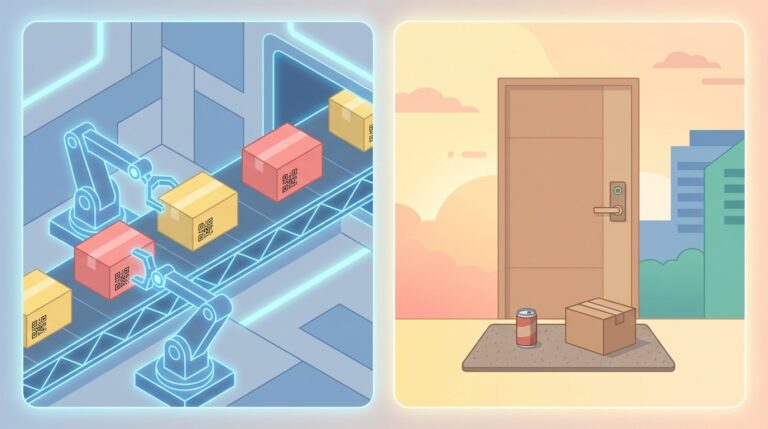
Phase 1: Empathy — The Midnight Magic of Korean Delivery
Hello there! I’m your Daily Hangul Editor.
Picture this: It’s 11:58 PM in Seoul. You’re lying in bed, watching the latest K-Drama where the female lead flawlessly cooks a gourmet meal before work. Suddenly, you realize your fridge is entirely empty, and you have guests coming over for brunch tomorrow. Panic? Not in Korea. You simply open an app, tap a few buttons to order a premium meal kit, and go to sleep. At 6:00 AM, a text chimes: “Delivery complete at your door.”
Welcome to the miracle of 로켓배송 (Rocket Delivery) and Korea’s hyper-efficient automated logistics network.
But here’s the catch for advanced (C2) Korean learners: When you track these packages, you aren’t just reading simple words like “shipped” or “arrived.” You are confronted with high-level Sino-Korean (Hanja) industry jargon. Knowing these terms doesn’t just help you find your lost K-Pop merchandise; it gives you profound insight into the intricate, automated system that keeps the Ppalli-ppalli (빨리빨리, hurry-hurry) culture alive. Let’s decode the matrix of Korean logistics!
Phase 2: Deep Dive into Logistics Terminology
When navigating advanced Korean, understanding the Hanja roots of industry jargon is your superpower. Here are the core terms you’ll see on your tracking app.
1. 집화 처리 (Collection Processing)
- Pronunciation: jiphwa cheori / [jeep-hwa chuh-ree] (The ‘hwa’ sounds like a sharp exhale while saying ‘wa’)
- Meaning: Literal: ‘Gathering goods processing’. Real nuance: The moment the courier picks up your package and scans it into the initial network.
- K-Culture Moment: You ordered that limited-edition K-Pop lightstick. For three days, the status was “Preparing.” Finally, it changes to 집화 처리. Fans know this is the exact moment you can finally breathe—your item is officially in the system!
- Editor’s Insight: This is a formal, systemic term. 집 (Jip) means ‘to gather’ (as in 집중 – concentration) and 화 (Hwa) means ‘goods/freight’ (as in 화물 – cargo). You won’t use this in daily chat, but it’s essential for reading tracking logs.
- Situation Spectrum:
[🚫 Casual] ———— [⚠️ Semi-formal] ———— [✅ Formal/Systemic]- Texting a friend: 🚫
- Customer Service inquiry: ✅
- Reading tracking apps: ✅
- 🤔 Think About It: Why does Korean rely so heavily on dense Sino-Korean words (Hanja) for official and systemic processes, rather than pure Korean words? How does this compare to Latin or French roots used in English legal or technical jargon?
2. 간선 상차 / 간선 하차 (Trunk Loading / Unloading)
- Pronunciation: ganseon sangcha / [gahn-sun sahng-cha] (‘cha’ like in cha-cha-cha)
- Meaning: Literal: ‘Mainline vehicle boarding / unboarding’. Real nuance: Loaded onto or unloaded from the massive 18-wheeler trucks moving between major automated hubs.
- K-Culture Moment: The dreaded 간선 상차. Your package has been loaded onto a truck heading to the sorting hub. But sometimes, it stays in this status for days if it gets stuck in the automated sorting loops.
- Editor’s Insight: 상 (Sang) means ‘up/on’ and 하 (Ha) means ‘down/off’. 차 (Cha) is vehicle. This is pure logistics terminology. If your K-Food midnight snack delivery is delayed, you’ll be feverishly refreshing the app waiting for 상차 to turn into 하차 at your local terminal.
- Situation Spectrum:
[🚫 Casual] ———— [⚠️ Semi-formal] ———— [✅ Formal/Systemic]
3. 분류 터미널 (Automated Sorting Terminal)
- Pronunciation: bunryu teomineol / [boon-ryoo tuh-mee-null]
- Meaning: Sorting terminal. Real nuance: The mega-facilities where AI algorithms, barcode scanners, and miles of conveyor belts sort millions of packages overnight.
- K-Culture Moment: This is the heart of Rocket Delivery. While you sleep, AI-driven Automated Guided Vehicles (AGVs) at the 분류 터미널 are seamlessly categorizing your cosmetics, groceries, and clothes so they reach your door by dawn.
- Editor’s Insight: Koreans often refer to specific notorious terminals, like the “Okcheon Hub” (옥천 허브), jokingly calling it the “Bermuda Triangle” because packages sometimes go in and never seem to come out.
- Situation Spectrum:
[🚫 Casual] ———— [✅ Semi-formal] ———— [✅ Formal/Systemic]
Phase 3: Textbook vs. Real Life Korean
Let’s look at how logistics is taught versus how natives actually complain about their delayed packages on Twitter or KakaoTalk.
| Situation | 📖 Textbook Korean | 🗣️ Real Korean | 💡 Why the Difference? |
|---|---|---|---|
| Package is out for delivery | 소포가 배달되고 있습니다. (The parcel is being delivered.) | 택배 기사님 오고 계신대! (The delivery driver is on the way!) | Native speakers emphasize the person (driver) rather than the object (parcel) in casual speech. |
| Super fast delivery | 배송이 매우 빠릅니다. (Delivery is very fast.) | 와, 로켓 탔네. (Wow, it rode a rocket.) | A slang homage to Coupang’s “Rocket Delivery” brand, which has become a generic term for hyper-speed. |
| Package is delayed at the hub | 물류 센터에서 지연되고 있습니다. (It is delayed at the logistics center.) | 내 택배 옥천 버뮤다에 갇혔어 ㅠㅠ (My package is trapped in the Okcheon Bermuda Triangle T_T) | Internet meme culture. The Okcheon Hub is notoriously massive, and automated loop errors used to trap packages there. |
| Delivery completed | 문 앞에 놓았습니다. (I placed it in front of the door.) | 문앞배송 완. (Door-delivery complete.) | Extreme abbreviation (완료 -> 완) reflects the Ppalli-ppalli culture of texting. |
Phase 4: Cultural Deep Dive
4-1. Non-verbal Communication: The “Proof Shot” Culture
When an automated delivery is completed at 3:00 AM, the driver obviously won’t ring your bell. Instead, the final step of the logistics system is a non-verbal assurance: The Photo. You will receive a text with a photo of your specific package sitting peacefully in front of your specific door.
This relies on Korea’s High-Trust Society (and ubiquitous CCTV). Leaving a $2,000 laptop in the hallway for 14 hours? No one will touch it. The photo isn’t just proof of delivery; it’s a cultural symbol of systemic trust and automated accountability.
4-2. K-Culture Connection: The “Dawn Delivery” (새벽배송) Phenomenon
If you watch K-Dramas, you’ll notice characters having impromptu rooftop BBQ parties or suddenly applying a specific brand of skincare before a big meeting. How did they get those items so fast?
Korea’s topography (densely populated apartment complexes in highly urbanized areas) makes AI-routed, automated hub systems incredibly efficient. You can order a fresh, refrigerated meal kit (밀키트) at 11:00 PM and cook it for breakfast at 7:00 AM. This has entirely revolutionized Korean food culture. You no longer need a massive fridge to hoard food; the automated logistics center is your fridge.
Phase 5: Immersive Roleplay Scenario
Scenario A: The Office “Rocket” Crisis
Setting: Tuesday, 2:00 PM. The breakroom of your Seoul tech company. You and your coworker, Ji-hoon, are organizing the team workshop for tomorrow. You ordered the workshop snacks and banners online.
Characters:
– YOU: The hyper-organized expat manager.
– Ji-hoon (지훈, 30s): Your Korean coworker, a severe caffeine addict who checks his delivery app every 10 minutes.
Dialogue:
지훈: 매니저님, 내일 워크샵 물품 배송 조회 해보셨어요? 📦
(maenijeonim, naeil wokeusyap mulpum baesong johoe haebosyeosseoyo?)
(Manager, did you check the delivery tracking for tomorrow’s workshop items?)
(🎭 Stage Direction: Ji-hoon aggressively taps his smartphone screen.)
YOU: 네, 아까 확인했는데 아직 ‘집화 처리’ 상태더라고요.
(ne, akka hwaginhanneunde ajik ‘jiphwa cheori’ sangtaedeoragoyo.)
(Yes, I checked earlier, and it’s still in the ‘Collection Processing’ state.)
지훈: 아, 진짜요? 지금 간선 상차 안 됐으면 내일 아침에 못 받을 수도 있는데…
(a, jinjjayo? jigeum ganseon sangcha an dwaesseumyeon naeil achime mot badeul sudo inneunde…)
(Ah, really? If it hasn’t been trunk-loaded by now, we might not get it by tomorrow morning…)
YOU: 로켓배송이라서 새벽에는 터미널 거쳐서 올 거라고 생각했어요.
(roketbaesongiraseo saebyeogeneun teomineol geochyeoseo ol georago saenggakaesseoyo.)
(Since it’s Rocket Delivery, I figured it would pass through the terminal by dawn.)
지훈: 하필 옥천 허브로 빠지면 답 없거든요. 기사님한테 연락 한번 해볼까요?
(hapil okcheon heobeuro ppajimyeon dap eopgeodeunyo. gisanimhante yeollak hambeon haebolkkayo?)
(If it falls into the Okcheon Hub of all places, there’s no hope. Should we try contacting the driver?)
🔀 Your Turn! How should you respond?
– A) “네, 당장 전화해서 빨리 가져오라고 하세요!” (Yes, call right now and tell them to bring it fast!)
– B) “아직 허브에 있으면 기사님도 모를 거예요. 조금만 더 기다려보죠.” (If it’s still at the hub, the driver won’t know either. Let’s wait a bit longer.)
– C) “옥천 허브가 뭐예요?” (What is the Okcheon Hub?)✅ Best Choice: B — Why? Advanced cultural insight! Delivery drivers (택배 기사님) only handle the “Last Mile” delivery. If the app says it’s at the automated hub (분류 터미널) or trunk-loaded (간선 상차), the local driver has zero control over it. Calling them would just stress them out. Choice B shows high-level logic and empathy.
Scenario B: The Delivery App Note (Bonus)
Setting: You are ordering bottled water to your apartment, but there’s a security door.
앱 메시지 (App Message Box): 배송 요청사항을 입력해주세요. (Please enter delivery requests.)
YOU: 공동현관 비밀번호는 종소리 1234 🔔 입니다. 문 앞에 두고 가주세요. 감사합니다! 🙇♂️
(gongdonghyeongwan bimilbeonhoneun jongsori 1234 imnida. mun ape dugo gajuseyo. gamsahamnida!)
(The common entrance password is Bell 1234. Please leave it at the door. Thank you!)
Phase 6: 10-Second Shadowing Drill
Let’s practice a high-level sentence you might use when explaining this system to a friend back home.
Focus on the rhythm and Hanja compound words:
😤 한국의 / 물류 자동화 시스템은 / 정말 / 세계 최고 수준이에요!
(hangugui / mullyu jadonghwa siseutemeun / jeongmal / segye choego sujunieyo!)
(Korea’s automated logistics system is truly world-class!)
😊 밤 11시에 / 주문했는데 / 다음 날 새벽에 / 문 앞에 있더라고요.
(bam yeolhansie / jumunhaenneunde / daeum nal saebyeoge / mun ape itdeoragoyo.)
(I ordered at 11 PM, and it was in front of my door by the next dawn.)
(Tip: Pause slightly at the slashes. Stress the “정~말” (jeong~mal) for native-like exaggeration!)
Phase 7: K-Culture Glossary (Logistics Edition)
| 한국어 (Korean) | Romanization | English | Cultural Context |
|---|---|---|---|
| 로켓배송 | roket-baesong | Rocket Delivery | Coupang’s signature next-day or dawn delivery service. The ultimate symbol of modern Korean speed. |
| 택배 기사님 | taekbae gisanim | Delivery Driver (Honorable) | Always attach ‘님’ (nim) to respect their hard labor in the fast-paced ecosystem. |
| 옥천 버뮤다 | okcheon beomyuda | Okcheon Bermuda | Internet slang. The mega-logistics hub in Okcheon where packages supposedly get lost in sorting loops. |
| 공동현관 | gongdong-hyeongwan | Common Entrance | The main security door of a Korean apartment building. You MUST provide the password in delivery apps. |
| 송장번호 | songjang-beonho | Tracking Number | The barcode number scanned by the automated conveyors at every step. |
Phase 8: Traveler’s Survival Kit
Even if you are just visiting Korea for a week, you’ll likely want to experience the magic of Korean online shopping (like ordering K-beauty products straight to your hotel).
🆘 Survival Expressions for Travelers
– 🇰🇷 “택배를 호텔 프론트로 받을 수 있을까요?” (taekbaereul hotel peuronteuro badeul su isseulkkayo?)
– 🗣️ Meaning: Can I receive a parcel at the hotel front desk?
– 📍 Where to use: Calling your hotel concierge before ordering.
– 💡 Pro Tip: Not all hotels allow this due to storage limits. Always ask first! If they say yes, make sure the delivery name matches your passport/hotel reservation name exactly.
📌 Editor’s Travel Note:
– The ARC Hurdle: To use Coupang or automated delivery apps natively, you need an Alien Registration Card (ARC) for identity verification and Korean credit card processing.
– The Loophole: If you are a tourist without an ARC, use concierge services, ask a Korean friend to gift it to you via KakaoTalk, or use global-friendly services like Gmarket Global which accept foreign cards!
Phase 9: Think Deeper — Convenience vs. Labor
🧠 Think Deeper: The Shadow of Automation (Media vs Reality)
In K-Dramas, dawn delivery looks like pure magic—a box just neatly appears at the protagonist’s pristine apartment door. But stepping beyond the screen reveals a complex socio-economic reality. While the 물류 센터 (Logistics Centers) utilize cutting-edge AI and robotic sorting, the “Last Mile” still relies on the grueling night-shift labor of human delivery drivers running up and down apartment stairs at 3:00 AM. Korea’s automated logistics system is a fascinating juxtaposition: hyper-advanced AI algorithms dictating the routes, paired with intense physical labor fueled by society’s uncompromising demand for Ppalli-ppalli convenience. Does absolute consumer convenience come at the cost of human breathing room?💬 Your Turn: How fast is too fast? In your home country, is there a push for “Dawn Delivery,” or do people prioritize the work-life balance of logistics workers? Share your thoughts below!
Phase 10: FAQ & Troubleshooting
Q: Can I give a cash tip to the delivery driver if they deliver at dawn?
A: 🚫 No. Korea does not have a tipping culture. In fact, you won’t even see the dawn delivery driver! If you want to show appreciation during hot summers or busy holidays (like Chuseok), Koreans often leave a small basket of bottled water or vitamin drinks outside their door with a sticky note saying: “기사님, 감사합니다. 하나씩 드세요!” (Driver, thank you. Please take one!).
Q: My tracking says “배송 완료” (Delivery Complete) but nothing is there! What do I do?
A: Check the photo! Usually, they send a proof shot via text or app. If the door in the photo isn’t yours, they might have delivered it to the wrong apartment number (e.g., Building 101 instead of 102).
❌ Common Mistake: Calling customer service immediately and yelling in English.
✅ Do This Instead: Check the app for “기사님 연락처” (Driver’s contact). Send a polite text: “기사님, 배송 완료라고 뜨는데 문 앞에 택배가 없습니다. 혹시 오배송 되었을까요?” (Driver, it says delivery complete but there’s no parcel at my door. Could it have been misdelivered?)
Phase 11: Wrap-up & Action Items
One-Liner Summary: Mastering advanced Korean logistics terms like 집화 처리 and 간선 상차 unlocks a deeper understanding of Korea’s hyper-efficient, AI-driven Ppalli-ppalli society.
🎯 Action Mission:
– 🥉 Bronze: Say the phrase “한국의 물류 자동화 시스템은 세계 최고예요” out loud 3 times with native intonation.
– 🥈 Silver: Look up the tracking status of any package you currently have (in any country) and try to translate its status into the Korean Hanja terms we learned today.
– 🥇 Gold (K-Culture Mission): Order something using a Korean app (or have a Korean friend help you). Track the journey from 집화 처리 to 문앞배송 완, and leave a little vitamin drink at your door for the 기사님!
Did you ever experience the magic of Korean Rocket Delivery? Let me know your craziest late-night order in the comments! 👇
Phase 12: Interactive Quiz
1. Situational Judgment: Your tracking app has been stuck on “간선 상차” (Trunk Loaded) for 2 days. What does this mean?
– A) The driver is lost in your neighborhood.
– B) The item hasn’t been picked up from the seller yet.
– C) It is currently in a massive truck moving between logistics hubs (or delayed at a hub like Okcheon).
2. Fill in the Blank:
택배가 밤새 AI ( ______ ) 터미널을 거쳐서 오늘 아침에 도착했어요.
(The parcel passed through the AI _____ terminal overnight and arrived this morning.)
– A) 상차 (Sangcha)
– B) 분류 (Bunryu)
– C) 현관 (Hyeongwan)
3. True or False – Culture Edition:
It is considered polite to wait at the door at 4:00 AM to personally hand a cash tip to the Dawn Delivery driver. (T / F)
👀 Click here for Answers!
1. C – It is moving between hubs. The local driver doesn’t have it yet!
2. B – 분류 (Bunryu / Sorting). The Automated Sorting Terminal.
3. False – Korea has no tipping culture, and dawn delivery is meant to be contact-free (비대면). Leaving a canned coffee at the door is the highest form of appreciation!
Frequently Asked Questions (FAQ)
Q: What does "집화 처리 (Collection Processing)" mean in Korean and how do you pronounce it?
A: In Korean, "집화 처리 (Collection Processing)" is pronounced [jiphwa cheori / [jeep-hwa chuh-ree] and means: Literal: 'Gathering goods processing'. Real nuance: The moment the courier picks up your package and scans it into the initial network.
Q: What does "간선 상차 / 간선 하차 (Trunk Loading / Unloading)" mean in Korean and how do you pronounce it?
A: In Korean, "간선 상차 / 간선 하차 (Trunk Loading / Unloading)" is pronounced [ganseon sangcha / [gahn-sun sahng-cha] and means: Literal: 'Mainline vehicle boarding / unboarding'. Real nuance: Loaded onto or unloaded from the massive 18-wheeler trucks moving between major automated hubs.
Q: What does "분류 터미널 (Automated Sorting Terminal)" mean in Korean and how do you pronounce it?
A: In Korean, "분류 터미널 (Automated Sorting Terminal)" is pronounced [bunryu teomineol / [boon-ryoo tuh-mee-null] and means: Sorting terminal. Real nuance: The mega-facilities where AI algorithms, barcode scanners, and miles of conveyor belts sort millions of packages overnight.






