

Phase 1: Immersive Hook
Hello! I’m the Lead Editor at Daily Hangul.
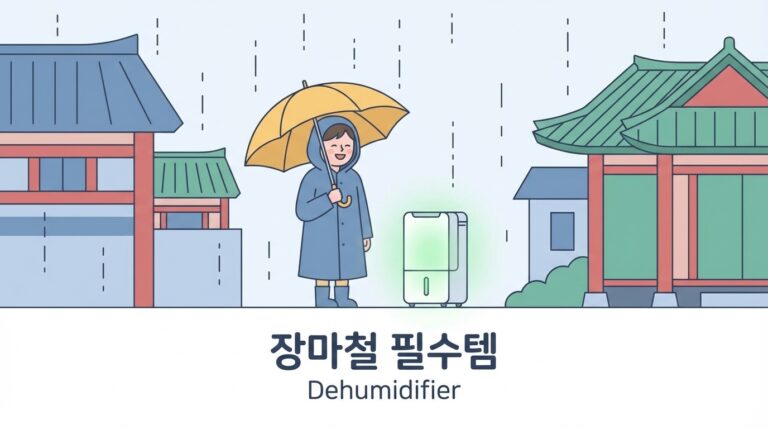
Picture this: You step out of Incheon Airport in mid-July. You expect a warm summer breeze, but instead, it feels like you’ve just walked into a giant, invisible bowl of hot soup. Your glasses instantly fog up, your hair doubles in volume, and within five minutes, your t-shirt is clinging to your back. Welcome to Jangma (장마) – Korea’s notorious monsoon season.
In K-Dramas, summer rain is romantic. The male lead runs through the rain, holds an umbrella over the heroine, and they share a magical moment. But in reality? That umbrella is doing nothing against the 90% humidity, and both of them are probably thinking about one thing: “I need to get to an air-conditioned room with a dehumidifier, ASAP.”
If you want to survive summer in Korea—whether you’re navigating the subway, working in an office, or staying at an Airbnb—knowing how to express your discomfort with the humidity and asking for the sweet relief of a dehumidifier (제습기) is an absolute survival skill.
Let’s dive into the real, sweaty, “I-can’t-breathe” Korean phrases that will make locals go, “Wow, you really get it.”
Phase 2: Deep Dive into Core Expressions
1. 날씨가 너무 꿉꿉해요. (The weather is so muggy/sticky.)
- Pronunciation: [Nalssiga neomu kkupkkuphaeyo] – ‘Kkup-kkup’ sounds like the sticky sound your shoes make on a wet floor.
- Meaning: Literal: The weather is damp. / Real nuance: It’s disgustingly sticky, humid, and uncomfortable.
- K-Culture Moment: You’ll hear this non-stop in July. Walk into any cafe, and the barista is probably complaining to their coworker, “아우, 오늘 진짜 꿉꿉하다” (Ugh, it’s so sticky today).
- Editor’s Insight: Textbooks will teach you “습해요” (It’s humid), but “꿉꿉해요” is the golden word. It captures not just the moisture in the air, but the unpleasant, sticky feeling on your skin and the slightly musty smell of damp clothes.
- Situation Spectrum:
[🚫 절대 금지] ———— [⚠️ 주의] ———— [✅ 자유롭게]
- Friends (Casual): ✅ (꿉꿉해 죽겠어!)
- Coworkers (Semi-formal): ✅ (오늘 좀 꿉꿉하네요.)
- Boss/Elders (Formal): ⚠️ (Use with -요: 날씨가 많이 꿉꿉하네요.)
- 🤔 Think About It: Why do Koreans have so many specific sensory words (like 꿉꿉하다) for weather and feelings? How does your native language describe the physical sensation of humidity?
2. 불쾌지수가 너무 높아요. (The discomfort index is too high.)
- Pronunciation: [Bulkwaejisuga neomu nopayo]
- Meaning: Literal: The discomfort index is high. / Real nuance: Everyone is cranky because of the weather, so don’t mess with me.
- K-Culture Moment: You’ll hear this on the morning news every day during Jangma. The weather forecaster will say, “Today’s discomfort index is at 80%.” It’s the ultimate excuse for being a bit irritable on the crowded subway.
- Editor’s Insight: This is a very B2/C1 level phrase! Using a pseudo-scientific term like “불쾌지수” (discomfort index) in casual conversation is uniquely Korean. It’s a polite, objective way to say, “I’m annoyed because of the heat.”
- Situation Spectrum:
[🚫 절대 금지] ———— [⚠️ 주의] ———— [✅ 자유롭게]
- Friends (Casual): ✅
- Coworkers (Semi-formal): ✅ (Great for small talk at the office!)
- Boss/Elders (Formal): ✅
- 🤔 Think About It: Is there a numerical “index” for bad moods in your culture, or is this scientific approach to crankiness a Korean specialty?
3. 제습기 좀 틀어주시겠어요? (Could you turn on the dehumidifier?)
- Pronunciation: [Jeseupgi jom teureojusigesseoyo?]
- Meaning: Literal & Real nuance: Please turn on the dehumidifier.
- K-Culture Moment: You’re at an indoor K-Pop fan meeting or a study cafe. There are 50 people in the room, and the air is thick. You politely ask the staff this question.
- Editor’s Insight: Notice the verb “틀다” (to turn on). In Korean, we “turn” machines on (air conditioners, heaters, dehumidifiers). Also, “좀” (a little/please) softens the request, making you sound polite rather than demanding.
- Situation Spectrum:
[🚫 절대 금지] ———— [⚠️ 주의] ———— [✅ 자유롭게]
- Friends (Casual): ✅ (야, 제습기 좀 틀자 – Hey, let’s turn on the dehumidifier.)
- Coworkers (Semi-formal): ✅
- Boss/Elders (Formal): ✅ (Polite request)
- 🤔 Think About It: Koreans almost always soften requests with “좀” (literally: a little). Why is directness often avoided in Korean society?
Phase 3: Textbook vs Real Life
| Situation | 📖 Textbook Korean | 🗣️ Real Korean | 💡 Why the difference? |
|---|---|---|---|
| Complaining about the humidity | 날씨가 습합니다. (The weather is humid.) | 아, 진짜 꿉꿉해 죽겠네! (Ah, I’m dying from this stickiness!) | Koreans love adding “~죽겠네” (I’m dying of…) to emphasize extreme physical or emotional states. |
| Suggesting to turn on the AC/Dehumidifier | 에어컨을 켜도 됩니까? (May I turn on the air conditioner?) | 에어컨 좀 빵빵하게 틀까요? (Shall we blast the AC?) | “빵빵하게” is a fun onomatopoeia meaning “at full blast/capacity.” Perfect for hot days! |
| Describing how much you’re sweating | 땀이 많이 납니다. (I am sweating a lot.) | 땀으로 샤워했어요. (I took a shower in sweat.) | Exaggeration is key in Korean everyday conversations to draw empathy. |
Phase 4: Cultural Deep Dive
4-1. Non-verbal Communication & Nunchi (눈치)
When the discomfort index is high, Nunchi (the subtle art of reading the room) becomes crucial. If you see a coworker fanning themselves with a piece of paper or wiping their forehead, don’t wait for them to ask. Offering an “아아” (Iced Americano) or saying, “에어컨 좀 더 세게 틀까요?” (Should I turn the AC up?) before they complain will earn you massive respect.
4-2. K-Food Connection: The Rainy Day Ritual
During Jangma, when the humidity hits 90% and the rain is pouring, K-Drama characters and real Koreans alike flock to one specific type of restaurant: the Jeon (pajeon/pancakes) house.
Why? There’s a famous theory that the sound of sizzling oil in the pan sounds exactly like the heavy monsoon rain hitting the pavement. When you’re feeling kkup-kkup (꿉꿉), the ultimate cure is sitting in a slightly open-air pub, listening to the rain, drinking cold Makgeolli (rice wine) out of a brass bowl, and eating crispy Pajeon (green onion pancake). It’s the perfect cultural coping mechanism for the terrible weather!
Phase 5: Immersive Roleplay
Scenario A: The Sticky Airbnb
- Setting: Mid-July. You just arrived at your Airbnb in Hongdae after dragging your suitcase from the subway station. It’s pouring rain. The room looks great, but the air feels incredibly heavy and damp. Your Korean host is showing you around.
- Characters:
- YOU: A traveler whose clothes are currently sticking to their skin.
- Host (Jimin, 40s): Friendly, but rushing because she has another appointment.
Host: 침대는 여기 있고요, 화장실은 저기입니다. 편하게 쉬세요!
(Chimdaeneun yeogi itgoyo, hwajangshireun jeogiimnida. Pyeonhage swiseyo!)
[The bed is here, and the bathroom is there. Please rest comfortably!]
YOU: 네, 감사합니다. 그런데 방이 조금 습하네요.
(Ne, gamsahamnida. Geureonde bangi jogeum seuphaneyo.)
[Yes, thank you. By the way, the room is a bit humid.]
Host: 아, 장마철이라서 그래요. 에어컨 리모컨 여기 있어요.
(Ah, jangmacheoriraseo geuraeyo. Eoeokeon rimokeon yeogi isseoyo.)
[Ah, it’s because it’s the monsoon season. The AC remote is right here.]
🔀 Your Turn! How do you ask for the dehumidifier?
– A) “제습기! 주세요!” (Dehumidifier! Give!)
– B) “혹시 제습기도 틀어주실 수 있나요? 너무 꿉꿉해서요.”
– C) “불쾌지수가 너무 높아요. 죽겠어요.”✅ Best Choice: B — “혹시” (By any chance) + polite request + “너무 꿉꿉해서요” (gives a valid, relatable reason). The host will instantly understand and appreciate your natural Korean.
⚠️ Choice C Analysis: While grammatically correct, telling a host you’re “dying” from the high discomfort index might make them panic and think you hate the room!
Host: 아! 네, 제습기 저기 구석에 있어요. 제가 바로 켜드릴게요.
(Ah! Ne, jeseupgi jeogi guseoge isseoyo. Jaega baro kyeodeurilgeyo.)
[Ah! Yes, the dehumidifier is in the corner. I’ll turn it on for you right away.]
Scenario B: Bonus K-Food Scenario
You run into a small restaurant to escape the rain.
YOU: 사장님, 여기 파전 하나랑 막걸리 하나 주세요!
(Sajangnim, yeogi pajeon hanarang makgeolli hana juseyo!)
Owner: 네~ 비 오는 날엔 역시 파전이지! 꿉꿉한데 시원하게 드세요!
(Ne~ bi oneun naren yeoksi pajeoniji! Kkupkkuphande siwonhage deuseyo!)
[Yes~ Pajeon is the best for a rainy day! It’s muggy out, so enjoy it refreshingly!]
Phase 6: 10-Second Shadowing Drill
Practice these sentences out loud. Pay attention to the pauses (/) and the emotional tags!
- 😩 (Exhausted) 아우 / 오늘 날씨가 / 너무 꿉꿉하네요.
(Au / oneul nalssiga / neomu kkupkkuphaneyo.) - 🥺 (Pleading) 너무 습한데 / 제습기 좀 / 틀어주시겠어요?
(Neomu seuphande / jeseupgi jom / teureojusigesseoyo?) - 😤 (Annoyed) 오늘 / 불쾌지수가 / 장난 아니에요.
(Oneul / bulkwaejisuga / jangnan anieyo.) (jangnan anieyo = no joke)
Phase 7: K-Culture Glossary
| Korean | Romanization | English Meaning | Cultural Context |
|---|---|---|---|
| 장마 | jangma | Monsoon season | Usually lasts from late June to late July. High humidity and heavy rains. |
| 꿉꿉하다 | kkupkkuphada | Muggy, sticky | The ultimate sensory word for uncomfortable summer humidity. |
| 불쾌지수 | bulkwaejisu | Discomfort index | Frequently used on weather reports to indicate how irritable people will be due to heat/humidity. |
| 제습기 | jeseupgi | Dehumidifier | A must-have home appliance in Korea, just as important as the AC. |
| 파전에 막걸리 | pajeone makgeolli | Green onion pancake & rice wine | The classic Korean comfort food combo for a rainy day. |
Phase 8: Traveler’s Survival Kit
If you’re traveling in Korea during July or August, you will need these phrases.
🆘 Survival Phrases for the Monsoon Season
– 🇰🇷 “우산 하나 주세요.” (Usan hana juseyo.)
– 🗣️ Meaning: Please give me an umbrella.
– 📍 Where to use: Convenience stores (CU, GS25, 7-Eleven) when a sudden downpour hits.
- 🇰🇷 “에어컨 좀 빵빵하게 틀어주세요.” (Eoeokeon jom ppangppanghage teureojuseyo.)
- 🗣️ Meaning: Please crank up the AC.
- 📍 Where to use: In a taxi if the driver has the windows down but it’s too humid.
📌 Editor’s Travel Note
– Dehumidifier settings: Look for the word 제습 (Je-seup) on your Airbnb’s air conditioner remote. Many Korean ACs have a built-in dehumidifying mode! Just pressing that button will save your life.
– Indoor escapes: When the discomfort index is too high, do what Koreans do: head to COEX Mall, The Hyundai Seoul, or a large local cafe. They blast the AC so high you might actually need a light cardigan.
Phase 9: Think Deeper — “One Step Further”
🧠 Think Deeper: Food & Identity During the Rain
The cultural phenomenon of eating Pajeon and Makgeolli on a rainy day is fascinating. It shows how Korean culture deeply connects weather, sensory experiences, and communal eating. The heavy rain creates an annoying, isolating environment (high humidity, staying indoors). But Koreans flip this negative experience into an excuse to gather, share a large plate of food, and drink together. It transforms the frustrating Jangma season into a time of cozy bonding. Food here isn’t just sustenance; it’s a shared psychological remedy for the weather.💬 Your Turn: How does your culture cope with bad weather? Do you have a specific “rainy day” or “snow day” food? Share it in the comments!
Phase 10: Troubleshooting (FAQ)
Q: Can I complain about the weather (“꿉꿉해요”) to someone I just met?
Yes! In fact, it’s one of the best icebreakers in Korea. Complaining about the heat or humidity is a shared national pastime. Saying “오늘 진짜 꿉꿉하네요” (It’s really muggy today) in an elevator with a neighbor is perfectly natural and polite.
Q: Are “습하다” and “꿉꿉하다” exactly the same?
Not quite. “습하다” is objective (The air has moisture). “꿉꿉하다” is subjective and sensory (My skin feels sticky, and things feel a bit damp/unpleasant).
❌ Common Mistake #1: Saying “날씨가 젖었어요” (The weather is wet).
✅ Do this instead: “젖다” means physically wet (like a towel). For weather, always use “습해요” (humid) or “비가 와요” (It’s raining).
Phase 11: Wrap-up & Action Items
One-Liner Summary: To survive the Korean monsoon season, master the word “꿉꿉해요” (it’s muggy) and don’t hesitate to ask for the “제습기” (dehumidifier)!
Action Mission:
– 🥉 Bronze (Solo): Look out your window. If it’s raining or humid, say “아우, 꿉꿉해” out loud 3 times with maximum frustration.
– 🥈 Silver (Online): Go to YouTube, search for a Korean weather forecast (날씨 예보), and try to catch the word “장마” or “불쾌지수”.
– 🥇 Gold (Real Life): Next time you’re at a Korean restaurant or cafe on a humid day, say “오늘 날씨가 정말 꿉꿉하네요!” to the staff.
🎬 Special K-Culture Mission:
Next time you watch a K-Drama where a character gets drenched in the rain, imagine them going home and turning on their Jeseupgi. Realism!
Phase 12: Interactive Quiz
1. Situational Judgment: You are in a taxi. It’s raining outside, and the windows are fogging up. You are sweating. What is the most natural thing to say to the driver?
– A) 기사님, 날씨가 젖었어요. (Driver, the weather is wet.)
– B) 기사님, 에어컨 좀 틀어주시겠어요? (Driver, could you turn on the AC please?)
– C) 기사님, 불쾌지수가 100%입니다. (Driver, my discomfort index is 100%.)
2. Fill in the Blank:
비가 와서 방이 너무 _________. (It’s raining so the room is very muggy/sticky.)
3. True or False – K-Culture Edition:
During the Jangma (monsoon) season, Koreans typically eat cold noodles to cool down from the rain.
(Answers: 1: B – C is too aggressive for a stranger! / 2: 꿉꿉해요 / 3: False! They eat hot, sizzling Pajeon and drink Makgeolli!)
Frequently Asked Questions (FAQ)
Q: What does "날씨가 너무 꿉꿉해요. (The weather is so muggy/sticky.)" mean in Korean and how do you pronounce it?
A: In Korean, "날씨가 너무 꿉꿉해요. (The weather is so muggy/sticky.)" is pronounced [Nalssiga neomu kkupkkuphaeyo] and means: Literal: The weather is damp. / Real nuance: It's disgustingly sticky, humid, and uncomfortable.
Q: What does "불쾌지수가 너무 높아요. (The discomfort index is too high.)" mean in Korean and how do you pronounce it?
A: In Korean, "불쾌지수가 너무 높아요. (The discomfort index is too high.)" is pronounced [Bulkwaejisuga neomu nopayo] and means: Literal: The discomfort index is high. / Real nuance: Everyone is cranky because of the weather, so don't mess with me.
Q: What does "제습기 좀 틀어주시겠어요? (Could you turn on the dehumidifier?)" mean in Korean and how do you pronounce it?
A: In Korean, "제습기 좀 틀어주시겠어요? (Could you turn on the dehumidifier?)" is pronounced [Jeseupgi jom teureojusigesseoyo?] and means: Literal & Real nuance: Please turn on the dehumidifier.







