

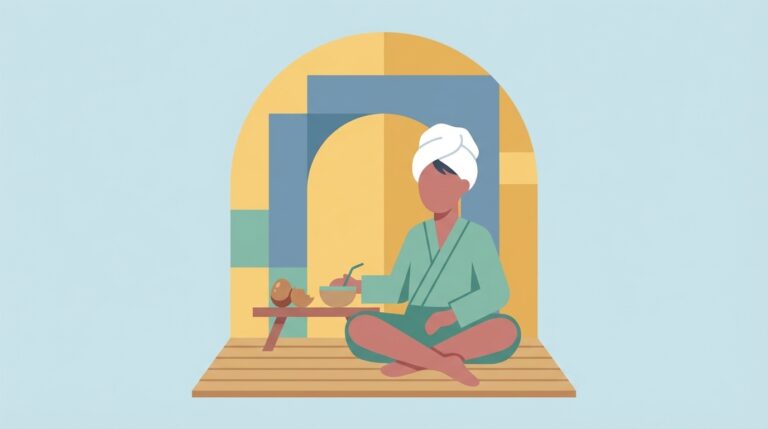
Phase 1: Empathy — Immersive Hook
Hello! I’m the Lead Editor of Daily Hangul.
Picture this: You are watching your favorite K-Drama. The main character has just suffered a terrible breakup or had a stressful day at work. The scene cuts, and suddenly, they are wearing oversized orange pajamas and a towel rolled into the shape of sheep horns (양머리, Yangmeori) on their head. They crack a brown, baked egg on their friend’s head, take a sip of a milky-looking iced drink, and sigh deeply while sitting in a room that looks literally like an oven.
Then, the subtitle says: “Ah, that’s refreshing.”
Wait… refreshing? In a room that is 70°C (158°F)?
Welcome to the Korean Jjimjilbang (찜질방), the ultimate cultural hub for relieving fatigue! If you visit Korea, experiencing a sauna is an absolute must. But if you only rely on textbook Korean, you might miss out on the true magic of the Jjimjilbang. Let’s learn how to relax, order snacks, and speak exactly like a local when you want to melt your stress away!
(Note: This lesson is based on real questions from our A2 beginner students who were confused by Korean temperature adjectives!)
Phase 2: Core Expressions Deep Dive
Let’s master the top 3 expressions you need to survive and thrive in a Korean sauna.
1. 아, 시원하다!
- Pronunciation: [Ah, siwonhada!] (Sounds like ‘she-won-ha-da’)
- Meaning: Literal = “Ah, it is cool.” / Real nuance = “Ah, that hits the spot / That’s refreshing!”
- K-Culture Moment: You will hear Koreans say this when they step into an ice-cold room, but also when they sink into a boiling hot bath or drink a bowl of hot soup. It expresses a deep physical and mental release of tension.
- Editor’s Insight: This isn’t just about temperature; it’s about the feeling of your muscles relaxing. If you say this while stepping into a hot bath, older Koreans will look at you with deep respect.
- Situation Spectrum:
[🚫 Never] ———— [⚠️ Caution] ———— [✅ Freely]
- Close friends (Casual): ✅ (아, 시원해! – Ah, siwonhae!)
- Co-workers (Semi-formal): ✅ (아, 시원하네요! – Ah, siwonhaneyo!)
- Boss/Elders (Formal): ✅ (아, 시원합니다! – Ah, siwonhamnida!)
- 🤔 Think About It: Why do Koreans use a word that means “cool” to describe hot things? Could it be that to Koreans, “releasing trapped heat (stress) from the body” leaves you feeling “cool” and refreshed inside?
2. 피로가 풀려요.
- Pronunciation: [Pi-ro-ga pul-lyeo-yo.] (The ‘r’ in piro sounds like a soft ‘d’. pee-ro-gah pool-ryuh-yo)
- Meaning: Literal = “Fatigue is untangling.” / Real nuance = “My stress/tiredness is melting away.”
- K-Culture Moment: This is what you say while lying on the heated floor (Ondol) of the Jjimjilbang, staring at the ceiling after a long day of touring Seoul.
- Editor’s Insight: Think of your muscles like a tangled ball of yarn. In Korean, we don’t just “lose” fatigue; we “untangle” (풀다) it.
- Situation Spectrum:
- Close friends (Casual): ✅ (피로가 풀려 – Piroga pullyeo)
- Strangers/Elders (Formal): ✅ (피로가 풀리네요 – Piroga pullineyo)
- 🤔 Think About It: In English, we “cure” or “relieve” fatigue. In Korean, we “untangle” it. What does this tell you about how Koreans view stress in the body?
3. 식혜 하나 주세요.
- Pronunciation: [Sik-hye ha-na ju-se-yo.] (sheek-heh ha-nah joo-seh-yo)
- Meaning: Literal & Real = “Please give me one Sikhye (sweet rice punch).”
- K-Culture Moment: The holy trinity of a Jjimjilbang is: A hot room, baked eggs (맥반석 계란), and ice-cold Sikhye. You cannot leave without trying this sweet, icy drink!
- Editor’s Insight: When you go to the snack counter (매점), just say this with a big smile. It is the ultimate survival phrase for your sweet cravings.
- Situation Spectrum:
- Snack counter staff (Polite): ✅
Phase 3: Textbook vs Real Life
How do real Koreans talk about being tired and going to the sauna?
| Situation | 📖 Textbook Korean | 🗣️ Real Korean | 💡 Why is it different? |
|---|---|---|---|
| Expressing tiredness | 저는 피곤합니다. (I am tired.) | 아, 피곤해. (Ah, pigonhae.) | In real life, Koreans drop “I” (저는) and use exclamations (아!) to show emotion. |
| Suggesting relaxation | 우리는 쉬어야 합니다. (We must rest.) | 좀 쉬자. (Jom swija.) | “쉬자” (Let’s rest) with “좀” (a little) makes the suggestion softer and friendlier. |
| Feeling refreshed | 기분이 좋습니다. (My mood is good.) | 진짜 시원하다! (Jinjja siwonhada!) | “시원하다” captures the physical sensation of relief much better than just “good”. |
(Bottom Note: As a beginner, sticking to textbook Korean is perfectly fine, but adding “진짜” (really) or “아!” (Ah!) instantly makes you sound like a local!)
Phase 4: Cultural Deep Dive — The K-Sauna Experience
4-1. Non-verbal Communication: The Nunchi in the Jjimjilbang
In Korea, reading the room (눈치, Nunchi) is essential, especially in public spaces like saunas.
– Towel Etiquette: When entering the gender-segregated wet bath areas, never let your towel dip into the bathwater! Keep it on your head or beside the tub.
– Voice Volume: While the snack area is noisy and fun, the “Sleeping Rooms” (수면실) or very hot sauna rooms require absolute silence. Using your nunchi to adjust your volume is key.
4-2. K-Drama Connection: The “Runaway” Trope
Have you noticed that in K-Dramas, when a teenager runs away from home, or a businessman goes bankrupt, they always sleep at a Jjimjilbang?
Because Jjimjilbangs are open 24/7 and charge only around 10,000 to 15,000 KRW ($8-$12) for an overnight stay, they are the ultimate “safe haven” in Korean culture. It’s not just a place to wash; it’s a communal living room for the whole society. However, unlike in Dramas, please don’t smash the baked eggs on your friend’s head too hard—it actually hurts in real life!
Phase 5: Immersive Roleplay Scenario
Setting: Friday night. You and your Korean friend, Min-su, just stepped out of a 70°C heated salt room at a giant Jjimjilbang in Seoul. You are both wearing oversized matching T-shirts and shorts, sweating profusely.
Characters:
– YOU: A foreign traveler eager to try everything K-Culture has to offer.
– Min-su (32): Your local Korean friend who knows the best ways to relax.
Dialogue:
Min-su: 아, 진짜 덥다. 우리 마실 것 좀 살까?
(Ah, jinjja deopda. Uri masil geot jom salkka?)
[Translation: Ah, it’s really hot. Shall we buy something to drink?]
(🎭 Stage Direction: Min-su wipes his forehead with his sheep-head towel)
YOU: 네! 저 너무 목말라요.
(Ne! Jeo neomu mongmallayo.)
[Translation: Yes! I am so thirsty.]
Min-su: 뭐 마실래? 식혜? 아이스 커피?
(Mwo masillae? Sikhye? Aiseu keopi?)
[Translation: What do you want to drink? Sikhye or Iced Coffee?]
YOU: 식혜요! 계란도 같이 먹어요.
(Sikhye-yo! Gyeran-do gachi meogeoyo.)
[Translation: Sikhye! Let’s eat eggs together too.]
Min-su: 오~ 한국 사람 다 됐네! 내가 살게. 여기 키로 계산해 주세요.
(O~ Hanguk saram da dwaenne! Naega salge. Yeogi ki-ro gyesanhae juseyo.)
[Translation: Oh~ You’ve become a total Korean! I’ll buy. Please charge it to this key here.]
(🎭 Stage Direction: Min-su taps his electronic wristband on the cashier’s machine)
YOU: 우와, 지갑이 필요 없네요.
(Uwa, jigabi piryo eomneyo.)
[Translation: Wow, we don’t need a wallet.]
Min-su: 응, 편하지? 자, 식혜 마셔봐.
(Eung, pyeonhaji? Ja, sikhye masyeobwa.)
[Translation: Yeah, convenient right? Here, try the Sikhye.]
🔀 Your Turn! How should you respond after taking a big gulp of the ice-cold Sikhye?
– A) “아, 피곤해요!” (Ah, I’m tired!)
– B) “아, 시원하다!” (Ah, refreshing!)
– C) “아, 뜨거워요!” (Ah, it’s hot!)✅ Best Choice: B (아, 시원하다!) — The ultimate phrase for drinking a cold beverage after a hot sauna!
⚠️ Choice A & C Analysis: You wouldn’t complain about being tired right after getting a sweet treat, and Sikhye is served ice-cold, so C is factually incorrect!
Min-su: 그렇지? 피로가 좀 풀려?
(Geureochi? Piroga jom pullyeo?)
[Translation: Right? Is your fatigue relieved a bit?]
YOU: 네, 피로가 다 풀려요!
(Ne, piroga da pullyeoyo!)
[Translation: Yes, my fatigue is totally relieved!]
Phase 6: 10-Second Shadowing Drill
Practice these lines out loud. Pay attention to the pauses (/) and emotions!
- 😤 (Stepping into the hot bath)
아~ / 진짜 / 시원하다!
(Ah~ / jinjja / siwonhada!) -
😌 (Lying down on the warm floor)
피로가 / 싹 / 풀려요.
(Piroga / ssak / pullyeoyo.)
(Tip: “Ssak” means completely/entirely!) -
😊 (At the snack counter)
식혜 / 하나 / 주세요.
(Sikhye / hana / juseyo.)
Phase 7: K-Culture Glossary (Mini Dictionary)
| 한국어 (Korean) | Romanization | English | Cultural Context |
|---|---|---|---|
| 찜질방 | jjimjilbang | Korean Sauna | A 24-hour gender-segregated bathhouse with communal heated lounging areas. |
| 양머리 | yangmeori | Sheep head towel | Folding a towel to look like Princess Leia’s hair or sheep horns. A cute sauna staple! |
| 때밀이 | ttaemiri | Body scrub | A professional exfoliating service using rough towels. Painful but incredibly refreshing! |
| 매점 | maejeom | Snack counter | Where you buy Sikhye, eggs, cup noodles, and ice cream inside the sauna. |
| 온돌 | ondol | Heated floor | Traditional Korean underfloor heating. Laying on it is heaven for a sore back. |
Phase 8: Traveler’s Survival Kit 🧳
If you visit a Jjimjilbang in Korea, these survival phrases are your best friends!
🆘 Survival Phrases for the Sauna
– 🇰🇷 “이거 키로 계산해 주세요.” (Igeo ki-ro gyesanhae juseyo.)
– 🗣️ Pronunciation Guide: [ee-geo kee-ro gyeh-san-hae joo-seh-yo]
– 📍 Where to use: At the sauna snack counter, massage chair, or restaurant.
– 💡 Pro Tip: Inside a Jjimjilbang, you do NOT carry cash or cards. Your locker wristband (키, “key”) acts as your credit card. You scan it for snacks and pay the total bill when you leave the building!📌 Editor’s Travel Note
– Tattoos: Unlike some hot springs in Japan, most Korean Jjimjilbangs allow tattoos. However, if you have very large, full-body tattoos, a few traditional places might ask you to cover up or politely decline entry.
– Nudity: The hot/cold baths are strictly gender-segregated and 100% naked. Don’t be shy; nobody is looking! The communal lounging areas (where the snack counters and igloo-shaped hot rooms are) require the provided T-shirt and shorts uniform.
Phase 9: Think Deeper — “One Step Further”
🧠 Media vs Reality: The Jjimjilbang as a Microcosm of Society
In modern Korea, the “Ppalli-ppalli” (Hurry, hurry) culture dominates work and city life. Everything is fast: internet, food delivery, walking speeds. Yet, paradoxically, Koreans flock to the Jjimjilbang to deliberately sit in a 70-degree room where you cannot move fast. It is a forced slowing down of time. Furthermore, in a highly hierarchical society based on age and job titles, everyone in the Jjimjilbang wears the exact same cheap uniform. It is one of the few places in Korea where a CEO and a college student look exactly the same, eating the same baked eggs on the floor. It is communal healing.
💬 Your Turn: Does your country have a communal culture for relaxing or bathing? How do you “force yourself to slow down” in your culture? Share in the comments!
Phase 10: FAQ & Troubleshooting
Q: Can I use “아, 시원하다” when the weather is actually cold outside?
Yes! If there is a nice, cool breeze in autumn, you can absolutely say “시원하다.” However, if it’s freezing winter snow, use “춥다” (chupda – cold).
Q: Do I really have to smash the egg on my head?
No! K-Dramas make it look fun, but those baked eggs (맥반석 계란) have very hard shells. If you smash it hard on your friend’s head without asking, they will definitely get mad! Tap it gently on the floor instead.
❌ Common Mistake #1: Wearing your own swimsuit or clothes into the wet baths.
✅ Do this instead: You must be completely naked in the gender-segregated shower and bath area. Swimsuits are considered unsanitary there.❌ Common Mistake #2: Taking photos inside the locker room or wet baths.
✅ Do this instead: Phones are strictly prohibited in the locker and bath areas for privacy. You can only use your phone in the communal (uniform-wearing) Jjimjilbang area!
Phase 11: Wrap-up & Action Items
One-Liner Summary: To relax like a true Korean, use “시원하다” (It hits the spot) in a hot bath, and order “식혜” (sweet rice punch) to “untangle” (풀다) your fatigue!
Your Action Missions:
– 🥉 Bronze (Solo): Stand in a hot shower today, close your eyes, and say out loud: “아~ 진짜 시원하다!”
– 🥈 Silver (Online): Go to YouTube, search “Jjimjilbang vlog,” and spot the Sikhye and Yangmeori towels.
– 🥇 Gold (Real Life): Visit a Korean grocery store, buy a can of Sikhye (식혜), and enjoy it after a tiring day!
K-Culture Mission: Next time you watch a K-Drama, look closely at the Jjimjilbang scenes. Can you spot the colorful electronic wristbands they wear? Now you know that’s their wallet!
What’s your favorite way to relieve fatigue? Let me know in the comments below! 👇
Phase 12: Interactive Challenge (Quiz)
Let’s see if you’re ready for the sauna!
1. Situational Judgment: You have been walking around Myeongdong for 6 hours. You sit on a massage chair at the Jjimjilbang. What is the most natural thing to say?
– A) 저는 피곤합니다. (I am tired.)
– B) 피로가 싹 풀려요. (My fatigue is melting away.)
– C) 식혜 하나 주세요. (One Sikhye please.)
2. Fill in the Blank:
“아, 진짜 ______!” (Ah, this hits the spot / feels refreshing!)
3. True or False — K-Culture Edition:
You should bring your physical credit card with you to the snack counter inside the sauna.
4. Roleplay follow-up:
If Min-su pays for your Sikhye with his wristband, what should you do when you both leave the building?
– A) Run away.
– B) Offer to pay the final bill at the front desk or buy the next meal.
– C) Keep his wristband as a souvenir.
(Answers: 1. B, 2. 시원하다, 3. False – use your wristband key!, 4. B – Nunchi and sharing costs is good manners!)
Frequently Asked Questions (FAQ)
Q: What does "아, 시원하다!" mean in Korean and how do you pronounce it?
A: In Korean, "아, 시원하다!" is pronounced [Ah, siwonhada!] and means: Literal = "Ah, it is cool." / Real nuance = "Ah, that hits the spot / That's refreshing!"
Q: What does "피로가 풀려요." mean in Korean and how do you pronounce it?
A: In Korean, "피로가 풀려요." is pronounced [Pi-ro-ga pul-lyeo-yo.] and means: Literal = "Fatigue is untangling." / Real nuance = "My stress/tiredness is melting away."
Q: What does "식혜 하나 주세요." mean in Korean and how do you pronounce it?
A: In Korean, "식혜 하나 주세요." is pronounced [Sik-hye ha-na ju-se-yo.] and means: Literal & Real = "Please give me one Sikhye (sweet rice punch)."







