

안녕하세요! 매일한글(Daily Hangul) 에디터입니다.
Imagine this: You’re at COEX, Seoul’s massive convention center, attending a high-profile MICE (Meetings, Incentives, Conferences, and Exhibitions) event. The topic? Korea’s booming medical tourism industry. You’ve watched Hospital Playlist and know Korea’s medical infrastructure is world-class. But as you sit in the conference room, the Korean policy makers and gangnam clinic directors aren’t talking about ‘getting surgery’ (수술받다). They are intensely debating ‘의료 관광 활성화를 위한 법적 제도 개선’ (Legal and institutional improvements to vitalize medical tourism).
If you’ve reached the C2 level, you already know how to order a Samgyeopsal and chat with your Korean friends. But can you hold your own in a Gangnam boardroom discussing government deregulation? In this advanced module, we are diving deep into the high-stakes, professional Korean used in policy, MICE, and the medical business sector.
Let’s upgrade your Korean from ‘fluent tourist’ to ‘industry insider.’
Phase 2: 핵심 표현 심층 분석 (Deep Dive)
Let’s break down the heavy-hitting policy vocabulary you will hear at any Korean MICE event regarding medical tourism.
1. 규제를 완화하다
- Pronunciation: [gyuje-reul wanhwa-hada] (gyu-jay-reul wan-hwa-ha-da)
- Meaning: (Literal) To ease regulations / (Real nuance) Deregulation, cutting the red tape.
- K-Culture Moment: You’ll hear this on prime-time Korean news (KBS 9 O’clock News) when anchors discuss how strict government rules are holding back Gangnam’s plastic surgery clinics from attracting more foreign VIPs.
- Editor’s Insight: 규제 means regulation, and 완화하다 means to soften or ease. In Korea, rapid economic growth was historically driven by strong government control. Now, businesses constantly beg the government to ‘ease’ these rules. It’s a polite but firm way to demand policy change.
- Situation Spectrum:
[🚫 절대 금지] ———— [⚠️ 주의] ———— [✅ 자유롭게]
- Casual friends: 🚫 (Too academic, unless you are debating politics over soju)
- Business colleagues/Seminars: ✅
- Government officials: ✅
- 🤔 Think About It: Why do Koreans prefer the word ‘완화’ (easing) instead of ‘철폐’ (abolishing) when speaking to government officials? It’s about Nunchi—saving the government’s face while still asking them to back off.
2. 제도적 뒷받침
- Pronunciation: [jedojeok dwitbatchim] (je-do-jeok dwit-bat-chim)
- Meaning: (Literal) Institutional back-support / (Real nuance) Systemic/Legal framework support.
- K-Culture Moment: During a medical tourism conference, a clinic CEO says, “We have the best doctors, but without jedojeok dwitbatchim, we can’t protect foreign patients!”
- Editor’s Insight: 뒷받침 literally means something supporting you from behind. It’s a beautifully visual Korean word used in highly formal contexts. When an industry needs new laws to protect it, they don’t just say “we need laws”; they ask for “institutional backing.”
- Situation Spectrum:
[🚫 절대 금지] ———— [⚠️ 주의] ———— [✅ 자유롭게]
- Casual friends: 🚫
- Formal Presentations/MICE: ✅
- 🤔 Think About It: English often uses architectural metaphors (foundation, framework). Korean uses physical support metaphors (뒷받침 – back support). How does this reflect the Korean community mindset of ‘having each other’s backs’?
3. 불법 브로커 근절
- Pronunciation: [bulbeop beurokeo geunjeol] (bul-beop bro-ker geun-jeol)
- Meaning: (Literal) Eradication of illegal brokers.
- K-Culture Moment: A major pain point in Korean medical tourism. Unregistered ‘agencies’ rip off foreign tourists for cosmetic surgeries. The government frequently launches campaigns for their geunjeol.
- Editor’s Insight: 근절 (Eradication) comes from Hanja meaning “to cut the root.” It’s an incredibly strong, C2-level noun. You don’t just stop illegal brokers; you pull them out by the roots.
- Situation Spectrum:
[🚫 절대 금지] ———— [⚠️ 주의] ———— [✅ 자유롭게]
- Public speeches/Policy debates: ✅
- Casual chat: 🚫
Phase 3: 교과서 vs 진짜 한국어 (Textbook vs Real Life)
Even in high-level business, what’s written in policy papers differs from what industry insiders say when the microphones are turned off.
| 상황 | 📖 정책/교과서 한국어 | 🗣️ 업계 진짜 한국어 (Business Casual) | 💡 왜 다를까? |
|---|---|---|---|
| Complaining about strict laws | 법적 규제가 너무 엄격합니다. (The legal regulations are too strict.) | 법이 너무 빡세서 일을 못 하겠어요. (The law is so tight, we can’t work.) | ‘빡세다’ is a slang term originally from the military, deeply embedded in Korean work culture to describe extreme difficulty or strictness. |
| Referring to Medical Agencies | 외국인 환자 유치업자 (Foreign patient attraction business entity) | 에이전시 / 브로커 (Agencies / Brokers) | The legal term is heavily bureaucratic. Insiders use Konglish (English loan words) for speed. (Note: ‘Broker’ often has a negative nuance in Korea). |
| Need government help | 정부의 제도적 지원이 시급합니다. (Government institutional support is urgent.) | 나라에서 좀 밀어줘야죠. (The country needs to push us forward a bit.) | ‘밀어주다’ (to push/support) reflects the Korean emotional expectation of the state acting as a supportive parental figure. |
Bottom Note for C2 Learners: In a boardroom, stick to the formal terms. But at the post-conference Hoesik (dinner), dropping a phrase like “법이 너무 빡세죠?” will instantly earn you insider status.
Phase 4: 문화적 맥락 — K-Culture 딥다이브 (Cultural Deep Dive)
4-1. 비언어적 요소 (Non-verbal Communication in Business)
When discussing sensitive legal reforms (like medical malpractice liability for foreigners) with Korean officials, maintaining Kibun (기분, mood/face) is crucial. Do not cross your arms or point directly at a flaw in their system. Instead, use a soft intake of breath (“쓰읍…”), tilt your head slightly, and say, “훌륭한 시스템이지만, 한 가지 아쉬운 점은…” (It’s an excellent system, but one unfortunate thing is…).
4-2. K-Culture 연결 고리: The Dual Reality of K-Medical Drama vs. Real Life
If you watch Hospital Playlist (슬기로운 의사생활), you see brilliant, warm-hearted doctors working in perfect harmony. But the MICE and Medical Tourism reality in areas like Sinsa-dong or Apgujeong is fiercely commercial.
Critical Viewpoint: The Korean government strictly regulates medical tourism because while they want the economic boost (K-Beauty, advanced cancer treatments), they fear the commercialization of their national healthcare system (which is highly socialist and protective of Korean citizens). Understanding this tension is the key to mastering C2-level policy discussions. You aren’t just learning words; you are navigating the cultural anxiety between global expansion and domestic protection.
Phase 5: 실전 롤플레이 시나리오 (Immersive Roleplay)
시나리오 A: 메인 롤플레이 (The Gangnam Boardroom)
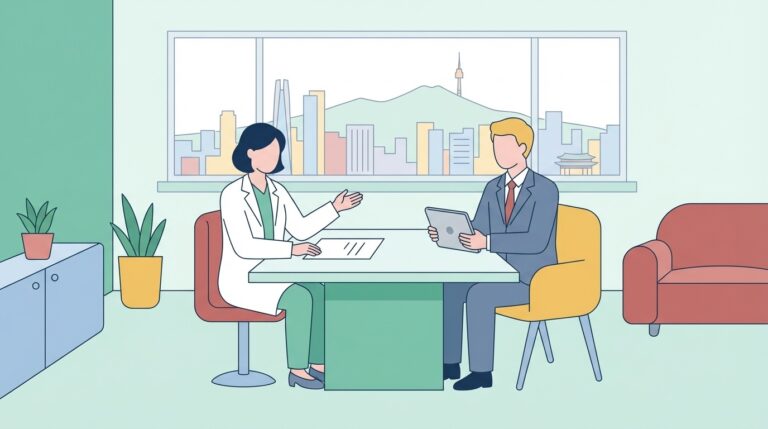
Setting: 4:00 PM. A sleek meeting room overlooking the Han River in Gangnam. You are attending a MICE working group discussing how to attract more Middle Eastern and Western medical tourists.
Characters:
– YOU (The Reader): A foreign medical tourism consultant.
– Director Park (50s): A high-ranking official from the Ministry of Health and Welfare. He is proud but aware of the system’s flaws.
Director Park: 이번 MICE 박람회에서 외국인 환자 유치 방안에 대해 좋은 아이디어가 있으십니까?
(Ibeon MICE bangnamhoe-eseo waegugin hwanja yuchi bangane daehae joeun aidi-eoga isseusimnikka?)
(Do you have any good ideas for attracting foreign patients at this MICE expo?)
YOU: 네, 한국의 의료 기술은 세계 최고 수준입니다. 하지만 외국인 환자들이 수술 후 겪는 불안감을 해소해야 합니다.
(Ne, hangugui uiryo gisureun segye choego sujunimnida. Hajiman waegugin hwanjadeuri susul hu gyeongneun burangameul haesohaeya hamnida.)
(Yes, Korea’s medical technology is world-class. However, we must alleviate the anxiety foreign patients feel after surgery.)
Director Park: (Nodding seriously) 맞습니다. 불법 브로커 문제 때문에 한국 의료의 신뢰도가 떨어지는 게 사실입니다.
(Matseumnida. Bulbeop beurokeo munje ttaemune hanguk uiryoui sillwedoga tteoreojineun ge sasil-imnida.)
(That is correct. It’s true that the reliability of Korean medicine is dropping due to the illegal broker issue.)
🔀 당신의 차례! 어떻게 대답할까요? (C2 Level Decision)
– A) “그래서 정부가 브로커들을 다 감옥에 보내야 합니다!” (So the government must send all brokers to jail!)
– B) “맞습니다. 따라서 투명한 에이전시를 위한 제도적 뒷받침이 시급합니다.”
– C) “진짜 빡세네요. 나라에서 밀어줘야죠.”✅ Best Choice: B — “You’re right. Therefore, institutional support for transparent agencies is urgent.” This uses the advanced C2 vocabulary (제도적 뒷받침) and maintains the highly formal, respectful tone required for government officials.
⚠️ Choice A & C 분석: A is too aggressive and emotionally charged for a professional policy meeting. C uses business slang (빡세다, 밀어주다) which is strictly for post-meeting drinks, NEVER for the boardroom.
Phase 6: 10초 섀도잉 드릴 (Shadowing Drill)
Let’s practice the cadence of a Korean professional. Pay attention to the pauses!
😤 단호하고 전문적으로 (Firmly and professionally):
성공적인 / 의료 관광 활성화를 위해서는 / 무엇보다 / 제도적 뒷받침이 / 시급합니다.
(seonggongjeogin / uiryo gwangwang hwalseonghwa-reul wihaeseoneun / mueotboda / jedojeok dwitbatchimi / sigeuphamnida.)
Phase 7: K-Culture 미니 사전 (K-Culture Glossary: Medical MICE Edition)
| 한국어 | Romanization | 영어 | 맥락 설명 |
|---|---|---|---|
| 마이스 | MICE | MICE Industry | Meetings, Incentives, Conferences, Exhibitions. Often heavily supported by city governments like Seoul and Busan. |
| 원격 진료 | won-gyeok jillyo | Telemedicine | A highly controversial topic in Korea. Currently heavily restricted due to strong opposition from the Korean Medical Association. |
| 성형외과 | seonghyeong-oegwa | Plastic Surgery Clinic | The driving force behind Korea’s medical tourism, concentrated in the Gangnam district. |
| 유치업자 | yuchi-eopja | Facilitator / Agent | The legal term for businesses that bring foreign patients to Korean hospitals. |
| 의료 비자 | uiryo bija | Medical Visa | Visas like C-3-3 or G-1 specifically designed for foreigners receiving medical treatment in Korea. |
Phase 8: 여행자 서바이벌 키트 (Traveler’s Survival Kit)
Even as a C2 professional, if you are navigating a medical clinic as a foreigner, you need absolute clarity. Here are top survival phrases to protect yourself or your clients legally.
🆘 서바이벌 표현 (Medical Legal Protection)
– 🇰🇷 “외국인 환자 유치 등록증이 있나요?”
– 🗣️ (waegugin hwanja yuchi deungnokjeung-i innayo?)
– 🇬🇧 “Do you have the foreign patient attraction registration certificate?”
– 📍 쓰는 곳: Before signing any surgical or major medical contract in Korea.
– 💡 Pro Tip: By law, only registered clinics and agencies can cater to foreign tourists. Asking this question immediately signals that you know Korean law, protecting you from being overcharged.📌 Editor’s Travel Note
– Pricing Transparency: In Gangnam clinics, always ask for the “Tax Refund” (텍스 리펀). Cosmetic surgeries for foreigners are eligible for VAT refunds at the airport!
– Language Support: If a clinic does not offer professional in-house translation (통역), be extremely cautious about signing legal consent forms (동의서).
Phase 9: 비판적 사고 코너 — “한 발 더 깊이” (Think Deeper)
🧠 언어와 권력 (Language & Power in Korean Policy)
Notice how the vocabulary around medical tourism heavily utilizes Sino-Korean words (Hanja) like 활성화 (vitalize), 규제 (regulation), and 근절 (eradication). In Korean society, there is a distinct diglossia—a divide between everyday pure Korean words and the Hanja-heavy vocabulary used by the elite, legal, and medical professions. To participate in making or changing the rules (제도 개선) in Korea, mastering these Hanja-based nouns isn’t just a vocabulary test; it is the entry ticket to being taken seriously by those in power. Without it, you remain an outsider or just a ‘tourist.’
💬 Your Turn: Does your native language have a completely different set of vocabulary for legal/policy discussions compared to daily life? How difficult is it for foreigners to navigate your country’s medical system? Let us know in the comments!
Phase 10: FAQ & 오해 방지 (Troubleshooting)
- Q: Can I use words like ‘근절’ (eradicate) when complaining about bad service at a restaurant?
- A: NO. It will sound hilarious, like a news anchor screaming at a waiter. Keep policy words strictly for policy/business contexts.
- Q: Are ‘의료 관광’ (Medical Tourism) and ‘원정 진료’ (Traveling for Medical Care) the same?
- A: Nuance difference. ‘의료 관광’ implies a mix of medical care and leisure (e.g., getting Botox and shopping in Myeongdong). ‘원정 진료’ sounds more serious, usually referring to someone traveling a long distance specifically because the surgery is life-saving and unavailable at home.
❌ 흔한 실수 (Common Mistake):
Translating “The law should be changed” as “법을 바꿔야 해요” in a formal MICE setting.
✅ 이렇게 하세요:
While grammatically correct, it sounds too simple for C2. Use “제도적 개선이 필요합니다” (Institutional improvement is needed) to sound like a true industry expert.
Phase 11: 요약 및 액션 아이템 (Wrap-up)
🎯 One-Liner Summary: To debate medical tourism policy in Korea, upgrade your vocabulary from simple verbs to Hanja-based institutional nouns like 제도적 뒷받침 (Institutional support) and 규제 완화 (Deregulation).
🎬 Action Mission 3단계:
– 🥉 Bronze: Read the shadow drill sentence 3 times aloud, maintaining a serious, professional tone.
– 🥈 Silver: Search Naver News for “의료 관광 규제 완화” and try to read the headlines of the top 3 articles.
– 🥇 Gold: Next time you discuss business or policy with Korean colleagues, use the phrase “제도적 뒷받침이 필요합니다” and watch their eyes widen in respect!
Phase 12: 퀴즈 — 인터랙티브 챌린지 (Interactive Quiz)
1. 상황 판단 (Situational Judgment):
You are at a press conference discussing the future of Korea’s MICE industry. You want to say that the government needs to reduce strict laws. Which is the most appropriate phrase?
– A) 법이 진짜 빡셉니다. 없애주세요.
– B) 규제 완화가 시급합니다.
– C) 정부가 우리를 뒷받침해야 합니다.
2. True or False – K-Culture 에디션:
“In Korea, any hospital can freely market to and attract foreign tourists without special permission.” (T/F)
(Answers: 1. B – It uses the correct formal terminology. A is slang, C is slightly too demanding. / 2. False – They must legally be registered as a 외국인 환자 유치기관 to prevent illegal broker activities.)
Keep pushing your boundaries, and I’ll see you in the next advanced module! 🇰🇷💼
Frequently Asked Questions (FAQ)
Q: What does "규제를 완화하다" mean in Korean and how do you pronounce it?
A: In Korean, "규제를 완화하다" is pronounced [gyuje-reul wanhwa-hada] and means: (Literal) To ease regulations / (Real nuance) Deregulation, cutting the red tape.
Q: What does "제도적 뒷받침" mean in Korean and how do you pronounce it?
A: In Korean, "제도적 뒷받침" is pronounced [jedojeok dwitbatchim] and means: (Literal) Institutional back-support / (Real nuance) Systemic/Legal framework support.
Q: What does "불법 브로커 근절" mean in Korean and how do you pronounce it?
A: In Korean, "불법 브로커 근절" is pronounced [bulbeop beurokeo geunjeol] and means: (Literal) Eradication of illegal brokers.







