

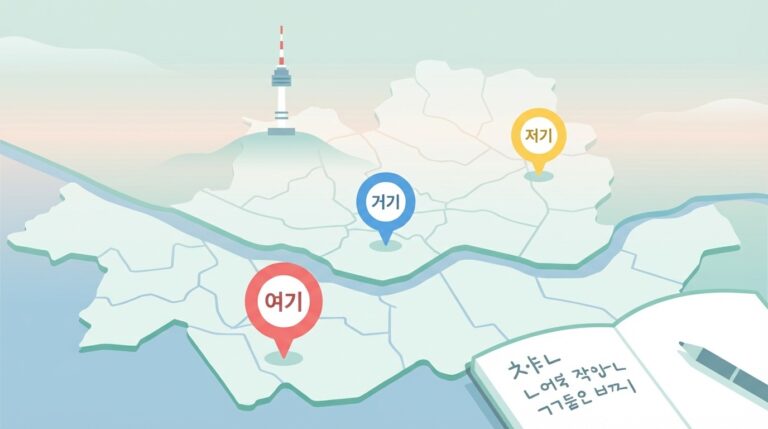
Lost in a K-Drama Scene? Mastering “Here, There, and Over There” 📍
Phase 1: The Immersive Hook
Hello! This is your Daily Hangul Editor.
Picture this: You are watching a tense scene in a K-Drama. The male lead is running through a crowded market in Seoul. Suddenly, he stops, breathless. He spots the female lead far away in the crowd. He points his finger and shouts, “JEOGI!”
But wait… yesterday, you saw a variety show where someone raised their hand in a restaurant and shouted “JEOGI-YO!” to call the waiter.
Is the waiter “far away”? Is the girlfriend “a waiter”? Why is everybody shouting “Over there”?
If you confuse Yeogi (Here), Geogi (There), and Jeogi (Over there), you might end up waiting for a taxi that never comes, or worse, staring at a waiter who never brings you water. Today, let’s decode the secret map of Korean conversation.
Phase 2: Deep Dive into Core Expressions
In English, we mainly use “Here” and “There.” But Korean adds a third dimension. It’s all about relative distance.
1. 여기 (Yeogi)
- Pronunciation: [Yeo-gi] Sounds like “Yuh-ghee”
- Meaning: Here (Close to ME)
- K-Culture Moment: A K-Pop idol doing a live stream points to their heart and says, “Yeogi-e isseoyo” (You are in here/my heart).
- Editor’s Insight: Use this when pointing at something within your reach. “This place right here.”
- Situation Spectrum:
[🚫 Formal: N/A] ———— [⚠️ Caution] ———— [✅ Casual: OK](Safe to use generally, add ‘yo’ for politeness: Yeogi-yo)
🤔 Think About It: Why does Korean emphasize “my location” so distinctly? It grounds the conversation in the speaker’s immediate reality.
2. 거기 (Geogi)
- Pronunciation: [Geo-gi] Sounds like “Guh-ghee”
- Meaning: There (Close to YOU / Or a place we mentioned before)
- K-Culture Moment: In a phone call scene, one character asks, “Geogi eodiya?” (Where is that place you are at?).
- Editor’s Insight: This is the trickiest one. If you and I are talking about a coffee shop we visited yesterday, that shop is Geogi (contextual there), even if neither of us is there right now.
3. 저기 (Jeogi)
- Pronunciation: [Jeo-gi] Sounds like “Juh-ghee”
- Meaning: Over There (Far from BOTH of us)
- K-Culture Moment: The dramatic pointing scene! “Look over there!” Also used to hesitate before speaking: “Jeogi…” (Umm… excuse me…).
- Editor’s Insight: It implies visible distance. If you have to squint to see it, it’s Jeogi.
Phase 3: Textbook vs. Real Life
| Situation | 📖 Textbook Korean | 🗣️ Real Life Korean | 💡 Why? |
|---|---|---|---|
| Calling a waiter | “웨이터님!” (Waiter-nim!) | “저기요!” (Jeogiyo!) | Koreans prefer indirectness. Calling someone by job title feels stiff; “Hey, you over there” (politely) is the norm. |
| Asking taxi to stop | “여기에서 세워주세요.” (Please stop at this location.) | “여기요!” (Yeogiyo!) | In a moving car, speed matters. Short, punchy clarity wins. |
| Finding a seat | “저기 앉을까요?” (Shall we sit over there?) | “저기!” (Jeogi!) + 👉 Pointing | Body language does 50% of the work in high-context cultures. |
Note: Jeogiyo literally means “Over there, please,” but functionally it means “Excuse me!” Use it to grab attention anywhere.
Phase 4: Cultural Deep Dive — The Art of Pointing
4-1. Non-verbal Communication (Nunchi Factor)
In Western culture, pointing with an index finger is normal. In Korea? Use caution.
– Pointing at objects/places: Index finger is OK.
– Pointing at PEOPLE: 🚫 Rude! Never point at a person with one finger. Instead, use an open hand (palm facing up) to direct attention toward someone.
4-2. K-Food Connection: The “Bell” vs. “Jeogiyo”
In many Korean restaurants, there is a call bell on the table.
– If there is a bell: Press it. Ding dong! 🛎️
– If there is NO bell: This is your time to shine. Raise your hand confidently and shout “Jeogiyo!” Don’t wait for eye contact; Korean servers are busy and expect the shout.
Phase 5: Immersive Roleplay
Scenario A: The Street Food Stall (Pojangmacha)
Setting: A steamy winter night in Hongdae. You are at a Tteokbokki (spicy rice cake) stall. It’s crowded.
Characters:
– YOU: Hungry traveler.
– Imo-nim (Auntie): The busy stall owner, grilling skewers.
Dialogue:
YOU: (Pointing at the fish cakes right in front of you)
이모님, 여기 떡볶이 주세요! 🍢
(Imo-nim, yeogi tteokbokki juseyo!)
(English: Auntie, please give me Tteokbokki [here]!)
Imo-nim: (Pointing to the spicy sauce far at the end)
매운 거? 저기 있는 거?
(Mae-un geo? Jeogi inneun geo?)
(English: The spicy one? The one [over there]?)
🔀 YOUR TURN! How do you answer?
- A) “네, 그거요!” (Ne, geugeoyo!) – Yes, that one!
- B) “아니요, 여기요.” (Aniyo, yeogiyo.) – No, here.
✅ Best Choice: A
Since the Auntie pointed at it (far from you, close to her or far from both), referring to it as “That one” (Geu-geo) or agreeing with her location fits best.
Phase 6: 10-Second Shadowing Drill
Practice these to get the “feel” of distance. Focus on the intonation!
- 😊 Here please! (Paying the bill or stopping a taxi)
여기요! / 계산 / 해 주세요.
(Yeogi-yo! / gye-san / hae ju-se-yo.) -
😯 What is that? (Asking about something near the listener)
거기 / 뭐예요?
(Geogi / mwo-ye-yo?) -
🙋♂️ Excuse me! (Calling a waiter)
저기요! / 주문 / 할게요!
(Jeogi-yo! / ju-mun / hal-ke-yo!)
Phase 7: K-Culture Glossary
| Korean | Romanization | Meaning | Context |
|---|---|---|---|
| 저기요 | Jeogiyo | Excuse me | Literally “Over there, please.” Used to call strangers/staff. |
| 이모님 | Imo-nim | Auntie | Affectionate term for older female restaurant owners. |
| 여기요 | Yeogiyo | Here, please | Used to hand something over or ask a taxi to stop. |
Phase 8: Traveler’s Survival Kit 🧳
Situation: You are in a Taxi.
🆘 Survival Expression #1: Stopping the Car
– 🇰🇷 “여기 내려주세요.” (Yeogi naeryeo-juseyo.)
– 🗣️ Pronunciation: [Yuh-ghee neh-ryuh ju-seh-yo]
– 📍 Meaning: Please drop me off HERE.
– 💡 Pro Tip: Say this about 50 meters before your actual stop so the driver has time to pull over safely.📌 Editor’s Travel Note
– Navigation: Google Maps often fails in Korea. Use Naver Map or KakaoMap. They understand “Yeogi” (Current Location) much better!
Phase 9: Think Deeper — “Why so vague?”
Topic: Indirectness in Korean Culture
Have you noticed we often use location words instead of “You”? Calling someone “You” (Dangshin/Neo) to a stranger is considered aggressive or rude in Korea. By saying “Jeogiyo” (Over there), we are technically addressing the space rather than the person, creating a polite “buffer zone.” It’s a way of getting attention without invading personal space verbally.
💬 Your Turn: In your country, how do you call a waiter? Do you shout, make eye contact, or click your fingers? Tell us in the comments!
Phase 10: Troubleshooting & FAQ
Q: Can I use “Jeogi” to point at a person?
A: NO! 🚫 While you say “Jeogiyo” to call them, pointing your finger at a person and saying “Jeogi” (That person over there) is rude. Use their name or title if possible.
Q: I’m confused. Geogi vs. Jeogi?
A: Simple test:
– Can you touch it? -> Yeogi
– Is it near your friend? -> Geogi
– Is it far from both of you? -> Jeogi
❌ Common Mistake:
Don’t whisper “Jeogiyo” in a loud restaurant. The staff won’t ignore you on purpose, but K-BBQ places are noisy! Speak from your diaphragm!
Phase 11: Wrap-up & Mission
One-Liner: Yeogi is HERE (Me), Geogi is THERE (You), and Jeogi is OVER THERE (Far away/Excuse me).
🚀 Action Mission:
– 🥉 Bronze: Look at objects in your room. Point and say “Yeogi” (near) or “Jeogi” (far).
– 🥈 Silver: Watch a K-Drama episode. Count how many times they say “Jeogi” or “Jeogiyo.”
– 🥇 Gold: Go to a Korean restaurant (or pretend). Raise your hand and practice saying “Jeogiyo!” loudly!
Phase 12: Pop Quiz
1. You are in a taxi and want to get out right now. What do you say?
A) Jeogi-yo! (Excuse me!)
B) Yeogi-yo! (Here!)
C) Geogi-yo! (There!)
2. True or False?
It is polite to point at an elderly person with your index finger while saying “Jeogi.”
3. Situation: Your friend is holding a delicious drink. You want to ask “What is that (in your hand)?”
A) Yeogi mwo-ye-yo?
B) Geogi mwo-ye-yo?
(Answers: 1-B, 2-False, 3-B)
Frequently Asked Questions (FAQ)
Q: What does "여기 (Yeogi)" mean in Korean and how do you pronounce it?
A: In Korean, "여기 (Yeogi)" is pronounced [Yeo-gi] and means: Here (Close to ME)
Q: What does "거기 (Geogi)" mean in Korean and how do you pronounce it?
A: In Korean, "거기 (Geogi)" is pronounced [Geo-gi] and means: There (Close to YOU / Or a place we mentioned before)
Q: What does "저기 (Jeogi)" mean in Korean and how do you pronounce it?
A: In Korean, "저기 (Jeogi)" is pronounced [Jeo-gi] and means: Over There (Far from BOTH of us)







