

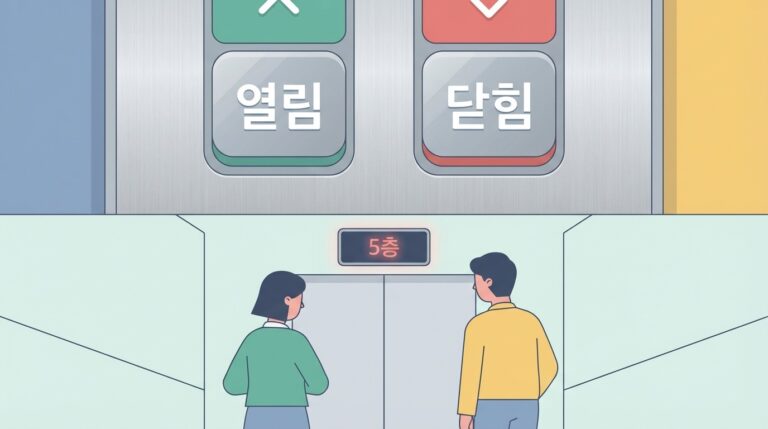
The Art of Awkward Silence: Mastering Korean Elevator Etiquette
Phase 1: Immersive Hook — The 10-Second Thriller
Greeting: 안녕하세요! Welcome back to Daily Hangul. Today, we are stepping into the most intense 2 square meters in Korean society.
Picture this scene from a high-tension K-Drama like Misaeng or What’s Wrong with Secretary Kim. The elevator doors slide open. You step in, and there he is—your company’s CEO, or perhaps the intimidating mother-in-law character. The doors close.
Ding.
The silence is deafening. You stare at the floor numbers counting up… 12… 13… 14. Do you say something? Do you comment on the weather? Or do you stand there like a statue? In Western cultures, this might be the perfect time for a witty icebreaker. In Korea, however, this box is a microcosm of social hierarchy and Nunchi (눈치).
Today, we aren’t just learning how to say “Hello.” We are decoding the sophisticated semiotics of silence and the precise, high-level phrases used to navigate shared vertical spaces without losing face.
Phase 2: Deep Dive — The Language of Vertical Politeness
Since you are at a C2 level, we move beyond simple greetings to expressions that govern social flow and spatial courtesy.
1. 먼저 올라가 보겠습니다 (I will go up first)
- Pronunciation: [Meon-jeo ol-la-ga bo-get-seum-ni-da]
- Meaning: “I will go up first.” (Highly Formal)
- Context: You are leaving the elevator before your superior or a senior acquaintance.
- Editor’s Insight: This is the elevator equivalent of “퇴근해 보겠습니다” (I am leaving work now). It acknowledges the hierarchy—you are ‘daring’ to exit the shared space while they remain. It’s a verbal bow.
- Situation Spectrum:
[🚫 Friends] ———— [⚠️ Colleagues] ———— [✅ Superiors/Elders]- 🤔 Think About It: Why does Korean require a verbal announcement for physical departure? How does this relate to the concept of Jeong (bond) and the reluctance to sever connections abruptly?
2. 닫힘 버튼 좀 눌러 주시겠어요? (Could you press the close button?)
- Pronunciation: [Dat-him beo-teun jom nul-leo ju-si-get-seo-yo?]
- Meaning: “Could you please press the close button?”
- K-Culture Moment: The “Pali-Pali” (Hurry-Hurry) culture in action. In K-Dramas, the protagonist often frantically presses this button to escape a villain or chase a love interest. In reality, it’s just everyone wanting to get home 3 seconds faster.
- Editor’s Insight: Note the use of ‘좀’ (jom). At a C2 level, you know this softens a request. Without it, you sound demanding.
- Situation Spectrum:
[✅ Strangers] ———— [✅ Colleagues] ———— [✅ Elders]3. 몇 층 가세요? (Which floor are you going to?)
- Pronunciation: [Myeot cheung ga-se-yo?]
- Meaning: “Which floor are you going to?”
- Editor’s Insight: This is functional benevolence. It is not an invitation for a chat; it is a service. If you are standing near the buttons, you are the de facto elevator operator.
Phase 3: Textbook vs. Real Life
| Situation | 📖 Textbook Korean | 🗣️ Real Korean (C2 Context) | 💡 Why the difference? |
|---|---|---|---|
| Meeting a neighbor | “안녕하세요? 오늘 날씨가 참 좋네요.” (Hello, the weather is nice today.) | (Light Bow + Smile) OR “안녕하세요.” (Softly) | In modern apartment complexes (Apateu), privacy is cherished. Excessive small talk can be seen as intrusive (burden/budam). |
| Exiting a crowded elevator | “실례합니다. 내리겠습니다.” (Excuse me. I will get off.) | “잠시만요.” (Just a moment) OR “내릴게요.” (I’m getting off.) | “Sil-rye-ham-nida” can feel too stiff/bookish. “Jamsimanyo” acts as a verbal bulldozer to clear the path. |
| Silence | (Awkward panic) | (Peaceful silence looking at the phone/screen) | Silence in Korea is not “awkward” by default; it is a sign of respecting shared personal boundaries. |
Bottom Note: At an advanced level, your goal is to blend in, not to stand out as the “chatty foreigner.” Reading the gong-gi (air/atmosphere) is key.
Phase 4: Cultural Deep Dive — The Physics of Nunchi
4-1. The Non-Verbal “Mokrye” (목례)
In a cramped elevator, a full 90-degree bow is physically impossible and socially weird. The solution is Mokrye (Eye-greeting). It involves a slight nod of the head (about 15 degrees) while making brief eye contact, then immediately averting your gaze. It says, “I acknowledge your existence and rank, but I will not disturb your peace.”
4-2. The “Corner Strategy” from K-Dramas
If you watch workplace dramas like Start-Up, you’ll notice subordinates often retreat to the corners of the elevator, leaving the center or the back wall for the highest-ranking person. This is spatial hierarchy. As a C2 learner, be mindful of where you stand. Blocking the button panel when you are the youngest/junior is a strategic error.
Phase 5: Immersive Roleplay — The Friday Night Crisis
Setting: Friday, 6:30 PM. An office building in Yeouido. You are exhausted. The elevator stops at the 10th floor, and Director Kim (a strict, traditional boss) walks in. You are holding a take-out coffee cup.
Characters:
* YOU: A foreign team leader (working in Korea for 3 years).
* Director Kim: 50s, stern face, tired.
(The doors open. Director Kim enters.)
YOU: (Quickly bowing slightly)
(Directory Kim nods silently and stands in front of the door.)
YOU: 이사님, 퇴근하십니까? (Director, are you leaving for the day?)
Director Kim: 어, 그래. 자네도 가나? (Oh, yes. Are you going too?)
YOU: 네, 주말 잘 보내십시요. (Yes, have a good weekend.)
(Silence ensues for 5 floors. The air is heavy.)
Director Kim: (Suddenly) 요즘 프로젝트는 잘 돼가? (Is the project going well these days?)
🔀 Decision Point! How do you respond?
- A) “네! 사실 조금 어려움이 있지만 열심히 하고 있습니다!” (Detailed work report)
- B) “네, 팀원들이랑 열심히 하고 있습니다. 걱정 마세요.” (Brief, positive assurance)
- C) “아, 이사님. 지금은 퇴근 시간이니까 월요일에 보고드리겠습니다.” (Setting boundaries)
✅ Best Choice: B.
Elevator talk with executives should be brief and positive. It’s not the place for a full report (A), nor is it wise to strictly draw lines with a superior in a high-context culture like Korea (C), which might be seen as lacking Jeong or being cold.
Phase 6: 10-Second Shadowing Drill
Let’s practice the “Polite Exit.” Practice this until it rolls off your tongue effortlessly.
- Emotion: Polite but efficient. You are moving while speaking.
- Drill: 😊 죄송하지만 / 먼저 / 내리겠습니다. (Joe-song-ha-ji-man / meon-jeo / nae-ri-get-seum-ni-da.)
- Tip: Don’t stress the “Joe-song.” Stress the “Meon-jeo” (First).
Phase 7: K-Culture Mini Glossary
| Korean | Romanization | Meaning | Context |
|---|---|---|---|
| 목례 | Mokrye | Silent Bow/Nod | The standard elevator greeting. Subtle and efficient. |
| 스몰토크 | Small Talk | Small Talk | A loanword, but often considered distinct from “chatting.” In Korea, it’s less about weather and more about immediate context (food, busy-ness). |
| 닫힘 버튼 | Datchim Button | Close Button | The most worn-out button in any Korean elevator due to the “Hurry Hurry” culture. |
Phase 8: Traveler’s Survival Kit (Elevator Edition)
Even if you aren’t working in Korea, you will use elevators in hotels, department stores, and subways.
🆘 Survival Expression #1
– 🇰🇷 “잠시만요!” (Jam-si-man-yo!)
– 🗣️ Sound Analogy: Sounds like “Jam” + “Sea” + “Man” + “Yo”.
– 📍 Usage: The doors are closing, and you need to catch the elevator. Or you need to push through people to get out.
– 💡 Pro Tip: Shout this before you stick your hand in the door. Korean elevator sensors can be unforgiving!📌 Editor’s Travel Note
– Button confusion: ‘1’ is the ground floor. ‘L’ is Lobby (sometimes different from 1). ‘B’ is Basement.
– The ‘Open’ Button: Look for 열림 (Yeollim). It looks like< >.
– The ‘Close’ Button: Look for 닫힘 (Dachim). It looks like> <. Don’t mix these up, or you will crush someone!
Phase 9: Think Deeper — Silence as a Social Lubricant
Subject: High-Context Culture & The Virtue of Silence
In many Western cultures (Low-Context), silence is a vacuum that needs to be filled with words to establish safety and connection. In Korea (High-Context), silence is often a shared agreement of peace. Especially in the hyper-dense city of Seoul, where personal space is a luxury, an elevator ride is a rare moment of anonymity. By not speaking to your neighbor, you are ironically showing them the highest form of consideration: the gift of privacy.
🧠 Think Deeper: How does your native culture interpret silence with strangers? Is it “awkward” or “peaceful”? Does the Korean approach feel cold to you, or efficient?
Phase 10: FAQ & Troubleshooting
Q: Can I compliment a Korean person’s outfit in the elevator?
A: Maybe. If you are a foreigner, you get a “Free Pass” to be friendlier. A simple “Nice shoes” is okay. But generally, commenting on appearance to a stranger can be seen as burdensome (budam). Keep it to extreme non-intrusive compliments if you must.
Q: What if I smell like BBQ/Soju after a Hoesik (Company Dinner)?
A: This is a classic K-Drama trope. If you smell strongly of alcohol or food, try to stand near the ventilator or the corner. Apologizing with a sheepish smile (“죄송합니다, 회식을 해서…”) is a very high-level social move that instantly builds empathy.
❌ Common Mistake #1: Holding the door open for too long.
✅ Fix: Efficiency is polite. Hold it until they enter, then immediately press ‘Close’. Don’t wait for a leisurely chat.
Phase 11: Wrap-up & Action Mission
Summary: In Korean elevators, silence is golden, “closing the door” is a love language, and knowing when to bow (Mokrye) is better than a thousand words.
🎬 Action Mission:
* 🥉 Bronze: Look at a mirror and practice the “Mokrye” (15-degree nod) without saying a word.
* 🥈 Silver: In your next elevator ride (wherever you are), try to identify who has the highest “rank” based on position and body language.
* 🥇 Gold: If you are in Korea, muster the courage to say “몇 층 가세요?” to someone rushing in with their hands full.
💬 Your Turn: Have you ever had an awkward elevator moment in Korea? Did you press the wrong button? Share your story below!
Phase 12: Quiz — The Nunchi Master Challenge
- Situational Judgment: You are in an elevator with a neighbor you’ve only seen once. What is the BEST greeting?
- A) “Where are you going today?”
- B) A full 90-degree bow and “An-nyeong-ha-sim-ni-kka!”
- C) A light nod (Mokrye) and a small smile.
- D) Stare at your phone and ignore them completely.
- K-Culture True/False: In Korea, the “Close” button (닫힘) is rarely used because it is considered rude to rush.
- (True / False)
(Scroll down for answers)
|
|
|
Answers:
1. C) A light nod is perfect. A is too intrusive, B is too formal for a neighbor, D is a bit cold (though common).
2. False. It is the most used button. Pressing it quickly is the norm!ment!
Frequently Asked Questions (FAQ)
Q: What does "먼저 올라가 보겠습니다 (I will go up first)" mean in Korean and how do you pronounce it?
A: In Korean, "먼저 올라가 보겠습니다 (I will go up first)" is pronounced [Meon-jeo ol-la-ga bo-get-seum-ni-da] and means: "I will go up first." (Highly Formal)
Q: What does "닫힘 버튼 좀 눌러 주시겠어요? (Could you press the close button?)" mean in Korean and how do you pronounce it?
A: In Korean, "닫힘 버튼 좀 눌러 주시겠어요? (Could you press the close button?)" is pronounced [Dat-him beo-teun jom nul-leo ju-si-get-seo-yo?] and means: "Could you please press the close button?"
Q: What does "몇 층 가세요? (Which floor are you going to?)" mean in Korean and how do you pronounce it?
A: In Korean, "몇 층 가세요? (Which floor are you going to?)" is pronounced [Myeot cheung ga-se-yo?] and means: "Which floor are you going to?"







