

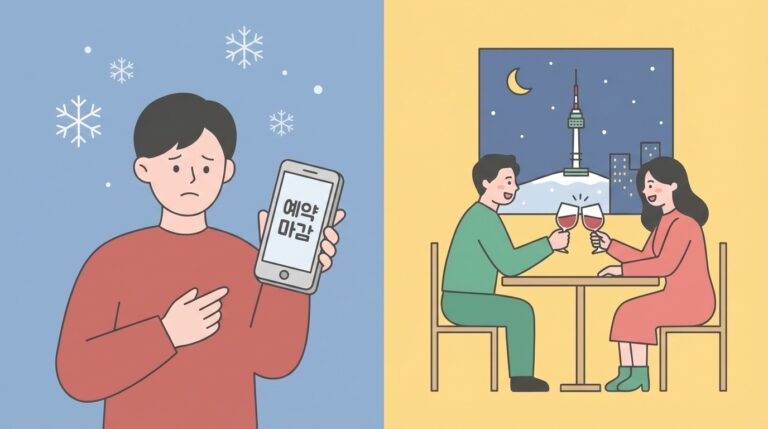
Phase 1: The ‘Click War’ Begins (Immersive Hook)
안녕하세요! This is your Daily Hangul Editor.
Imagine this: It’s early December. You are in Seoul. You’ve met someone special, maybe a sseom (썸 – a fling/pre-dating phase) that feels like the start of a K-Drama romance. You want to impress them with a perfect Christmas dinner. You open your phone, confident.
But wait.
Every trendy restaurant in Hannam-dong and Yeonnam-dong says “Reservation Full” (예약 마감). It feels like you’re trying to buy tickets for a BTS concert, not just dinner. In Korea, Christmas isn’t a quiet family holiday; it is the Super Bowl of Dating.
If you don’t know the right phrases to secure that last table—or how to navigate the intense “reservation deposit” culture—you might end up eating cup noodles at a convenience store while couples in matching coats walk by. Tragic, right?
Today, we are going to equip you with the B2-level linguistic weapons you need to win the Christmas Reservation War. Let’s get that table.
Phase 2: Deep Dive into Core Expressions
Here are the three phrases that will make you sound like a local who knows the system.
1. [혹시 12월 25일 저녁에 남은 자리 있나요?]
(Hoksi 12-wol 25-il jeonyeoge nameun jari innayo?)
- Pronunciation: [Hok-shi] + [12-wol e-ship-o-il] + [jeon-yeog-e] + [na-meun ja-ri] + [in-na-yo?]
- Sound Analogy: Hoksi sounds a bit like “Hoax-y” but shorter. It’s the magic word for politeness.
- Meaning: Literal: Do you have any remaining seats on the evening of Dec 25th? / Real Nuance: “I know you’re probably fully booked, but is there a miracle spot left?”
- K-Culture Moment: Think of the desperate protagonist in a drama running into a flower shop 5 minutes before closing. They always start with “Hoksi…”
- Editor’s Insight: Starting a question with “Hoksi” (By any chance) instantly lowers your aggression level. It shows you understand how busy they are. It’s the key to unlocking Korean kindness (Jeong).
- Situation Spectrum:
[🚫 Formal Presentation] ———— [✅ Restaurant/Service] ———— [✅ Stranger]- 🤔 Think About It: Why do Koreans use “Hoksi” so much? Does your language have a “buffer word” to make requests sound less demanding?
2. [창가 자리로 부탁드려도 될까요?]
(Chang-ga jariro butak-deuryeodo doelkkayo?)
- Pronunciation: [Chang-ga ja-ri-ro] + [bu-tak-deu-ryeo-do] + [doel-kka-yo?]
- Meaning: Literal: Can I ask for a window seat? / Real Nuance: “The vibe (atmosphere) is crucial for this date, so could you please give me the best spot?”
- K-Culture Moment: In K-Dramas, serious conversations or romantic confessions always happen at a table with a view of the Han River or Namsan Tower. Nobody confesses facing the kitchen door!
- Editor’s Insight: The grammar
-(으)ㄹ까요?is a soft suggestion. You aren’t demanding; you are checking possibility. This is essential for B2 learners to sound sophisticated.3. [예약금 입금했습니다. 확인 부탁드려요.]
(Yeyak-geum ip-geum-haetsseumnida. Hwagin butak-deuryeoyo.)
- Pronunciation: [Ye-yak-geum] + [ip-geum-het-sum-ni-da]…
- Meaning: I have deposited the reservation fee. Please confirm it.
- Editor’s Insight: This is crucial. In Korea, popular spots require a “No-Show Prevention Deposit” (usually 20,000~50,000 KRW per person) during Christmas. If you say you booked but didn’t pay this, you didn’t book.
- Situation Spectrum:
[🚫 Casual Friends] ———— [✅ Business/Transactions] ———— [✅ Formal]- 🤔 Think About It: Why has the “No-Show” penalty become so strict in Korea recently? It reflects the high value placed on efficiency and respect for the owner’s time in a fast-paced society.
Phase 3: Textbook vs. Real Life
| Situation | 📖 Textbook Korean | 🗣️ Real Korean (In the Field) | 💡 Why the difference? |
|---|---|---|---|
| Checking Availability | 예약을 하고 싶습니다. (I would like to make a reservation.) | 지금 크리스마스 예약 다 찼나요? (Is Christmas fully booked already?) | Real life assumes the worst (full booking) to get a quick Yes/No answer. Efficient! |
| Asking for a favor | 좋은 자리로 주세요. (Please give me a good seat.) | 혹시 조용한 자리 있을까요? (Is there a quiet seat by any chance?) | Specificity prevents disappointment. “Good” is subjective; “Quiet” is objective. |
| Full Booked? | 알겠습니다. 안녕히 계세요. (Okay. Goodbye.) | 혹시 대기(waiting) 걸어놓을 수 있나요? (Can I be put on the waiting list?) | Koreans never give up easily! The “Waiting List” is a culture in itself. |
Phase 4: Cultural Deep Dive — The “Couple’s Holiday”
4-1. Non-verbal: The Art of “Nunchi” (눈치)
When you call a restaurant in December, the staff is likely stressed. If you hear a chaotic background noise, keep your sentences short. Do not ask about every item on the menu. Show Nunchi (situational awareness) by saying, “바쁘시겠지만…” (I know you are busy, but…) before asking for a special request like a window seat.
4-2. K-Culture Connection: Why is Christmas for Lovers?
Unlike the West, where Christmas is for family reunions, in Korea, it is essentially Valentine’s Day Part 2.
– K-Drama Context: If a character is alone on Christmas, it’s depicted as the ultimate tragedy or loneliness.
– K-Food Context: Restaurants often switch to a “Special Christmas Course” (expensive fixed menu) only for that day. If you try to order just one pasta dish, you might be refused. Knowing this context helps you understand why the manager asks, “Are you okay with the set menu?”
Phase 5: Immersive Roleplay
Setting: It is Dec 10th. You are calling “Mood Seoul,” a hot wine bar with a view of the Han River. You are desperate.
Characters:
– YOU: A B2 Korean learner trying to secure a date spot.
– Manager: Stressed restaurant manager handling 50 calls an hour.
(Phone rings)
Manager: 네, 무드서울입니다. (Ne, Mood Seoul-imnida.)
YOU: 안녕하세요! 혹시 24일 저녁 7시에 두 명 예약 될까요?
(Annyeonghaseyo! Hoksi 24-il jeonyeok 7-si-e du myeong yeyak doelkkayo?)
Manager: 아, 24일은 이미 마감되었습니다. 25일 늦은 저녁인 9시는 가능하세요.
(Ah, the 24th is already closed. 9 PM on the 25th is available.)
YOU: 아, 25일 9시요? 음… 그때라도 괜찮을 것 같아요.
(Ah, 9 PM on the 25th? Hmm… I think that might be okay.)
Manager: 네, 그때는 ‘크리스마스 코스’만 주문 가능하신데 괜찮으세요? 1인당 10만 원입니다.
(Yes, but you can only order the ‘Christmas Course’ then. It’s 100,000 won per person. Is that okay?)
🔀 Decision Point: What do you say?
- A) “너무 비싸요. 깎아주세요!” (Too expensive. Discount please!)
- B) “네, 괜찮습니다. 혹시 창가 자리 가능할까요?” (Yes, that’s fine. Is a window seat possible?)
- C) “네, 알겠습니다. 예약금은 어디로 보내면 되나요?” (Okay. Where should I send the deposit?)
✅ Best Choice: C
Why? Option B is risky because at 9 PM on Christmas, any seat is a blessing. Asking for a window seat immediately might make you look demanding. Secure the booking with the deposit (Option C) first!
Option A Analysis: Never ask for a discount at a restaurant on Christmas. It’s culturally inappropriate and impossible.
Phase 6: 10-Second Shadowing Drill
Emotion: Desperate but polite (🥺)
“혹시 / 취소 자리가 나오면 / 연락 주실 수 있나요?”
(Hoksi / chwiso jariga naomyeon / yeollak jusil su innayo?)
Translation: If a cancellation spot opens up / by any chance / could you give me a call?
Note: Use this when they say “Full.” It’s your Hail Mary pass!
Phase 7: K-Culture Mini Glossary
| Korean | Romanization | Meaning | Context |
|---|---|---|---|
| 분위기 깡패 | Bunwigi Kkangpae | Ambiance Gangster | Slang for a place with an absolutely killer vibe/interior. Essential for dates. |
| 노쇼 | No-Show | No-Show | Making a reservation and not showing up. Highly frowned upon. |
| 내돈내산 | Naedonnaesan | My money, my buy | Often seen in blog reviews. It means “I paid for this myself (not sponsored),” so the review is trustworthy. Check these reviews before booking! |
| 커플 지옥 | Couple Jiok | Couple Hell | A joking term singles use to describe places crowded with couples on Christmas. |
Phase 8: Traveler’s Survival Kit (Reservation Edition)
🆘 Survival Phrases for Travelers
– 🇰🇷 “당일 예약 되나요?” (Dang-il yeyak doenayo?)
– English: Can I book for today (same day)?
– Use at: When you walk past a nice place and want to eat there tonight.
– 🇰🇷 “웨이팅 얼마나 걸려요?” (Waiting eolmana geollyeoyo?)
– English: How long is the wait?
– Pro Tip: If they say “1 hour,” usually it means 40 mins. If they say “We don’t know,” run away.📌 Editor’s Travel Note: The App Ecosystem
In Korea, calling is old school. Locals use apps like CatchTable (캐치테이블) or Naver Map (네이버 지도) to book.
Warning: Many apps require a Korean phone number for identity verification. If you are a traveler without an ARC (Alien Registration Card), calling directly or using the hotel concierge is your best bet!
Phase 9: Think Deeper — “Romantic Pressure”
🧠 Think Deeper: The Commercialization of Romance
In Korea, there is immense social pressure to have a “perfect” Christmas date. K-Dramas portray it as a magical event with snow, wine, and expensive gifts. This drives the “Reservation War.”
But think about it: Does the value of a relationship depend on securing a window seat at a Michelin restaurant? This intense reservation culture reflects the Korean distinctiveness of “Trends” (Yuhang)—everyone wants to be at the same hot place at the same time.
💬 Your Turn: How is Christmas celebrated in your culture? Is it a quiet night or a party night? Share in the comments!
Phase 10: FAQ & Troubleshooting
Q: Can I just walk into a popular restaurant on Christmas without a reservation?
A: Honestly? No. Unless you want to eat at a 24-hour Gukbap (Soup) restaurant (which is actually delicious, but maybe not “romantic”). For hot spots, bookings open 1 month in advance.
Q: I don’t have a Korean bank account for the deposit (예약금). What do I do?
A: Explain this clearly! Say: “제가 외국인이라 한국 계좌가 없어요. 현장에서 카드로 결제해도 될까요?” (I am a foreigner so I don’t have a Korean account. Can I pay by card on-site?). Many places will make an exception or ask for a credit card guarantee instead.
❌ Common Mistake:
Don’t say “I want to book” and hang up. You must wait for their “Confirmation” (확정) message. If you didn’t get a text, you aren’t booked.
Phase 11: Wrap-up & Action Mission
One-Liner: Polite persistence (using Hoksi) and understanding the deposit culture are your keys to a romantic Korean Christmas.
🚀 Action Missions:
– 🥉 Bronze: Practice saying “Hoksi… chang-ga jari innayo?” three times while looking in the mirror. Make a pleading face!
– 🥈 Silver: Go to a Korean restaurant in your country and try making a reservation in Korean.
– 🥇 Gold: Download the app CatchTable (it has an English version!) and browse restaurants in Seoul to see which ones require a deposit.
Phase 12: Quiz — Did you survive the reservation?
1. Situation: The staff says there are no tables, but you want to leave your number just in case. What do you say?
– A) 예약금 입금했습니다. (I sent the deposit.)
– B) 대기 걸어주실 수 있나요? (Can you put me on the waiting list?)
– C) 메뉴판 주세요. (Menu please.)
2. True or False: On Christmas in Korea, it is common for restaurants to serve only expensive “Course Menus.”
– ( ) True / ( ) False
Answers:
1. B) This is the standard phrase for waitlisting.
2. True. It’s a peak season strategy called “Teuk-su” (Special demand).
See you in the next lesson! Merry Christmas in advance! (미리 메리 크리스마스!)







