

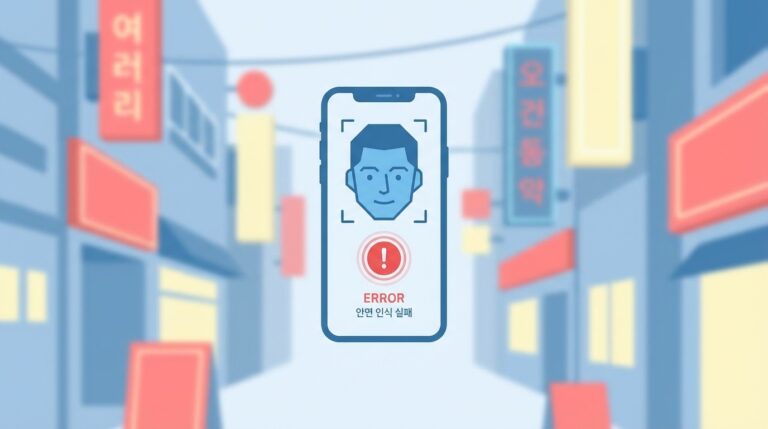
Phase 1: The ‘Digital Gatekeeper’ Hook
Hello! This is your Senior Editor at Daily Hangul.
Imagine this scene from a K-Drama: The high-flying CEO walks up to his penthouse door. He doesn’t fumble for keys. He doesn’t even punch in a code. He simply looks at a camera or speaks a command, and Tiriling! The door opens.
But let’s cut to reality. You are in Korea, trying to order delivery chicken or transfer money to a friend via KakaoPay. Suddenly, the screen demands ‘본인 인증’ (Identity Verification). You try to use your voice ID, but the app keeps saying it can’t hear you. You are stuck in the digital limbo known to every foreigner living in Seoul.
Today, we are tackling the C1-level vocabulary of Voice ID and Biometric Authentication. This isn’t just about technology; it’s about the keys to the ‘Palli-palli’ (hurry-hurry) digital lifestyle of Korea. If you want to survive Korea’s FinTech and smart home culture, you need to master these terms.
Let’s unlock this unit together.
Phase 2: Deep Dive into Core Expressions
1. 본인 인증아다 (Bonin injeunghada)
- Pronunciation: [Bon-in in-jeung-ha-da]
- Meaning: To verify one’s identity (Literal: To authenticate the self)
- Nuance: In Western apps, you often just ‘log in.’ In Korea, 본인 인증 is a stricter, more ubiquitous concept. It implies proving you are who you say you are via biometrics or mobile phone verification to access anything important (banking, government sites, age-restricted shopping).
- K-Culture Moment: Every time a K-Pop fan tries to buy concert tickets on Interpark, this is the final boss they must defeat.
- Situation Spectrum:
[✅ Casual] ———— [✅ Formal] ———— [✅ Technical](Used universally in digital contexts) - 🤔 Think About It: Why does Korea require strict identity verification even for simple online activities? How does this reflect the country’s emphasis on cyber security versus privacy?
2. 인식이 안 ᄃᄐ다 (Insigi an doeda)
- Pronunciation: [In-si-gi an dwe-da]
- Meaning: To not be recognized / Recognition failed
- Nuance: ‘인식’ means recognition or perception. In a tech context, it refers to the machine failing to read your biometric data. It’s the phrase you mutter when your Face ID fails because you’re wearing a mask, or Voice ID fails because it’s noisy.
- Editor’s Insight: Passive verbs are crucial here. You don’t say “The machine didn’t recognize me.” You say “Recognition didn’t happen” (인식이 안 ᄃ여와). It shifts the blame to the process, not you or the machine.
- Situation Spectrum:
[✅ Casual] ———— [✅ Formal]
3. 잠금외 해제 (Jamgeum haeje)
- Pronunciation: [Jam-geum hae-je]
- Meaning: Unlock (Literal: Release the lock)
- Nuance: While ‘잠금외그아’ implies locking something away, 해제 is a slightly formal term used in settings and technical manuals. In spoken Korean, we often just say “풀다” (pulda – to untie/solve/unlock).
- K-Culture Moment: In spy thrillers or heist movies, the hacker always shouts, “잠금 해제 맬료ᄒ애요!” (Unlock complete!)
- 🤔 Think About It: Why use the Sino-Korean word ‘해제’ (release/cancel) for phones, but ‘열다’ (open) for physical doors? It shows how we categorize digital barriers differently from physical ones.
Phase 3: Textbook vs. Real Life
| Context | 📖 Textbook Korean | 🗣️ Real Korean | 💡 Why the difference? |
|---|---|---|---|
| Face ID fails | 얼굴 인식이 안 ᄃᄐ어요. (Face recognition did not work.) |
아, 오픈 어플 커져자. (Ah, why won’t it open?) |
Native speakers react to the frustration, not the technical error process. |
| Setting up Voice ID | 목소리를 등록해 주세요. (Please register your voice.) |
목소리 ᄔᅩ터 따아워. (Pick/Record the voice first.) |
‘따다’ (ddada) is slang for ‘acquiring’ data or a copy, used often in tech setup. |
| Biometrics | 생체 인증 수단 (Biometric authentication method) |
지인이나 페이스아이디 (Fingerprint or FaceID) |
People prefer specific brand names (FaceID) or concrete terms (Fingerprint) over abstract ones. |
Phase 4: Cultural Deep Dive
4-1. Non-verbal: The ‘Public Screen Shield’
When using banking apps in public for bonin injeung, you will notice Koreans subtly angling their phones away or shielding the screen with one hand, even for biometric scans. It’s not just security; it’s 사생활 보호 (privacy protection). Doing your banking openly on the subway is considered lacking in ‘common sense’ security awareness.
4-2. K-Culture Connection: FinTech & The ‘1-Second’ Culture
In Korea, if an app takes more than 3 seconds to open, it’s considered ‘broken.’ This 랴리랴리 (Palli-palli) culture drove the massive adoption of biometric ID. Why type a 10-digit password with special characters when you can just look at your phone?
* Critical Perspective: While convenient, this has led to a digital divide. Elderly people (디지털 소예 계층) often struggle with kiosks and voice recognition that fail to understand dialect or slower speech patterns.
Phase 5: Immersive Roleplay
Setting: A bustling, noisy cafe in Hongdae. You are trying to transfer your share of the lunch bill to your Korean friend, Minji, using a banking app. The app requires voice authentication.
Characters:
* YOU: A tech-savvy foreigner, but struggling with the noise.
* Minji (28): Your Korean friend, impatient but helpful.
💬 Dialogue:
Minji: 아직도 안 보내써? 소아다 라가게써. ᄏᄏᄏ
(Ajikdo an bonaesseo? Song-eum-hada sum neomeogagesseo. kkk)
(Eng: You haven’t sent it yet? I’m going to die waiting for the transfer. lol)
YOU: 아니, 자쵸 목소리 인식이 안 ᄃ여. 여기 너무 시끄러워서.
(Ani, jakku moksori insigi an dwae. Yeogi neomu sikkeureowoseo.)
(Eng: No, the voice recognition keeps failing. It’s too noisy here.)
Minji: 아 진자? 그쿠 앱이 얼래 좀 카다라워. 지인으로 바꿔바.
(Ah jinjja? Geu aebi wonlae jom kkadarowo. Jimuneuro bakkwoba.)
(Eng: Oh really? That app is usually a bit picky. Try switching to fingerprint.)
💡 Decision Point: How do you respond?
- A) 지인도 등록 안 해ᄁ대… 아이디 인증으로 해야게ᄁ다. (I didn’t register my fingerprint either… I guess I’ll use password auth.)
- B) 목소리가 안 ᄃ여서 자존심 상해! 될 때까지 한다. (My pride is hurt because the voice didn’t work! I’ll do it until it works.)
- C) 내 해드폰이 고장나써. (My phone is broken.)
✅ Best Choice: A – Logical and moves the situation forward. ‘ID Authentication’ implies using a PIN or password, which is the reliable backup.
⚠️ Choice B Analysis: Funny and shows determination (근성 – tenacity), but Minji might just pay for you out of frustration!
Phase 6: 10-Second Shadowing Drill
Practice these sentences to sound like a local when tech fails you.
- 😤 Frustrated: 지인 인식이 / 자쵸 / 오류가 나요!
(Jimun insigi / jakku / oryuga nayo!)
“The fingerprint recognition / keeps / giving an error!” -
😊 Polite Inquiry: 본인 인증은 / 어ᄖᅥ냐 / 하면 되나요?
(Bonin injeungeun / eotteoke / hamyeon doenayo?)
“How should I / proceed with / identity verification?”
Phase 7: K-Culture Glossary: The ‘Auth’ World
| Korean | Romanization | English | Context |
|---|---|---|---|
| 간편 인증 | Ganpyeon injeung | Simple Authentication | A 6-digit PIN or biometric scan used instead of complex certificates. |
| 아자동 자층 간편 인증 | Jadong churip-guk | Smart Entry Service | The automated immigration gates at Incheon Airport using face/passport scan. |
| 카우 / 페이스아이디 | Kao / Face ID | KakaoTalk / Face ID | Koreans often shorten tech terms. ‘Kao’ is rarely used for the app itself (usually ‘Katalk’), but ‘Face ID’ is standard. |
Phase 8: Traveler’s Survival Kit
Even if you aren’t living in Korea, you will meet biometrics at the airport.
🆘 Survival Expression: Smart Pass
* 🇰🇷 “저 아자동 자층가ᄀ 등록 돼어 이써요?”
* (Jeo jadong churip-guk deungnok dwe-eo isseoyo?)
* Meaning: “Am I registered for the automated immigration service?”
* Where to use: Incheon Airport Immigration Desk.
* 💡 Pro Tip: Most long-term foreign residents can register for this. It saves you standing in the long ‘Foreigner’ line. You scan your passport and face, and you’re through in 10 seconds.
Phase 9: Think Deeper — “Your Face is Your Key”
🧠 Privacy vs. Convenience (Palli-palli Culture)
Korea adopts new technology at breakneck speed. From apartments that open with facial recognition to paying for lunch by scanning your hand (Hand Pay), the drive for convenience (편리함) often outweighs privacy concerns compared to Western cultures.
In your country, would people be comfortable with a convenience store entry system that requires a credit card scan or facial recognition to unlock the door at night? In Korea, these ‘unmanned stores’ (무인 엁포) are becoming normal.
💬 Your Turn: Is biometric convenience worth the privacy risk? Share your thoughts in the comments!
Phase 10: FAQ & Troubleshooting
- Q: Can I use Voice ID for banking if I have a strong accent?
- A: Honestly? It might be tough. Korean banking apps are optimized for standard Korean pronunciation. If it keeps saying “인식 오류” (Recognition Error), switch to Fingerprint or PIN. Don’t stress yourself out!
- Q: My door lock ran out of battery! How do I authenticate?
- A: K-Culture Alert! 🚨 Every Korean digital door lock has a spot for a 9V battery (the rectangular one). You press the battery against the external nodes to power it up temporarily. Keep a 9V battery in your bag!
❌ Common Mistake: Saying “얼굴 인증” (Face Verification) when you mean “얼굴 인식” (Face Recognition).
✅ Correction: ‘Verification’ (인증) is the process of proving who you are. ‘Recognition’ (인식) is the technical action the camera does.
Phase 11: Wrap-up & Mission
Summary: Today we learned that 본인 인증 is the gateway to Korean life, and 인식 오류 is our common enemy.
🎯 Action Mission:
* 🥉 Bronze: Set your phone language to Korean and try to find the ‘Face ID & Passcode’ menu (얼굴 ID 미ᅬ 앑호).
* 🥈 Silver: Watch a K-Drama thriller scene and spot the word 잠금 해제.
* 🥇 Gold: Try setting up a ‘Simple Password’ (간편 인증) on a Korean app if you have access!
Phase 12: Quiz — K-Tech Savvy Check
- Situational Judgment: You are at a Kiosk ordering food, but your card isn’t working. The machine says “인식 오류.” What should you do?
- A) Shout your order at the screen.
- B) Wipe the chip on your card and insert it again (re-attempt recognition).
- C) Kick the machine.
- True or False: In Korea, “Bonin Injeung” (Identity Verification) is only needed for banking.
- (Answer: False! You need it for delivery apps, concert tickets, games, and even some shopping sites.)
(Scroll down for answers)
…
Answers: 1) B, 2) False
Frequently Asked Questions (FAQ)
Q: What does "본인 인증아다 (Bonin injeunghada)" mean in Korean and how do you pronounce it?
A: In Korean, "본인 인증아다 (Bonin injeunghada)" is pronounced [Bon-in in-jeung-ha-da] and means: To verify one's identity (Literal: To authenticate the self)
Q: What does "인식이 안 ᄃᄐ다 (Insigi an doeda)" mean in Korean and how do you pronounce it?
A: In Korean, "인식이 안 ᄃᄐ다 (Insigi an doeda)" is pronounced [In-si-gi an dwe-da] and means: To not be recognized / Recognition failed
Q: What does "잠금외 해제 (Jamgeum haeje)" mean in Korean and how do you pronounce it?
A: In Korean, "잠금외 해제 (Jamgeum haeje)" is pronounced [Jam-geum hae-je] and means: Unlock (Literal: Release the lock)







