

Phase 1: The Immersive Hook
Greeting: 안녕하세요! It’s your Daily Hangul editor here.
Imagine this: You are the protagonist in a K-Drama. You are standing in the middle of Gwanghwamun Square, waiting for your date. You checked the weather app, and it said -2°C (28°F). “Not too bad,” you thought. But then, the wind blows. It cuts through your coat like a knife. Your ears feel like they might fall off. You see locals walking by, wrapped in giant, long padded coats that look like sleeping bags.
That creates a huge gap between what the thermometer says and what your body feels. In Korea, we don’t just talk about the temperature; we talk about the pain. If you don’t know the phrase for “feels-like temperature,” you might underestimate a Seoul winter and end up freezing while your Korean friends are safely hidden in a warm cafe.
Today, let’s learn how to express that bone-chilling cold like a true local. Trust me, I’ve learned this the hard way waiting for the night bus in January!
Phase 2: Deep Dive into Core Expressions
1. 체감 온도 (Chegam ondo)
- Pronunciation: [Che-gam on-do] (Sounds like: Check + Gum + On + Dough)
- Meaning: Feels-like temperature (Sensory temperature)
- K-Culture Moment: You’ll see this on every Korean news channel in winter. An idol on a variety show might say, “Today the temp is -5, but the ‘chegam ondo’ is -20!” while shivering in an outdoor mission.
- Editor’s Insight: Che (body) + Gam (feeling). It’s scientific but deeply personal. It justifies why you are refusing to go outside.
- Situation Spectrum:
[🚫 Formal Only] ———— [✅ Universal] ———— [⚠️ Casual Only]
- Verdict: ✅ Universal. You can use this with your boss, your grandma, or your best friend.
- 🤔 Think About It: Why do Koreans obsess over the feeling rather than just the number? It reflects a culture that values shared sensory experiences and “Nunchi” (reading the atmosphere/situation).
2. 영하 (Yeong-ha)
- Pronunciation: [Yeong-ha] (Sounds like: Young + Ha-ha)
- Meaning: Below zero (Minus degrees)
- K-Culture Moment: In K-Pop lyrics or winter ballads, this word sets a frozen, sad atmosphere.
- Editor’s Insight: Yeong means Zero, Ha means Under. In Korea, saying just “5 degrees” in January implies positive 5°C, which is warm! You must specify “Yeong-ha” to indicate the freezing cold.
- Situation Spectrum: ✅ Universal.
- 🤔 Think About It: Korea uses Celsius. If you are from the US, remember: 0°C is the freezing point (32°F). When we say “Yeong-ha 10,” that’s 14°F. Serious cold!
3. 얼어 죽겠다 (Eoreo jukgetda)
- Pronunciation: [Eo-reo juk-get-da] (Start with ‘Uh-oh’, then ‘Juke-box’)
- Meaning: Literal: “I will freeze to death.” / Real: “It is extremely cold.”
- K-Culture Moment: A classic line in sitcoms. A student runs into a convenience store, stomps their feet, and yells this.
- Editor’s Insight: Koreans love hyperbole (exaggeration). We don’t just say “it’s cold.” We say we are dying of cold, dying of hunger, or dying of laughter.
- Situation Spectrum:
[🚫 Formal] ———— [⚠️ Caution] ———— [✅ Casual]
- Verdict: ✅ Friends/Family. ⚠️ Close Colleagues. 🚫 Boss/Elders (Use “Neomu chupseumnida” instead).
Phase 3: Textbook vs. Real Life
| Situation | 📖 Textbook Korean | 🗣️ Real Korean (Inssa Style) | 💡 Why the difference? |
|---|---|---|---|
| Checking Weather | 날씨가 추워요. (Nalssiga chuwoyo) | 와, 미쳤다. 너무 추워. (Wa, michyeotda. Neomu chuwo.) | “The weather is cold” is a fact. “Crazy cold” is an emotion shared with friends. |
| Complaining | 기온이 영하 10도예요. (Gioni yeongha 10-doyeyo) | 오늘 체감 온도 영하 20도래! (Oneul chegam ondo yeongha 20-dorae!) | We care more about how painful the wind is than the official number. |
| Suggesting Indoors | 안으로 들어갑시다. (Aneuro deureogapsida) | 야, 얼어 죽겠다. 빨리 들어가자. (Ya, eoreo jukgetda. Ppalli deureogaja.) | Urgency! In extreme cold, politeness often gives way to survival instincts. |
Phase 4: Cultural Deep Dive — The “Long Padding” Survival Gear
4-1. The “Long Padding” (Long Puffer Coat)
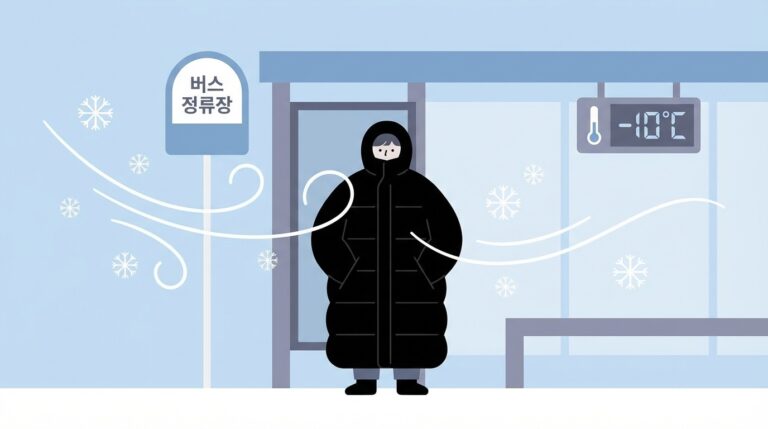
If you watch any K-Drama filmed in winter, or look at photos of K-Pop idols at the airport in January, you will see them wearing black, ankle-length puffer coats. We call this “Long Padding” (롱패딩).
- Drama Trope: The lead actor opens his Long Padding to wrap the shivering female lead inside it. (Classic romance move!)
- Why? It’s not just fashion; it’s survival. When the chegam ondo hits -15°C, style doesn’t matter. Covering your legs is essential.
4-2. “Eol-juk-a” (얼죽아)
Even when the chegam ondo is below zero, you will see Koreans holding iced coffees.
– Meaning: It stands for “Eoreo juk-eodo Americano” (Even if I freeze to death, Iced Americano).
– Insight: It shows the fast-paced Korean lifestyle. We need the caffeine hit immediately, and hot coffee takes too long to cool down!
Phase 5: Immersive Roleplay Scenario
Setting: Friday night, outside Hongdae Station Exit 9. The wind is howling. It’s technically -5°C, but the wind chill is severe. You are waiting for your friend, Minji.
Characters:
– YOU: An exchange student who wore a stylish wool coat (big mistake).
– Minji: Your Korean friend, wearing a “Long Padding” that looks like a sleeping bag.
(Dialogue)
Minji: (Running towards you, shivering) 으아, 너무 춥다! 괜찮아?
(Eua, neomu chupda! Gwaenchana?)
(Ugh, it’s so cold! Are you okay?)
YOU: (Teeth chattering) 아니, 안 괜찮아. 오늘 날씨 왜 이래?
(Ani, an gwaenchana. Oneul nalssi wae irae?)
(No, I’m not okay. Why is the weather like this today?)
Minji: 뉴스 봤어? 오늘 체감 온도가 영하 15도래!
(Nyuseu bwasseo? Oneul chegam ondo-ga yeong-ha 15-dorae!)
(Did you see the news? They say the feels-like temp is below zero 15 degrees!)
YOU: 와… 진짜 얼어 죽겠다.
(Wa… jinjja eoreo jukgetda.)
(Wow… I’m seriously freezing to death.)
Minji: 저기 오뎅 국물 좀 마시고 갈까?
(Jeogi odeng gungmul jom masigo galkka?)
(Should we go drink some fish cake broth over there?)
🔀 Your Turn! How do you respond?
- A) “좋아! 국물 마시자.” (Sure! Let’s drink broth.)
- B) “아니, 카페로 가자. 너무 추워.” (No, let’s go to a cafe. It’s too cold.)
✅ Best Choice Analysis:
– If you choose A: Very K-Drama style! Standing at a Pojangmacha (street stall) eating Eomuk (fish cake) creates a warm bond (“Jeong”).
– If you choose B: Practical survival. If you are not wearing “Long Padding,” standing outside for street food might actually be dangerous!
Phase 6: 10-Second Shadowing Drill
Practice this sentence to sound natural when complaining about the weather!
“Hearing that the feels-like temp is minus 20 degrees today!”
😤 Emotion: Shocked & complaining
Korean: 오늘 / 체감 온도가 / 영하 20도래! / 미쳤어!
Romanization: Oneul / chegam ondo-ga / yeong-ha 20-dorae! / Michyeosseo!
Sound Guide: Oh-neul / che-gam on-do-gah / young-ha e-ship-do-rae! / Me-chuss-uh!
Phase 7: K-Culture Mini Glossary
| Korean | Romanization | Meaning | Context |
|---|---|---|---|
| 롱패딩 | Long-padding | Long Puffer Coat | The unofficial uniform of Korean winter. |
| 핫팩 | Hot-pack | Heat Pack | Disposable hand warmers sold at convenience stores. Essential! |
| 칼바람 | Kal-baram | Knife Wind | Wind that is so cold it feels sharp like a knife. |
| 온돌 | Ondol | Floor Heating | Traditional Korean heating system. The reason we sit on the floor. |
Phase 8: Traveler’s Survival Kit (Winter Edition)
Are you visiting Korea between December and February? Here is how to survive the Chegam ondo.
🆘 Survival Phrase #1
– 🇰🇷 “여기 너무 추워요. 난방 좀 켜주세요.”
– (Yeogi neomu chuwoyo. Nanbang jom kyeojuseyo.)
– Meaning: It’s too cold here. Please turn on the heater.
– Where to use: Taxi, Airbnb, Guesthouse.💡 Pro Tip: The Bus Stop Heaters
Look for benches at bus stops with signs that say “온기 의자” (Ongi-uija). These are heated seats! Sit down while waiting for the bus to melt your frozen legs.
Phase 9: Think Deeper — Language & Environment
Think Deeper: Why so dramatic?
Korean phrases like “Eoreo jukgetda” (Freeze to death) or “Baegopa jukgetda” (Starve to death) might sound extreme to English speakers. This linguistic habit reflects the intense history and passion of Korean people (often called Han and Heung). Emotions are rarely expressed mildly; they are felt deeply and expressed loudly to seek empathy from others. In a collective society, expressing suffering vividly invites others to care for you.
💬 Your Turn: Does your language have phrases where you claim to be “dying” from something trivial? Share in the comments!
Phase 10: FAQ & Troubleshooting
Q: Can I say “Eoreo jukgetda” to my teacher?
A: No! That sounds a bit childish or too rough. To a teacher, simply say: “날씨가 너무 춥네요” (Nalssiga neomu chumnneyo – The weather is very cold).
Q: What is the ‘Yellow Dust’ warning in winter?
A: Sometimes, even if it’s cold, air quality can be bad. If you see ‘Mi-se-mon-ji’ (Fine dust) warnings, wear a mask not just for warmth, but for health.
❌ Common Mistake:
Don’t confuse 영상 (Yeong-sang) and 영하 (Yeong-ha).
– Yeong-sang: Above zero (Plus degrees)
– Yeong-ha: Below zero (Minus degrees)
If the news says “Yeong-sang 2 degrees,” don’t wear your heaviest coat!
Phase 11: Wrap-up & Action Mission
One-Liner: When in Korea, ignore the thermometer; listen to the Chegam ondo and wear your Long Padding!
🎯 Action Missions:
– 🥉 Bronze: Say “Oneul chegam ondo yeong-ha-ya” (Feels like temp is below zero today) to yourself in the mirror.
– 🥈 Silver: Check the weather app for Seoul right now. Comment below what the Chegam ondo is!
– 🥇 Gold: If you are in Korea, go to a convenience store (Pyeonuijeom) and buy a ‘Hot pack’ using Korean: “Hot pack isseyo?”
Phase 12: Interactive Quiz
- Situation: Your boss asks, “How is the weather outside?”
- A) Eoreo jukgetda! (I’m freezing to death!)
- B) Chegam ondo-ga yeong-ha-yeyo. (The feels-like temp is below zero.)
- Answer: B. Option A is too casual for a boss.
- Culture: True or False? Koreans stop drinking Iced Americano when the temperature drops below zero.
- Answer: False! “Eol-juk-a” (Freezing to death but Iced Americano) is a real lifestyle.
- Vocab: What does ‘Yeong-ha’ mean?
- Answer: Below Zero.
Frequently Asked Questions (FAQ)
Q: What does "체감 온도 (Chegam ondo)" mean in Korean and how do you pronounce it?
A: In Korean, "체감 온도 (Chegam ondo)" is pronounced [Che-gam on-do] and means: Feels-like temperature (Sensory temperature)
Q: What does "영하 (Yeong-ha)" mean in Korean and how do you pronounce it?
A: In Korean, "영하 (Yeong-ha)" is pronounced [Yeong-ha] and means: Below zero (Minus degrees)
Q: What does "얼어 죽겠다 (Eoreo jukgetda)" mean in Korean and how do you pronounce it?
A: In Korean, "얼어 죽겠다 (Eoreo jukgetda)" is pronounced [Eo-reo juk-get-da] and means: Literal: "I will freeze to death." / Real: "It is extremely cold."







