

Phase 1: The Immersive Hook
Hello! This is your Daily Hangul Editor.
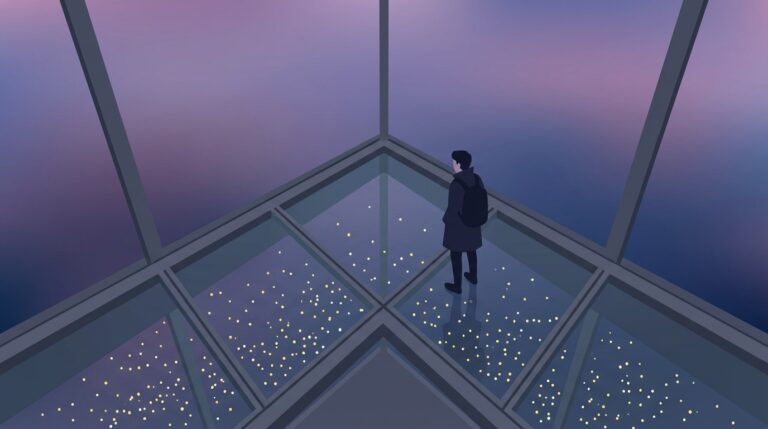
Imagine this: You are standing in an elevator that shoots up 123 floors in less than a minute. Your ears pop, the doors slide open, and suddenly, the entire sprawl of Seoul lies beneath your feet like a glittering circuit board.
We’ve all seen this scene in K-Dramas. The chaebol heir brings the protagonist here to look at the 야경 (yagyeong – night view), and the atmosphere gets romantic. But let’s be real—if you’re actually there, you’re not just thinking “It is pretty.” You might be feeling vertigo, awe, or a sudden release of stress.
Today, we are leaving the basic “와, 예쁘다 (Wow, pretty)” behind. At the Lotte World Tower Observatory (Seoul Sky), you need B2-level expressions to describe the dizzying heights and the emotional impact of the view. Ready to touch the sky?
Phase 2: Deep Dive into Key Expressions
1. 야경이 한눈에 들어오다 (Yagyeong-i hannune deureooda)
- Pronunciation: [Ya-gyeong-i han-nu-ne deu-reo-o-da]
- Sound tip: ‘Han-nune’ sounds like saying “Ha!” then “New” + “Neh” quickly.
- Meaning:
- Literal: The night view comes into one eye.
- Real Nuance: “The panoramic night view is visible all at once.” It implies a sweeping, unobstructed view that fills your vision.
- K-Culture Moment: Think of that scene in a drama where the camera pans wide over the Han River bridges lit up at night. The character takes a deep breath and says this line.
- Editor’s Insight: This is a sophisticated way to praise a view. It suggests you aren’t just looking at a building, but grasping the whole city’s landscape.
- Situation Spectrum:
[🚫 Formal Ban] ———— [⚠️ Caution] ———— [✅ Go Ahead]- Casual/Friends: ✅ (Drop the ‘yo’ -> 한눈에 들어와!)
- Polite/Dates: ✅ (한눈에 들어오네요.)
🤔 Think About It: Why is “one eye” (한눈) used to mean “all at once”? Is it because the view is so cohesive it doesn’t require scanning with both eyes, or because it fits into a single glance?
2. 아찔하다 (Ajjilhada)
- Pronunciation: [A-jjil-ha-da]
- Sound tip: The ‘jj’ is a tense sound. Imagine the sharp intake of breath when you almost slip.
- Meaning:
- Literal: To be dizzy/giddy.
- Real Nuance: “It’s dizzying/vertiginous (in a thrilling or scary way).”
- K-Culture Moment: You’ll hear this on variety shows like Running Man when they force idols to walk on the glass ‘Sky Deck’. “와, 진짜 아찔하다!” (Wow, it’s seriously dizzying!)
- Editor’s Insight: Use this specifically for the feeling of looking down from a great height. It can also be used metaphorically for a “dizzying” attraction to someone, but here, we stick to the height!
- Situation Spectrum:
[🚫 Formal Ban] ———— [⚠️ Caution] ———— [✅ Go Ahead]- Casual: ✅ (아찔해!)
- Polite: ✅ (아찔하네요.)
3. 가슴이 뻥 뚫리다 (Gaseumi ppeong ttullida)
- Pronunciation: [Ga-seu-mi ppeong ttul-li-da]
- Sound tip: ‘Ppeong’ sounds like a cork popping out of a bottle.
- Meaning:
- Literal: My chest is pierced ‘pop’.
- Real Nuance: “I feel totally relieved / My stress is gone.”
- K-Culture Moment: Koreans often associate stress with a “blocked chest” (frustration/hwabyung). High places or spicy food “unblock” this. Standing 555 meters up, looking at the tiny cars, you feel liberated.
- Editor’s Insight: This is the perfect B2 emotional expression. It shows you understand the Korean connection between physical space and emotional relief.
- Situation Spectrum:
[🚫 Formal Ban] ———— [⚠️ Caution] ———— [✅ Go Ahead]- Casual: ✅
- Polite: ✅ (가슴이 뻥 뚫리는 기분이에요.)
🤔 Think About It: In many Western cultures, heights might induce fear. Why do you think Korean language emphasizes “relief” (unblocking) when facing a vast open view?
Phase 3: Textbook vs. Real Life
| Situation | 📖 Textbook Korean | 🗣️ Real Korean | 💡 Why the difference? |
|---|---|---|---|
| Looking at the view | 경치가 아주 아름다워요. (The scenery is beautiful.) |
와, 뷰 미쳤다! (Wow, the view is insane/crazy!) |
“Beautiful” is too calm. Modern Koreans use “Crazy” (미쳤다) for extreme awe. |
| On the Glass Floor | 무서워요. (I am scared.) |
다리가 후들거려. (My legs are trembling.) |
Describing the physical reaction is more vivid and natural. |
| Taking a photo | 사진 찍어 주세요. (Please take a photo.) |
인생샷 좀 부탁드려요! (Please take a ‘life shot’ for me!) |
We don’t just want a photo; we want the best photo of our lives (Instagram culture). |
Phase 4: Cultural Context — The “Sky” Manners
4-1. The Art of the “Certification Shot” (인증샷)
At Lotte World Tower, everyone is trying to get that perfect silhouette photo against the window.
* Nunchi (눈치) Rule: Do not hog the best corner spot for 10 minutes. Take your photos quickly and move. If you see someone waiting behind you, turn around and say “죄송합니다, 금방 비켜드릴게요” (Sorry, I’ll move out of the way soon).
4-2. K-Architecture Connection
Seoul is a mix of the ancient (Palaces) and the hyper-modern (Lotte Tower).
* The Contrast: From the tower, try to spot the Hanok villages or the curvy roofs of palaces.
* Critical Perspective: While Lotte Tower is a marvel, it was also controversial for its location and traffic impact. In Korea, rapid development (Architecture) often clashes with preservation. Being aware of this adds depth to your observation.
Phase 5: Roleplay Scenario
Setting: It is sunset at Seoul Sky (118th floor). The sky is turning purple. You are with Ji-min, your Korean friend who is afraid of heights.
Ji-min: (Standing far back from the window) 와… 진짜 높다. 난 저기 가까이 못 가겠어.
(Wa… jinjja nopda. Nan jeogi gakkai mot gagesseo.)
Translation: Wow… it’s really high. I can’t go near there.
YOU (Select your response):
- Option A: “겁쟁이네! 빨리 와.” (You’re a coward! Come here quickly.)
- Option B: “여기 서면 서울이 한눈에 들어와서 정말 멋져. 조금만 와 봐.” (If you stand here, Seoul comes into view all at once, it’s cool. Just come a little.)
- Option C: “나도 아찔한데, 가슴이 뻥 뚫려! 손 잡아줄게.” (I’m dizzy too, but it feels so relieving! I’ll hold your hand.)
🔀 Decision Point:
* Option A: Too aggressive! calling someone a coward (겁쟁이) can be rude unless you are best friends.
* Option B: Good, logical persuasion. Uses the key expression well.
* Option C (✅ Best Choice): This is the “K-Drama Protagonist” move. You acknowledge the fear (Empathy) but offer the benefit (Relief) + Skinship (Holding hands). Perfect!
Ji-min: (Taking your hand, stepping onto the glass floor) 으아… 다리가 후들거려. 그래도 진짜 가슴이 뻥 뚫리네!
(Eua… dariga hudeulgeoryeo. Geuraedo jinjja gaseumi ppeong ttulline!)
Translation: Ugh… my legs are shaking. But my chest really does feel unblocked!
Phase 6: 10-Second Shadowing Drill
Practice saying this as you look down at the city lights.
😊 (Amazed/Refreshed)
여기서 보니까 / 서울이 / 한눈에 들어오네요!
(Yeogiseo bonikka / Seouri / hannune deureo-oneyo!)
Looking from here / Seoul / comes into view all at once!
Phase 7: K-Culture Mini Glossary
| Korean | Romanization | English | Context |
|---|---|---|---|
| 마천루 | macheonnu | Skyscraper | A more formal/literary word for very tall buildings like Lotte Tower. |
| 고소공포증 | gosogongpojeung | Acrophobia | Fear of heights. Useful to explain why you won’t step on the glass! |
| 인생샷 | insaeng-shot | Life Shot | The best photo of your life; a must-do at tourist spots. |
| 전망대 | jeonmangdae | Observatory | The specific word for observation decks. |
Phase 8: Traveler’s Survival Kit (Seoul Sky Edition)
🆘 Survival Expressions
1. 🇰🇷 “매표소가 어디예요?” (Maepyosoga eodiyeyo?)
* English: Where is the ticket office?
2. 🇰🇷 “창가 쪽 자리 있어요?” (Chang-ga jjok jari isseoyo?)
* English: Do you have a seat by the window? (Use this at the café on the 122nd floor).
3. 🇰🇷 “사진 좀 찍어주시겠어요?” (Sajin jom jjigeojusigesseoyo?)
* English: Could you please take a photo for us?
* 💡 Pro Tip: Hand them your phone with the camera app already open. Koreans are generally excellent photographers!📌 Editor’s Travel Note
* Best Time: Go 1 hour before sunset. You get the day view, the sunset, and the night view (야경) all for one ticket price.
* App: Download the ‘Seoul Sky’ app for a guide, but honestly, just enjoying the view with your eyes is enough.
Phase 9: Think Deeper — “The Desire for Height”
Topic: Why do Koreans love high places?
Seoul is one of the most densely populated cities in the world. On the ground, space is limited, and life is “pali-pali” (fast-fast).
Perhaps the obsession with “views” (Han River view apartments are the most expensive) and observatories comes from a desire for visual space. When you are high up, no one is bumping into your shoulder. The expression “가슴이 뻥 뚫리다” (Chest unblocked) reflects this psychological release from the pressure of the crowded ground level.
💬 Your Turn: In your country, are high-rise buildings seen as symbols of luxury and freedom, or just office spaces? How do you express “relief” in your language?
Phase 10: FAQ & Troubleshooting
- Q: Can I say “야경이 한눈에 들어와” to my boss?
- A: No! Drop the casual tone. Say “야경이 한눈에 들어오네요” or “들어옵니다.” The verb ending determines politeness, not the vocabulary itself.
- Q: Is it okay to sit on the floor to take photos?
- A: Briefly, yes. But don’t sprawl out if it’s crowded. That’s bad nunchi.
❌ Common Mistake #1: Saying “High!” (높아!) when looking at the view.
✅ Fix: “High” describes the building. For the feeling of the view, use “탁 트였다” (It’s wide open/unobstructed) or the expressions we learned today.
Phase 11: Wrap-up & Mission
One-Liner: At Lotte Tower, don’t just see the height; feel the relief (뻥 뚫리다) and the thrill (아찔하다).
🚀 Action Mission:
* 🥉 Bronze: Look out your window (even if it’s the 1st floor) and say “바깥 풍경이 한눈에 들어오네.”
* 🥈 Silver: Search “Seoul Sky View” on Instagram/YouTube and comment in Korean: “와, 진짜 아찔하네요!” (Wow, really dizzying!)
* 🥇 Gold: Visit a high place in your city (or Seoul Sky), take a photo looking down at your feet, and post it with the caption: “가슴이 뻥 뚫리는 기분! 🏙️”
See you at the top!
Frequently Asked Questions (FAQ)
Q: What does "야경이 한눈에 들어오다 (Yagyeong-i hannune deureooda)" mean in Korean and how do you pronounce it?
A: In Korean, "야경이 한눈에 들어오다 (Yagyeong-i hannune deureooda)" is pronounced [Ya-gyeong-i han-nu-ne deu-reo-o-da] and means: a key conversational Korean expression covered in this lesson.
Q: What does "아찔하다 (Ajjilhada)" mean in Korean and how do you pronounce it?
A: In Korean, "아찔하다 (Ajjilhada)" is pronounced [A-jjil-ha-da] and means: a key conversational Korean expression covered in this lesson.
Q: What does "가슴이 뻥 뚫리다 (Gaseumi ppeong ttullida)" mean in Korean and how do you pronounce it?
A: In Korean, "가슴이 뻥 뚫리다 (Gaseumi ppeong ttullida)" is pronounced [Ga-seu-mi ppeong ttul-li-da] and means: a key conversational Korean expression covered in this lesson.







