

Why Planes Stop Flying in Korea: Decoding ‘Suneung’ (CSAT) Culture
Phase 1: The Immersive Hook
안녕하세요! Hello, Daily Hangul family! It’s your editor here.
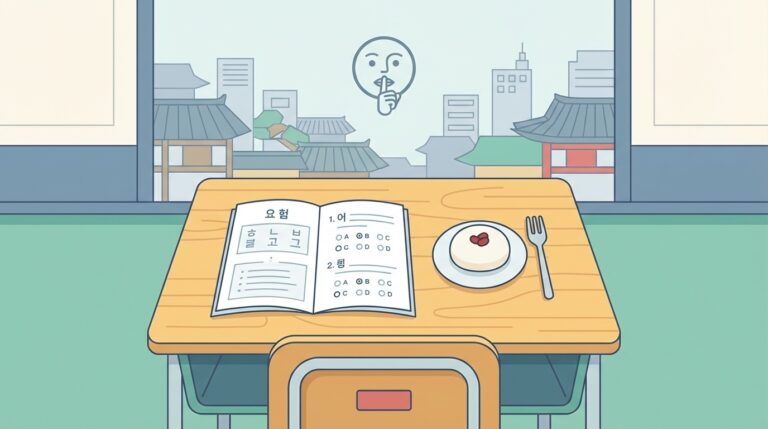
Imagine this scene from a K-Drama: The entire city of Seoul seems to hold its breath. Stock markets open an hour late. Offices delay their start times. Even airplanes are grounded for 35 minutes during the English listening test so engine noise doesn’t distract anyone. Suddenly, a police motorcycle siren wails, weaving through traffic not to catch a criminal, but to escort a high school student who is running late.
Is this a national emergency? No. It’s the Suneung (수능), or the College Scholastic Ability Test (CSAT).
If you’ve watched dramas like Sky Castle or Reply 1988, you know this isn’t just a test; it’s a cultural phenomenon that defines the transition to adulthood in Korea. Today, we aren’t just learning words; we are stepping into the most intense day of a Korean student’s life. Understanding this will help you understand the “Education Fever” that powers modern Korea.
Phase 2: Deep Dive into Key Expressions
Here are the phrases you need to know to survive—or support someone during—exam season.
1. 수능 대박나세요 (Suneung Daebak-naseyo)
- Pronunciation: [Suneung Daebak-naseyo] + (Sounds like: Su-neung Day-bak nah-seh-yo)
- Meaning: Literal: “Have a big hit on the Suneung.” | Real Nuance: “I hope you get an incredible score (better than expected)!”
- K-Culture Moment: You’ll see banners with this phrase hanging outside every high school in November. It’s the ultimate wish for a miracle.
- Editor’s Insight: ‘Daebak’ (대박) originally meant a great success or a jackpot. Adding it to Suneung means you want them to hit the jackpot of life.
- Situation Spectrum:
[🚫 Boss] ———— [⚠️ Colleague] ———— [✅ Everyone Else]
(Actually, this is safe to say to almost any student, regardless of politeness level, as it is a blessing.)- 🤔 Think About It: Why do Koreans use the word “Jackpot” for a test? Does it imply that success is based on luck, or that the reward is life-changing money?
2. 찰싹 붙어라 (Chalssak buteora)
- Pronunciation: [Chalssak buteora] + (Sounds like: Chal-sak boo-tuh-rah)
- Meaning: Literal: “Stick tightly.” | Real Nuance: “Pass the exam!” (In Korean, passing an exam is expressed as ‘sticking’ to it.)
- K-Culture Moment: This is why people give Yeot (Korean taffy) or Chapssaltteok (Sticky rice cakes/Mochi) as gifts. The food is sticky, symbolizing the wish that the student “sticks” to the university of their choice.
- Editor’s Insight: This is a fun, superstitious phrase. Conversely, you should never eat Miyeok-guk (Seaweed soup) on exam day because it is slippery, and you might “slip” (fail).
- Situation Spectrum:
[🚫 Formal Speech] ———— [⚠️ Semi-formal] ———— [✅ Casual]
(Best used among family and close friends.)- 🤔 Think About It: Does your culture have foods you must eat or avoid before a big event?
3. 잘 찍어! (Jal jjigeo!)
- Pronunciation: [Jal jjigeo] + (Sounds like: Jal jee-guh)
- Meaning: Literal: “Spear/Pick well!” | Real Nuance: “Guess the answers correctly!”
- K-Culture Moment: Friends often give forks as gifts. Why? Because you use a fork to jjikda (stab/pick up) food. It’s a pun wishing them luck on questions they don’t know.
- Editor’s Insight: This is witty and relieves tension. It acknowledges that sometimes, hard work isn’t enough—you need a little luck with guessing too.
- Situation Spectrum:
[🚫 Elders] ———— [⚠️ Strangers] ———— [✅ Friends/Juniors]- 🤔 Think About It: Why is admitting that you might have to “guess” considered an encouragement rather than an insult in Korea?
Phase 3: Textbook vs. Real Life
| Situation | 📖 Textbook Korean | 🗣️ Real Korean | 💡 Why the difference? |
|---|---|---|---|
| Encouraging | 시험 잘 보세요. (Take the test well.) |
긴장하지 말고 평소대로 해! (Don’t be nervous, just do as usual!) |
“Test well” is too generic. Real comfort focuses on reducing anxiety (nerves). |
| Cheering | 합격을 기원합니다. (I pray for your pass.) |
찰떡같이 붙어라! (Stick like a sticky rice cake!) |
Using imagery (sticky rice cake) adds emotional warmth and cultural humor. |
| Asking Result | 시험 결과가 어때요? (How is the test result?) |
(Silence / Don’t ask) | Nunchi! Unless they tell you first, asking about Suneung scores is a taboo immediately after the test. |
💡 Editor’s Note: For B2 learners, remember that silence is also a form of language in Korea. If a student looks down, don’t ask “Did you do well?” Just say, “You worked hard” (수고했어).
Phase 4: Cultural Deep Dive — The Power of Objects
4-1. The Symbolism of Gifts
In the West, you might say “Good Luck.” In Korea, we give objects that represent the action we want the student to take.
– Toilet Paper: Because it unrolls easily (pulda). In Korean, “solving” a problem is also pulda. We want the questions to “unroll” easily like tissue.
– Mirror: To see well (boda). Taking a test is siheomeul boda. So, see (take) the test well!
4-2. The “Nunchi” of November
If you are traveling in Korea on the third Thursday of November (Suneung Day):
– Don’t honk your horn near schools.
– Don’t make loud noises in cafes during the day; many students who aren’t taking the test might be studying nearby.
– It is a day of collective anxiety and support. Being quiet is a sign of respect.
Phase 5: Immersive Roleplay
Setting: It is the night before Suneung. You are at a bakery with your Korean friend, Jisoo (28, female). She is buying Chapssaltteok (Sticky rice cakes) for her younger brother who is taking the test tomorrow.
Jisoo: (Sighs) 내 동생, 내일 수능이라 너무 떨려 하네. 잠도 못 자는 것 같아.
(Nae dongsaeng, naeil suneungira neomu tteollyeo hane. Jamdo mot janeun geot gata.)
(Translation: My little brother is so nervous because Suneung is tomorrow. I don’t think he can even sleep.)
YOU: (Looking at the rice cakes)
아, 그래서 찹쌀떡 사는 거야?
(Ah, geuraeseo chapssaltteok saneun geoya?)
(Translation: Ah, is that why you’re buying sticky rice cakes?)
Jisoo: 응. 이거 먹고 찰싹 붙었으면 좋겠어. 너도 한마디 해줄래?
(Eung. Igeo meokgo chalssak buteosseumyeon jukesseo. Neodo hanmadi haejullae?)
(Translation: Yeah. I hope he eats this and “sticks” (passes). Do you want to say something to him too?)
🔀 Decision Point: What do you write on the card?
- A) “시험 잘 봐! 파이팅!” (Standard & Safe)
- B) “모르는 건 잘 찍어! 대박 나!” (Witty & Fun)
- C) “재수 없길 바라!” (High Risk Pun)
✅ Best Choice: B — For a younger brother of a friend, being witty relieves pressure. “Guess well” is a classic funny encouragement.
⚠️ Choice C Analysis: “재수 없다” usually means “bad luck” or “jerk,” but in exam context, it means “No retaking (Re-study).” It’s a clever pun, but if misunderstood, it sounds like “I hope you have bad luck!” Use with caution!
YOU (Choosing B): 그래! “모르는 건 잘 찍어! 수능 대박!”이라고 쓸게.
(Geurae! “Moreuneun geon jal jjigeo! Suneung daebak!”-irago sseulge.)
(Translation: Okay! I’ll write “Guess the unknown ones well! Suneung Jackpot!”)
Phase 6: 10-Second Shadowing Drill
Let’s practice the most comforting phrase you can say to a student after the exam.
Sentiments: 😊 Warmly & Softly
Sentence: 결과는 / 신경 쓰지 말고 / 푹 쉬어.
Romanization: Gyeolgwa-neun / singyeong sseuji malgo / puk swieo.
Meaning: Don’t worry about the results, and just rest deeply.
Phase 7: K-Culture Mini Glossary
| Korean | Romanization | Meaning | Context |
|---|---|---|---|
| 고3 | Gosam | High school senior | The most stressed demographic in Korea. Often called “Zombies” due to lack of sleep. |
| 재수 | Jaesu | Studying again | Spending another year to retake the Suneung. (Jaesu-saeng = Retaker). |
| 야자 | Yaja | Night Self-Study | Short for Yagan Jayeul Hakseup. Staying at school until 10 PM to study. |
| 스카 | Seuka | Study Cafe | Short for Study Cafe. Premium libraries where students live. |
Phase 8: Traveler’s Survival Kit (Exam Day Edition)
If you visit Korea in mid-November, you might encounter this day.
🆘 Survival Phrase #1
– 🇰🇷 “오늘 수능 날이에요?” (Oneul suneung narieyo?)
– 🗣️ Pronunciation: [Oh-neul su-neung nal-ee-eh-yo?]
– 📍 Use here: When the subway is crowded with students or shops open late.
– 💡 Pro Tip: On Suneung day, banks and public offices often open at 10:00 AM instead of 9:00 AM to clear traffic for students.📌 Editor’s Travel Note
– Police Escorts: Don’t be alarmed if you see police cars with sirens on carrying high schoolers. They are offering free rides to late students!
– Discounts: After the exam, many stores offer “Suneung Discounts” (수험표 할인). If you have a friend who took the test, tag along—sometimes they give discounts to the companion too!
Phase 9: Think Deeper — “One Shot, One Kill?”
Topic: Social Hierarchy & The Exam
Why is Suneung so intense? In many Western countries, college admission is holistic (grades, essays, activities). In Korea, while changing slowly, the Suneung score is still the dominant factor. It is often seen as the “fair” equalizer—everyone takes the same test on the same day. However, this creates a “One Shot, One Kill” culture. One mistake on one day can force a student to wait a whole year to try again (Jaesu).
🧠 Think Deeper:
Does a single test score fairly represent a person’s potential? In your country, is the university name as important as it is in Korea (where ‘SKY’ universities are considered the golden ticket)?💬 Your Turn: How do students in your country celebrate finishing high school exams? Share in the comments!
Phase 10: FAQ & Troubleshooting
Q: Can I give chocolate to a test taker?
A: Yes! Chocolate helps with brain function. But Sticky Rice Cake (Chapssaltteok) or Taffy (Yeot) is better for the cultural “sticking” meaning.
Q: My Korean friend failed the exam. What do I say?
A: Do not say: “It’s okay, try again.” (Too easy to say for an outsider).
Say: “고생 많았어. 맛있는 거 먹으러 가자.” (You suffered/worked hard. Let’s go eat something delicious.) Food is the best healer in Korea.
❌ Common Mistake:
Don’t joke about the exam day to a Gosam (senior). Even if you are close, their stress level is beyond imagination. Keep it supportive, not teasing.
Phase 11: Wrap-up & Mission
One-Liner: Suneung is more than a test; it’s a national event of support, silence, and sticky rice cakes.
🔥 Action Missions:
– 🥉 Bronze: Look in the mirror and say “수능 대박!” (Suneung Daebak!) to cheer for your own daily goals.
– 🥈 Silver: Watch a clip of “Suneung police escort” on YouTube. It’s fascinating!
– 🥇 Gold: Visit a Korean bakery and ask for “Chapssaltteok” (Sticky rice cake). Taste the texture of “passing”!
Phase 12: Interactive Quiz
- Which gift should you avoid giving on exam day?
- A) Fork (To pick answers)
- B) Toilet Paper (To solve easily)
- C) Seaweed Soup (Miyeok-guk)
- D) Sticky Rice Cake
- What does “Jal Jjigeo” mean in the context of an exam?
- A) Take a good photo.
- B) Guess the answer well.
- C) Sleep well.
- True or False (Culture):
- Planes are grounded in Korea during the English listening portion of the Suneung. (T/F)
🔑 Answers:
1. C (Because it is slippery, implying you will fail/slip.)
2. B (It implies luck on difficult questions.)
3. True (Silence is mandatory for about 35 minutes nationwide!)
Frequently Asked Questions (FAQ)
Q: What does "수능 대박나세요 (Suneung Daebak-naseyo)" mean in Korean and how do you pronounce it?
A: In Korean, "수능 대박나세요 (Suneung Daebak-naseyo)" is pronounced [Suneung Daebak-naseyo] and means: Literal: "Have a big hit on the Suneung." | Real Nuance: "I hope you get an incredible score (better than expected)!"
Q: What does "찰싹 붙어라 (Chalssak buteora)" mean in Korean and how do you pronounce it?
A: In Korean, "찰싹 붙어라 (Chalssak buteora)" is pronounced [Chalssak buteora] and means: Literal: "Stick tightly." | Real Nuance: "Pass the exam!" (In Korean, passing an exam is expressed as 'sticking' to it.)
Q: What does "잘 찍어! (Jal jjigeo!)" mean in Korean and how do you pronounce it?
A: In Korean, "잘 찍어! (Jal jjigeo!)" is pronounced [Jal jjigeo] and means: Literal: "Spear/Pick well!" | Real Nuance: "Guess the answers correctly!"







