

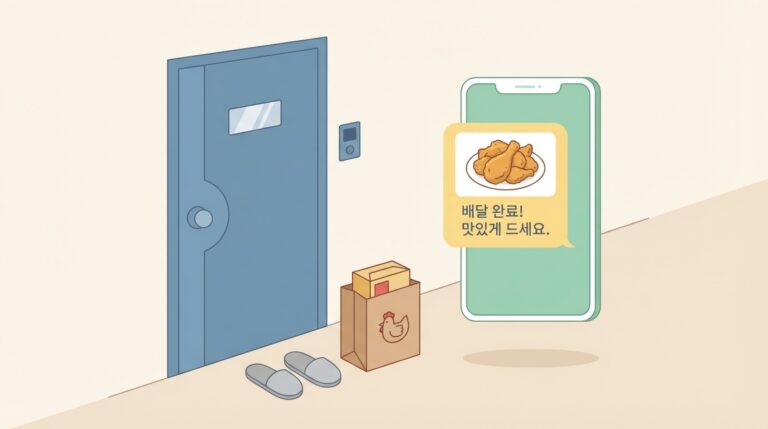
Phase 1: Immersive Hook — The “Pajama Panic”
Hello! This is your Daily Hangul Editor. 👋
Picture this: It’s Friday night. You’ve had a long week. You are wearing your most comfortable (and arguably ugliest) pajamas, your hair is a mess, and you are binge-watching your favorite K-Drama on Netflix. Suddenly, you hear the sound of a motorcycle engine outside, followed by the terrifying DING-DONG! 🔔
It’s your fried chicken delivery.
In a K-Drama, the main character might panic, hide behind the sofa, or frantically try to fix their hair in 3 seconds. But in real life Seoul? We don’t panic. We use the magic of “Non-face-to-face Receipt” (비대면 수령).
Today, I will teach you the survival phrases to get your food safely without ever having to make awkward eye contact or show your messy hair to the delivery rider. Let’s master the art of the “Ghost Delivery”! 👻🍗
Phase 2: Deep Dive — 3 Key Expressions
1. 문 앞에 놔주세요 (Please leave it in front of the door)
- Pronunciation:
Mun-ape nwajuseyo- Mun (Moon 🌕) + ap (App 📱) + e (Eh) + nwa (Noir 🎞️) + ju-se-yo
- Meaning:
- Literal: Please put (it) in front of the door.
- Real Nuance: “Just drop it off at the door (so I don’t have to open it right now).”
- K-Culture Moment: You will see this option as a checkbox in every Korean delivery app (Baedal Minjok, Yogiyo). It is the default mode for modern Koreans who value privacy.
- Editor’s Insight: This is the polite standard. You aren’t being rude; you are being efficient! The rider actually prefers this because it saves them time.
- Situation Spectrum:
[🚫 Formal Boss] ———— [✅ Rider/Stranger] ———— [✅ Friend]- (You use this with delivery riders, regardless of age)
- 🤔 Think About It: In some countries, leaving food on the floor is considered rude or dirty. In Korea, it’s considered considerate and safe. Why do you think that is?
2. 벨 누르지 말아 주세요 (Please don’t ring the bell)
- Pronunciation:
Bel nureuji mara juseyo- Bel (Bell 🔔) + nu-reu-ji (New-lu-gee) + ma-ra (Ma-la 🌶️) + ju-se-yo
- Meaning: Please do not press the bell.
- K-Culture Moment: Imagine a K-Pop idol doing a live stream (V-Live) in their dorm. They order food but don’t want the loud bell to interrupt the broadcast. They would write this in the request box!
- Editor’s Insight: Use this if you have a sleeping baby, a barking dog, or if you are secretly eating a late-night snack (Ya-sik) and don’t want your roommates/parents to know. 🤫
3. 두고 가시면 돼요 (You can just leave it and go)
- Pronunciation:
Dugo gasimyeon dwaeyo - Meaning: It is okay if you leave it and go.
- Editor’s Insight: Use this specifically when the rider calls you or speaks through the intercom (interphone). It sounds softer than a command. It means, “No need to wait for me to open the door, you are free to go!”
- Situation Spectrum:
[🚫 Very Formal] ———— [✅ Polite/Standard] ———— [⚠️ Casual]
Phase 3: Textbook vs. Real Life
| Situation | 📖 Textbook Korean | 🗣️ Real Korean (App/Notes) | 💡 Why different? |
|---|---|---|---|
| Requesting drop-off | 물건을 문 앞에 놓아 주십시오. (Please place the item…) | 문 앞에 놔주세요. (Leave it at door.) | Textbook is too stiff. Apps use polite but short phrases. |
| Avoiding the bell | 초인종을 누르지 마십시오. (Do not press the doorbell.) | 벨 X / 노크해주세요. (Bell X / Knock pls) | In delivery requests, shorter is better for the rider to read quickly while driving. |
| Confirmation | 제가 음식을 받으러 나가겠습니다. (I will go out to receive food.) | (Just checking the photo) | In reality, we don’t speak. The rider sends a photo proof! |
Bottom Note: When typing in a delivery app request box, you can be concise. “문 앞 O, 벨 X” (Door OK, Bell No) is perfectly understood by riders!
Phase 4: Cultural Deep Dive — The “Trust” Delivery
4-1. The “Photo Verification” (인증샷)
When you ask for “Non-face-to-face” (비대면), the rider won’t just leave. They will take a picture of the food in front of your door and send it to you via text or the app.
* Non-verbal Tip: You do not need to reply to this text with “Thank you.” It is an automated system confirmation.
4-2. K-Culture Connection: The “CCTV” Effect 📹
In many countries, leaving a $30 chicken set on a public hallway floor is a recipe for theft. In Korea, packages and food sit in front of doors for hours (sometimes days!) untouched.
* Why? Korea has one of the highest densities of CCTV cameras, and a strong culture of “social tracking.”
* K-Drama Context: Notice how in thrillers, the police always check the “Black Box” (dashcam) or CCTV? That is real life. If someone steals your chicken, they will be caught. This high-trust environment makes non-face-to-face delivery possible.
Phase 5: Immersive Roleplay
Scenario: It is 11:00 PM on a Friday. You are at a strictly “Quiet Zone” guesthouse. You ordered Tteokbokki (Spicy Rice Cakes). The intercom rings.
Characters:
* YOU: Hungry traveler in pajamas.
* Rider: Busy delivery driver (via Intercom).
Dialogue:
Rider: (Through Intercom) 배달 왔습니다~ 🛵
(Baedal wat-seumnida~)
[Delivery has arrived!]
YOU: 아, 네! 감사합니다.
(Ah, ne! Gamsahamnida.)
[Ah, yes! Thank you.]
Rider: 문 열어 주시겠어요?
(Mun yeoreo jusigesseoyo?)
[Could you open the door?]
🔀 Decision Point: How do you respond?
- A) “네, 잠시만요!” (Open door and meet him)
- B) “그냥 문 앞에 놔주세요.”
- C) “싫어요!” (No!)
✅ Best Choice: B — You want to respect the quiet hours and stay in pajamas.
Dialogue Continues (Option B):
YOU: 죄송한데, 그냥 문 앞에 놔주세요. 🤫
(Joesonghande, geunyang mun-ape nwajuseyo.)
[I’m sorry, but please just leave it in front of the door.]
Rider: 아, 네 알겠습니다. 맛있게 드세요!
(Ah, ne algesseumnida. Masitge deuseyo!)
[Ah, understood. Enjoy your meal!]
Phase 6: 10-Second Shadowing Drill
Repeat after the guide. Pay attention to the emotion!
- Polite Request: 😊
문 앞에 / 놔주세요.
(Mun-ape / nwajuseyo.) -
Urgent Whisper (Baby is sleeping!): 🤫
벨 / 누르지 / 마세요!
(Bel / nureuji / maseyo!) -
Friendly confirmation: 😉
두고 / 가시면 / 돼요.
(Dugo / gasimyeon / dwaeyo.)
Phase 7: K-Culture Mini Glossary
| Korean | Romanization | Meaning | Context |
|---|---|---|---|
| 비대면 | Bidaemyeon | Non-face-to-face | The keyword to look for in apps or banking. |
| 배달비 | Baedal-bi | Delivery Fee | The extra charge you pay. It varies by distance. |
| 리뷰 이벤트 | Ribyu Event | Review Event | Free food (like a soda) if you promise to write a review! 🎁 |
| 라이더 | La-i-deo | Rider | We call delivery persons “Riders.” |
Phase 8: Traveler’s Survival Kit — Hotel Edition 🏨
If you are staying at a Hotel or Airbnb, delivery works differently.
🆘 Survival Phrases #1
* 🇰🇷 “로비에 맡겨 주세요.” (Lobie matgyeo juseyo)
* 🗣️ Sound: Lob-ee-eh mat-gyeo ju-seh-yo
* Meaning: Please leave it at the lobby.
* Why: Most Korean hotels do not allow riders to go up to guest floors for security. You must go down to the lobby to pick it up.📌 Editor’s Travel Note
* App Tip: If you can’t use Korean apps (Baedal Minjok) because you don’t have a Korean number, use “Shuttle Delivery” or “Uber Eats” (limited areas). Or, ask the hotel concierge to order for you (Chimaek is a must!).
Phase 9: Think Deeper — “Trust vs. Convenience”
🧠 Think About It:
Korea’s delivery culture is famous for its speed (“Pali-pali” culture) and the “Doorstep Drop-off.”
In many Western countries, leaving food unattended is unthinkable due to “Porch Pirates” (thieves). In Korea, the package is safer than the person leaving it!
Does this system rely more on technology (CCTV/Apps) or social morality (shame/honesty)? How would this system work in your home country?
Phase 10: FAQ & Troubleshooting
Q: Do I need to tip the rider?
A: NO! 🙅♂️ There is absolutely no tipping culture in Korea. The delivery fee (배달비) is already included in your payment. If you try to give cash, the rider might be confused or refuse. Just say “Gamsahamnida” (Thank you).
Q: Can I ask them to knock instead of ringing the bell?
A: Yes! You can write “벨 대신 노크해주세요” (Bel daesin nokeu-haejuseyo – Please knock instead of bell).
❌ Common Mistake:
* Mistake: Opening the door while the rider is taking the “Proof Photo.”
* Fix: Wait until you hear the footsteps leave or receive the text message. Opening the door suddenly can startle the rider (and ruin their photo!).
Phase 11: Wrap-up & Action Items
One-Liner: To get delivery like a local, just say “Mun-ape nwajuseyo” and enjoy your privacy!
🎯 Action Missions:
* 🥉 Bronze: Say “Mun-ape nwajuseyo” out loud 3 times right now.
* 🥈 Silver: Go to a Korean delivery app (or Google Images of one) and find the checkbox that says “문 앞에 두고 가기” (Leave at door).
* 🥇 Gold: Order food in Korea (or a Korean restaurant in your city) and try to use a non-contact method or write a note!
K-Culture Mission: Watch a K-Drama scene where they eat fried chicken or Jajangmyeon. Do they pay at the door, or was it already paid for? Spot the difference!
Phase 12: Quiz — Interactive Challenge
1. Situation Judgment:
Your baby has finally fallen asleep after 2 hours of crying. You ordered pizza. What request should you write?
* A) 문 앞에 놔주시고 벨 눌러주세요. (Leave at door and ring bell.)
* B) 직접 받을게요. (I will receive it personally.)
* C) 문 앞에 놔주시고 벨 누르지 마세요. (Leave at door and DO NOT ring bell.)
2. True or False:
* In Korea, you must tip the delivery rider at least 10%. (T/F)
3. Fill in the Blank:
Rider on Intercom: “Delivery is here!”
You: “Ne! Just leave it and go.” -> “네! _____ 가시면 돼요.”
Answers:
1. C (A will wake the baby!)
2. False (No tipping!)
3. 두고 (Dugo)
Frequently Asked Questions (FAQ)
Q: What does "문 앞에 놔주세요 (Please leave it in front of the door)" mean in Korean and how do you pronounce it?
A: In Korean, "문 앞에 놔주세요 (Please leave it in front of the door)" is pronounced [Mun-ape nwajuseyo] and means: a key conversational Korean expression covered in this lesson.
Q: What does "벨 누르지 말아 주세요 (Please don't ring the bell)" mean in Korean and how do you pronounce it?
A: In Korean, "벨 누르지 말아 주세요 (Please don't ring the bell)" is pronounced [Bel nureuji mara juseyo] and means: a key conversational Korean expression covered in this lesson.
Q: What does "두고 가시면 돼요 (You can just leave it and go)" mean in Korean and how do you pronounce it?
A: In Korean, "두고 가시면 돼요 (You can just leave it and go)" is pronounced [Dugo gasimyeon dwaeyo] and means: It is okay if you leave it and go.







