

Phase 1: Immersive Hook
Hello! I am the Daily Hangul Editor, your local cultural navigator and veteran tutor. 😊
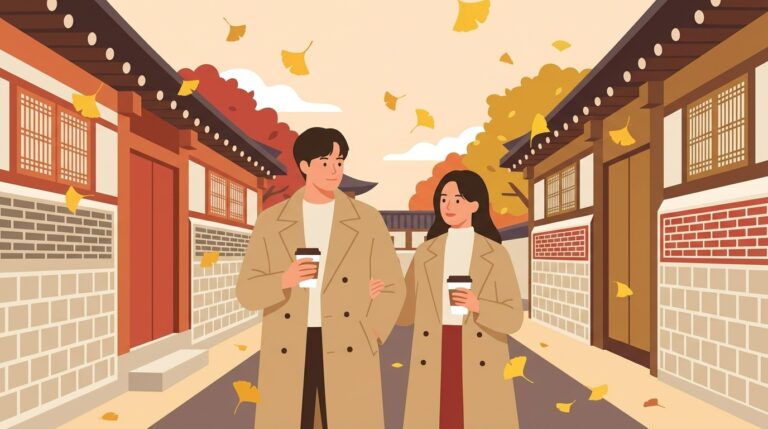
Picture this: You are watching a classic K-Drama. The camera pans down a beautiful street in Seoul lined with yellow ginkgo trees. The handsome male lead is walking gracefully, the autumn breeze rustling his stylish beige trench coat. It looks incredibly romantic, doesn’t it?
But if you step into the real streets of Seoul in mid-October, you will witness a fascinating, unspoken psychological battle happening among Koreans. We call it the ‘Trench Coat Nunchi Game’ (트렌치코트 눈치게임).
Autumn in Korea is gorgeous, but the weather is notoriously tricky. If you step out in a t-shirt, you will freeze by sunset. If you wear a thick coat too early, you will sweat during lunch and people might stare. Knowing exactly when and how to talk about this changing weather will not only save you from catching a cold, but it will also instantly elevate your Korean from “textbook learner” to “local insider.”
Let’s dive into the essential autumn phrases you need, based on real questions from my B1 students! 🍂
Phase 2: Deep Dive into Core Expressions
1. 일교차가 커요 (The temperature difference is big)
- Pronunciation: ilgyochaga keoyo (eel-gyo-cha-ga kuh-yo)
- Meaning: Literal: “The daily temperature range is big.” / Real nuance: “It’s warm during the day but freezing at night, so dress in layers!”
- K-Culture Moment: This is the absolute #1 small-talk phrase in Korean offices during autumn. If you get into an elevator with your boss in October, saying “요즘 일교차가 참 크네요” (The temperature difference is really big lately) is the safest, most polite icebreaker.
- Editor’s Insight: English speakers usually just say “The weather is crazy” or “It gets cold at night.” But Koreans love using this specific pseudo-scientific term (일교차) in daily conversation.
- Situation Spectrum:
[🚫 절대 금지] ———— [⚠️ 주의] ———— [✅ 자유롭게]
- Casual (Friends): ✅ (Usually as “일교차 진짜 크다”)
- Semi-formal (Co-workers): ✅
- Formal (Boss/Elders): ✅ (Add ~요 or ~네요)
- 🤔 Think About It: Why do Koreans use such a formal-sounding word (일교차) in everyday chats? It shows how sensitive Korean culture is to seasonal changes and collective health. Does your culture have a specific word for this autumn weather phenomenon?
2. 쌀쌀해졌어요 (It has gotten chilly)
- Pronunciation: ssalssalhaejyeosseoyo (ssal-ssal-heh-jyeot-suh-yo)
- Meaning: Literal: “It became chilly.” / Real nuance: “It’s not freezing winter cold yet, but there’s a bite in the air.”
- K-Culture Moment: You are at an outdoor Pojangmacha (tent bar) eating spicy tteokbokki. A sudden gust of wind hits, and your friend rubs their arms and says, “아, 갑자기 쌀쌀해졌네” (Ah, it suddenly got chilly).
- Editor’s Insight: Pronouncing ‘ㅆ’ (ss) sounds like the hissing sound of a cold wind! Don’t say “추워요” (It’s cold) in early October, or Koreans will tease you: “벌써 춥다고요? 겨울엔 어떡하려고요!” (You’re cold already? What will you do in winter!)
- Situation Spectrum:
[🚫 절대 금지] ———— [⚠️ 주의] ———— [✅ 자유롭게]
- Casual: ✅
- Semi-formal: ✅
- Formal: ✅
- 🤔 Think About It: Notice the “~아/어지다” (to become) grammar here. Koreans focus a lot on the transition of states. It’s not just chilly; it became chilly.
3. 겉옷 챙기세요 (Make sure to bring outerwear)
- Pronunciation: geot-ot chaenggiseyo (guht-ot cheng-gi-seh-yo)
- Meaning: Literal: “Pack/prepare your outer clothes.” / Real nuance: “Take a jacket with you so you don’t catch a cold.”
- K-Culture Moment: This is the ultimate phrase of Korean affection (정 – Jeong). When your K-Drama crush texts you before your evening date, they won’t say “I love you.” They will text: “밤엔 쌀쌀하니까 겉옷 꼭 챙겨요.” (It’s chilly at night, so make sure to bring a jacket.)
- Editor’s Insight: The verb ‘챙기다’ is magical. It means to pack, prepare, or take care of something. It shows you are looking out for the other person’s well-being.
- Situation Spectrum:
[🚫 절대 금지] ———— [⚠️ 주의] ———— [✅ 자유롭게]
- Casual: ✅ (겉옷 챙겨!)
- Semi-formal: ✅
- Formal: ⚠️ (To a boss, use “겉옷 챙기셔야 할 것 같습니다” to be extremely polite)
- 🤔 Think About It: Expressing care through physical well-being (weather, eating food) is a core part of Korean communication. How do you show casual affection in your language?
Phase 3: Textbook vs Real Life
| Situation | 📖 Textbook Korean | 🗣️ Real Korean | 💡 Why is it different? |
|---|---|---|---|
| Commenting on autumn weather | 가을에는 날씨가 춥습니다. (It is cold in autumn.) | 아침저녁으로 쌀쌀해요. (It’s chilly in the morning and evening.) | “추워요” is reserved for actual winter. “쌀쌀해요” captures the crisp autumn breeze perfectly. |
| Telling someone to bring a jacket | 외투를 입으세요. (Wear a coat.) | 겉옷 챙기세요. (Bring some outerwear.) | ‘외투’ sounds very formal and heavy. ‘겉옷’ (outer clothing) + ‘챙기다’ (to take care/pack) sounds much more natural and affectionate. |
| Trying to decide what to wear | 무슨 옷을 입을까요? (What clothes should I wear?) | 트렌치코트 눈치게임 시작됐어요. (The trench coat nunchi game has started.) | Real life relies on slang! Koreans jokingly treat dressing for tricky weather as a strategic mind game. |
Phase 4: Cultural Deep Dive
4-1. Non-verbal Communication: The “Nunchi” Shiver
When saying “쌀쌀해요,” do not just stand still! To sound like a true Korean, lightly rub your upper arms with your hands and slightly shrug your shoulders. This physical expression of feeling the chill adds 100% authenticity to your Korean. Also, when playing the ‘Trench Coat Nunchi Game’, look around on the subway. If you are the only one wearing a trench coat, your nunchi failed!
4-2. K-Culture Connection: The Shared Jacket Trope
You have definitely seen this in K-Dramas. The main couple is walking home from a dinner date. The female lead shivers slightly. The male lead immediately takes off his jacket/trench coat and drapes it over her shoulders, saying, “일교차가 크다니까요. 감기 걸려요.” (I told you the temperature difference is big. You’ll catch a cold.)
Critical View: While this is romantic on screen, in reality, if a guy gives you his only jacket in late autumn, he will probably be freezing and miserable! Also, in everyday life, modern Koreans just check the weather app and prepare their own geot-ot (outerwear). But the underlying culture of showing care through warmth remains a strong part of Korean social dynamics.
Phase 5: Immersive Roleplay
Scenario A: Hangang Park Picnic (The Nunchi Game in Action)
Setting: Friday evening, 6:30 PM. Yeouido Hangang Park. The autumn sunset is beautiful, but the wind blowing off the river is surprisingly sharp. You are sitting on a picnic mat, eating fried chicken with your Korean colleague.
Characters:
– YOU: A foreign professional working in Seoul, wearing just a light long-sleeve shirt.
– Min-su: (32, your friendly Korean co-worker, wearing a cozy cardigan.)
Dialogue:
민수: 야, 해 지니까 바람이 확 달라지네요. 🌬️
(Ya, hae jinikka barami hwak dallajineyo.)
[Wow, the wind completely changes now that the sun is setting.]
YOU: 맞아요. 낮에는 진짜 더웠는데…
(Majayo. Najeneun jinjja deowonneunde…)
[You’re right. It was really hot during the day, but…]
민수: 요즘 일교차가 커서 그래요.
(Yojeum ilgyochaga keoseo geuraeyo.)
[It’s because the daily temperature difference is big lately.]
(🎭 Stage Direction: Min-su zips up his cardigan and looks at you shivering)
민수: 겉옷 안 챙겨왔어요? 감기 걸리겠는데?
(Geot-ot an chaenggyeowasseoyo? Gamgi geolligenneunde?)
[Didn’t you bring a jacket? You might catch a cold?]
🔀 Your Turn! How will you respond?
– A) “네, 날씨가 매우 춥습니다.” (Yes, the weather is very cold.)
– B) “아, 괜찮아요! 아직 트렌치코트 눈치게임 중이라서 겉옷을 안 챙겼어요!”
– C) “진짜 얼어 죽을 것 같아요! 살려주세요!”✅ Best Choice: B — Why? This is the ultimate witty insider response! You are acknowledging your mistake but blaming it humorously on the cultural “nunchi game” of not wanting to be the first one to wear a coat. Min-su will definitely laugh out loud.
⚠️ Choice C Analysis: “얼어 죽을 것 같아요” (I feel like I’ll freeze to death) is very natural and funny among close friends, but a bit too dramatic for a semi-formal office colleague.
Scenario B: Bonus K-Pop Fanmeeting Roleplay
Imagine you are at a fan-call or outdoor fan event in October. Your favorite idol looks worried because fans are standing in the cold.
Idol: 여러분, 밖에서 오래 기다렸죠? 안 추워요?
(Everyone, you waited outside for a long time, right? Aren’t you cold?)
YOU: 쪼~금 쌀쌀해요! 오빠도(언니도) 겉옷 꼭 챙겨 입어요!
(Just a little chilly! Make sure you wear your outerwear too!)
Idol: 감동… 네, 저도 챙겨 입을게요. 감기 조심해요!
(Touched… Yes, I will wear it too. Be careful not to catch a cold!)
Phase 6: 10-Second Shadowing Drill
Let’s practice saying this with the right Korean intonation! Follow the pauses (/) and the emotion tags.
🥺 걱정스럽게 (Worriedly)
요즘 / 일교차가 / 너무 커요. (yojeum / ilgyochaga / neomu keoyo)
😊 다정하게 (Affectionately)
밤에는 / 쌀쌀하니까 / 겉옷 / 꼭 챙기세요! (bameneun / ssalssalhanikka / geot-ot / kkok chaenggiseyo!)
Phase 7: K-Culture Glossary (Autumn Edition)
| 한국어 | Romanization | English | Context |
|---|---|---|---|
| 눈치게임 | nunchigeim | Nunchi Game | The psychological game of observing others before making a move (e.g., deciding when to wear a trench coat or turn on the heater). |
| 환절기 | hwanjeolgi | Change of seasons | The transitional period between seasons. You will hear “환절기 감기 조심하세요” (Beware of seasonal colds) everywhere. |
| 가을 타다 | gaeul tada | Feeling autumn-y | Feeling unusually sentimental, lonely, or melancholic because of the autumn atmosphere. |
| 단풍 | danpung | Autumn foliage | The beautiful red and yellow autumn leaves. Koreans love going on “단풍놀이” (autumn leaf viewing trips). |
Phase 8: Traveler’s Survival Kit
If you are traveling to Korea in October or November, navigating the “Trench Coat Nunchi Game” means you might need to buy an emergency jacket!
🆘 Survival Phrases for Autumn Shopping
– 🇰🇷 “이거 좀 더 두꺼운 거 있어요?” (igeo jom deo dukkeoun geo isseoyo?)
– 🗣️ English Guide: [Do you have a thicker version of this?]
– 📍 Where to use: Underground shopping malls (Gangnam, Goto Mall), SPA brands.
– 💡 Pro Tip: Korean clothing shops change their seasonal display extremely fast. By late October, summer/light clothes are gone, and heavy padded jackets (패딩) are already on display!📌 Editor’s Travel Note
– Layering is key: Seoul mornings can be 10°C (50°F), but afternoons can hit 22°C (71°F). Bring a cardigan or light trench coat that you can stuff in your tote bag.
– Weather Apps: Don’t just check the icon. Look at the “체감온도” (Feels like temperature), as Seoul’s autumn wind makes it feel colder.
Phase 9: Think Deeper — “한 발 더 깊이”
🧠 Think Deeper: Language & The Collective Mindset
Have you ever wondered why Koreans call choosing an outfit a “Nunchi Game”? In many Western cultures, fashion is highly individualistic—if you are cold, you wear a coat, regardless of what others do. However, Korea’s high-context, collectivist culture naturally makes people highly aware of their surroundings. Being the only person wearing a thick coat in early October makes many Koreans feel they stand out too much. This “Nunchi” isn’t just peer pressure; it’s a profound social radar.💬 Your Turn: Does your culture have a ‘Nunchi Game’ for seasonal clothes? Do people judge you if you wear winter boots in early Autumn? Let me know in the comments!
Phase 10: FAQ & Troubleshooting
Q: Can I just say “추워요” (It’s cold) instead of “쌀쌀해요” in October?
Yes, you can, but natives might playfully tease you! “추워요” implies winter-level freezing. If you use it in October, people might say, “엄살 부리지 마세요!” (Stop exaggerating!). Stick to “쌀쌀해요” for the perfect autumn vibe.
Q: I’m buying coffee. Can I tell the barista the weather is “일교차가 커요”?
Not usually! “일교차가 커요” is great for colleagues, friends, and acquaintances. But with a busy barista or convenience store clerk, Koreans rarely make small talk about the weather unless they are regulars. A simple “감사합니다” is best.
❌ Common Mistake: Throwing on a “롱패딩” (Long padded winter coat) in October.
✅ Do this instead: Stick to the “Trench Coat Nunchi Game.” Wear a light jacket, a cardigan, or a trench coat. Save the Long Padding for late November!
Phase 11: Wrap-up & Action Items
🎯 One-Liner Summary: Survive Korea’s tricky autumn weather by mastering the “Trench Coat Nunchi Game” and showing you care with “겉옷 챙기세요!”
Action Mission 3 Steps:
– 🥉 Bronze (Solo): Look at your jacket today and say “쌀쌀해졌어요. 겉옷 챙기세요” 3 times in front of the mirror.
– 🥈 Silver (Online): Go to your favorite K-Pop idol’s Weverse or Instagram and leave a comment: “요즘 일교차가 커요! 겉옷 꼭 챙기세요 🥺”
– 🥇 Gold (Real Life): Next time you meet your Korean friend in the evening, shiver slightly and say, “갑자기 쌀쌀해졌네요!”
🎬 K-Culture Mission: Watch any K-Drama set in autumn. I guarantee you will spot a scene where someone gives their jacket to the other person. When you see it, shout: “일교차가 커서 그래!” (It’s because the daily temperature difference is big!)
Phase 12: Interactive Quiz 🏆
1. Situational Judgment:
You are leaving the office at 7 PM in late October. The wind is biting. Your boss is waiting for the elevator with you. What is the most natural thing to say?
– A) 부장님, 오늘 날씨가 아주 춥습니다. 겨울입니다.
– B) 부장님, 요즘 일교차가 참 크네요. 겉옷 잘 챙기셨어요?
– C) 부장님, 트렌치코트 눈치게임 실패하셨네요.
Answer: B! It’s polite, references the temperature difference, and shows care. C is hilarious but will probably get you fired! 😂
2. Fill in the Blank:
“낮에는 더운데 밤에는 바람이 차가워요. 요즘 정말 (_____)가 크네요.”
– A) 겉옷
– B) 눈치게임
– C) 일교차
Answer: C (일교차 – daily temperature difference)
3. True or False – K-Culture Edition:
“Koreans always wear what they want in autumn without looking at what others are wearing.”
Answer: False! We play the Trench Coat Nunchi Game and actively check if others have started wearing fall coats before we do!
Frequently Asked Questions (FAQ)
Q: What does "일교차가 커요 (The temperature difference is big)" mean in Korean and how do you pronounce it?
A: In Korean, "일교차가 커요 (The temperature difference is big)" is pronounced [ilgyochaga keoyo (eel-gyo-cha-ga kuh-yo] and means: Literal: "The daily temperature range is big." / Real nuance: "It's warm during the day but freezing at night, so dress in layers!"
Q: What does "쌀쌀해졌어요 (It has gotten chilly)" mean in Korean and how do you pronounce it?
A: In Korean, "쌀쌀해졌어요 (It has gotten chilly)" is pronounced [ssalssalhaejyeosseoyo (ssal-ssal-heh-jyeot-suh-yo] and means: Literal: "It became chilly." / Real nuance: "It's not freezing winter cold yet, but there's a bite in the air."
Q: What does "겉옷 챙기세요 (Make sure to bring outerwear)" mean in Korean and how do you pronounce it?
A: In Korean, "겉옷 챙기세요 (Make sure to bring outerwear)" is pronounced [geot-ot chaenggiseyo (guht-ot cheng-gi-seh-yo] and means: Literal: "Pack/prepare your outer clothes." / Real nuance: "Take a jacket with you so you don't catch a cold."







