

Phase 1: The Immersive Hook
Annyeonghaseyo! This is your Daily Hangul Editor. 👋
Picture this: You’re watching a K-Drama. The male lead is stressed. Maybe he just lost the company to his evil step-brother. What happens next? Cut to the “Brooding Shower Scene.” 🚿 You know the one—water cascading over sculpted abs, deep sighs, and no soap in sight.
But here is the reality check: In real Korean life, we don’t just stand under the water thinking about our tragic pasts. We are busy scrubbing, washing, and getting ready for that skincare routine!
Today, we are diving into the Unit: Taking a Shower. Whether you are at a fancy hotel in Gangnam or a cozy guesthouse in Hongdae, you need to know how to say “I’m going to wash.” If you don’t, your Korean roommate might think you are dirty! Let’s get clean, K-style.
Phase 2: Deep Dive into Key Expressions
Here are the top 3 expressions you need to survive the bathroom battle.
1. 샤워하다 (Sya-wo-ha-da)
- Pronunciation: [Sya-wo-ha-da] -> Sounds like “Shower” + “Hada” (to do).
- Meaning: To take a shower (Literal).
- K-Culture Moment: This is the standard word. But honestly? We use the next word (#2) much more often in real life.
- Situation Spectrum:
[🚫 Formal] ———— [⚠️ Polite] ———— [✅ Casual]
(Used mostly when describing the specific act of using the shower head.)- 🤔 Think About It: Why do Koreans use the English word “Shower” combined with a Korean verb? It shows how modern housing (with standing showers) is a relatively new concept compared to the traditional bath culture.
2. 씻다 (Ssit-da)
- Pronunciation: [Ssit-da] -> The ‘Ss’ sounds like the sharp hiss of a snake 🐍 + ‘it’ + ‘da’. Make the ‘S’ sound strong!
- Meaning: To wash (Real nuance: To clean up/shower/get ready).
- Editor’s Insight: This is the Magic Word. If you say “Na ssit-eul-ge” (I’m gonna wash), it implies everything: brushing teeth, washing face, and showering. It’s much more natural than saying “I will shower.”
- Situation Spectrum:
[🚫 Formal] ———— [⚠️ Polite] ———— [✅ Casual/Daily]
- Close Friends/Family: ✅ (Everyone uses this)
3. 머리 감다 (Meo-ri gam-da)
- Pronunciation: [Meo-ri gam-da] -> “Mori” (like ‘memento mori’) + “Gam-da”.
- Meaning: To wash hair.
- K-Culture Moment: Caution! In English, you “wash” your car, your hands, and your hair. In Korean, we have a specific verb for hair: 감다 (gam-da). If you say “I’m going to ssit-da my hair,” people will understand, but you’ll sound like a cute toddler.
- 🤔 Think About It: Why is hair so special that it gets its own verb? In traditional Confucian culture, hair was considered a precious part of the body given by parents.
Phase 3: Textbook vs. Real Life
Let’s see how a robot talks vs. how a Seoulite talks.
| Situation | 📖 Textbook Korean | 🗣️ Real Korean (Insa Style) | 💡 Why different? |
|---|---|---|---|
| Telling a friend you’ll shower | 저는 샤워를 하러 갑니다. (Jeoneun syaworeul hareo gamnida.) | 나 씻고 올게! (Na ssit-go ol-ge!) | “I’m going to shower” feels like a formal announcement. “I’ll wash and come back” is natural. |
| Asking if someone washed | 샤워했어요? (Syawo-haesseoyo?) | 씻었어? (Ssit-eosseo?) | 씻다 (To wash) covers the whole routine, not just the water part. |
| After a long day | 목욕하고 싶어요. (Mogyok-hago sipeoyo.) | 지지… 찜질방 가고 싶다. (Jjimjilbang gago sipda.) | Koreans often prefer the communal sauna (Jjimjilbang) for a deep clean/relax. |
💡 Bottom Note: As a beginner (A1), just remember 씻다 (Ssit-da). It saves you in 90% of situations!
Phase 4: Cultural Deep Dive 🧖♀️
4-1. The “Sheep Head” (Yangmeori) 🐑
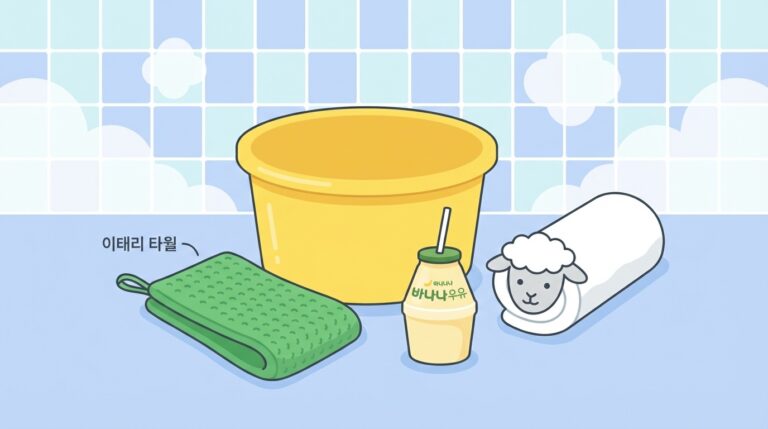
If you watch K-Dramas like My Name is Kim Sam-soon or variety shows like Running Man, you’ve seen people with towels rolled up on their heads looking like sheep. This is Yangmeori. It’s done at the Jjimjilbang (Korean Sauna) to keep sweat out of your eyes while looking cute. It’s not just a towel; it’s a fashion statement!
4-2. The “Italian Towel” Paradox
If you go to a Korean mart, you will see a green, rough scratchy towel. We call it the “Italy Towel” (이태리 타월).
- Wait, is it from Italy? No. The fabric texture was originally inspired by Italian viscose, but it is 100% a Korean invention for exfoliating dead skin.
- K-Beauty Tip: Real K-Beauty starts here. We scrub until our skin is pink and soft. It hurts a little, but the result is “Ssi-won-ha-da” (refreshing)!
Phase 5: Immersive Roleplay 🎭
Scenario: It is 9:00 PM at a guesthouse in Busan. You want to join the chicken & beer (Chimaek) party downstairs, but you need to freshen up first. Your Korean friend, Jisoo, is on her phone.
Characters:
* YOU: A traveler who feels sticky from the humidity.
* Jisoo: Your energetic Korean friend.
Ready? Action! 🎬
Jisoo: (Looking at phone) 와, 배달 왔다! 치킨 냄새 대박이야. 🍗
(Wa, baedal watda! Chicken naemsae daebakiya.)
(Wow, delivery is here! The chicken smells amazing.)
YOU (Select your response):
🔀 Decision Point:
* A) 나 샤워하고 올게! (Na syawo-hago ol-ge!) – Standard & Clear
* B) 나 먼저 씻을게! (Na meonjeo ssit-eul-ge!) – Natural & Pro
* C) I am dirty. (English) – Boring!
✅ Best Choice: B) “나 먼저 씻을게!” (I’ll wash first!)
* Why? 먼저 (Meonjeo) means “first.” In a shared bathroom situation, claiming “first” is a crucial survival skill! Also, using 씻다 sounds like you are a local.
Jisoo: 그래, 빨리 씻어! 다 먹어버린다? 😉
(Geurae, ppalli ssiseo! Da meogeo-beorinda?)
(Okay, wash fast! Or I’ll eat it all!)
Phase 6: 10-Second Shadowing Drill 🎤
Repeat after me. Don’t just read it, act it out! Imagine you are holding a towel.
- Declaring your turn:
😤 저 / 먼저 / 씻을게요! (Jeo / meonjeo / ssit-eul-ge-yo!)
(Meaning: I will wash first!) -
Feeling fresh:
😊 아, / 개운해! (Ah, / gae-un-hae!)
(Meaning: Ah, I feel refreshed!)
Tip: Say “Ah” with a long breath out, like you just drank cold water. 🥤
Phase 7: K-Culture Mini Glossary 📚
| Word | Romanization | Meaning | Context |
|---|---|---|---|
| 찜질방 | Jjimjilbang | Korean Sauna | A 24-hour bathhouse/sauna where you can sleep, eat eggs, and sweat. |
| 때수건 | Ttae-su-geon | Exfoliating Towel | That green, rough towel. “Ttae” means dirt/dead skin. |
| 온수 | On-su | Hot Water | Essential word for shower controls. |
| 냉수 | Naeng-su | Cold Water | The opposite of On-su. |
Phase 8: Traveler’s Survival Kit 🆘
Scenario: You are at your Airbnb, you turn on the shower, and… ICE COLD WATER. 🥶
🆘 Survival Expression #1
– 🇰🇷 “따뜻한 물이 안 나와요.” (Ttatteut-han muri an nawayo.)
– 🗣️ Sounds like: Ta-teut-han mool-ee an na-wa-yo.
– 📍 Use: Hotel front desk, Airbnb host chat.
– 💡 Pro Tip: In older Korean houses, you often need to turn on a “Boiler” (보일러) control panel on the wall before showering to get hot water. Look for a button that says ‘목욕’ (Bath) or ‘온수’ (Hot water).
Phase 9: Think Deeper — Language & Lifestyle 🧠
Topic: The “Evening Shower” Culture
In many Western cultures, a morning shower wakes you up. But in Korea (and much of East Asia), the evening shower is almost a ritual. Why?
Because of the “Floor Culture” (Ondol). Historically, Koreans sleep on the floor. To keep the sleeping area clean, you must wash off the dust of the outside world before entering the bedroom. Even today with beds, this mindset remains: You don’t bring the “outside dirt” into your sheets.
💬 Your Turn: Do you shower in the morning or at night? Does your language have a saying about “washing away the day”? Tell us in the comments!
Phase 10: FAQ & Troubleshooting 🛠️
- Q: Can I wear a swimsuit in a Korean bathhouse (Jjimjilbang)?
- A: NO! 🚫 In the gender-segregated wet areas, you must be completely naked. It’s scary at first, but nobody cares. It’s a judgment-free zone. (In the mixed-gender dry sauna area, you wear the provided T-shirt and shorts).
- Q: My Korean friend asked “Did you wash?” Is she saying I smell?
- A: Probably not! It’s a common way to ask “Are you ready for bed?” or “Did you get comfortable?” Don’t panic.
- ❌ Common Mistake: Using 머리 씻다 (Meori ssit-da) instead of 머리 감다 (Meori gam-da).
- Correction: While understandable, Gam-da is the proper verb for hair. It sounds much more fluent!
Phase 11: Wrap-up & Mission 🚀
Summary: Today we learned that 씻다 (Ssit-da) is the ultimate verb for getting clean, and 머리 감다 (Meori gam-da) is for hair.
🔥 Action Mission:
* 🥉 Bronze: Look in the mirror tonight and say “나 씻을게!” before you shower.
* 🥈 Silver: Watch a K-Drama scene and spot if they are wearing a “Yangmeori” (Sheep towel).
* 🥇 Gold: If you are in Korea, find the “Boiler” button in your room and successfully turn on the hot water!
Phase 12: Interactive Quiz 📝
1. Which sentence sounds most natural when telling a friend you are going to get ready?
– A) 나 머리 씻을게.
– B) 나 목욕탕 갈게.
– C) 나 씻고 올게.
2. True or False?
– You should wear a swimsuit in the wet area of a Korean Jjimjilbang. ( T / F )
Answers:
1. C) Na ssit-go ol-ge is the most common, natural phrase.
2. False! Birthday suits only in the wet area! 🙈
See you in the next lesson! 안녕! (Annyeong!)
Frequently Asked Questions (FAQ)
Q: What does "샤워하다 (Sya-wo-ha-da)" mean in Korean and how do you pronounce it?
A: In Korean, "샤워하다 (Sya-wo-ha-da)" is pronounced [Sya-wo-ha-da] and means: To take a shower (Literal).
Q: What does "씻다 (Ssit-da)" mean in Korean and how do you pronounce it?
A: In Korean, "씻다 (Ssit-da)" is pronounced [Ssit-da] and means: To wash (Real nuance: To clean up/shower/get ready).
Q: What does "머리 감다 (Meo-ri gam-da)" mean in Korean and how do you pronounce it?
A: In Korean, "머리 감다 (Meo-ri gam-da)" is pronounced [Meo-ri gam-da] and means: To wash hair.







