

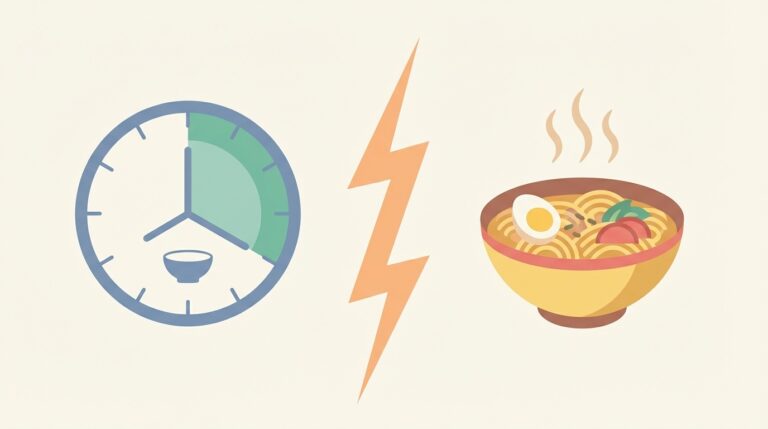
Phase 1: Immersive Hook
Hello, Daily Hangul readers! This is your Senior Editor.
Picture this: You are watching a K-Drama. The protagonist, who was previously heartbroken and disheveled, undergoes a transformation montage. They are running by the Han River, drinking only Iced Americanos, and checking their reflection in store windows. Fast forward, and they look radiant. The secret? Often, it’s portrayed as sheer willpower and “Jagi-gwalli” (Self-management, 자기관리).
But let’s step into reality. You are living in Seoul, the city that never sleeps—and apparently, never stops eating. You’re trying Intermittent Fasting (Ganheoljeok Dansik, 간헐적 단식), but your friends want to meet for Chimaek (Chicken & Beer) at 10 PM. The delivery apps are sending you push notifications for discount coupons on Tteokbokki.
Navigating a diet in Korea is a battle between the cultural obsession with slenderness and the equally powerful cultural imperative to share food. Today, we are not just learning vocabulary; we are decoding the Korean psyche regarding health, beauty standards, and the iron will required to say “No” to a midnight snack in the land of Mukbangs.
Let’s master the language of high-level health management.
Phase 2: Deep Dive Keywords
1. 공복 (Gongbok)
- Pronunciation: [Gong-bok] (Sounds like ‘Gong’ as in a bell + ‘Bok’ as in ‘book’ but with a shorter ‘o’)
- Meaning: Empty stomach (Literal) / Fasting state (Medical/Diet context)
- K-Culture Moment: In health variety shows, doctors often emphasize “Gongbok yuji” (Maintaining an empty stomach). You’ll also hear idols say, “I danced on a gongbok today,” implying they haven’t eaten to prevent bloating on camera.
- Editor’s Insight: This word carries a nuance of discipline. Doing something on a “gongbok” (like cardio) is seen as a sign of dedication. It’s not just “hungry”; it’s a physiological state you are actively maintaining.
- Situation Spectrum:
[🚫 Formal] ———— [⚠️ Semi-formal] ———— [✅ Casual](Actually, this is a neutral/medical term usable everywhere ✅) - 🤔 Think About It: Why do Koreans emphasize the state of the stomach (empty/full) so much? It reflects a culture deeply attuned to digestion and bodily sensations (think of expressions like “sok siwonhada” – inside is refreshed).
2. 급찐급빠 (Geup-jjin-geup-ppa)
- Pronunciation: [Geup-jjin-geup-ppa]
- Meaning: “Rapidly gained, rapidly lost.”
- K-Culture Moment: Monday morning office talk. “I ate too much over the weekend, so I need to do geup-jjin-geup-ppa.” This often involves intense intermittent fasting or a detox juice cleanse for 3 days.
- Editor’s Insight: This is a perfect example of Korean “Palli-Palli” (Hurry-Hurry) culture applied to biology. It reflects the belief that weight gained recently hasn’t “settled” yet and can be removed quickly if acted upon immediately.
- Situation Spectrum:
[🚫 Formal] ———— [⚠️ Semi-formal] ———— [✅ Casual](Avoid in medical reports, perfect for conversation ⚠️) - 🤔 Think About It: Does this concept exist in your language? The idea that “new fat” is easier to lose than “old fat” is a common pseudo-scientific belief in the Korean diet community.
3. 식단 조절 (Sikdan Jojeol)
- Pronunciation: [Sik-dan Jo-jeol]
- Meaning: Diet/Menu control (Literal) / Going on a strict diet (Real nuance)
- K-Culture Moment: When a K-Pop idol refuses a snack on a variety show, the caption will read: “Currently doing Sikdan.” It sounds more professional and managed than simply saying “I’m on a diet” (Dai-eo-teu).
- Editor’s Insight: Using “Sikdan” implies a systematic approach (chicken breast, sweet potato, salad). It sounds like you are an athlete or a professional managing your body, rather than just someone trying to lose a few pounds.
- Situation Spectrum:
[🚫 Formal] ———— [⚠️ Semi-formal] ———— [✅ Casual](Highly professional and usable in all contexts ✅)
Phase 3: Textbook vs. Real Life
| Situation | 📖 Textbook Korean | 🗣️ Real Korean | 💡 Why the difference? |
|---|---|---|---|
| Explaining you are fasting | 저는 간헐적 단식을 하고 있습니다. (I am doing intermittent fasting.) | 저 요즘 공복 시간 지키고 있어서요. (I’m keeping my fasting window these days.) | Focusing on the action (keeping time) sounds more natural and less like a medical declaration. |
| Refusing food | 저는 다이어트 중이라서 안 먹겠습니다. (I am on a diet, so I won’t eat.) | 아, 저 관리 중이라서요. (Ah, I’m currently ‘managing’ myself.) | “Management” (Gwalli) is the ultimate C2 euphemism. It sounds sophisticated and committed. |
| Complaining about hunger | 배가 너무 고파요. (I am very hungry.) | 당 떨어져… (My sugar is dropping…) | Koreans often express hunger as a physiological drop in energy/sugar, emphasizing the need for fuel. |
Phase 4: Cultural Deep Dive
4-1. The “Self-Management” (Jagi-gwalli) Obsession
In Korea, being fit is often equated with diligence and competence. If someone successfully practices intermittent fasting, they aren’t just “skinny”; they are seen as dokhan saram (독한 사람 – a person of strong/venomous will). While “dokhada” can be negative, in the context of diet and study, it’s a high compliment acknowledging your grit.
4-2. The “Spoon” Culture Paradox
Korea has a “Spoon Culture” (Sikgu – family/mouths to feed), meaning eating together is the primary way of bonding. Intermittent fasting disrupts this. If you skip lunch (Jeomsim) because your fasting window starts at 2 PM, you risk missing the crucial social bonding time of the office.
Editor’s Tip: If you skip the meal, never skip the coffee. Go to the cafe with your colleagues. Order an Iced Americano (0 calories). In Korea, the “Chat” is more important than the “Chewing.”
Phase 5: Immersive Roleplay
Setting: A trendy brunch cafe in Hannam-dong, Sunday 11:00 AM. You are meeting your Korean friend, Ji-eun (29, works in fashion, very health-conscious but loves desserts).
Characters:
* YOU: An expat on a strict 16:8 intermittent fasting schedule. Your eating window opens at 12:00 PM.
* Ji-eun: Wants to share a croffle (croissant waffle) immediately.
Dialogue:
Ji-eun: 와, 여기 크로플 냄새 장난 아니다. 우리 이거 하나 시켜서 나눠 먹자! 🥐
(Wa, yeogi keu-ro-peul naem-sae jang-nan a-ni-da. U-ri i-geo ha-na si-kyeo-seo na-nwo meok-ja!)
[Wow, the croffle smell here is no joke. Let’s order one and share it!]
YOU (Thinking): It’s 11:00 AM. I have one hour left until my window opens.
🔀 Your Turn! How do you respond?
- A) 미안해, 나 12시까지는 금식이야. (Sorry, I am fasting until 12.)
- B) 오, 좋아! 근데 나 지금 공복 시간이 1시간 남아서, 넌 먼저 먹고 있어. 난 아아(Iced Americano) 마실게. (Oh, good! But I have 1 hour of fasting time left, so you eat first. I’ll drink an Ice Americano.)
- C) 하나만 시키자. 나 다이어트해서 안 먹어. (Just order one. I’m dieting so I won’t eat.)
✅ Best Choice: B
* Reason: Option A is too stiff. Option C sounds like you are judging the food. Option B explains the logic (time remaining) and offers a compromise (drink coffee), maintaining the social harmony.
Ji-eun: 아, 진짜? 너 요즘 간헐적 단식 해? 독하다, 진짜! 그럼 나 혼자 먹기 좀 그런데…
(Ah, jin-jja? Neo yo-jeum gan-heol-jeok dan-sik hae? Dok-ha-da, jin-jja! Geu-reom na hon-ja meok-gi jom geu-reon-de…)
[Ah, really? You’re doing intermittent fasting these days? You’re so disciplined/intense! Then I feel a bit awkward eating alone…]
YOU:
괜찮아! 나 대리만족할게. 맛이 어떤지 설명해 줘. 😄
(Gwaen-chan-a! Na dae-ri-man-jok hal-ge. Ma-si eo-tteon-ji seol-myeong-hae jwo.)
[It’s okay! I’ll get ‘vicarious satisfaction.’ Describe the taste to me.]
Phase 6: 10-Second Shadowing Drill
Let’s practice a sentence you can use to explain your routine professionally.
😊 Confident & Professional Tone
요즘은 / 컨디션 조절 때문에 / 공복 시간을 / 좀 지키고 있어요.
(Yo-jeumeun / con-di-shyeon jo-jeol ttae-mu-ne / gong-bok si-ga-neul / jom ji-ki-go i-sseo-yo.)
[These days / for condition control / the fasting time / I am keeping (it) a bit.]
Phase 7: K-Culture Mini Glossary
| Korean | Romanization | Meaning | Context |
|---|---|---|---|
| 눈바디 | Nun-body | Eye-body check | Checking body changes visually in the mirror rather than weighing yourself. |
| 치팅데이 | Chi-ting-de-i | Cheat Day | A day to eat whatever you want. Very popular concept in Korea. |
| 붓기 | But-gi | Swelling/Bloating | Koreans are obsessed with reducing facial bloating (using pumpkin juice, specialized teas). |
| 유지어터 | Yu-ji-eo-teo | Maintainer | Someone who has finished dieting and is now maintaining the weight (Yu-ji + Dieter). |
| 1일 1식 | I-ril-il-sik | One Meal a Day (OMAD) | An extreme form of intermittent fasting popularized by celebrities. |
Phase 8: Traveler’s Survival Kit (Diet Edition)
Even if you are traveling, you might want to avoid heavy meals. Here is how to survive a Korean restaurant.
🆘 Survival Expression #1: Asking for less rice
* 🇰🇷 “사장님, 밥은 반 공기만 주세요.” (Sajangnim, babeun ban gong-gi-man juseyo.)
* 🗣️ Meaning: “Boss, please give me only half a bowl of rice.”
* 💡 Pro Tip: Doing this reduces food waste and shows you are a conscious eater. You often get a nod of respect from the owner.🆘 Survival Expression #2: Dressing on the side
* 🇰🇷 “소스는 따로 주실 수 있나요?” (Soseuneun tta-ro ju-sil su innayo?)
* 🗣️ Meaning: “Can you give me the sauce/dressing separately?”
* 📍 Where: Salad shops, Brunch cafes, Tonkatsu restaurants.📌 Editor’s Travel Note
* Convenience Stores: Korean ‘Pyeon-ui-jeom’ are heaven for dieters. Look for “Protein” (프로틴) drinks and “Chicken Breast” (닭가슴살) bars. They are everywhere and high quality.
* Calorie Labeling: Most franchise cafes in Korea display calories (Kcal) on the menu. It’s mandatory for large chains.
Phase 9: Think Deeper — “Lookism or Health?”
Think Deeper: The Double-Edged Sword of ‘Gwalli’ (Management)
Korea is often criticized for its strict beauty standards, and language reflects this. The word for “losing weight” is often used interchangeably with “becoming prettier” (yeppeojyeotda). However, the rise of terms like Geongang-gwalli (Health management) and Daesa-yuyeonseong (Metabolic flexibility) shows a shift towards functional health.
Yet, the pressure remains. In your culture, is declining food considered rude? In Korea, rejecting food offered by an elder or superior was historically taboo, but the concept of “personal health autonomy” is slowly changing this. Intermittent fasting is at the forefront of this cultural clash—prioritizing one’s own biological clock over the social clock.
💬 Your Turn: How would you explain intermittent fasting to a grandmother who thinks love equals feeding you? Share in the comments!
Phase 10: FAQ & Troubleshooting
Q: Is it rude to drink just water at a group dinner (Hoesik)?
A: Honestly? Yes, it can be seen as killing the vibe (Bun-wi-gi).
Solution: Order a carbonated water or a zero-calorie drink if available. Hold a glass in your hand for toasts (Geon-bae), even if you don’t drink it. It’s about participation, not consumption.
Q: Can I ask for ‘Diet Coke’ at a traditional BBQ place?
A: Most places now have “Zero Cola” (Je-ro Kol-la). It is incredibly popular. Just say: “Je-ro isseoyo?” (Do you have Zero?)
❌ Common Mistake: Saying “I’m on a diet” (Da-i-eo-teu haeyo) too vaguely.
✅ Fix: Be specific to sound professional. “I have a health check-up coming up” or “I’m watching my blood sugar” (Hyeol-dang gwalli jung-i-e-yo) shuts down peer pressure instantly.
Phase 11: Wrap-up & Action Mission
Summary: Today we learned that in Korea, dieting is not just about weight loss; it’s about “Gwalli” (Management), “Gongbok” (Discipline), and navigating social dining with wit.
🚀 Action Missions:
* 🥉 Bronze: Look in the mirror and say: “Oneul gongbok 16sigan seong-gong!” (Today, 16 hours fasting success!)
* 🥈 Silver: Go to a Korean convenience store (or Asian mart) and find a product labeled with ‘Protein’ or ‘Zero Sugar’. Post a photo on the community.
* 🥇 Gold: Next time you decline food, use the phrase: “Yo-jeum sikdan jojeol jung-i-ra-seo-yo” (I am controlling my diet these days) instead of just saying “No.”
📺 K-Culture Mission: Watch a “Mukbang” video on YouTube, but search for “Diet Mukbang” (다이어트 먹방). You will see people eating healthy food in enormous quantities—a fascinating intersection of diet culture and gluttony!
Phase 12: Quiz — Interactive Challenge
1. Situation Judgment
Your boss offers you a donut at 4 PM, but your eating window closed at 2 PM. What is the most C2-level (Advanced/Polite) response?
* A) 싫어요. 저 안 먹어요. (No. I don’t eat.)
* B) 감사합니다! 제가 지금은 공복 시간이라서, 챙겨뒀다가 내일 아침에 먹겠습니다. (Thank you! I’m in my fasting window now, so I’ll save it and eat it tomorrow morning.)
* C) 저 다이어트 하는 거 모르세요? (Don’t you know I’m dieting?)
2. Fill in the Blank
“I gained weight rapidly over the weekend, so I need to lose it rapidly.”
= 주말에 많이 먹어서 ( ______________ ) 해야 해.
Answers & Explanations
1. B) This is perfect. You accepted the gesture (the donut) but adhered to your principle (fasting). It’s the most socially intelligent response.
2. 급찐급빠 (Geup-jjin-geup-ppa). Using this slang makes you sound like a native Korean millennial.
Frequently Asked Questions (FAQ)
Q: What does "공복 (Gongbok)" mean in Korean and how do you pronounce it?
A: In Korean, "공복 (Gongbok)" is pronounced [Gong-bok] and means: Empty stomach (Literal) / Fasting state (Medical/Diet context)
Q: What does "급찐급빠 (Geup-jjin-geup-ppa)" mean in Korean and how do you pronounce it?
A: In Korean, "급찐급빠 (Geup-jjin-geup-ppa)" is pronounced [Geup-jjin-geup-ppa] and means: "Rapidly gained, rapidly lost."
Q: What does "식단 조절 (Sikdan Jojeol)" mean in Korean and how do you pronounce it?
A: In Korean, "식단 조절 (Sikdan Jojeol)" is pronounced [Sik-dan Jo-jeol] and means: Diet/Menu control (Literal) / Going on a strict diet (Real nuance)






