

Phase 1: Immersive Hook
안녕하세요! Daily Hangul Editor-in-Chief here.
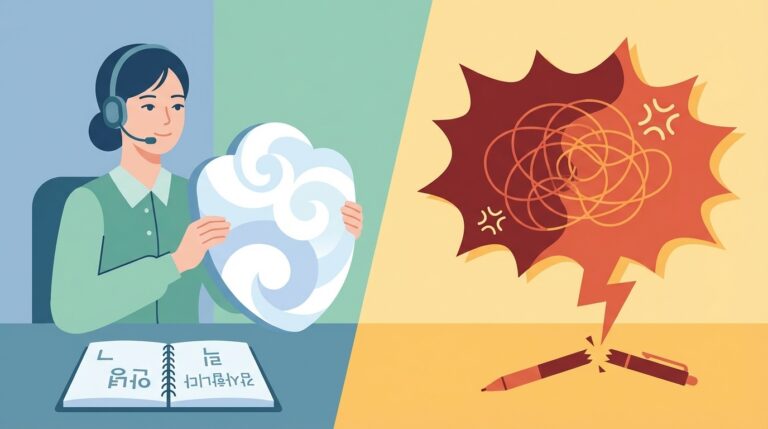
Picture this scene from a K-Drama: The camera zooms in on a protagonist sitting in a gray cubicle, wearing a headset. Her eyes look tired, but her voice is bright, pitched perfectly at the ‘Sol’ note (G note). A furious customer is screaming on the other end because their fried chicken delivery was 10 minutes late. The protagonist closes her eyes, takes a deep breath, and says a sentence that magically calms the storm.
It wasn’t just “I’m sorry.” It was a sophisticated linguistic dance of empathy, humility, and professional boundaries.
In the world of Korean Customer Service (CS), language is your shield and your weapon. As a C1 learner, you know the basics. But do you know how to navigate the high-pressure environment of a Korean call center, where ‘Palli-Palli’ (Hurry, Hurry) culture meets the intense expectation of ‘Gap-jil’ (Power harassment) prevention? Today, we aren’t just learning words; we are learning the art of de-escalation in the world’s most demanding service culture.
This isn’t just theory. These are the strategies used by top-tier CS managers in Seoul to turn angry callers into loyal fans.
Phase 2: Deep Dive — The Art of Professional De-escalation
Here are three high-level expressions essential for Quality Assurance (QA) in Korean CS.
1. 너그러운 양해 부탁드립니다
(Neogeureoun yanghae butakdeurimnida)
- Pronunciation: [Nuh-guh-ruh-oon yang-hae boo-tak-deu-rim-ni-da]
Tip: ‘Yanghae’ sounds a bit like ‘Young’ + ‘Hair’ without the ‘r’. It implies a deep understanding.- Meaning:
Literal: I ask for your generous understanding.
Real Nuance: “We made a mistake (or can’t do what you want), and I am humbly appealing to your maturity and grace to forgive us.”- K-Culture Moment: You’ll hear this in official announcements at airports or by high-ranking managers in dramas when a crisis hits. It frames the customer as a “generous person” if they accept the apology.
- Editor’s Insight: This is the C1 upgrade from “죄송합니다” (Sorry). It shifts the focus from your error to the customer’s benevolence. It’s a psychological tactic.
- Situation Spectrum:
[🚫 Casual Friends] ———— [⚠️ Colleagues] ———— [✅ Angry Customers/Official Notices]- 🤔 Think About It: Why does Korean CS language focus so much on the customer’s character (generous) rather than just the facts of the mistake?
2. 말씀하신 부분 충분히 공감합니다
(Malsseumhasin bubun chungbunhi gonggamhamnida)
- Pronunciation: [Mal-sseum-ha-sin boo-boon choong-boon-hi gong-gam-ham-ni-da]
- Meaning:
Literal: I sufficiently empathize with the part you spoke about.
Real Nuance: “I hear you, I validate your feelings, and I am on your side before I even offer a solution.”- K-Culture Moment: In reality TV shows like Baek Jong-won’s Alley Restaurant, when a restaurant owner complains about difficulties, the expert always starts with this validation before criticizing.
- Editor’s Insight: In Korean QA, skipping empathy (공감) is a fatal error. Logic comes after emotion. If you skip this step, you are seen as ‘cold’ (차가운 사람).
- Situation Spectrum:
[🚫 Casual] ———— [⚠️ Semi-formal] ———— [✅ Professional CS]- 🤔 Think About It: In Western CS, we often say, “I understand.” How is “Gonggam” (Empathy/Resonance) different from just “Understanding”?
3. 유관 부서와 확인 후 신속히 안내해 드리겠습니다
(Yugwan buseowa hwagin hu sinsokhi annaehae deurigessseumnida)
- Pronunciation: [Yu-gwan bu-seo-wa hwa-gin hu sin-sok-hi an-nae-hae deu-ri-get-seum-ni-da]
- Meaning:
Literal: After checking with the related department, I will guide you swiftly.
Real Nuance: “I don’t have the answer right now, but I am taking ownership and invoking the ‘Speed’ (8282) promise.”- K-Culture Moment: The word ‘신속히’ (Swiftly) is the magic key. Koreans hate waiting. Adding this adverb reduces anxiety significantly.
- Editor’s Insight: A C1 speaker doesn’t just say “Wait a moment.” They explain who they are asking (Yugwan buseo) and how they will return (Sinsokhi).
- Situation Spectrum:
[🚫 Friends] ———— [✅ Business Email/Calls] ———— [✅ Official CS]
Phase 3: Textbook vs. Real Life
| Situation | 📖 Textbook Korean | 🗣️ Real CS Pro (C1 Level) | 💡 Why the difference? |
|---|---|---|---|
| Putting on hold | 잠시만 기다려 주세요. (Please wait a moment.) | 잠시만 시간을 양해해 주시겠습니까? (Could I ask for your understanding for a moment of time?) | “Waiting” is a command. “Asking for understanding” is a request that respects the customer’s time. |
| Saying ‘No’ | 그건 안 됩니다. (That is not allowed.) | 도움 드리고 싶지만 규정상 어려운 점 양해 부탁드립니다. (I want to help, but please understand it’s difficult due to regulations.) | Direct rejection is considered rude. You must show intent to help (emotional cushion) before rejecting. |
| Ending a call | 안녕히 계세요. (Goodbye.) | 더 필요하신 부분은 없으실까요? (Is there no other part you need?) | Proactive checking marks the end of a professional service interaction, not just a farewell. |
Bottom Note: In C1 Business Korean, indirectness is not about being vague; it’s about saving face (Chemyon, 체면) for the customer.
Phase 4: Cultural Deep Dive — Emotional Labor & The ‘Sol’ Tone
4-1. The ‘Sol’ Tone (솔톤)
If you walk into any department store or call a service line in Korea, you will hear a voice pitch that is unnaturally high. We call this the ‘Sol’ Tone (Do-Re-Mi-Fa-Sol).
– Why? A lower voice is often associated with being serious, angry, or authoritative. The ‘Sol’ tone conveys brightness, energy, and submissiveness to the customer.
– The Dark Side: Recently, there’s a movement to stop this because of Emotional Labor (감정노동). As a C1 learner, you should know that while ‘Sol’ tone is standard, maintaining a calm, mid-range ‘Mi’ tone is becoming more acceptable to protect workers’ dignity.
4-2. The ‘Gap-jil’ (갑질) Culture
CS agents often deal with Gap-jil (abuse of power by the superior status).
– K-Drama Connection: Think of the drama Misaeng or My Liberation Notes. Characters often swallow their pride to earn a salary.
– Critical Insight: The phrases we learned today (like “Generous understanding”) are linguistic tools to disarm a person attempting Gap-jil. By lowering yourself excessively, you ironically take control of the conversation by making it socially unacceptable for them to continue screaming.
Phase 5: Immersive Roleplay — The Missing Delivery Crisis
Setting: A bustling call center in Yeouido, Monday morning 9:00 AM. The call volume is peaking. You are a Senior QA Manager handling an escalated call.
Characters:
– YOU: Senior Agent (Handling VIPs).
– Customer (Mr. Kim): A ‘Black Consumer’ (notorious complainer) claiming his premium hanwoo beef set arrived thawed.
(Phone rings)
Mr. Kim: 야! 너네 일 이따위로 할 거야? 고기가 다 녹아서 왔잖아! 당장 환불해!
(Ya! Neone il ittawiro hal geoya? Gogiga da nogaseo watjana! Dangjang hwanbulhae!)
(Hey! Is this how you work? The meat arrived melted! Refund me right now!)
🔀 Your Turn! How do you de-escalate?
A) “고객님, 진정하시고요. 운송장 번호가 어떻게 되시죠?”
(Customer, please calm down. What is your tracking number?)B) “아이고, 고객님. 귀한 선물용 고기였을 텐데 얼마나 속상하셨습니까. 정말 죄송합니다.”
(Oh my, Customer. It must have been precious gift meat; how upset you must be. I am truly sorry.)C) “규정상 녹은 사진을 보내주셔야 환불이 가능합니다.”
(Per regulations, you must send a photo of the melted state for a refund.)
✅ Best Choice: B
– Why? Empathy First. Options A and C are logical but will make Mr. Kim explode. You must acknowledge the value of the item (Hanwoo beef = precious gift) to validate his anger. This is the “Gonggam” technique.
(Scenario continues if you chose B)
Mr. Kim: (Slightly calmer) 아니, 내가 장인어른 드릴 건데… 이걸 어떻게 드려?
(No, I mean… I was going to give this to my father-in-law… how can I give this?)
YOU: “맞습니다, 저라도 정말 당황스러웠을 것 같습니다. 제가 유관 부서와 확인해서 가장 신속하게 새 상품으로 교환해 드려도 괜찮으시겠습니까?”
(That is correct, even I would have been flustered. May I check with the related department and swiftly exchange it for a new product?)
Phase 6: 10-Second Shadowing Drill
Let’s practice the “Magic Fix” sentence. Use a professional, calm, but apologetic tone.
Expression:
🥺 불편을 드려 / 정말 죄송합니다. // 말씀하신 내용은 / 유관 부서에 전달하여 / 시정하도록 하겠습니다.
Romanization:
Bulpyeoneul deuryeo / jeongmal joesonghamnida. // Malsseumhasin naeyong-eun / yugwan buseoe jeondalhayeo / sijeonghadorok hagessseumnida.
Meaning:
I am truly sorry for the inconvenience. The content you mentioned will be delivered to the relevant department so it can be rectified.
Phase 7: K-Culture Mini Glossary (CS Edition)
| Korean | Romanization | Meaning | Context |
|---|---|---|---|
| 감정노동 | Gamjeong nodong | Emotional Labor | The stress of managing feelings to create a publicly visible facial and bodily display. |
| 진상 | Jinsang | Rude Customer | A slang term for customers who make unreasonable demands or throw tantrums. |
| 블랙컨슈머 | Beullaek keonsyumeo | Black Consumer | A malicious consumer who complains for financial gain (compensation). |
| 응대 | Eungdae | Response/Service | The act of dealing with customers. (e.g., “응대 품질” = Service Quality). |
| 쿠션어 | Kusyeon-eo | Cushion Language | Softening phrases used before a negative statement (e.g., “I’m afraid but…”). |
Phase 8: Traveler’s Survival Kit — Reverse CS
Usually, you are the customer. But what if you need to complain in Korea effectively without being a ‘Jinsang’?
🆘 Survival Expression: How to Complain Politely
– 🇰🇷 “혹시 확인 한번 부탁드려도 될까요?”
(Hoksi hwagin hanbeon butakdeuryeodo doelkkayo?)
– Meaning: “Could I possibly ask you to check just once?”
– Context: When your food is wrong, or your hotel room is dirty.
– 💡 Pro Tip: Starting with “혹시” (Hoksi – By chance) magically softens any request. It makes you sound hesitant and polite, not demanding. The staff will be much more willing to help you.
Phase 9: Critical Thinking — “Think Deeper”
Language & Power: The Hierarchy of ‘Sorry’
In English, “I’m sorry” covers everything from bumping into someone to a major corporate scandal. In Korean, the hierarchy of apology is vast: Mianhae (Friends) < Joesonghamnida (Standard) < Songguhamnida (Formal/Written) < Sajwa-deurimnida (Grave sin).
In the CS context, agents often use excessive honorifics (Subject Honorifics applied to objects, e.g., “The coffee comes out now” -> 커피가 나오십니다). This is grammatically wrong but socially enforced. It reflects a society where the customer’s status must be elevated above all else, even above grammar rules.
💬 Your Turn: Does your language have a “Customer Service Voice” or specific grammar that is only used by staff members? How does it change the power dynamic?
Phase 10: FAQ & Troubleshooting
Q: Can I use these CS phrases with my Korean friends?
A: Absolutely NOT. If you say “너그러운 양해 부탁드립니다” to a friend who is waiting for you at a cafe, they will think you are mocking them or reading a script. With friends, just say “미안, 좀 늦어!” (Sorry, running late!).
Q: What if the customer keeps screaming?
A: Under Korea’s new Emotional Labor Protection Act, agents are now allowed to warn the customer and hang up after 3 warnings. You can say: “산업안전보건법에 따라 언어폭력 시 상담이 종료될 수 있습니다.” (Counseling may be terminated in case of verbal abuse according to the Occupational Safety and Health Act.)
❌ Common Mistake #1: Saying “아니요” (No) directly.
✅ Fix: Use “어려우실 것 같습니다” (It seems it might be difficult). It’s the Korean way of saying “No” without cutting the connection.
Phase 11: Wrap-up & Action Mission
One-Liner Summary: Advanced Korean CS is about validating feelings (Gonggam) and lowering yourself to elevate the customer, using specific “Cushion Language.”
Action Missions:
– 🥉 Bronze: Look in the mirror and practice your ‘Sol’ tone greeting: “반갑습니다, 고객님!” (Nice to meet you, customer!).
– 🥈 Silver: Watch a scene from the drama ‘Misaeng’ or ‘Start-Up’ where they handle a crisis. Identify if they used “Joesonghamnida” or the heavier “Songguhamnida.”
– 🥇 Gold: Next time you call a Korean help center (or visit a store), listen carefully. Did they use the phrase “양해 부탁드립니다”? Count how many times they use “Cushion Language.”
Phase 12: Quiz — Interactive Challenge
1. Situational Judgment:
A customer asks for a discount that is impossible to give. Which response is the most professional C1 level response?
– A) 안 됩니다. 정찰제입니다. (No. It’s a fixed price.)
– B) 깎아 드릴 수 없어서 미안해요. (Sorry I can’t cut the price.)
– C) 도움 드리고 싶지만, 형평성 문제로 할인이 어려운 점 너그러운 양해 부탁드립니다.
2. True or False (K-Culture):
– “In Korea, the phrase ‘The Customer is King’ is taken literally, but recent laws are trying to protect workers from ‘Gap-jil’.”
Answers:
1. C (A is too blunt, B is too casual. C uses the ‘Intent to help’ + ‘Reason’ + ‘Request for Understanding’ formula.)
2. True
Frequently Asked Questions (FAQ)
Q: What does "'신속히'" mean in Korean and how do you pronounce it?
A: In Korean, "'신속히'" is pronounced [Swiftly] and means: is the magic key. Koreans hate waiting. Adding this adverb reduces anxiety significantly.
Q: What does ""혹시"" mean in Korean and how do you pronounce it?
A: In Korean, ""혹시"" is pronounced [Hoksi - By chance] and means: magically softens any request. It makes you sound hesitant and polite, not demanding. The staff will be much more willing to help you.







