

Phase 1: The ‘Bonus’ Culture Shock (Immersive Hook)
Hello! This is your Daily Hangul Editor. 👋
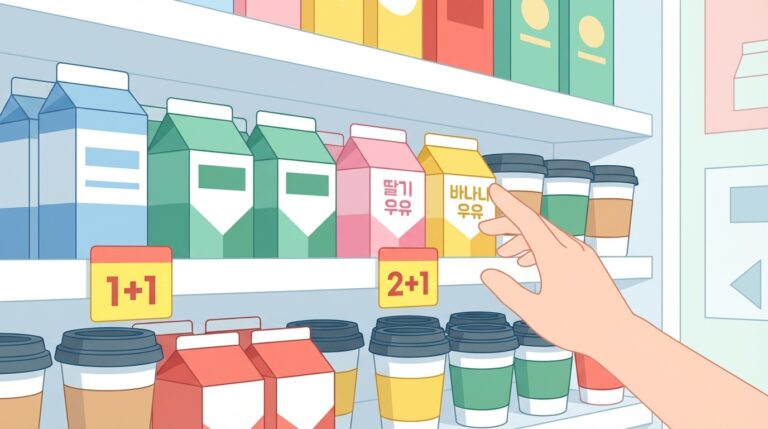
Picture this: You are the main character in a K-Drama. It’s 11 PM. You’ve just had a long, dramatic day. You walk into a glowing convenience store (pyeoneui-jeom) to grab a drink. You see a bright yellow tag under your favorite coffee that says 1+1.
You grab one and head to the counter. The part-timer looks at you, then at the coffee, then back at you with a confused look. Silence.
“Hana deo… (One more…)” they mumble.
Panic sets in. Do you have to take another one? What if you don’t want it? Can you pick a different flavor?
In Korea, Convenience Stores are not just shops; they are strategic battlegrounds for discounts. Understanding the “Plus One” culture isn’t just about saving money; it’s about understanding the Korean psyche of Jeong (sharing) mixed with hyper-efficiency. Today, we graduate from pointing fingers to negotiating deals like a Seoulite.
Phase 2: Deep Dive into Key Expressions
1. [이거 교차 증정 되나요?]
- Pronunciation: [Igeo gyo-cha jeung-jeong doenayo?]
- Sound Analogy: “Gyo-cha” sounds like “Gotcha” but with a ‘Gyo’. “Jeung-jeong” sounds a bit like a buzzing engine “Jung-jung”.
- Meaning:
- Literal: Is cross-presentation allowed for this?
- Real Nuance: “Can I mix and match flavors for the deal?”
- K-Culture Moment: You’re at the fridge. There’s a 2+1 deal on yogurt drinks. You want two strawberries and one peach. If you don’t ask this, you might be stuck with three strawberry yogurts like a rookie.
- Editor’s Insight: This is a Level B2+ phrase. Most beginners just stare at the clerk. Using the word 교차 (Gyo-cha – crossing/intersection) makes you sound incredibly intellectual about buying milk. It commands respect.
- Situation Spectrum:
[🚫 Formal Meeting] ———— [✅ Convenience Store/Mart] - 🤔 Think About It: Why does Korea allow mixing flavors? It reflects the culture of 다양성 (Diversity) within a collective group. We move together (the deal), but we respect individual tastes (the flavors).
2. [키핑(Keeping)해 주세요 / 어플에 넣어주세요]
- Pronunciation: [Kiping-hae juseyo / Eopeul-e neoeo-juseyo]
- Meaning: “Please keep/store the free one in the app for me.”
- K-Culture Moment: In K-Dramas, you often see characters paying with their phones. Real Koreans don’t carry the free “+1” drink if they aren’t thirsty. They digitally store it in the store’s app (like GS25’s ‘My Fridge’ or CU’s ‘Pocket CU’) to redeem later or gift to a friend via mobile coupon.
- Editor’s Insight: This is the ultimate “Insider” move. If you say this, the part-timer will stop seeing you as a foreigner and start seeing you as a local resident.
- Situation Spectrum:
[⚠️ Only at major chains (GS25, CU, 7-Eleven)]
3. [통신사 할인 되나요?]
- Pronunciation: [Tong-sin-sa ha-rin doenayo?]
- Meaning: “Is the mobile carrier discount applicable?”
- K-Culture Moment: Before paying, almost every Korean pulls out a barcode. Korean telecom companies (SKT, KT, LG U+) offer discounts at specific convenience stores. It’s a national sport to get that 10% off.
- Editor’s Insight: Even if you don’t have one, asking this shows you understand the system.
Phase 3: Textbook vs. Real Life
| Situation | 📖 Textbook Korean | 🗣️ Real Korean (In the Wild) | 💡 Why the difference? |
|---|---|---|---|
| Asking about the deal | “이것은 일 더하기 일입니까?” (Is this one plus one?) | “이거 원플원(One-Pl-One)이에요?” | Koreans love shortening English loanwords for speed (Efficiency culture). |
| Declining the free item | “저는 하나만 필요합니다.” (I need only one.) | “그냥 하나만 가져갈게요.” (I’ll just take one.) | Direct refusal can feel cold; adding “Geunyang” (just) softens the blow. |
| Mixing flavors | “다른 맛으로 선택할 수 있습니까?” | “다른 맛 섞어도(mix) 돼요?” | “섞다(Seok-da)” is the everyday verb for mixing; it’s faster than “choose”. |
💡 Editor’s Note: “One-Pl-One” (1+1) and “Two-Pl-One” (2+1) are pronounced with a distinct Korean accent. Don’t say “One Plus One” quickly like in English. Say [Won-Peul-Won].
Phase 4: Cultural Deep Dive — The Art of ‘Nunchi’ in Shopping
4-1. Non-verbal Communication: The “Hesitant Hand”
In a busy convenience store, speed is vital. However, if you are unsure about a 2+1 deal, do not block the counter while thinking.
* The Move: Stand in front of the shelf, hold the two items, and look at the clerk with a slight bow and a questioning gaze. They will usually nod (Yes, it works) or make an ‘X’ with their arms (No, wrong items). This is Nunchi (reading the room) in action—communicating without slowing down the line.
4-2. K-Drama Connection: The “Lonely Eater” Trope
Have you noticed in dramas like Squid Game or Itaewon Class, characters often sit outside convenience stores at plastic tables drinking soju or eating cup noodles?
* The Context: The 2+1 event is deeply tied to this. Buying 3 drinks for the price of 2 is perfect for a small group of friends (3 people), but it’s also common for a lonely protagonist to buy a 2+1, drink one, and leave two on the table for someone else (or look sadly at the extra ones). The “+1” represents abundance in a lonely city.
Phase 5: Immersive Roleplay — Late Night Snack Run
Setting: It is 11:30 PM at a GS25 near the Han River. The store is bright and buzzing with the hum of refrigerators. You are holding a coffee labeled “2+1”.
Characters:
* YOU: A foreign student who wants to study all night. You need caffeine.
* Minji (Part-timer): A college student, tired, wearing a vest, scanning items very fast.
☕ Dialogue Start:
Minji: (Scanning your one coffee) 2,500원입니다.
(Romanization) I-cheon-o-baek-won imnida.
(English) That’s 2,500 won.
YOU: (Noticing the tag late) 어, 잠시만요! 이거 투플원(2+1) 아니에요?
(Rom) Eo, jamsimanyo! Igeo tu-peul-won anieyo?
(Eng) Oh, wait! Isn’t this 2+1?
Minji: 아, 네 맞아요. 교차 가능하니까 아무거나 더 가져오세요.
(Rom) Ah, ne majayo. Gyo-cha ganeung-hanikka amugeona deo gajyeo-oseyo.
(Eng) Ah, yes right. Cross-selection is possible, so bring anything else.
🔀 Decision Point: You only want TWO coffees, not three. What do you do?
- A) Run and grab two more of the same flavor quickly.
- B) Ask “Does Vanilla Latte count?” (Check cross-selection).
- C) Say “I don’t need the rest, just give me one discount.”
✅ Best Choice: B. Since she already said “Gyo-cha ganeung” (Cross-selection possible), asking about the flavor confirms your understanding.
⚠️ Choice C Analysis: In Korea, 1+1 or 2+1 isn’t a percentage discount on a single item. It’s strictly “Buy X, Get Y”. Asking for a discount on just one item will confuse the system.
(Continuing from Choice B)
YOU: 바닐라 라떼도 섞어도 돼요?
(Rom) Banilla ratte-do seok-eo-do dwaeyo?
(Eng) Can I mix in Vanilla Latte too?
Minji: 네, 가격 같은 건 다 돼요.
(Rom) Ne, gagyeok gateun geon da dwaeyo.
(Eng) Yes, anything with the same price works.
Phase 6: 10-Second Shadowing Drill
Practice saying this like you are in a hurry but polite.
“Wait, can I mix different flavors?”
😮 (Surprised/Urgent) 잠시만요! / 이거 / 다른 맛 / 섞어도 / 되나요?
(Jam-si-man-yo! / i-geo / da-reun mat / seok-eo-do / doe-na-yo?)
Phase 7: K-Culture Mini Glossary
| Korean | Rom | English | Context in Convenience Stores |
|---|---|---|---|
| 행사 상품 | Haeng-sa sang-pum | Event Product | Items on sale (1+1, 2+1, free gift). Look for the tags! |
| 편의점 | Pyeon-ui-jeom | Convenience Store | The lifeline of modern Korea. Open 24/7. |
| 알바생 | Alba-saeng | Part-timer | The clerk. Usually a student working ‘Arbeit’. |
| 신상 | Sin-sang | New Product | Koreans love ‘new’ things. Look for ‘New’ tags. |
| 폐기 | Pye-gi | Disposal | Expired food. Part-timers often get to eat this for free (a classic K-Drama trope). |
Phase 8: Traveler’s Survival Kit (Convenience Store Edition)
Even if you aren’t living in Korea, you will visit a convenience store at least twice a day.
🆘 Survival Phrases TOP 3
1. 🇰🇷 “봉투 필요하세요?” (Bong-tu piryo-haseyo?)
* Clerk says this. Meaning: “Do you need a bag?”
* Your Answer: “네 (Yes)” or “아니요 (No)”. Note: Bags cost 20-100 won.
2. 🇰🇷 “데워 드릴까요?” (De-wo deurilkkayo?)
* Clerk says this. Meaning: “Shall I heat this up for you?” (For lunch boxes/hot bars)
3. 🇰🇷 “교통카드 충전해 주세요.” (Gyotong-kadeu chung-jeon-hae juseyo)
* You say this. Meaning: “Please recharge my transport card (T-Money).”📌 Editor’s Travel Note
* Trash Bins: Unlike the streets, convenience stores always have trash bins inside or right outside. It’s a safe haven for your garbage.
* Tables: Eating instant noodles (Ramyeon) at the store table is a quintessential Korean experience. Try it!
Phase 9: Think Deeper — “The Psychology of 2+1”
Topic: Consumerism vs. Smart Spending
Why does Korea have so many 2+1 deals instead of just 50% off?
🧠 Think Deeper:
The “2+1” strategy perfectly targets the Korean social structure. Ideally, you share with two friends (community). Realistically, in a society of increasing single-person households (1-in gagu), it forces a dilemma: buy more than you need to feel you got a “deal,” or pay full price for one. It fuels a cycle of consumption disguised as efficiency. Also, it drives the adoption of “App Keeping” services, locking customers into one brand’s ecosystem (GS25 vs CU).💬 Your Turn: Does your country have deals that force you to buy more? Do you think “Keeping” products in an app would work in your culture?
Phase 10: FAQ & Troubleshooting
Q: Can I drink the beverage inside the store?
* Maybe. If there are tables/chairs, yes. If it’s just aisles, no. You cannot drink before you pay (this is a crime!).
Q: The 2+1 items are different prices (e.g., Chocolate milk 1500w, Strawberry 1400w). How does it charge?
* The Rule: You usually pay for the two most expensive items, and the cheapest one is free.
❌ Common Mistake #1: Bringing only one item to the counter when it’s 1+1.
* Result: The clerk will stop scanning and stare at you until you go get the second one. They cannot process the transaction easily without the second barcode in some systems.
* Fix: Always check the tag before walking to the counter.
Phase 11: Wrap-up & Action Mission
One-Liner Summary: When shopping in Korea, “1+1” is not just a sale; it’s a test of your observation skills and ability to “mix and match” flavors!
🎯 Action Mission:
* 🥉 Bronze: Say “Tu-Peul-Won” (2+1) out loud 5 times. Get the accent right!
* 🥈 Silver: Go to a Korean convenience store (or an Asian mart in your country) and find a “Buy X Get Y” deal. Read the label.
* 🥇 Gold: Visit a convenience store in Korea, find a 2+1 drink, pick 3 different flavors, and ask “Igeo gyo-cha ganeung-haeyo?”
🎬 K-Culture Mission: Watch a K-Drama scene where characters eat cup noodles at a convenience store. Notice: Do they clean up their own table? (Hint: Yes, they must separates the food waste!)
Phase 12: Interactive Quiz
- Situation: You see a “2+1” tag. You bring 3 items to the counter. The clerk asks: “Tong-sin-sa ha-rin isseuseyo?” What are they asking for?
- a) A credit card.
- b) A plastic bag.
- c) A mobile carrier discount.
- d) Your ID card.
- True or False: In Korea, if you buy a 1+1 item but only want one, you can often save the second one in the store’s smartphone app.
-
Fill in the Blank: You want to ask if you can mix Strawberry and Banana milk for the deal.
- “Igeo ______ jeung-jeong doenayo?” (Is cross-presentation allowed?)
🔑 Answers:
1. (c)
2. True (The ‘Keeping’ system)
3. 교차 (Gyo-cha)
Frequently Asked Questions (FAQ)
Q: What does "[이거 교차 증정 되나요?]" mean in Korean and how do you pronounce it?
A: In Korean, "[이거 교차 증정 되나요?]" is pronounced [Igeo gyo-cha jeung-jeong doenayo?] and means: a key conversational Korean expression covered in this lesson.
Q: What does "[키핑(Keeping)해 주세요 / 어플에 넣어주세요]" mean in Korean and how do you pronounce it?
A: In Korean, "[키핑(Keeping)해 주세요 / 어플에 넣어주세요]" is pronounced [Kiping-hae juseyo / Eopeul-e neoeo-juseyo] and means: "Please keep/store the free one in the app for me."
Q: What does "[통신사 할인 되나요?]" mean in Korean and how do you pronounce it?
A: In Korean, "[통신사 할인 되나요?]" is pronounced [Tong-sin-sa ha-rin doenayo?] and means: "Is the mobile carrier discount applicable?"







