

Phase 1: The Hook — More Than Just Words
Hello! This is your Daily Hangul Editor. 👋
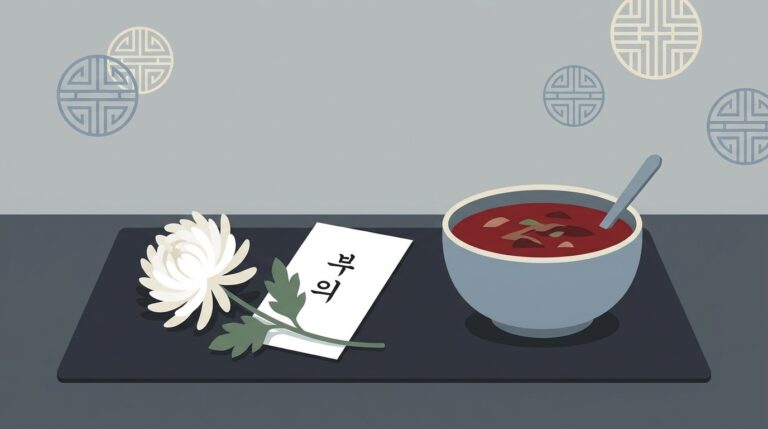
Picture this: You are watching a K-Drama. The main character walks into a room filled with white chrysanthemums and the smell of spicy beef soup (Yukgaejang). Everyone is wearing black. The hero stands in front of a portrait, burns incense, and bows. Then, he turns to the crying family and mumbles a long, difficult sentence.
This is the Korean Funeral (Jangryesikjang).
In this situation, saying “Hello” or “Have a nice day” is a disaster. You need the magic phrase that shows ultimate respect. But here is the secret: even Koreans find this phrase difficult to say perfectly!
Today, we will learn the most solemn phrase in the Korean language. Don’t worry if it looks scary. I’ll teach you the words, but more importantly, I’ll teach you the silence and manners that speak louder than words.
Phase 2: Deep Dive — The Phrase You Must Know
There is really only one “official” phrase for this moment. It is formal, poetic, and deep.
1. 삼가 고인의 명복을 빕니다
- Pronunciation: [Sam-ga go-in-ui myeong-bog-eul bim-ni-da]
- Sound-alike: Sam (like Sam Smith) – ga (like Lady Gaga) … go-in (go inside) … myeong-bog (my young bog) … bim-ni-da (beam me up, da!).
- Meaning:
- Literal: “I respectfully pray for the happiness of the deceased in the next world.”
- Real Nuance: “Rest in Peace.”
- K-Culture Moment: In almost every melodrama (like Goblin or My Mister), you see this phrase written on the ribbon of the flower wreaths sent to the funeral home.
- Editor’s Insight: This sentence is very formal. Honestly, for an A1 (Beginner) learner, it is a tongue twister.
- 💡 Pro Tip: You usually write this on the envelope containing money. When speaking to the family, sometimes a silent, sorrowful nod is better than stuttering through this long sentence.
- Situation Spectrum:
[🚫 Casual Friends] ———— [✅ Formal/Standard] ———— [✅ Writing]
- Note: You can say this to anyone, but it sounds very prepared and formal.
🤔 Think About It: Why does Korean have a specific “prayer for the next world” instead of just saying “I’m sorry”? It reflects the Buddhist and Confucian belief that the afterlife journey is important.
2. 얼마나 상심이 크세요?
- Pronunciation: [Eol-ma-na sang-sim-i keu-se-yo?]
- Meaning: “How big is your heartbreak?” (Meaning: You must be so heartbroken.)
- Situation: Used when talking to the person who is crying (the family).
- Editor’s Insight: This shows Empathy (Gong-gam). It focuses on the living person’s pain.
Phase 3: Textbook vs. Real Life
| Situation | 📖 Textbook Korean | 🗣️ Real Korean (Survival) | 💡 Why different? |
|---|---|---|---|
| Greeting the family | 삼가 고인의 명복을 빕니다. (Full formal sentence) | (Silent deep bow) + “…” | Koreans value “Non-verbal communication”. Sometimes words feel too light for heavy sadness. |
| Comforting a friend | 기운 내세요. (Cheer up / Be energetic.) | 밥 좀 먹자. (Let’s eat something.) | In Korea, eating together is the ultimate form of care. Making sure the mourner eats is love. |
Bottom Note: As a beginner, do not try to be too talkative at a funeral. Your presence is the message.
Phase 4: Cultural Deep Dive — K-Culture Context
4-1. The “2.5 Bows” Rule (Non-verbal)
In Korea, we bow once for the living. But for the deceased?
1. Face the portrait: Bow Twice fully (down to the floor). Then do a half-bow.
2. Face the family: Bow Once fully (or a deep standing bow) to the living family members.
Warning: Do NOT bow twice to the living family. That implies they are dead too! 😱
4-2. The “Yukgaejang” Connection (K-Food)
Why do K-Drama characters always eat spicy red soup at funerals? That is Yukgaejang (Spicy Beef Soup).
– Red color: Believed to chase away bad spirits (Ghost-busting soup!).
– Practicality: Funeral guests visit for 3 days, 24 hours. The soup is easy to cook in huge pots to feed hundreds of guests.
Phase 5: Immersive Roleplay
Setting: A hospital funeral hall in Seoul. It is 10 PM. The air smells of incense. You are visiting your Korean coworker, Min-su, whose father passed away.
Characters:
– YOU: A caring foreign coworker.
– Min-su: Your coworker, wearing a black suit and an armband, looking tired.
(Dialogue Start)
(Stage Direction: You enter the room, bow to the portrait twice, and then face Min-su.)
Min-su: (Bows to you) 와 주셔서 감사합니다. (Wa ju-syeo-seo gam-sa-ham-ni-da.)
(Thank you for coming.)
YOU: (Bow deeply back to him)
🔀 Decision Point: What do you say next?
- A) “Hello, Min-su! How are you?”
- B) “…” (Hold his hands for a second with a sad face)
- C) “Samga goin-ui myeongbog-eul bimnida.” (Perfectly recited)
✅ Best Choice: B or C.
– B is safest for a beginner. It shows Nunchi (emotional intelligence).
– C is excellent if your pronunciation is good.
– A is WRONG. Never ask “How are you?”—he is definitely not okay!
Min-su: (Leads you to a table) 식사하고 가세요. (Sik-sa-ha-go ga-se-yo.)
(Please eat before you go.)
YOU: 네, 감사합니다. (Ne, gam-sa-ham-ni-da.)
(Yes, thank you.)
(Stage Direction: You sit down. There is Soju on the table.)
💡 Bonus Cultural Tip: When drinking Soju at a funeral, never do “Cheers!” (Geonbae). You just pour for each other and drink quietly.
Phase 6: 10-Second Shadowing Drill
Let’s practice the “Short & Safe” version. Speak with a low, calm voice.
😢 Sorrowful Tone:
마음 / 잘 / 추스르세요.
(Ma-eum / jal / chu-seu-reu-se-yo.)
Meaning: Please take care of your heart/mind. (Lit: Pull your heart together well.)
Phase 7: K-Culture Mini Glossary
| Korean | Romanization | Meaning | Context |
|---|---|---|---|
| 조의금 | Jo-ui-geum | Condolence Money | Money you give in an envelope. Usually 30,000, 50,000, or 100,000 KRW (Odd numbers are lucky). |
| 상주 | Sang-ju | Chief Mourner | The main person organizing the funeral (usually the eldest son). |
| 향 | Hyang | Incense | You burn this for the deceased. Stick to 1 or 3 sticks. |
Phase 8: Traveler’s Survival Kit — Funeral Edition
Even if you are just traveling, you might get invited if you make close Korean friends.
🆘 Survival Tips
1. Dress Code: Black is best. Navy or dark gray is okay. No bright colors, no shorts, no sandals.
2. Socks are MANDATORY: You must take off your shoes. Bare feet are considered very rude. Wear black socks.
3. The Envelope: There are usually white envelopes at the entrance. Write your name on the back (vertically).
Phase 9: Think Deeper — “Money and Mourning”
Community over Individuality:
In many Western cultures, giving money at a funeral might feel transactional or cold. But in Korea, Jo-ui-geum (Condolence Money) is a practical way to support the family. Funerals are expensive, and the community “crowdfunds” the cost to relieve the burden from the grieving family. It is a symbol of Jeong (deep attachment/bond).
💬 Your Turn: Does your culture bring flowers, food, or money to a funeral? Why?
Phase 10: FAQ & Troubleshooting
- Q: Can I take photos at the funeral home?
- A: NO! 🚫 Absolutely not. It is very disrespectful to take selfies or photos of the food/altar. Put your phone away.
- Q: Do I have to drink the alcohol?
- A: No. If you don’t drink, just accept the cup (don’t refuse the pour) and put it down. You don’t have to sip it.
- Q: How long should I stay?
- A: Usually, you eat the soup, stay for about 30 minutes to 1 hour to keep the family company, and then leave.
❌ Common Mistake: Clinking glasses together when drinking Soju.
✅ Do this: Lift your glass slightly, nod, and drink. Silence is respect.
Phase 11: Wrap-up
Today’s One-Liner: At a Korean funeral, silence and presence are more powerful than perfect grammar.
Action Mission:
– 🥉 Bronze: Practice bowing 90 degrees in front of a mirror. It’s deeper than you think!
– 🥈 Silver: Watch the funeral scene in the K-Drama My Mister (나의 아저씨) or Reply 1988. Observe the eating and bowing.
– 🥇 Gold: If you have a Korean friend, ask them: “Does red soup (Yukgaejang) really chase away ghosts?”
Phase 12: Interactive Quiz
1. You are standing in front of the deceased’s photo. How many times do you bow?
– A) 1 time
– B) 2 times
– C) 3 times
2. True or False?
– “It is polite to say ‘Cheers!’ to cheer up the sad family while drinking Soju.”
3. Situation: You forgot your black suit. You only have these clothes. Which is the least bad option?
– A) A bright red hoodie
– B) Dark blue jeans and a dark grey t-shirt
– C) Running shorts and sandals
Answers:
1. B (2 full bows + 1 half bow is the standard).
2. False (Never clink glasses!).
3. B (Dark colors are key. Avoid bright colors and skin exposure at all costs.)
Frequently Asked Questions (FAQ)
Q: What does "삼가 고인의 명복을 빕니다" mean in Korean and how do you pronounce it?
A: In Korean, "삼가 고인의 명복을 빕니다" is pronounced [Sam-ga go-in-ui myeong-bog-eul bim-ni-da] and means: Literal: "I respectfully pray for the happiness of the deceased in the next world."
Q: What does "얼마나 상심이 크세요?" mean in Korean and how do you pronounce it?
A: In Korean, "얼마나 상심이 크세요?" is pronounced [Eol-ma-na sang-sim-i keu-se-yo?] and means: "How big is your heartbreak?" (Meaning: You must be so heartbroken.)






