

Phase 1: The “Dojang” Moment — Immersive Hook
안녕하세요! Daily Hangul Editor here.
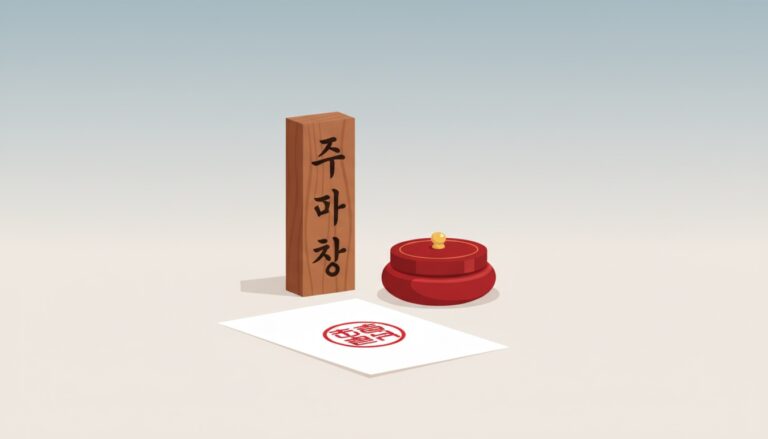
If you’ve watched enough Korean corporate dramas (think Misaeng or Start-Up), you know that scene. The background music stops. The camera zooms in on a hand reaching into a suit pocket. A small wooden stick comes out. The lid pops off. Thump. A red circle is stamped onto a crisp white paper.
The tension breaks, hands are shaken, and suddenly everyone is talking about dinner.
That red stamp is a Dojang (도장), and in Korea, sealing a deal is often more about the relationship you just solidified than the ink on the page. You might think the negotiation ends when the numbers match, but in Korea, it ends with a specific vibe and a specific phrase. If you just say “Thank you” and leave, you might feel a sudden chill in the air.
Today, we’re learning how to stick the landing—how to finalize a contract and transition from “negotiation mode” to “partner mode.”
Phase 2: Deep Dive into Key Expressions
1. 이대로 진행하시죠 (Idero jinhaenghasijyo)
- Pronunciation: [ee-dae-ro jin-haeng-ha-shi-jyo]
- Meaning: “Let’s proceed like this / Let’s go ahead with this plan.”
- K-Culture Moment: Imagine a team leader looking at a proposal, nodding slowly, closing the file folder with a satisfying thud, and looking you in the eye. That’s the moment they say this.
- Editor’s Insight: This is the green light. It’s polite because of the honorific ending -si-jyo, but it’s decisive. It signals that the debating is over and action is starting.
- Situation Spectrum:
[🚫 Casual Friends] ———— [✅ Colleagues] ———— [✅ Boss/Client] - 🤔 Think About It: Why does Korean use “Proceed like this” (demonstrative) rather than “I agree”? It focuses on the shared object/plan rather than the individual’s opinion, softening the directness.
2. 도장 찍으시죠 (Dojang jjigeusijyo)
- Pronunciation: [do-jang jji-geu-shi-jyo]
- Meaning: “Let’s stamp the seal (Let’s sign the contract).”
- K-Culture Moment: The climax of a business thriller. The villain hesitates, the hero smirks, and pushes the ink pad forward.
- Editor’s Insight: Even though signatures (sseain) are common now, the word 찍다 (to stamp/press) is still used metaphorically for finalizing things. It carries more weight than just “signing.”
- Situation Spectrum:
[🚫 Friends] ———— [⚠️ Semi-formal] ———— [✅ Formal Business]
3. 앞으로 잘 부탁드립니다 (Apeuro jal butakdeurimnida)
- Pronunciation: [ah-peu-ro jal boo-tak-deu-rim-ni-da]
- Meaning: “I look forward to your help/support in the future.”
- K-Culture Moment: Every new employee introduction and every contract signing scene. It’s the ultimate closer.
- Editor’s Insight: This is untranslatable. If you translate it to “Please do it well,” it sounds demanding. It actually means, “We are in this together now, so please look after me/us kindly.” It acknowledges that the contract is just the start of a relationship that requires mutual effort.
- Situation Spectrum:
[✅ Casual (shortened)] ———— [✅ Colleagues] ———— [✅ Formal] - 🤔 Think About It: Western business ends with “Pleasure doing business with you” (past/present focus). Korean business ends with “Please take care of me” (future focus). What does this say about how each culture views a contract?
Phase 3: Textbook vs. Real Life
| Situation | 📖 Textbook Korean | 🗣️ Real Korean (Business) | 💡 Why different? |
|---|---|---|---|
| Agreeing to terms | 합의했습니다. (We have agreed.) | 이 조건으로 가시죠. (Let’s go with these terms.) | “Going with” (가다) sounds more active and forward-moving than a static “agreement.” |
| Asking to sign | 서명해 주십시오. (Please sign.) | 여기 도장/사인 부탁드립니다. (Seal/Sign here, please.) | “Asking for a favor” (butak) is softer than a command (jusipsio). |
| Ending the meeting | 안녕히 계세요. (Goodbye.) | 들어가 보겠습니다. (I will try going in.) | Leaving implies interrupting work; saying “going in” (back to work) shows diligence. |
Note: B2 learners often sound too rigid. In business, softening your request (using
jeom,butak) is a sign of high fluency.
Phase 4: Cultural Context — The “Nunchi” of the Seal
4-1. The Body Language of Signing
When you are signing a contract or handing over a pen:
1. Support your arm: If you are handing a pen or document to a senior/client, support your right forearm with your left hand. It’s the “polite pour” posture, applied to business items.
2. The Bow: After the final signature/stamp, a handshake is common, but it’s almost always accompanied by a slight bow. Don’t maintain stiff eye contact like a Western power move; soften your gaze.
4-2. K-Drama Connection: The “Hoesik” (Dinner)
In Korean culture, the contract isn’t really done until you’ve eaten together.
- The Trope: The scene cuts from the boardroom to a BBQ restaurant. Ties are loosened.
- Reality: If a client suggests dinner after signing, saying “No, I’m tired” is a major faux pas. You don’t have to drink alcohol, but you must share the meal. The “Jeong” (bonding) happens over grilled meat, not conference tables.
Phase 5: Immersive Roleplay
Setting: A sleek meeting room in Gangnam. You (Manager Kim from the overseas branch) have just finished a grueling 2-hour negotiation with Mr. Park (Client).
Characters:
– YOU: Manager Kim (Foreigner, fluent but respectful)
– Mr. Park: Korean client (50s, traditional but friendly)
(Dialogue Start)
Mr. Park: (Closing the file) 자, 그럼 가격은 5% 할인하는 걸로 조정합시다.
(Ja, geureom gagyeogeun 5% halinhaneun geollo jojeonghapsida.)
(Okay, then let’s adjust the price to a 5% discount.)
YOU: 네, 저희도 좋습니다. 이대로 진행하시죠.
(Ne, jeohuido joseumnida. Idero jinhaenghasijyo.)
(Yes, we are good with that too. Let’s proceed like this.)
Mr. Park: (Laughs) 시원시원해서 좋네요. 여기 계약서 가져왔습니다.
(Siwon-siwonhaeseo jonneyo. Yeogi gyeyakseo gajyeowatseumnida.)
(I like that you’re decisive/refreshing. Here is the contract.)
(Mr. Park pushes the paper toward you.)
🔀 Decision Point! How do you respond?
- A) “네, 감사합니다.” (Signs immediately)
- B) “잠시만요, 다시 읽어볼게요.” (Reads for 10 mins in silence)
- C) “네, 바로 날인하겠습니다. 앞으로 잘 부탁드립니다.”
✅ Best Choice: C. You show readiness (“Immediately sealing/signing”) and use the magic phrase “Jal butak deurimnida.”
⚠️ Choice B Analysis: While prudent in the West, reading deeply after verbally agreeing might look like you don’t trust them. It’s better to say “Let me double-check the typo we discussed” rather than reading the whole thing again.
YOU: (Signing) 네, 앞으로 잘 부탁드립니다, 대표님.
(Ne, apeuro jal butakdeurimnida, daepyonim.)
Mr. Park: 저야말로 잘 부탁해요. 오늘 저녁에 삼겹살에 소주 한잔 어때요?
(Jeoyamallo jal butakhaeyo. Oneul jeonyeoge samgyeopsare soju hanjan eottaeyo?)
(The pleasure is mine. How about Soju and Pork Belly tonight?)
Phase 6: 10-Second Shadowing Drill
Practice saying this with a slight bow in your voice.
😊 Polite & Hopeful:
어려운 결정 / 해주셔서 / 감사합니다. / 앞으로 / 잘 부탁드립니다!
(eoryeoun gyeoljeong / haejusyeoseo / gamsahamnida. / apeuro / jal butakdeurimnida!)
Thank you for making a difficult decision. I look forward to working with you!
Phase 7: K-Culture Mini Glossary
| Korean | Romanization | Meaning | Context |
|---|---|---|---|
| 도장 | Dojang | Name Seal/Stamp | Used instead of signatures in formal documents. |
| 인주 | Injoo | Red Ink Paste | The red paste used for the dojang. It stains easily! |
| 계약금 | Gyeyak-geum | Deposit | Usually 10% paid immediately upon signing. |
| 갑 / 을 | Gap / Eul | A / B (in contracts) | ‘Gap’ has power, ‘Eul’ follows. Often used socially to describe power dynamics. |
Phase 8: Traveler’s Survival Kit (Contract Edition)
Even as a traveler, you sign “contracts”—rental cars, Airbnb rules, or expensive equipment rentals.
🆘 Survival Phrase #1
– 🇰🇷 “여기에 사인하면 되나요?” (Yeogie sainhamyeon doenayo?)
– 🗣️ Sound: [Yeo-gi-eh sign-ha-myeon dweh-na-yo?]
– 📍 Use: Hotels, Car Rentals, Duty-Free pickup.
– 💡 Pro Tip: Koreans use the English word “Sign” (sain) for casual signatures. “Seomyeong” is too formal for a credit card receipt.📌 Editor’s Note
When renting a car in Jeju or signing a waiver for Bungee jumping in Gapyeong, never sign without asking: “취소 수수료는 얼마예요?” (How much is the cancellation fee?). Policies can be strict!
Phase 9: Think Deeper — “Gap and Eul”
Language & Power:
You might have heard the term “Gapjil” (갑질) in the news. It comes from contracts where ‘Gap’ (Party A) holds power over ‘Eul’ (Party B).
In Korea, once you sign a contract, the hierarchy is set. The language reflects this. The ‘Eul’ will almost always use higher honorifics to the ‘Gap’, even if the ‘Eul’ is older. However, a smart ‘Gap’ knows that treating ‘Eul’ with respect (using polite language) is the mark of a true leader.
💬 Your Turn: In your culture, does the person paying the money always get to dictate the tone of the conversation? How does your language handle power dynamics?
Phase 10: FAQ & Troubleshooting
Q: Can I just use a pen, or do I need a Dojang?
A: For foreigners, a signature is almost always accepted legally. However, having a Dojang made (you can get one carved in Insadong for $30) is a massive “flex” and shows deep respect for Korean culture. If you pull one out, you win the room.
Q: What if I need to reject the final offer?
A: Don’t say “No.” Say “곤란합니다” (Gonranhamnida – It is difficult). It sounds like you want to say yes, but the situation prevents you. It saves face for everyone.
❌ Common Mistake: Extending your hand for a handshake before your boss or the client does.
✅ Fix: Wait. The senior person initiates the handshake. You initiate the bow.
Phase 11: Wrap-up & Mission
One-Liner:
Finalizing a deal in Korea isn’t just about the signature; it’s about the phrase “Jal butak deurimnida” and the dinner that follows.
Action Mission:
– 🥉 Bronze: Say “Apeuro jal butak deurimnida” 3 times in front of a mirror while bowing slightly.
– 🥈 Silver: Watch a K-Drama scene where a contract is signed. Look for the red ink pad!
– 🥇 Gold: If you are in Korea, go to a stamp shop (Dojang-bang) and have your name carved in Hangul. It’s the best souvenir.
K-Culture Mission:
Check out the drama Misaeng. It’s the bible of Korean office life. Spot the “Gap and Eul” dynamic in Episode 1!
Phase 12: Interactive Quiz
1. Situation: You just signed a rental contract for an apartment. The landlord says “Jal butakhaeyo.” What is the best reply?
– A) “No, thank you.”
– B) “Jal butak deurimnida!”
– C) “Goodbye.”
2. True or False:
– It is rude to read a contract silently for 20 minutes while the other person waits.
– (Answer: True-ish. In Korean culture, it creates awkwardness. Better to say you need a moment or check specific points politely.)
(Answer Key: 1-B)
Frequently Asked Questions (FAQ)
Q: What does "이대로 진행하시죠 (Idero jinhaenghasijyo)" mean in Korean and how do you pronounce it?
A: In Korean, "이대로 진행하시죠 (Idero jinhaenghasijyo)" is pronounced [ee-dae-ro jin-haeng-ha-shi-jyo] and means: "Let's proceed like this / Let's go ahead with this plan."
Q: What does "도장 찍으시죠 (Dojang jjigeusijyo)" mean in Korean and how do you pronounce it?
A: In Korean, "도장 찍으시죠 (Dojang jjigeusijyo)" is pronounced [do-jang jji-geu-shi-jyo] and means: "Let's stamp the seal (Let's sign the contract)."
Q: What does "앞으로 잘 부탁드립니다 (Apeuro jal butakdeurimnida)" mean in Korean and how do you pronounce it?
A: In Korean, "앞으로 잘 부탁드립니다 (Apeuro jal butakdeurimnida)" is pronounced [ah-peu-ro jal boo-tak-deu-rim-ni-da] and means: "I look forward to your help/support in the future."







