

Phase 1: The Smell of Victory (and MSG)
Hello! Your Daily Hangul editor here.
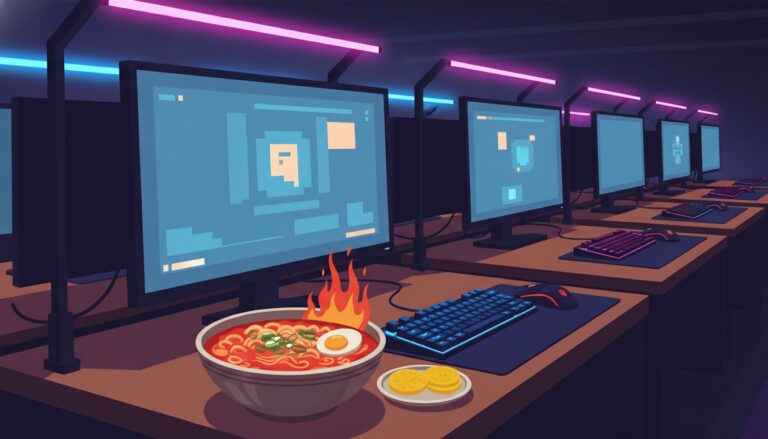
Imagine this: You are in a semi-dark room in Seoul. Rows of high-end monitors are glowing with neon LED lights. To your left, someone is shouting “Nice!” while playing League of Legends. To your right, someone is watching a K-Drama at 2x speed.
Then, it hits you. That smell.
It’s spicy, savory, and irresistible. It’s PC Bang Ramen.
In K-Dramas like Twenty-Five Twenty-One, you see characters bonding over cup noodles at a convenience store. But the real gourmet experience is in the PC Bang (Internet Cafe). Here, ramen isn’t just food; it’s fuel.
Most modern PC Bangs have a digital ordering system on your screen (we call it “clicking for food”). But what if the system glitches? What if you are at a retro spot? Or what if you just need to ask for extra kimchi?
If you stay silent, you go hungry. Let’s make sure you get that bowl.
Phase 2: Core Expressions (Deep Dive)
Here are the three phrases that stand between you and starvation.
1. 라면 하나 주세요 (Ramyun hana juseyo)
- Pronunciation: [Ra-myun ha-na ju-se-yo]
- Sound Analogy: Ra (like ‘rock’) – myun (like ‘moon’ but shorter) + Ha-na (Hah-nah) + Ju-se-yo (Joo-say-yo).
- Meaning: “Please give me one ramen.”
- K-Culture Moment: Think of Reply 1988. When they order food, it’s rarely a polite request; it’s a demand for happiness. This is the polite version of that.
- Editor’s Insight: You might see “Ramyeon” or “Ramyun.” Both are fine. Also, “Hana” is the native Korean number for “one.” When counting objects (or bowls of noodles), we use Native numbers (Hana, Dul, Set), not Sino-Korean numbers (Il, I, Sam).
- Situation Spectrum:
[🚫 Boss] ———— [⚠️ Colleague] ———— [✅ Server/Staff]
(Safe to use with staff at any shop)- 🤔 Think About It: Why do you think Korean has two number systems? (Hint: One is originally Korean, one came from China. We use them for different things!)
2. 단무지 좀 더 주세요 (Danmuji jom deo juseyo)
- Pronunciation: [Dan-mu-ji jom deo ju-se-yo]
- Sound Analogy: Dan-mu-ji + Jom (rhymes with ‘home’) + Deo (like ‘duh’ but softer).
- Meaning: “Please give me a little more pickled radish.”
- K-Culture Moment: You know that yellow, crunchy radish side dish? That is Danmuji. Eating spicy ramen without it is like listening to K-Pop without the bass. It balances the heat.
- Editor’s Insight: “Jom” literally means “a little,” but we use it to soften a request. It makes you sound less demanding and more polite.
- Situation Spectrum:
[🚫 Formal Meeting] ———— [⚠️ Stranger] ———— [✅ Restaurant]3. 카드 돼요? (Kadeu dwaeyo?)
- Pronunciation: [Ka-deu dwae-yo?]
- Sound Analogy: Ka-deu (Card) + Dwae (sounds like ‘day’) + yo.
- Meaning: “Do you take cards?” (Lit: Does card become?)
- K-Culture Moment: In modern Korea, cash is disappearing. Even street vendors often take bank transfers. But in older shops, it’s polite to check.
- Editor’s Insight: This is the ultimate survival phrase. You can swap “Kadeu” with anything. “Wifi dwaeyo?” (Does Wifi work?), “Igeo dwaeyo?” (Is this possible?).
- Situation Spectrum:
[✅ Universal]
(Use this anywhere, anytime)
Phase 3: Textbook vs. Real Life
How does a classroom robot speak versus a hungry gamer in Hongdae?
| Situation | 📖 Textbook Korean | 🗣️ Real Korean | 💡 Why different? |
|---|---|---|---|
| Ordering | 라면을 주문하고 싶습니다. (I would like to order ramen.) |
라면 하나요! (One ramen!) |
“Clicking” culture. Speed is everything in a PC Bang. Short = Good. |
| Asking for side dishes | 단무지를 더 주실 수 있습니까? (Could you give me more radish?) |
여기, 단무지 좀요~ (Here, radish please~) |
Efficiency. The staff is busy running between 100 computers. |
| Payment | 신용카드로 계산이 가능합니까? (Is payment by credit card possible?) |
카드 돼요? (Card okay?) |
Spoken Korean loves to drop “particles” (grammar markers) for speed. |
Bottom Note: As a beginner, stick to “Juseyo” (Please give). It is polite but not too stiff. “Ramyun hanayo!” might sound rude if your tone isn’t right.
Phase 4: Cultural Deep Dive
4-1. The “Mukbang” Effect
Have you noticed people in K-Dramas eat loudly? In the West, slurping is rude. In Korea, slurping your noodles shows the chef (or the PC Bang staff) that the food is delicious. If you eat silently, they might think you hate it. So, don’t be shy—make some noise!
4-2. Why PC Bang Ramen Tastes Better
Ask any Korean: “Why does ramen at home taste different from PC Bang ramen?”
It’s a mystery. Some say it’s the high-heat machines they use. Others say it’s the “gaming vibe.”
Connecting to K-Travel:
If you visit a PC Bang in Korea, you aren’t just paying for the computer. You are paying for a mini-hotel. You have a comfortable chair, endless food options (Rice bowls! Hot dogs! Smoothies!), and high-speed internet. Many travelers actually go to PC Bangs to book concert tickets because the internet is faster than at home!
Phase 5: Roleplay Scenario
Scenario: The Counter Order
Setting: It’s 11 PM in a PC Bang in Busan. The digital ordering system on your desk is broken (uh oh). You walk to the counter. The part-timer looks tired but friendly.
Characters:
– YOU: Hungry traveler.
– Staff: Min-ho (20s, wearing a headset around his neck).
Dialogue:
Staff: (Looking up) 필요한 거 있으세요?
(Piryohan geo isseuseyo?)
(Do you need anything?)
YOU:
(Choose your response below!)
🔀 Your Turn! How do you order?
– A) “Ramen.” (Too short!)
– B) “Ramyun hana juseyo.” (Perfect!)
– C) “I want to eat Ramen.” (Grammatically correct, but sounds like a robot)
✅ Best Choice: B
YOU: 저… 라면 하나 주세요. (Uh… One ramen, please.)
Staff: 네, 선불입니다. 4천 원이에요.
(Ne, seonbul-imnida. Sacheon-won-ieyo.)
(Okay, it’s prepaid. 4,000 won.)
YOU: 아, 카드 돼요? (Ah, do you take cards?)
Staff: 네, 돼요. (Yes, we do.)
Phase 6: 10-Second Shadowing Drill
Let’s practice feeling the emotion. Don’t just read it, act it out.
- 😊 Brightly: 라면 / 하나 / 주세요! (Ramyun / hana / juseyo!)
- 🥺 Desperate for food: 단무지 / 좀 / 더 / 주세요… (Danmuji / jom / deo / juseyo…)
- 🧐 Checking: 여기 / 카드 / 돼요? (Yeogi / kadeu / dwaeyo?)
Phase 7: K-Culture Glossary (Ramen Edition)
| Word | Romanization | Meaning | Context |
|---|---|---|---|
| 짜파게티 | Chapagetti | Black Bean Noodles | The famous dark noodles from the movie Parasite (part of Jjapaguri). A PC Bang classic. |
| 정액제 | Jeong-aek-je | Prepaid Plan | Buying time in bulk (e.g., 10 hours) is cheaper than paying by the hour. |
| 야간 정액 | Yagan Jeong-aek | Night Flat Rate | Discounted price for staying overnight (usually 10 PM – 8 AM). |
| 알바 | Alba | Part-timer | Short for “Arbeit” (German). The staff member helping you. |
| 맛집 | Mat-jip | Tasty House | Slang for a delicious restaurant. A PC Bang with good food is called a “PC Bang Mat-jip.” |
Phase 8: Traveler’s Survival Kit
PC Bangs are everywhere, but ordering can be tricky.
🆘 Survival Expression: “The Button”
Most PC Bangs now use a kiosk (machine) to pay for time, and a desktop UI to order food.
– Look for this button on screen: 상품 주문 (Sang-pum Ju-mun = Product Order) or 먹거리 (Meok-geo-ri = Food/Snacks).
– If you can’t read Korean: Use the Papago Image Translation function on the menu!📌 Editor’s Note on Payment:
– Time: You usually pay at a Kiosk before you sit down.
– Food: You often pay the staff at your seat when they bring the food (if you didn’t pay on the computer). Have your card ready!
Phase 9: Think Deeper — “Food and Speed”
Why is Korean culture so fast?
You will hear the word “Ppal-li Ppal-li” (Faster, Faster) everywhere in Korea. PC Bang food culture is the ultimate example of this. The food must be cooked fast, eaten fast (so you can keep gaming), and cleaned up fast.
🧠 Think Deeper:
In many Western cultures, dining is about slow conversation. In a Korean PC Bang, dining is about refueling to get back to the “digital battlefield.” Does your culture have a space where eating is purely functional like this? Or is eating always social?
Phase 10: FAQ & Troubleshooting
Q: Can I bring outside food into a PC Bang?
A: NO. Most PC Bangs make their profit from food sales, not computer fees. Bringing outside food is rude and often forbidden. Support the Alba (staff) and buy that overpriced soda!
Q: Is it okay to slurp my noodles loudly?
A: Yes! In a casual setting like a PC Bang or a Ramen shop, it is perfectly acceptable. It implies the food is hot and tasty.
❌ Common Mistake: Saying “Ramen please” in English.
✅ Fix: Even if the staff speaks English, a simple “Ramyun Juseyo” gets you a warmer smile and maybe more Danmuji. Try it!
Phase 11: Wrap-up & Mission
Summary: Today we learned how to order Ramen (Ramyun hana juseyo), ask for sides (Danmuji jom deo juseyo), and check payment (Kadeu dwaeyo?).
🔥 Action Mission:
– 🥉 Bronze: Practice saying “Ramyun hana juseyo” 3 times before you eat your next meal.
– 🥈 Silver: Watch a “PC Bang Mukbang” video on YouTube and listen for the ordering sounds.
– 🥇 Gold: Go to a Korean restaurant (or a real PC Bang if you are in Korea) and order in Korean!
💬 Question for you: What is your favorite ramen topping? Cheese? Egg? Dumplings? Let me know in the comments!
Phase 12: Interactive Quiz
1. You want to ask if you can pay with a credit card. What do you say?
– A) Cash juseyo?
– B) Kadeu dwaeyo?
– C) Ramyun dwaeyo?
2. True or False?
– “It is rude to slurp noodles in a Korean PC Bang.”
– (True / False)
3. The staff brings your food. What is a polite thing to say?
– A) Gam-sa-ham-ni-da (Thank you)
– B) Mian-hae-yo (Sorry)
(Scroll down for answers)
⬇️ Click for Answers
- B) Kadeu dwaeyo? (Do you take cards?)
- False. Slurping is totally fine and expected!
- A) Gam-sa-ham-ni-da. Always thank your Alba!
Frequently Asked Questions (FAQ)
Q: What does "라면 하나 주세요 (Ramyun hana juseyo)" mean in Korean and how do you pronounce it?
A: In Korean, "라면 하나 주세요 (Ramyun hana juseyo)" is pronounced [Ra-myun ha-na ju-se-yo] and means: "Please give me one ramen."
Q: What does "단무지 좀 더 주세요 (Danmuji jom deo juseyo)" mean in Korean and how do you pronounce it?
A: In Korean, "단무지 좀 더 주세요 (Danmuji jom deo juseyo)" is pronounced [Dan-mu-ji jom deo ju-se-yo] and means: "Please give me a little more pickled radish."
Q: What does "카드 돼요? (Kadeu dwaeyo?)" mean in Korean and how do you pronounce it?
A: In Korean, "카드 돼요? (Kadeu dwaeyo?)" is pronounced [Ka-deu dwae-yo?] and means: "Do you take cards?" (Lit: Does card become?)






