

Phase 1: The Panic Moment
Hello! Daily Hangul Editor here.
Picture this: You are sitting in a bustling restaurant in Hongdae. You just took a brave bite of Tteokbokki (spicy rice cakes). It tasted like heaven for three seconds, and now your tongue feels like it’s on fire. You look around for a waiter to ask for water.
Five minutes pass. Nobody comes.
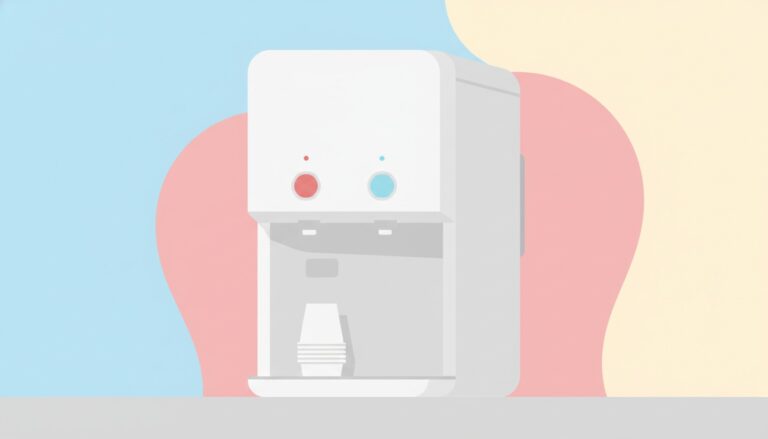
You see other customers standing up, walking to a corner, and getting water themselves. You feel awkward. You just want a drink, but you don’t know the rules. Welcome to the world of the Korean “Jeongsugi” (Water Purifier).
In Korea, water is almost always free, but it’s rarely brought to you. If you don’t know how to spot the machine or read the “Self” sign, you’re going to stay thirsty. Let’s fix that right now so you can handle the spice like a pro.
Phase 2: Core Expressions (The Survival Pack)
Here are the only three phrases you really need to survive the heat.
1. 물 (Mul)
- Pronunciation: [Mul] — Sounds a bit like the English word “Moon” but ends with an ‘L’. Think of “Pull” but with an ‘M’.
- Meaning: Water.
- K-Culture Moment: In K-Dramas, when a character hears shocking news, they often grab the back of their neck and shout, “Mul! Mul!”
- Editor’s Insight: This is the most basic word. You can just say this one word with a polite nod, and people will understand.
- Situation Spectrum:
[🚫 Formal Speech] ———— [✅ Standard/Casual]
(It’s a noun, so add ‘yo’ or ‘juseyo’ to make it polite!)2. 물 좀 주세요 (Mul jom ju-se-yo)
- Pronunciation: [Mul-jom-ju-se-yo] — “Mul” (Water) + “Jom” (Please/A little) + “Ju-se-yo” (Give me).
- Meaning: Please give me some water.
- Editor’s Insight: Use this if you are sitting at a table and there is no water bottle and no machine in sight. It’s polite and works on everyone.
- Situation Spectrum:
[🚫 Friends] ———— [✅ Strangers/Servers]3. 물은 셀프 (Mul-eun Self)
- Pronunciation: [Mul-eun-sel-peu]
- Meaning: Water is self-service.
- K-Culture Moment: You will see this written on signs in 90% of casual Korean restaurants. It’s basically the “Golden Rule” of Korean dining.
- Editor’s Insight: This isn’t something you say; it’s something you read. If you see this sign, don’t call the waiter. Stand up and find the machine!
- 🤔 Think About It: Why does Korea use the English word “Self” instead of a Korean word? It implies a modern, quick service culture that started booming in the 80s/90s.
Phase 3: Textbook vs. Real Life
| Situation | 📖 Textbook Korean | 🗣️ Real Korean | 💡 Why different? |
|---|---|---|---|
| Asking for water | 물을 주시겠습니까? (Mu-reul ju-si-get-seum-nik-ka?) | 여기 물 좀 주세요! (Yeogi, mul jom juseyo!) | The textbook version is too stiff. It sounds like you are asking a king for water. |
| Finding the purifier | 정수기가 어디에 있습니까? (Where is the purifier located?) | 정수기 어디예요? (Jeongsugi eodi-yeyo?) | In reality, we drop particles (like -ga) for speed. |
| Empty bottle on table | 물이 없습니다. (There is no water.) | (Just lift the empty bottle and look at the owner) | Usually, eye contact + lifting the bottle gets you a refill instantly. Context is everything! |
Bottom Note: As a beginner (A1), pointing at the empty cup and smiling while saying “Mul?” works 100% of the time.
Phase 4: Cultural Context — The “Jeongsugi” Code
4-1. The Red and Blue Buttons
Be careful. The Korean Jeongsugi usually has two taps or buttons:
– 🔵 Blue: Cold water (Naeng-su). This is what you want for spicy food.
– 🔴 Red: Hot water (On-su). This is piping hot, usually for instant coffee or cup noodles.
Editor’s Tip: I once saw a student fill a cup from the red tap thinking it was just ‘regular’ water. He couldn’t feel his tongue for a day. Watch out for the red safety lock!
4-2. The Paper Envelope Cup
Sometimes, next to the machine, you won’t see plastic cups. You’ll see a stack of tiny, flat paper envelopes. You have to pull one out and pop it open to hold water. It’s tricky! You can’t put these down on the table; they fall over. You must drink standing up right there. It’s a “drink and go” station.
Phase 5: Immersive Roleplay
Setting: A small, noisy Gimbap restaurant. Lunchtime. You are sweating because the Tuna Gimbap was spicier than expected.
Characters:
– YOU: A thirsty traveler.
– Ajumma (Owner): Busy, shouting orders to the kitchen, but kind.
(Dialogue Start)
YOU: (Waving hand timidly) 저기요… (Jeogiyo… / Excuse me…)
Ajumma: (Looking over while chopping carrots) 네? 뭐 필요해요? 🥕
(Ne? Mwo piryo-haeyo? / Yes? What do you need?)
🔀 Decision Point: You need water. What do you say?
A) “Water! Give!” (Too rude/broken)
B) “Mul jom ju-se-yo.” (Polite standard)
C) Look around for a sign first. (The observant pro)
Let’s choose C.
YOU: (You spot a sign on the fridge: ‘물은 셀프’)
Ah! 아, 물은 셀프네요? (Ah, mul-eun self-neyo?)
Ajumma: (Smiling huge) 네, 맞아요! 정수기 저쪽에 있어요. 👉
(Ne, majayo! Jeongsugi jeojjok-e isseoyo. / Yes, correct! The purifier is over there.)
YOU: (Walking to the machine) 감사합니다! (Gamsahamnida!)
(Dialogue End)
Phase 6: 10-Second Shadowing Drill
Don’t just read it. Say it. Feel the rhythm.
- Polite Request:
🥺 (Softly) 물 좀 / 주-세-요.
(Mul jom / ju-se-yo) -
Asking Location:
🤔 (Curious) 정수기 / 어디 / 예요?
(Jeong-su-gi / eo-di / ye-yo?) -
Realizing it’s Self-Service:
😲 (Realization) 아! / 물은 / 셀프!
(Ah! / Mul-eun / Self!)
Phase 7: K-Culture Mini Glossary
| Korean | Romanization | Meaning | Context |
|---|---|---|---|
| 정수기 | Jeongsugi | Water Purifier | Found in every home, office, and restaurant. Essential survival item. |
| 셀프 | Selpeuk (Self) | Self-Service | “Do it yourself.” Used for water, side dishes (Kimchi), and sometimes returning trays. |
| 냉수 | Naengsu | Cold Water | The blue button. |
| 온수 | Onsu | Hot Water | The red button. Caution! |
Phase 8: Traveler’s Survival Kit
So you are in a restaurant and thirsty?
🆘 Survival Expression #1
– 🇰🇷 “여기 물 있어요?” (Yeogi mul isseoyo?)
– 🗣️ Meaning: “Is there water here?” (Asking if you should get it yourself or if they bring it)
– 📍 Where: Any restaurant.
– 💡 Pro Tip: If you see a stainless steel cup box (sterilizer) with a blue light inside, that’s where the cups are. Don’t look for plastic cups on the table.
Phase 9: Think Deeper — “The Culture of Speed”
Why is “Self-Service” water so common in Korea?
In many Western countries, water is served by a waiter, often with ice and lemon, and sometimes you have to pay for bottled water. In Korea, water is 99% free and accessible instantly.
This reflects the Korean “Pali-Pali” (Hurry-Hurry) culture. Waiting for a waiter to bring a glass of water is too slow for a busy lunch rush. It’s also a sign of efficiency—why make the staff do something you can do in 5 seconds? It’s not about bad service; it’s about shared efficiency. Also, because Korean food is communal and often spicy, having an unlimited flow of cold water nearby is practically a human right here.
💬 Your Turn: In your country, is water free in restaurants? Do you serve yourself? Tell me in the comments!
Phase 10: FAQ & Troubleshooting
Q: Can I drink tap water in the bathroom?
A: Generally, Seoul tap water (Arisu) is safe to drink, but… most Koreans don’t drink it straight from the tap. We are obsessed with water purifiers. If you drink from the bathroom tap, locals might look at you with concern. Stick to the machine.
Q: Is the water in the plastic bottle on the table safe?
A: Yes! If there is a bottle already on the table, it’s fresh. Koreans drink a lot of water, so turnover is high.
❌ Common Mistake: Trying to put your mouth directly under the purifier tap.
✅ Fix: Always use a cup! It’s hygiene 101.
Phase 11: Wrap-up
Summary: Today we learned Mul (Water), Jeongsugi (Purifier), and the golden rule: Water is Self.
🚀 Action Mission:
– 🥉 Bronze: Say “Mul jom ju-se-yo” out loud three times right now.
– 🥈 Silver: Next time you watch a K-Drama or Youtube Mokbang, spot the water bottle or purifier in the background.
– 🥇 Gold: Go to a Korean restaurant (in Korea or your country) and find the “Self” sign. Take a picture (mental or real)!
Phase 12: Interactive Quiz
- Scenario: You see a machine with a RED button and a BLUE button. You just ate a spicy chili pepper. Which one do you press?
- A) Red
- B) Blue
- True or False: If you see the sign “물은 셀프” (Water is Self), you should yell loudly for the waiter.
- (True / False)
- Fill in the blank: “________ 좀 주세요.” (Please give me water.)
- A) Kimchi
- B) Mul
- C) Soju
Answers:
1. B (Blue) – Unless you want to burn your tongue twice!
2. False – Go get it yourself!
3. B (Mul)
Frequently Asked Questions (FAQ)
Q: What does "물 (Mul)" mean in Korean and how do you pronounce it?
A: In Korean, "물 (Mul)" is pronounced [Mul] and means: Water.
Q: What does "물 좀 주세요 (Mul jom ju-se-yo)" mean in Korean and how do you pronounce it?
A: In Korean, "물 좀 주세요 (Mul jom ju-se-yo)" is pronounced [Mul-jom-ju-se-yo] and means: Please give me some water.
Q: What does "물은 셀프 (Mul-eun Self)" mean in Korean and how do you pronounce it?
A: In Korean, "물은 셀프 (Mul-eun Self)" is pronounced [Mul-eun-sel-peu] and means: Water is self-service.







