

Phase 1: The Late-Night Panic 🌙
Hello! This is your Daily Hangul Editor.
Picture this: It’s 1:00 AM. You’re in your hotel room in Seoul. Your stomach is making angry noises because that “mild” Tteokbokki (spicy rice cake) you ate for dinner was actually nuclear-level spicy. 🥵
You need help. But wait—shops are closed. Is there a pharmacy open? Probably not.
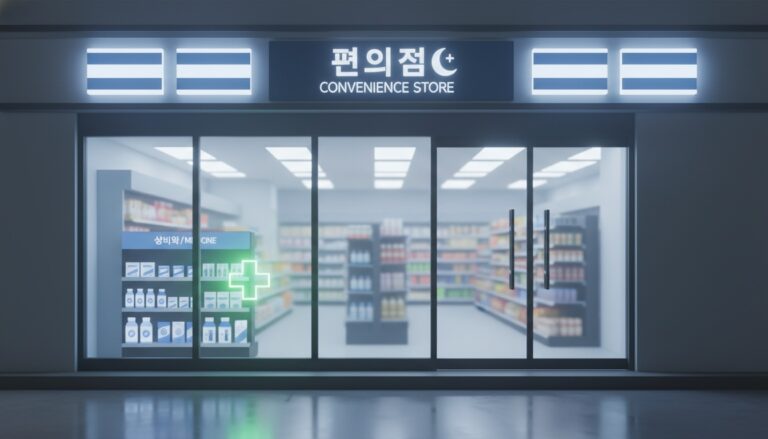
Then you see it. The glowing blue and white sign of a GS25 or CU on the corner. It’s a beacon of hope. In K-Dramas, this is where the lead characters meet for late-night ramen, but for you right now, it’s a lifeline.
Did you know Korean convenience stores are like mini-hospitals for minor emergencies? Today, we aren’t just learning words; we are learning how to survive a stomach ache in Seoul without waking up your host.
Phase 2: The Magic Words (Deep Dive) 💊
Here are the only three phrases you really need when you’re in pain and brain-fogged.
1. 약 있어요? (Yak i-sseo-yo?)
- Pronunciation: [Yak] (sounds like the animal ‘Yak’ but shorter) + [E-sseo-yo?] (rising tone at the end)
- Meaning: “Do you have medicine?”
- Real Nuance: This is the fastest way to ask. You don’t need to ask “Do you sell…?” Just ask “Is there…?”
- K-Culture Moment: In the drama Squid Game or any survival show, resources are scarce. Being able to ask “Do you have [item]?” is the ultimate survival skill.
- Situation Spectrum:
[🚫 Formal boss] ———— [⚠️ Polite strangers] ———— [✅ Convenience Store Staff]
(Perfect for talking to staff efficiently.)- 🤔 Think About It: In English, we often say “Do you carry…?” or “Do you sell…?” In Korean, we focus on existence: “Is it there?” (있어요?). Why do you think Korean focuses on the object’s existence rather than the shop’s action?
2. 소화제 (So-hwa-je)
- Pronunciation: [So-hwa-je]
- Meaning: Digestive medicine
- Editor’s Insight: This is arguably the most important word for travelers. Korean food is delicious but can be heavy on garlic, spice, and fermentation. Your stomach might need a transition period. Liquid digestive drinks (like Whal-myung-su) are legendary here.
3. 타이레놀 (Ta-i-re-nol)
- Pronunciation: [Ta-i-re-nol]
- Meaning: Tylenol (Painkiller)
- Editor’s Insight: Most Koreans use brand names. Instead of saying “painkiller” (jin-tong-je), just saying “Tylenol” works 99% of the time at convenience stores.
Phase 3: Textbook vs. Real Life 🗣️
| Situation | 📖 Textbook Korean | 🗣️ Real Korean | 💡 Why different? |
|---|---|---|---|
| Asking for meds | 비상 상비약이 구비되어 있습니까? (Is emergency medicine stocked?) | 약 팔아요? (Do you sell meds?) | No one uses complex grammar when their head hurts. |
| Asking for band-aids | 반창고 있습니까? (Do you have adhesive bandages?) | 밴드 있어요? (Have bands?) | “Band” (from Band-Aid) is the universal word now. |
| Buying digestive drink | 소화제 주세요. (Please give me digestive medicine.) | 까스활명수 하나요. (One Gas-Whal-myung-su, please.) | Brand names are often used as common nouns. |
💡 Bottom Note: Use the Real Korean column. The clerk will understand you faster, and you’ll look like a local.
Phase 4: Cultural Deep Dive — The “Sangbi-yak” System 🏪
4-1. The “Safety Reserve Drug” Shelf
Not every convenience store sells medicine, but most 24-hour ones do. Look for a small, separate shelf usually near the counter. It’s called 안전상비의약품 (Safety Reserve Drugs).
What you can usually find:
– Painkillers (Tylenol, Children’s Tylenol)
– Digestives (Pills and Drinks)
– Cold medicine (Basic Panpyrin)
– Patches (Pas) for muscle pain—Koreans love these for stiff shoulders!
4-2. Non-verbal Cue: The “Stomach Rub”
If you forget the word So-hwa-je, just rub your stomach in a circular motion and look in pain. The staff will immediately point you to the digestive drinks. It’s a universal language, but in Korea, where indigestion is treated seriously, they react fast.
Phase 5: Roleplay — Midnight at CU 🎬
Setting: 2:00 AM. A quiet CU convenience store in Hongdae. The staff is restocking shelves. You have a splitting headache.
Characters:
– YOU: Tourist with a headache.
– Staff: A tired university student working part-time.
(Dialogue)
Staff: (Hearing the door chime) 어서 오세요. (Eoseo oseyo / Welcome.)
YOU: 저기요… 약 있어요? (Jeogiyo… yak isseoyo?)
(Excuse me… do you have medicine?)
Staff: 네, 카운터 옆에 있어요. 어떤 거 찾으세요? (Ne, kaunteo yeope isseoyo. Eotteon geo chajeuseyo?)
(Yes, it’s next to the counter. What are you looking for?)
🔀 Decision Point: What do you say?
A) “My head hurts.” (Body language + “Head”)
B) “Tylenol?” (Direct brand name)
C) “Medicine give me.” (Direct translation)
✅ Best Choice: B) “타이레놀 있어요?” (Tylenol isseoyo?)
Why? It’s the clearest. The staff doesn’t need to diagnose you; they just need to scan the item.
Staff: 네, 여기요. (Ne, yeogiyo.)
(Points to the Tylenol).
YOU: 감사합니다. (Gamsahamnida.)
Phase 6: 10-Second Shadowing Drill 🎧
Practice these until they roll off your tongue.
- 😖 (In pain): 배가 / 너무 / 아파요.
- (Bae-ga / neo-mu / a-pa-yo)
- My stomach / really / hurts.
- 🚑 (Urgent): 혹시 / 약 / 팔아요?
- (Hok-si / yak / pa-ra-yo?)
- By chance / do you sell / medicine?
- 😌 (Relieved): 밴드 / 하나 / 주세요.
- (Ban-deu / ha-na / ju-se-yo)
- Band-aid / one / please give.
Phase 7: K-Culture Mini Glossary 📖
| Korean | Romanization | Meaning | Context |
|---|---|---|---|
| 편의점 | Pyeon-ui-jeom | Convenience Store | The lifeline of modern Korea. 24/7 access to food, meds, and caffeine. |
| 해장 | Hae-jang | Hangover cure | Eating or drinking something to relieve a hangover. Often sold at convenience stores. |
| 파스 | Pa-seu | Muscle Patch | A sticky patch for sore muscles. Smells like mint/menthol. K-Drama grandmas always use this. |
| 비상약 | Bi-sang-yak | Emergency Meds | The category of drugs legally allowed in convenience stores. |
Phase 8: Traveler’s Survival Kit 🆘
Can’t find a pharmacy? Go here.
💊 Survival Phrase Card
– 🇰🇷 “이거 소화제예요?” (I-geo so-hwa-je-ye-yo?)
– 🗣️ Meaning: “Is this digestive medicine?”
– 📍 Use when: You are holding a bottle but aren’t sure if it’s for digestion or energy.
– 💡 Pro Tip: Look for the fan icon (logo of Whal-myung-su) or a picture of a stomach on the package.📌 Editor’s Travel Note
– Pharmacy (약국 – Yak-guk): Marked with a “약” sign. They sell stronger meds and antibiotics (prescription needed for antibiotics).
– Convenience Store: Only basic meds. If you have a high fever or infection, you must wait for a pharmacy or go to an ER.
– Maps: Search “Drugstore” or “Pharmacy” on Naver Map to find real pharmacies, not just convenience stores.
Phase 9: Think Deeper — Speed & Access 🧠
Why can you buy medicine at a snack shop?
Korea legalized the sale of basic safety medicines in convenience stores in 2012. Before that, if you had a headache at night, you had to suffer or go to the Emergency Room. This change reflects the Korean value of “Palli-palli” (Quick, Quick) and efficiency. In a city that never sleeps, access to relief shouldn’t sleep either. Does your country allow medicine sales in supermarkets, or is it strictly pharmacies? How does that shape how you deal with minor sickness?
Phase 10: FAQ & Troubleshooting 🛠️
Q: Can I buy antibiotics at the convenience store?
A: No. Never. Antibiotics require a doctor’s prescription in Korea. Convenience stores only have painkillers, digestives, cold meds, and patches.
Q: I see a drink in a glass bottle. Is that medicine?
A: It depends. If it says 박카스 (Bacchus) or 비타500 (Vita500), it’s an energy drink (caffeine/vitamin). If it says 까스활명수, it’s for digestion. Ask the staff: “Energy?” or “Stomach?”
❌ Common Mistake: Asking for “Aspirin.”
✅ Fix: Aspirin is surprisingly hard to find in Korean convenience stores. Ask for “Tylenol” or “Bu-ru-fen” (Ibuprofen) instead.
Phase 11: Wrap-up & Mission 🚀
One-Liner: Convenience stores are your 24/7 pharmacy for headaches, stomach aches, and hangovers.
Your Mission:
- 🥉 Bronze: Say “Yak i-sseo-yo?” out loud three times right now.
- 🥈 Silver: Go to a Korean convenience store (or an Asian market in your country) and find the ‘digestive drink’ section.
- 🥇 Gold: Walk into a convenience store in Korea, find the medicine shelf, and buy a small pack of band-aids using Korean!
📺 K-Culture Mission: Watch a K-Drama scene where characters drink a hangover cure (often in a small brown bottle) the morning after drinking. That’s usually bought at a convenience store!
Phase 12: Quiz 📝
1. You ate too much Bibimbap and feel sick. What do you ask for?
A) 타이레놀 (Tylenol)
B) 소화제 (So-hwa-je)
C) 밴드 (Band)
2. True or False?
“You can buy antibiotics at 7-Eleven in Korea if you ask nicely.”
3. Situation Check:
You enter a store and see the sign “약” (Yak). Is this a convenience store or a pharmacy?
(Scroll down for answers)
.
.
.
Answers:
1. B) 소화제 (Digestive medicine).
2. False. Antibiotics are strictly prescription-only at pharmacies.
3. Pharmacy. Convenience stores don’t usually have a big “약” sign outside; they just have a small shelf inside.
Frequently Asked Questions (FAQ)
Q: What does "약 있어요? (Yak i-sseo-yo?)" mean in Korean and how do you pronounce it?
A: In Korean, "약 있어요? (Yak i-sseo-yo?)" is pronounced [Yak] and means: "Do you have medicine?"
Q: What does "소화제 (So-hwa-je)" mean in Korean and how do you pronounce it?
A: In Korean, "소화제 (So-hwa-je)" is pronounced [So-hwa-je] and means: Digestive medicine
Q: What does "타이레놀 (Ta-i-re-nol)" mean in Korean and how do you pronounce it?
A: In Korean, "타이레놀 (Ta-i-re-nol)" is pronounced [Ta-i-re-nol] and means: Tylenol (Painkiller)






