

Introduction: When Words Carry the Weight of Life
Hello, Daily Hangul family. It’s your Senior Editor here.
Usually, we talk about how to order food or ask for directions. But as you reach the C1 (Advanced) level, your Korean journey shifts from “survival” to “deep connection.” Today, we are stepping into a quiet, sterile hospital room to discuss a topic that even Koreans find difficult: Medical Ethics and the issue of Euthanasia (Death with Dignity).
Imagine a close Korean friend confiding in you about a sick family member, or watching a news debate about the “Well-dying Law.” If you only know A1 survival phrases, you can only offer a blank stare. But knowing how to discuss life, death, and dignity with nuance? That is when you truly become a part of their world.
This guide is based on real conversations happening in Korean hospitals and cafes right now. Let’s approach this with respect and focus.
Phase 2: Deep Dive into Core Expressions
Here are the three most critical expressions you need to navigate this heavy topic.
1. 연명 치료 (Yeon-myeong chi-ryo)
- Pronunciation: [Yeon-myeong chi-ryo] Sounds like ‘Yon-myung chee-ryo’
- Meaning: Life-sustaining treatment
- Editor’s Insight: This is the medical and legal term for treatments (like respirators or CPR) that only extend the dying process without curing the patient.
- Situation Check: Used in serious discussions, news, and consultations with doctors.
2. 존엄사 (Jon-eom-sa) vs. 안락사 (Al-lak-sa)
- Pronunciation: [Jon-eom-sa] / [Al-lak-sa]
- Meaning: Death with Dignity (Passive Euthanasia) vs. Euthanasia (Active)
- Editor’s Insight: This distinction is crucial in Korea. 안락사 often implies active injection (which is illegal and controversial). 존엄사 refers to the legal right to refuse meaningless life-sustaining treatment to die naturally. Mixing these up can cause a major misunderstanding about your stance.
- Situation Check: Debates, news, legal discussions.
3. 마음의 준비를 하다 (Ma-eum-ui jun-bi-reul ha-da)
- Pronunciation: [Ma-eum-ui jun-bi-reul ha-da]
- Meaning: To prepare one’s heart (To prepare for the worst/death)
- Editor’s Insight: Doctors rarely say “He will die soon.” Instead, they say “You should prepare your heart.” It is a heartbreakingly gentle euphemism used when death is imminent.
- Situation Check: Personal conversations, hospital verdicts.
Phase 3: Textbook vs. Real Life (C1 Nuance)
At the C1 level, it’s not about being “correct”; it’s about being “appropriate” for the emotional atmosphere.
| Textbook (Dry & Factual) | Real Life (Considerate & Softened) |
|---|---|
| 안락사에 찬성합니까? (Do you agree with euthanasia?) |
환자의 고통을 덜어주는 게 맞지 않을까요? (Wouldn’t it be right to relieve the patient’s pain?) |
| 그는 죽었습니다. (He died.) |
이제 편안한 곳으로 가셨어요. (He has gone to a comfortable place now.) |
| 치료를 거부하겠습니다. (I will refuse treatment.) |
무의미한 연명 치료는 원치 않아요. (I don’t want meaningless life-sustaining treatment.) |
Note: In “Real Life” Korean, we often use questions or softer verbs (like adding ~지 않을까요?) to express opinions on sensitive topics, rather than direct statements.
Phase 4: Cultural Context – Hyo (Filial Piety) vs. Reality
In Korea, Hyo (효, Filial Piety) is deeply ingrained. Historically, children felt they had to keep parents alive at all costs; stopping treatment was seen as “unfilial” (불효).
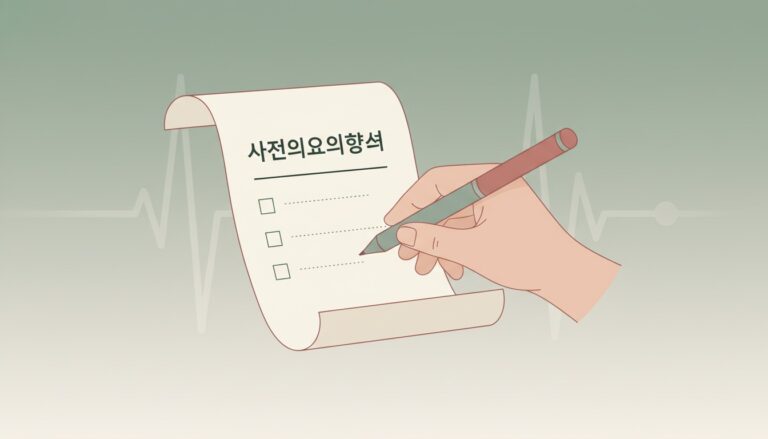
However, modern Korea is changing fast. The concept of “Well-dying” (웰다잉) is trending. Many elderly people now sign the 사전연명의료의향서 (Advance Directive) themselves because they don’t want to become a burden to their children.
Cultural Tip: If a Korean friend is struggling with this decision regarding a parent, never say “Just let them go, it’s logical.” Acknowledge their guilt. Say, “정말 힘든 결정이었을 텐데, 고생 많았어요” (It must have been a really hard decision; you went through a lot).
Phase 5: Roleplay Scenario
Setting: A quiet cafe. Min-ji is distressed about her grandmother in the ICU. Alex listens comfortably.
Min-ji: 할머니 상태가 더 나빠지셨어. 의사 선생님은 이제 마음의 준비를 하라고 하시네.
(Grandma’s condition got worse. The doctor said we should prepare for the worst.)
Alex: (Speaking softly, leaning in) 저런… 가족분들 걱정이 많으시겠다. 혹시 연명 치료 문제는 얘기해 봤어?
(Oh no… your family must be so worried. Have you discussed the life-sustaining treatment issue?)
Min-ji: 응. 할머니께서 건강하실 때 미리 사전연명의료의향서를 써두셨더라고. 기계에 의존해서 살고 싶지 않으시다고…
(Yeah. Grandma actually wrote an Advance Directive when she was healthy. She said she didn’t want to live depending on machines…)
Alex: 할머니께서 자식들 힘들게 안 하려고 미리 결정해 주셨네. 정말 현명하시다.
(She decided in advance so as not to burden her children. She is truly wise.)
Min-ji: 머리로는 알겠는데, 막상 보내드리려니 마음이 너무 아파.
(I understand it in my head, but actually letting her go hurts so much.)
Phase 6: 10-Second Shadowing Drill
Let’s practice a sentence you might use to express your own philosophy on “Well-dying.”
“If I fall into a critical condition, I don’t want meaningless treatment.”
만약 위독한 상태가 된다면, / 무의미한 연명 치료는 / 받고 싶지 않아요.
[Man-yak wi-dok-han sang-tae-ga doen-da-myeon, / mu-ui-mi-han yeon-myeong chi-ryo-neun / bat-go sip-ji an-a-yo.]
- Intonation Tip: Pause slightly after ‘된다면’ (condition). Stress ‘무의미한’ (meaningless) to emphasize your reason.
Phase 7: FAQ & Troubleshooting
Q: Can I use the word ‘안락사’ (Euthanasia) when talking about pets?
A: Yes! For animals, we use 안락사시키다 (to euthanize). But for humans, be careful. Using ‘안락사’ for humans usually implies a controversial, active measure. Use 존엄사 (Death with Dignity) when talking about withdrawing treatment legally.
Q: Is it rude to ask an elderly person if they signed the Advance Directive?
A: Generally, Yes, unless you are family. It can sound like you are waiting for them to die. However, you can discuss it as a general social topic: “요즘 웰다잉법에 대한 뉴스가 많더라고요” (There is a lot of news about the Well-dying law lately).
Phase 8: Wrap-up
Summary: Today we navigated the delicate vocabulary of 연명 치료 (life-sustaining treatment), 존엄사 (death with dignity), and the cultural shift towards Well-dying.
Action Mission: Watch a Korean news clip on YouTube searching for “존엄사 논란” (Death with dignity controversy). See if you can pick out the words we learned today.
Engagement: Does your country have a legal system for ‘Death with Dignity’? How is it different from Korea? Tell me in the comments!
Phase 9: Quiz
- What is the Korean term for “Life-sustaining treatment”?
- A) 물리 치료 (Physical therapy)
- B) 연명 치료
- C) 응급 처치 (First aid)
- Which phrase is a gentle euphemism for “Please expect death soon”?
- A) 짐을 싸세요 (Pack your bags)
- B) 마음의 준비를 하세요
- C) 퇴원 준비를 하세요 (Prepare for discharge)
- True or False: In Korea, active Euthanasia (injection) is currently legal.
- A) True
- B) False
(Answers: 1. B / 2. B / 3. B)
Frequently Asked Questions (FAQ)
Q: What does "연명 치료 (Yeon-myeong chi-ryo)" mean in Korean and how do you pronounce it?
A: In Korean, "연명 치료 (Yeon-myeong chi-ryo)" is pronounced [Yeon-myeong chi-ryo] and means: Life-sustaining treatment
Q: What does "존엄사 (Jon-eom-sa) vs. 안락사 (Al-lak-sa)" mean in Korean and how do you pronounce it?
A: In Korean, "존엄사 (Jon-eom-sa) vs. 안락사 (Al-lak-sa)" is pronounced [Jon-eom-sa] and means: Death with Dignity (Passive Euthanasia) vs. Euthanasia (Active)
Q: What does "마음의 준비를 하다 (Ma-eum-ui jun-bi-reul ha-da)" mean in Korean and how do you pronounce it?
A: In Korean, "마음의 준비를 하다 (Ma-eum-ui jun-bi-reul ha-da)" is pronounced [Ma-eum-ui jun-bi-reul ha-da] and means: To prepare one's heart (To prepare for the worst/death)







