

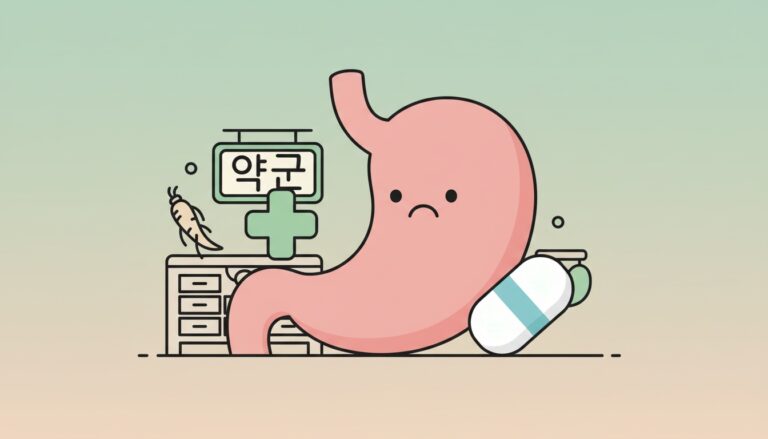
Ate Too Much Kimchi? Survival Korean for Your Upset Stomach
Hello! This is your Daily Hangul Editor.
Let’s be honest—Korean food is delicious. Between the endless side dishes (Banchan) and spicy rice cakes (Tteokbokki), it is very easy to overeat.
Imagine this: You are in Seoul, you just had a massive BBQ dinner, and now your stomach feels like a balloon ready to pop. You see a pharmacy sign (약), but you freeze. How do you explain that you feel bloated without acting out a mime performance?
Don’t worry. As a tutor, I’ve seen many students suffer in silence because they didn’t know this one simple phrase. Today, we are going to learn how to save your stomach (and your night) with the most essential survival phrase: “Please give me digestive medicine.”
Phase 1: Deep Dive (Key Expressions)
Here are the top 3 phrases you need. Since you are Level A1, we will keep it short, sweet, and polite.
1. 소화제 주세요 (Please give me digestive medicine)
- Pronunciation: [So-hwa-je ju-se-yo]
- So sounds like “Sew” a button.
- Hwa sounds like “Wha” in “What”.
- Je sounds like “Jay”.
- Meaning: “Digestive medicine, please.”
- Editor’s Insight: This is the magic key. You don’t need to explain why your stomach hurts. Just ask for this, and the pharmacist will understand immediately.
- Situation Check: ✅ Polite enough for strangers and pharmacists.
2. 체했어요 (I have indigestion)
- Pronunciation: [Che-haess-eo-yo]
- Che sounds like “Che” in “Check”.
- Haess sounds like “Hess”.
- Meaning: “I have an upset stomach/indigestion.”
- Editor’s Insight: In Korea, we use the verb 체하다 (che-ha-da) specifically when food gets “stuck” in your stomach. It’s more specific than just saying “It hurts.”
- Situation Check: ✅ Use this to describe your symptom.
3. 배가 아파요 (My stomach hurts)
- Pronunciation: [Bae-ga a-pa-yo]
- Bae sounds like the letter “A” with a ‘B’ in front (or ‘Bear’ without the ‘r’).
- A-pa sounds like “Appa” (Dad).
- Meaning: “My stomach hurts.”
- Editor’s Insight: This is a general phrase. You can use it if you have a stomach flu, cramps, or just ate too much spicy food.
- Situation Check: ✅ Very common and useful.
Phase 2: Textbook vs. Real Life
Textbooks often teach you formal medical terms, but in real life, we keep it simple.
| Textbook Korean (Too Stiff) | Real Korean (Natural) |
|---|---|
| 소화 불량입니다. (I am suffering from indigestion.) | 속이 안 좋아요. (My insides/stomach aren’t good.) |
| 약국이 어디입니까? (Where is the pharmacy located?) | 약국 어디예요? (Where’s the pharmacy?) |
Note for A1: Don’t worry about “Sok-i an jo-a-yo” (My insides aren’t good) yet if it’s too hard. Stick to “So-hwa-je ju-se-yo”!
Phase 3: Cultural Context & Manners
1. The Universal Hand Gesture
If you forget all the Korean words, do this: Rub your stomach in a circular motion with your hand. Every Korean understands this means “My tummy hurts/I have indigestion.”
2. The “Yak” (약) Sign
Korean pharmacies are marked with a big “약” (Yak) sign on the window.
* Insider Tip: If it’s late at night and pharmacies are closed, go to a convenience store (CU, GS25, 7-Eleven). They sell basic so-hwa-je (digestive drinks) 24/7!
3. The Grandmother’s Cure
If you tell a Korean friend you are “Che-haess-eo-yo,” they might offer to prick your thumb with a needle to let “bad blood” out. This is a traditional folk remedy. Don’t be scared, but you can politely say no and go to the pharmacy instead!
Phase 4: Real-Life Scenario (Roleplay)
Setting: A small pharmacy (Yakguk) in Hongdae.
Characters: Alex (You, holding stomach) vs. Pharmacist (Kind Korean lady).
(Alex walks in, looking uncomfortable and rubbing his stomach.)
Pharmacist: 안녕하세요. 어디 아프세요?
(An-nyeong-ha-se-yo. Eo-di a-peu-se-yo?)
[Hello. Where does it hurt?]
Alex: 체했어요.
(Che-haess-eo-yo.)
[I have indigestion.]
Pharmacist: 아, 저런. 약 드릴게요.
(Ah, jeo-reon. Yak deu-ril-ge-yo.)
[Oh, dear. I will give you medicine.]
Alex: 감사합니다. 소화제 주세요.
(Gam-sa-ham-ni-da. So-hwa-je ju-se-yo.)
[Thank you. Please give me digestive medicine.]
Phase 5: 10-Second Shadowing
Read this out loud. Focus on the pause at the / mark.
“So-hwa-je / ju-se-yo.”
(Digestive medicine / please give me.)
- Tip: Don’t say “ju-se-yo” too fast. Say it gently to sound polite.
Phase 6: FAQ (Troubleshooting)
Q: Can I use “So-hwa-je ju-se-yo” at a restaurant?
A: No! Restaurants don’t serve medicine. However, some restaurants serve “Maesil-cha” (Plum tea) after a meal, which is a natural digestive aid. You can ask: “Maesil-cha isseoyo?” (Do you have plum tea?)
Q: Is this phrase formal?
A: Yes! The ending “-yo” makes it polite. You can use it with a doctor, pharmacist, or a convenience store clerk.
Phase 7: Wrap-up
One-Liner Summary: When your stomach feels heavy, find a “약” sign and say “So-hwa-je ju-se-yo.”
Today’s Mission: Next time you are at a convenience store in Korea (or a Korean mart in your country), look for the drink section. Try to find the small brown bottles labeled “까스활” or “위생천”. These are famous digestive drinks!
Have you ever gotten sick from eating too much spicy food? Tell me in the comments! 👇
Phase 8: Pop Quiz
1. What does “So-hwa-je” mean?
a) Headache medicine
b) Digestive medicine
c) Water
2. Which body language means “My stomach hurts” in Korea?
a) Scratching your head
b) Rubbing your tummy in a circle
c) Clapping your hands
3. Where can you buy basic digestive medicine late at night?
a) Bank
b) Convenience Store
c) Post Office
Click to see answers
1. b) Digestive medicine
2. b) Rubbing your tummy in a circle
3. b) Convenience Store
Frequently Asked Questions (FAQ)
Q: What does "체하다" mean in Korean and how do you pronounce it?
A: In Korean, "체하다" is pronounced [che-ha-da] and means: specifically when food gets "stuck" in your stomach. It’s more specific than just saying "It hurts."







