

Phase 1: Introduction
Hello! This is your Senior Editor at Daily Hangul.
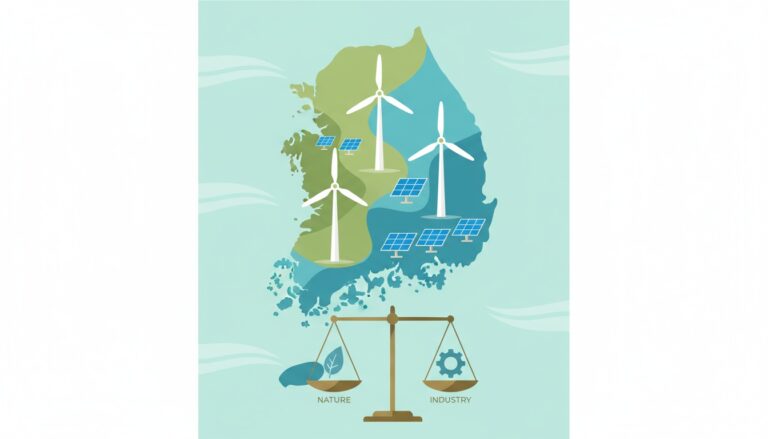
Imagine this: You are at a networking dinner or a university seminar in Seoul. The conversation shifts from K-Pop and food to something serious—Climate Change (gi-hu wi-gi). Suddenly, someone asks for your opinion on Korea’s push for renewable energy.
Most learners freeze here. You know how to say ‘it is hot’ or ‘trash,’ but do you know how to discuss policy feasibility or stakeholder conflict?
If you simply say, “Recycling is good,” you sound like a kind kindergartner. But at the C1 (Advanced) level, we want you to sound like an informed intellectual. Today, we are upgrading your vocabulary from ‘saving the earth’ to ‘analyzing the energy transition roadmap.’
Let’s dive into the words that will make Koreans nod in respect.
Phase 2: Deep Dive (Core Expressions)
Here are the heavy-hitters used in news editorials and serious discussions.
1. [탄소 중립을 실현하다]
- Pronunciation: [Tan-so jung-nip-eul sil-hyeon-ha-da] (Sounds like: Tan-so (carbon) + jung-nip (neutral) + sil-hyeon (realization))
- Meaning: To realize/achieve carbon neutrality.
- Editor’s Insight: You can’t just talk about climate change without this phrase. Note the verb 실현하다 (to realize/actualize). It sounds much more determined and policy-driven than simply ‘doing’ (하다) or ‘making’ (만들다).
- Situation Check: ✅ Formal Debate / ✅ News / ✅ Business Report
2. [이해관계가 얽혀 있다]
- Pronunciation: [I-hae-gwan-gye-ga eol-kyeo it-da] (Note: ‘Eol-kyeo’ is tricky. Think of ‘Earl’ + ‘K-yo’)
- Meaning: Interests are intertwined/tangled (Complex stakeholder situation).
- Editor’s Insight: This is the magic phrase when you want to say, “It’s complicated.” Why is the energy transition slow? Because the government, corporations, and environmental groups all have different goals. Use this, and you sound like a political analyst.
- Situation Check: ✅ Serious Conversation / ✅ Describing Politics
3. [시기상조]
- Pronunciation: [Si-gi-sang-jo] (See-gee-sang-jo)
- Meaning: Premature; too early to do something.
- Editor’s Insight: This is a Sajeoseong-eo (Four-character idiom). In energy debates, skeptics often say a full transition to 100% renewables is 시기상조. Using idioms like this instantly boosts your perceived fluency level.
- Situation Check: ✅ Debates / ✅ Expressing Doubts
Phase 3: Textbook vs. Real Life
At the C1 level, “Real Life” means sounding professional, not just casual.
| Textbook (Grammatically Correct) | Real Life / News (C1 Proficiency) |
|---|---|
| 환경을 위해 에너지를 바꿔야 해요. (We need to change energy for the environment.) |
에너지 전환은 거스를 수 없는 흐름입니다. (Energy transition is an irreversible trend.) |
| 그것은 아직 너무 빨라요. (That is still too fast/early.) |
현실적으로 시기상조라는 우려가 있습니다. (Realistically, there are concerns that it is premature.) |
| 여러 사람이 반대하고 있어요. (Many people are opposing it.) |
사회적 합의가 먼저 선행되어야 합니다. (Social consensus must precede this action.) |
Editor’s Note: Notice the use of nouns like 흐름 (trend/flow), 우려 (concern), and 합의 (consensus). C1 Korean relies heavily on Sino-Korean nouns to condense complex ideas.
Phase 4: Cultural Context (The Art of Debate)
The “Yes, but…” Strategy
In Korea, even when discussing dry topics like policy, harmony (Inhwa) is important. If you disagree with someone’s stance on nuclear vs. solar power, don’t say “You are wrong” (틀렸어요).
Instead, acknowledge their point first:
* “물론 그 말씀도 일리가 있습니다만…” (Of course, your point has merit/logic, but…)
Also, emphasize “Reality” (현실성). Korean debates often focus heavily on whether a policy is actually doable in the Korean context (a peninsula nation with limited natural resources). Mentioning “한국의 지리적 특성” (Korea’s geographical characteristics) shows you understand the local context deeply.
Phase 5: Roleplay Script
Setting: A discussion at a university study group about the Green New Deal.
Characters: Mark (Foreign exchange student, C1 level) and Sujin (Korean student majoring in Sociology).
Sujin: 정부가 재생 에너지 비중을 급격히 늘리겠다고 발표했는데, 현실성이 있을까?
(The government announced they’d drastically increase the proportion of renewable energy, but is that realistic?)
Mark: 글쎄, 장기적으로는 가야 할 길이지만, 당장은 이해관계가 복잡하게 얽혀 있어서 쉽지 않을 거야.
(Well, it’s the path we must take in the long run, but right now, interests are complicatedly intertwined, so it won’t be easy.) [(Shakes head thoughtfully)]
Sujin: 맞아. 산업계에서는 아직 시기상조라는 말이 나오더라고.
(Right. The industry sector is saying it’s still premature.)
Mark: 응. 그러니까 사회적 합의를 이끌어내는 과정이 정말 중요할 것 같아.
(Yeah. That’s why the process of drawing out a social consensus seems really important.)
Phase 6: 10-Second Shadowing
Practice this sentence to sound like a news anchor. Pay attention to the pauses.
“단순한 선언을 넘어 / 실효성 있는 대책 마련이 / 시급합니다.”
- Pronunciation: Dan-sun-han seon-eon-eul neo-meo / sil-hyo-seong it-neun dae-chaek ma-ryeon-i / si-geup-ham-ni-da.
- Meaning: Beyond simple declarations, the preparation of effective measures is urgent.
- Key: Emphasize 넘어 (beyond) and 시급 (urgent).
Phase 7: FAQ & Troubleshooting
- Q: Can I use ‘시기상조’ with my boss?
- A: Yes and No. It is a formal word, so it fits the setting. However, if you are telling your boss his idea is ‘시기상조’, it sounds arrogant. Use it to describe external situations or policies, not your superior’s direct suggestions.
- Q: Is ‘탄소 중립’ only for writing?
- A: No. It is the standard spoken term in news and debates. Don’t try to translate “carbon free” as “탄소 공짜” (that means free-of-charge carbon!). Stick to 탄소 중립.
Phase 8: Wrap-up
Today’s One-Liner:
Don’t just say “It’s good”; say “It requires social consensus” (사회적 합의가 필요해요).
Your Mission:
Go to a Korean news site (like Naver News), search for “재생 에너지” (Renewable Energy), and find the word “우려” (Concern) in the headlines. It’s everywhere!
Question:
Does your country have a lot of “이해관계” (intertwined interests) regarding climate policy? Let me know in the comments!
Phase 9: Quiz
1. Which word best fills the blank? “Ideally it’s great, but realistically it is ______.” (Still too early)
a) 일석이조 (Killing two birds with one stone)
b) 시기상조 (Premature)
c) 금시초문 (Hearing for the first time)
2. How do you say “Stakeholders/Interests are tangled”?
a) 이해관계가 얽혀 있다
b) 기분이 얽혀 있다
c) 날씨가 얽혀 있다
3. What is the Korean term for “Carbon Neutrality”?
a) 탄소 제로
b) 탄소 중립
c) 탄소 반대
(Answers: 1.b, 2.a, 3.b)
Frequently Asked Questions (FAQ)
Q: What does "[탄소 중립을 실현하다]" mean in Korean and how do you pronounce it?
A: In Korean, "[탄소 중립을 실현하다]" is pronounced [Tan-so jung-nip-eul sil-hyeon-ha-da] and means: To realize/achieve carbon neutrality.
Q: What does "[이해관계가 얽혀 있다]" mean in Korean and how do you pronounce it?
A: In Korean, "[이해관계가 얽혀 있다]" is pronounced [I-hae-gwan-gye-ga eol-kyeo it-da] and means: Interests are intertwined/tangled (Complex stakeholder situation).
Q: What does "[시기상조]" mean in Korean and how do you pronounce it?
A: In Korean, "[시기상조]" is pronounced [Si-gi-sang-jo] and means: Premature; too early to do something.







