

Hello! This is your Daily Hangul Editor. 👋
Have you ever watched a K-Drama and noticed that nobody seems to call each other by their actual names? Everyone is someone’s “brother” or “sister,” even if they aren’t related at all!
Imagine this: You meet a nice Korean friend who is a few years older than you. You want to be polite, so you keep using formal language. But suddenly, they look a bit sad and say, “Why are you so distant?”
In Korea, switching from a name to a title like Unni or Oppa isn’t just about age—it’s the magic switch that turns a stranger into family. If you don’t use these, you might forever remain just “that foreigner friend.”
Let’s break down how to use these terms without making things awkward. This guide is based on real questions from our A2 students!
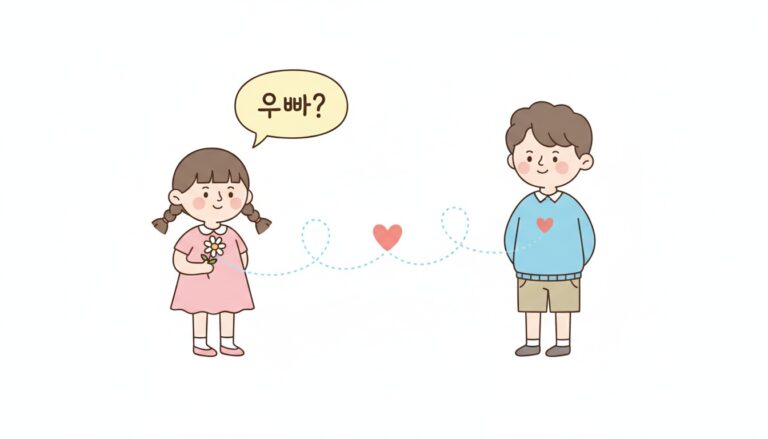
1. 오빠 (Oppa)
- Who uses it: A female 👧 calling an older male 👦.
- Pronunciation:
O-ppa- Sound Analogy: The ‘O’ sounds like the ‘O’ in “O-range.” The ‘ppa’ is a sharp sound, like the ‘pa’ in “Spa” (don’t let too much air out!).
- Meaning: Literally “Older Brother.” Nuance: “A reliable older guy friend I am close to.”
- Editor’s Insight: This word has power. When you call a guy “Oppa,” he instantly feels a responsibility to take care of you (and maybe buy you dinner!).
- Situation Check:
- ✅ Close Friend / Boyfriend
- ❌ Your Boss (Never!)
2. 언니 (Unni)
- Who uses it: A female 👧 calling an older female 👧.
- Pronunciation:
Eon-ni- Sound Analogy: ‘Eon’ sounds like the ‘un’ in “Un-lock.” ‘Ni’ is like the ‘nee’ in “Knee.”
- Meaning: Literally “Older Sister.” Nuance: “A cool older sister figure.”
- Editor’s Insight: Calling someone “Unni” breaks the ice fast. It says, “I want to follow your lead.”
- Situation Check:
- ✅ Close Friend / Senior at school
- ❌ Someone younger than you
3. 형 (Hyung) & 누나 (Nuna)
- For the guys:
- Hyung (형): Male 👦 to Older Male 👦.
- Nuna (누나): Male 👦 to Older Female 👧.
- Editor’s Insight: Guys, calling an older guy Hyung is the ultimate sign of loyalty in Korea.
Textbook vs. Real Life 🇰🇷
Textbooks often teach you to use names with “-ssi.” While correct, it can feel like a wall exists between you.
| Textbook (Safe but Distant) 📚 | Real Life (Friendly & Inssa) 🤩 |
|---|---|
| 지민 씨 (Jimin-ssi) (Mr./Ms. Jimin) |
지민 오빠 / 지민 언니 (Oppa/Unni) |
| 저기요 (Jeogiyo) (Excuse me – to a server) |
언니! / 사장님! (Sister! / Boss! – at a casual restaurant) |
| 선배님 (Sunbaenim) (Senior – very formal) |
형 / 누나 (Brother/Sister – after getting close) |
💡 Editor’s Note: Do not use these titles the very first second you meet someone. Wait until you have chatted for a bit, or simply ask for permission first!
Cultural Context: The Art of “Nunchi” (눈치) 👀
In Korea, figuring out when to drop the formal title is a game of Nunchi (sensing the vibe).
- The Age Check: You usually find out each other’s age early in the conversation. This isn’t rude in Korea; it’s necessary to pick the right title!
- The Permission: You can’t just randomly shout “Oppa!” at a stranger. It requires a mutual feeling of friendship.
- Non-verbal Tip: When you first use the title, smile brightly. If you say it with a straight face, it looks like you are demanding something!
Real-Life Scenario: The Café Date ☕
Setting: Minji (International student, Female) is having coffee with Jun-ho (Korean friend, Male, Older).
Minji: 저… 준호 씨? 질문 있어요.
(Jeo… Jun-ho ssi? Jilmun isseoyo.)
Um… Mr. Jun-ho? I have a question.
Jun-ho: (Laughing) 에이, ‘씨’는 너무 딱딱해요.
(Ei, ‘ssi’-neun neomu ttakttakhaeyo.)
Hey, ‘ssi’ is too stiff/formal.
Minji: (Shyly) 그럼… 오빠라고 불러도 돼요?
(Geureom… Oppa-rago bulleodo dwaeyo?)
Then… can I call you Oppa?
Jun-ho: (Smiling) 당연하죠! 편하게 말해요.
(Dangyeonhajyo! Pyeonhage malhaeyo.)
Of course! Speak comfortably.
10-Second Shadowing 🗣️
Practice asking for permission smoothly. Focus on raising your tone at the end to sound polite but cute.
“저도 / 언니라고 / 불러도 돼요?”
(Can I / call you Unni / too?)
- Pronunciation: Jeo-do / Eon-ni-ra-go / bul-leo-do / dwae-yo?
- Intonation: Low / High / Low / High ⤴️
FAQ: Troubleshooting 🛠️
- Q: Can I call my boss “Oppa” if he is older?
- A: NO! 😱 Unless you want to get fired or start a scandal. Use their job title (e.g., Manager-nim) at work.
- Q: I am a girl. Can I call an older guy “Hyung”?
- A: No. Hyung is strictly male-to-male. If a girl uses it, she sounds like she’s trying to be “one of the guys” in a comical way.
- Q: What if we are the same age?
- A: Just use their Name + ah/yah (if close) or Name + ssi (if polite). No family titles needed!
Wrap-up & Mission 🚀
One-Liner Summary: Using Unni/Oppa is about emotional closeness, not just biological age.
Your Mission: Next time you meet a Korean friend who is older than you, try this magic sentence: “Can I call you [Oppa/Unni/Hyung/Nuna]?” Watch their face light up!
Tell me in the comments: Have you ever accidentally used the wrong title? Tell me your story! 👇
Pop Quiz 📝
- You are a male student. Your Korean friend is an older female. What do you call her?
- A) Oppa
- B) Nuna
- C) Hyung
- Which situation is WRONG for using these titles?
- A) Calling your boyfriend “Oppa.”
- B) Calling a close senior at school “Unni.”
- C) Calling your CEO “Hyung” during a board meeting.
- What does it mean if a Korean asks your age?
- A) They are rude.
- B) They want to know which title to use.
- C) They want to borrow money.
(Answers: 1. B, 2. C, 3. B)
Frequently Asked Questions (FAQ)
Q: What does "오빠 (Oppa)" mean in Korean and how do you pronounce it?
A: In Korean, "오빠 (Oppa)" is pronounced [O-ppa] and means: a key conversational Korean expression covered in this lesson.
Q: What does "언니 (Unni)" mean in Korean and how do you pronounce it?
A: In Korean, "언니 (Unni)" is pronounced [Eon-ni] and means: a key conversational Korean expression covered in this lesson.







