

Phase 1: Introduction
Hello! This is your Senior Editor from Daily Hangul.
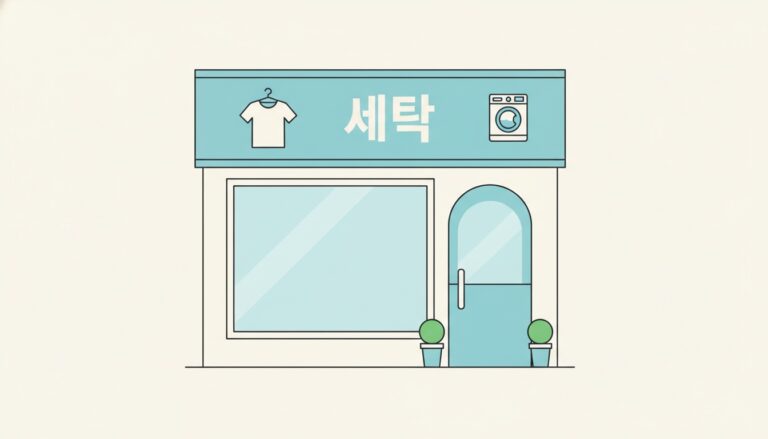
Picture this: You have your favorite wool coat. It’s getting a bit dusty, and winter is coming. You spot a small shop with a sign that says “세탁 (Setak)” in your neighborhood. You walk in, holding the coat, but suddenly you freeze.
“Wait, if I just hand this over, will they wash it in water? Will my expensive coat shrink to the size of a doll’s outfit?”
I’ve seen this happen. My student, Mark, once nodded silently when the owner asked a question he didn’t understand, and his silk shirt came back… different.
Don’t worry. Today, we are going to learn the absolute essentials to drop off your clothes safely at a Korean Dry Cleaners (세탁소 – Se-tak-so). This guide is based on real questions from beginners just like you.
Phase 2: Deep Dive into Key Expressions
Here are the only 3 phrases you really need to survive this mission.
1. 이거 드라이 해주세요 (Please dry clean this)
- Pronunciation: [I-geo deu-ra-i hae-ju-se-yo]
- Sound Check: “I-geo” (Like ‘E-go’) + “Deu-ra-i” (Just say ‘Dry’ with a Korean accent!) + “Hae-ju-se-yo”.
- Meaning: “This one, dry clean please.”
- Editor’s Insight: The word “Dry” (드라이) is universally understood in Korea. You don’t need a complex Korean word for this. Just say “Dry” with confidence!
- Situation Check: Perfect for any laundry shop, from local mom-and-pop stores to big chains.
2. 언제 돼요? (When will it be ready?)
- Pronunciation: [Eon-je dwae-yo?]
- Sound Check: “Eon-je” (On-jay) + “Dwae-yo” (Sounds like ‘Day-yo’ with a ‘w’ at the start).
- Meaning: “When (will it) become (done)?” → “When can I pick it up?”
- Editor’s Insight: This is the magic phrase for any service in Korea. Repair shop, restaurant, laundry. Memorize this pattern!
- Situation Check: Essential. If you don’t ask this, you might come back too early and face an awkward silence.
3. 얼마예요? (How much is it?)
- Pronunciation: [Eol-ma-ye-yo?]
- Sound Check: “Eol-ma” (All-ma) + “Ye-yo” (Yay-yo).
- Meaning: “How much is it?”
- Editor’s Insight: Even if you can’t understand the exact number they reply with, asking this prompts them to show you the calculator or the screen!
Phase 3: Textbook vs. Real Life
Textbooks often teach you formal sentences that make you sound like a news anchor. Let’s look at how people actually talk in the neighborhood.
| Textbook Korean (Formal) | Real Life Korean (Natural) |
|---|---|
| 드라이 클리닝을 부탁합니다. (Deu-ra-i keul-li-ning-eul bu-tak-ham-ni-da) | 이거 드라이요. (I-geo deu-ra-i-yo) |
| 언제 찾으러 오면 됩니까? (Eon-je cha-jeu-reo o-myeon doem-ni-kka?) | 언제 돼요? (Eon-je dwae-yo?) |
💡 Editor’s Note: For A1 beginners, adding “-yo” (요) at the end of a noun is a great cheat code. “Dry-yo?” (Dry clean please?) works perfectly!
Phase 4: Cultural Context & Manners
1. The “Pocket Check” Ritual
When you hand over your clothes, the owner will often vigorously pat down your pockets right in front of you.
* Don’t panic! They aren’t suspecting you of anything. They are checking for tissues, coins, or lighters that could ruin the machine. It is a professional courtesy.
2. Pre-pay vs. Post-pay
* Chain Stores (like Cleantopia): Usually Pay First (선불 – Seon-bul).
* Local Old Shops: Often Pay Later (후불 – Hu-bul) when you pick up.
* Tip: Just have your card ready. If they hold out a hand, pay now!
Phase 5: Real-Life Scenario (Roleplay)
Setting: You walk into a small local laundry shop with a winter coat.
Characters:
* You (Alex): A1 Level Korean Learner.
* Owner (Sajangnim): Friendly Korean laundry owner.
(Alex enters the shop and puts the coat on the counter)
Alex: 안녕하세요! 이거 드라이 해주세요.
(An-nyeong-ha-se-yo! I-geo deu-ra-i hae-ju-se-yo.)
(Hello! Please dry clean this.)
Owner: (Checks pockets) 네, 드라이요? 바지는요?
(Ne, deu-ra-i-yo? Ba-ji-neun-yo?)
(Yes, dry clean? What about the pants?)
Alex: 아, 코트만요. 언제 돼요?
(Ah, co-teu-man-yo. Eon-je dwae-yo?)
(Ah, just the coat. When will it be ready?)
Owner: 모레 오세요.
(Mo-re o-se-yo.)
(Come back the day after tomorrow.)
Alex: 네, 감사합니다!
(Ne, gam-sa-ham-ni-da!)
(Okay, thank you!)
Phase 6: 10-Second Shadowing Drill
Read this aloud. Focus on the pauses / to sound natural.
“사장님, / 이거 / 드라이 / 해주세요.”
(Boss, / this one / dry clean / please do.)
- Tip: Raise your tone slightly at “Dry” to emphasize what you want.
Phase 7: FAQ (Troubleshooting)
- Q: Can I use these phrases for shoes too?
- A: Yes! But say “이거 세탁 해주세요” (This, wash, please) because we don’t usually “dry clean” shoes. Many laundry shops in Korea wash sneakers amazingly well!
- Q: What if I have a stain?
- A: Just point at the spot and say “여기!” (Yeo-gi! – Here!) and make a sad face. Universal language works best at A1 level.
Phase 8: Wrap-up & Mission
One-Liner Summary:
Just point at your clothes and say “I-geo Deu-ra-i-yo” (This, Dry, please) and “Eon-je dwae-yo?” (When ready?).
Your Mission:
Next time you walk past a laundry shop, look for the sign 세탁 (Se-tak). If you see it, whisper “Deu-ra-i hae-ju-se-yo” to yourself. Practice makes perfect!
Have you ever had a laundry disaster in a foreign country? Tell me in the comments below!
Phase 9: Pop Quiz
1. How do you say “Please dry clean this” in the simplest way?
A) Wash please.
B) I-geo Deu-ra-i-yo.
C) Mul (Water) please.
2. “Eon-je dwae-yo?” means:
A) How much is it?
B) Who are you?
C) When will it be ready?
3. True or False: You should be offended if the owner checks your pockets.
A) True
B) False
(Answers: 1-B, 2-C, 3-B)
Frequently Asked Questions (FAQ)
Q: What does "이거 드라이 해주세요 (Please dry clean this)" mean in Korean and how do you pronounce it?
A: In Korean, "이거 드라이 해주세요 (Please dry clean this)" is pronounced [I-geo deu-ra-i hae-ju-se-yo] and means: a key conversational Korean expression covered in this lesson.
Q: What does "언제 돼요? (When will it be ready?)" mean in Korean and how do you pronounce it?
A: In Korean, "언제 돼요? (When will it be ready?)" is pronounced [Eon-je dwae-yo?] and means: a key conversational Korean expression covered in this lesson.
Q: What does "얼마예요? (How much is it?)" mean in Korean and how do you pronounce it?
A: In Korean, "얼마예요? (How much is it?)" is pronounced [Eol-ma-ye-yo?] and means: a key conversational Korean expression covered in this lesson.







