

Phase 1: Introduction
Hello! This is your editor from Daily Hangul.
Welcome back, K-Beauty lovers! Picture this: You are at a bustling Olive Young in Myeongdong. You pick up that viral vitamin C serum you’ve seen all over TikTok. You check the bottom of the bottle to see how fresh it is, and you see the numbers 240501.
Panic sets in. Is that the expiration date (May 1st, 2024)? Did you just buy an expired product? Or is it the manufacturing date?
Misreading these tiny Korean characters can mean the difference between glowing skin and a breakout. Since you are at a B2 (Intermediate) level, we won’t just ask “Is this old?”. We are going to learn how to decipher the labels like a pro and ask specific questions about product freshness.
Note: This guide is curated based on real questions from students who were confused by the ‘YYMMDD’ format in Korea.
Phase 2: Deep Dive into Key Expressions
Here are the 3 critical terms you must spot on a cosmetic package.
1. 제조 (Je-jo) vs. 까지 (Kka-ji)
- Pronunciation:
- 제조: [Je-jo] ‘Je’ as in ‘Jeju Island’, ‘jo’ as in ‘Joe’.
- 까지: [Kka-ji] Start with a sharp ‘K’ sound, like the ‘c’ in ‘sky’.
- Meaning:
- 제조: Manufacturing / Produced
- 까지: Until / Expiration
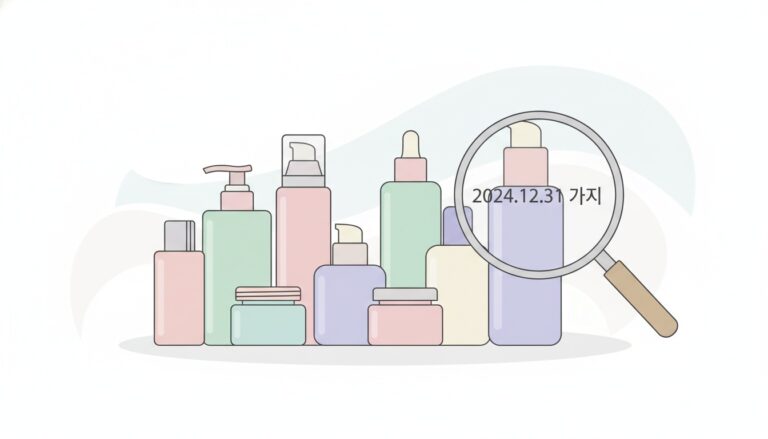
- Editor’s Insight: This is the most common trap! If you see
2024.10.01 제조, it means the product was born on that day. If you see2024.10.01 까지, it dies on that day. Sometimes they are abbreviated to just the first letter: 제 (Mfg) and 까 (Exp). - Situation Check: Essential for reading labels. Not usually spoken unless reading aloud.
2. 유통기한 (Yu-tong-gi-han)
- Pronunciation: [Yu-tong-gi-han] Rhythm: da-da-da-da (4 syllables).
- Meaning:
- Literal: Circulation period limit.
- Real Nuance: Expiration date (Sell-by date).
- Editor’s Insight: While food also uses this term, in cosmetics, it implies the shelf life of the unopened product. Once you open it, the rules change (see point 3).
- Situation Check: Formal & Standard. Use this when asking store staff.
3. 개봉 후 사용 기간 (Gae-bong hu sa-yong gi-han)
- Pronunciation: [Gae-bong hu sa-yong gi-han]
- Meaning: Period After Opening (PAO).
- Editor’s Insight: This is a bit of a mouthful, right? Usually, Koreans just point to the jar symbol on the back (the one that says 6M or 12M) and say “개봉 하고 6개월 (6 months after opening).” But at a B2 level, understanding the formal term helps you read user manuals or detailed descriptions online.
Phase 3: Textbook vs. Real Life
Let’s see how to sound less like a textbook and more like a local shopper.
| Textbook Korean (Grammatically perfect but stiff) | Real Life Korean (Natural & Smart) |
|---|---|
| 유통기한이 언제까지입니까? (Until when is the expiration date?) |
이거 언제까지 써야 해요? (Until when should I use this?) |
| 이 화장품은 오래된 것입니까? (Is this cosmetic an old thing?) |
혹시 이거 제조일자 확인 좀 해주실 수 있나요? (Could you please check the manufacturing date for me?) |
| 개봉 후 12개월 동안 사용할 수 있습니다. (You can use it for 12 months after opening.) |
뚜껑 따고 1년 안에 쓰시면 돼요. (You can use it within a year after ‘popping the lid’.) |
Bottom Note: Using “뚜껑 따고” (after popping the lid) instead of “개봉 후” (after opening) is a very native way to speak casually, but sticking to “개봉 하면” (if/when you open it) is safe for polite situations.
Phase 4: Cultural Context & Manners
The “Nunchi” of Checking Dates
In Korea, “Fast Beauty” is real. Trends change rapidly, and consumers are very sensitive to manufacturing dates.
- Don’t open the box: It is extremely rude to open a sealed box to check the bottle inside. The date is almost always stamped on the bottom of the outer box (단상자).
- Sale Items: If a product is heavily discounted (50%~70%), it is often due to a short remaining shelf life (임박 상품). Asking “Why is this cheap?” implies you suspect the quality. Instead, check the date yourself first. If the date is near, that’s the reason!
Phase 5: Roleplay Script
Setting: A cosmetic store (Olive Young or Innisfree). You found a cream, but the date print is smudged.
Characters: Alex (Foreigner, B2 level), Staff (Korean employee).
Alex: (holding the box and looking confused)
저기요, 이거 날짜가 잘 안 보여서요.
(Excuse me, I can’t see the date on this very well.)
Staff: 아, 그래요? 제가 봐 드릴게요. (takes the box)
음… 여기 밑에 20230901 제조라고 써 있네요.
(Ah, really? Let me check. Hmm… It says ‘Manufactured 2023.09.01’ here on the bottom.)
Alex: 아, 그럼 유통기한이 지난 건 아니네요?
(Ah, then it hasn’t passed the expiration date, right?)
Staff: 네, 보통 제조일로부터 3년까지니까 안심하고 쓰셔도 돼요.
(Yes, usually it’s good for 3 years from the manufacturing date, so you can use it with peace of mind.)
Alex: 다행이네요. 그럼 개봉 하면 언제까지 써야 해요?
(That’s a relief. Then, until when should I use it once opened?)
Staff: 이건 순수 비타민이라서, 뜯으면 최대한 빨리 쓰시는 게 좋아요.
(Since this is pure vitamin, it’s better to use it as soon as possible once you open/tear it.)
Phase 6: 10-Second Shadowing
Let’s practice the sentence that solves the confusion between MFG and EXP dates. Focus on the intonation!
“Is this the manufacturing date or the expiration date?”
이거 / 제조일자인가요, / 아니면 / 유통기한인가요?
[I-geo / je-jo-il-ja-in-ga-yo, / a-ni-myeon / yu-tong-gi-han-in-ga-yo?]
- Tip: Raise your pitch slightly at “인가요?” (is it?) to sound polite and inquiring.
Phase 7: FAQ & Troubleshooting
- Q: Can I use “유통기한” for food too?
- A: Yes! But recently, Korea is switching to 소비기한 (Consumption Date) for food to reduce waste. For cosmetics,
유통기한or just the date +까지is still the standard.
- A: Yes! But recently, Korea is switching to 소비기한 (Consumption Date) for food to reduce waste. For cosmetics,
- Q: What if there is no Korean, just codes?
- A: Look for these English codes common in K-Beauty exports:
- MFG = Manufacturing (제조)
- EXP = Expiration (만료/까지)
- BBE = Best Before (유통기한)
- A: Look for these English codes common in K-Beauty exports:
Phase 8: Wrap-up & Action Item
One-Liner Summary:
Remember that 제조 is the birthday (start) and 까지 is the deadline (end) of your product.
Action Mission:
Go to your bathroom vanity right now! Pick up a Korean product (or any cosmetic). Can you find the “Open Jar” symbol (6M, 12M)? Practice saying aloud: “이거는 개봉 후 12개월이야.” (This is 12 months after opening.)
Question:
Have you ever accidentally bought an expired product in a foreign country? Tell me your horror story in the comments!
Phase 9: Quiz
1. You see “2025.12.31 까지” on a sunscreen bottle. What does it mean?
A) It was made on Dec 31, 2025.
B) It expires on Dec 31, 2025.
C) You must open it by Dec 31, 2025.
2. Which word means “Manufacturing Date”?
A) 유통기한
B) 사용기한
C) 제조일자
3. How do you say “Period After Opening” naturally in conversation?
A) 개봉 후 사용 기간
B) 뚜껑 따고 나서
C) 박스 뜯고 나서
(Answers: 1. B, 2. C, 3. B – B is the most colloquial/natural vibe mentioned in the table)
Frequently Asked Questions (FAQ)
Q: What does "제조 (Je-jo) vs. 까지 (Kka-ji)" mean in Korean and how do you pronounce it?
A: In Korean, "제조 (Je-jo) vs. 까지 (Kka-ji)" is pronounced [제조: [Je-jo] and means: a key conversational Korean expression covered in this lesson.
Q: What does "유통기한 (Yu-tong-gi-han)" mean in Korean and how do you pronounce it?
A: In Korean, "유통기한 (Yu-tong-gi-han)" is pronounced [Yu-tong-gi-han] and means: Literal: Circulation period limit.
Q: What does "개봉 후 사용 기간 (Gae-bong hu sa-yong gi-han)" mean in Korean and how do you pronounce it?
A: In Korean, "개봉 후 사용 기간 (Gae-bong hu sa-yong gi-han)" is pronounced [Gae-bong hu sa-yong gi-han] and means: Period After Opening (PAO).







